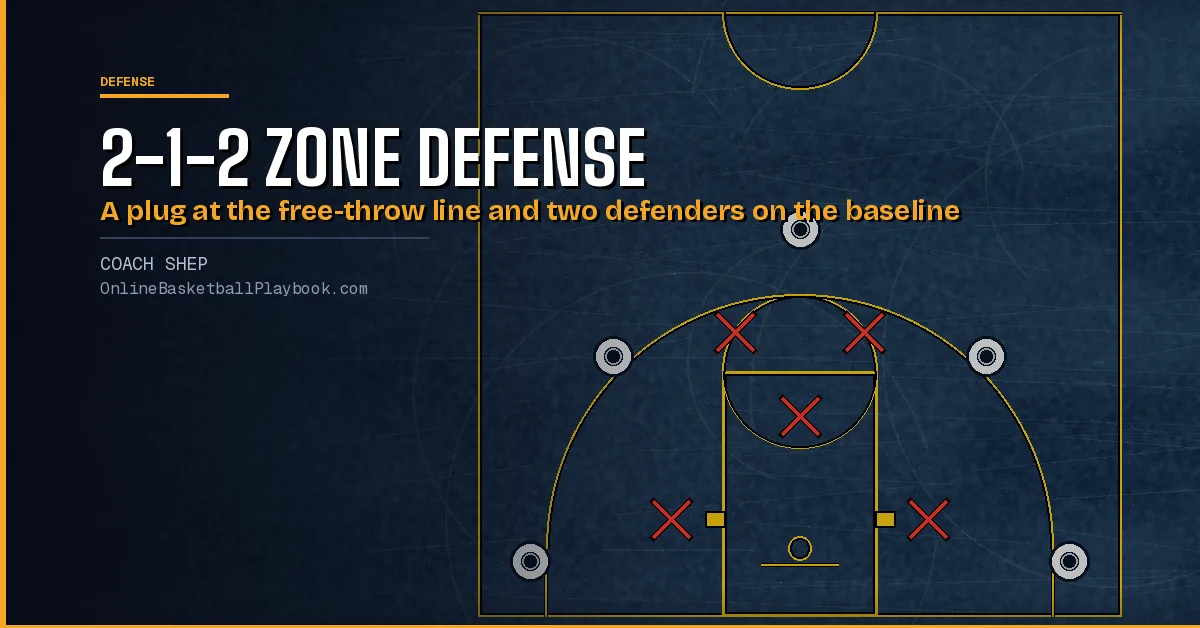
The 2-1-2 zone defense has two guards at the top of the key, one defender in the middle near the free-throw line and two defenders on the baseline. It plugs the high post and the middle of the floor from the first pass, and it pays for that with weaker coverage of outside shooting and an overloaded side. Two versions are taught in detail, the athlete-middle version and the bigs-on-the-blocks version, and they place the baseline defenders and the middle defender's job differently. This guide puts both versions side by side and shows how the 2-1-2 relates to the 2-3 zone, since the two are close cousins.
2-1-2 Zone Defense at a Glance
| Question | Answer | Version |
|---|---|---|
| Alignment | Two tops, one middle, two wings on the baseline | Athlete-middle version |
| Alignment | Two outside defenders, a middle post defender in front of the basket and two baseline defenders above the blocks. At the extreme, defenders keep a foot in the paint | Bigs-on-the-blocks version |
| Best against | Teams that feed the high post. Needs a long, athletic, shot-blocking big in the middle | Athlete-middle version |
| Best against | Poor outside shooting teams, or an offense built around the high post, for example a 1-3-1 look | Bigs-on-the-blocks version |
| Main weakness | Several shooters overloading a side, and lobs over the smaller back players | Athlete-middle version |
| Main weakness | Good outside shooting, because the zone is compact | Bigs-on-the-blocks version |
2-1-2 Zone vs 2-3 Zone
The athlete-middle version frames the 2-1-2 as the repair for the 2-3's two known problems, the high post and defensive rebounding. The one change is the center. In a 2-3 he typically plays near the rim and may close out to the high post after a catch. In a 2-1-2 he is at the high post from the start of the possession.


The bigs-on-the-blocks version also calls the 2-1-2 a variation of the 2-3, and contrasts it with a flat zone that protects the baseline and corners (named as the 2-3 in one telling and the 3-2 in another), while the 2-1-2 is compact and protects the middle. A third view, from the offense's side against the 2-3, uses the phrase differently. It describes a 2-3 whose low-middle defender steps up into a 2-1-2 look, and says the middle pass is still available and the high-low to the low post gets easier. It also says that when that defender cheats toward corner shooters, the high post fakes to the corner and goes high-low.
The two versions disagree on personnel. The athlete-middle version puts a tall athlete in the middle and leaves smaller players near the basket, which is why it flags lobs. The bigs-on-the-blocks version puts the bigs on the blocks for rebounding and an athletic defender in the middle. Teams that call both defenses by the same name should decide which one they mean before they teach it. The 3-2 version is covered in the 3-2 zone defense page and the shape comparison in 2-3 zone vs 3-2 zone.
Roles in the 2-1-2
| Role | Athlete-middle version | Bigs-on-the-blocks version |
|---|---|---|
| Two outside defenders | The tops. They take the ball at the free-throw line extended and above, stunt at a catch without fully committing, and make the high-post entry hard | Move in unison from sideline to sideline, so they should be the quickest players. On a corner pass the ball-side one denies the return pass while the other covers the elbow |
| Middle defender | Guards the paint. Covers the high post when the ball is high, drops to the block when it is low, plays any paint catch one on one and helps on drives | Covers the high post while the ball is out front, then fronts the low post once the ball moves to a wing or corner. Usually an aggressive, athletic player (or the most agile big) |
| Two baseline defenders | The wings. They own everything below the free-throw line extended and the weak-side post area against lobs, and take wing passes briefly until a top bumps them | Stay near the basket above the blocks, with one always in the weak-side rebounding position. The better rebounder goes opposite the opponent's best outside shooter |
Rotations by Ball Location
Both versions give the shifts for each ball spot. The pictures show the athlete-middle version with the ball on the left side, and the tables place the bigs-on-the-blocks version beside it.
| Ball spot | Athlete-middle version | Bigs-on-the-blocks version |
|---|---|---|
| Ball at the top of the key | Tops stunt so the point feels guarded without a body at the top of the key. Wings cheat up and out for the wing pass. The middle defender plays behind a high-post player, three-quarters a dangerous one or drops to the middle of the paint if no one is there | One outside defender on the ball, the other at the elbow, the middle defender in front of the basket and the baseline pair above the blocks |
| Ball on the wing | The wing takes the pass until a top bumps him, then slides toward the baseline but stays wide enough to reach the corner. The weak top drops to the free-throw line for the high post. The middle drops toward the block. The weak wing helps near the rim | The ball-side outside defender takes the ball and the other slides to the ball-side elbow. The ball-side baseline defender moves toward the corner, the middle stays between ball and basket and the far baseline defender takes the weak-side rebounding spot |
| Ball in the corner | The wing closes out and takes away the baseline. The ball-side top drops to the elbow. The middle defender fronts the block. The weak top drops into the paint and the weak wing stays home against a lob | The corner defender is on the ball. The middle fronts the low post, one guard cuts off the pass out of the corner and the other covers the high post. The far baseline player holds weak-side rebounding position |
| Ball into the high post | The middle defender plays it one on one. The tops do not turn and converge, because that gives up the kickout three. They find shooters | The middle defender steps up and jams, forcing the ball toward a corner. The guards collapse on the post and the baseline defenders collapse to the blocks to stop the high-low pass |


The high-post entry is where the two versions split. The athlete-middle version leaves the catch to the middle defender alone. The bigs-on-the-blocks version collapses on it. The same split shows up between 2-3 teachers, where some swarm the high post with the guards and others do not.

The athlete-middle version adds two more situations. On a pass to the short corner, the middle defender and the ball-side wing trap. The middle defender starts the trap and keeps the ball from going baseline, and the wing finishes it from behind. The weak wing takes the middle of the paint against a dive, the ball-side top cheats to the wing and the weak top plays centerfield for a skip. On a reversal to the top of the key, the weak top widens his closeout to the far side of the handler to get into the next passing lane, and the weak wing widens to take the wing until bumped.

Get the next coaching guide in your inbox
One email when a new guide or diagram set goes up. Free.
Skip Passes and Drives
The athlete-middle version assigns skip passes ahead of time. If the skip comes from a wing, the weak wing takes it, because the weak top is protecting the high post. If it comes from a corner, the opposite top takes it, because the weak wing has to stay in the lane against a lob. On a drive, wherever it starts, the middle defender stops the ball before it reaches the paint so the other four can stay with shooters, and the wings close out to force the ball back to the middle and never give up the baseline. The bigs-on-the-blocks version does not cover skip passes.
The Buzz Variation
The athlete-middle version offers the Buzz as a 2-1-2 that pressures the ball. The tops pick up around the volleyball line and stunt at the point guard with the inside hand and foot and stay in the passing lanes, so the entry pass to the wing has to be lofted slowly. The middle defender holds a spot 15 feet from the rim, always on the line between ball and basket. The wings start slightly outside the blocks and talk to teammates about cutters because they are on the back line. After the first pass the zone plays like the base 2-1-2 except that the outside four play the passing lanes and funnel the ball toward the middle defender.
Who Plays the Middle and When to Use It
The athlete-middle version says athleticism matters more than height for the middle. Someone asked to guard from the free-throw line to the rim has to move and jump well. The bigs-on-the-blocks version gives the job to an aggressive, athletic player. It also asks the two baseline defenders to be strong rebounders.
On when to run it, the athlete-middle version says it fits a team facing a high-post offense and says plainly not to play it with youth teams, where the goal should be learning man defense. The bigs-on-the-blocks version says use it against poor outside shooting teams or to match an offense built around the high post, for example a 1-3-1 look. A match-up view adds that a 2-1-2 match-up pushes an offense toward a 1-3-1 or a three-out, two-in set. For the other zones to choose from, see the best zone defense comparison, the 1-3-1 zone defense and the 1-2-2 zone defense, and for the hybrid that plays zone and man together, the match-up zone guide. The man-to-man vs zone page covers the bigger decision.
Weak Spots
- An overloaded side. Multiple shooters on one side force the zone to help and bump, which opens shots around the arc (athlete-middle version).
- Lobs. With the middle defender up high, smaller players are near the basket, so a good passer and athletes can throw over the back players (athlete-middle version).
- Outside shooting. A compact zone is vulnerable to good shooters (bigs-on-the-blocks version).
- Talk. Every zone needs constant talk about cutters who sit behind the defense, and the back line sees them first (athlete-middle version).
Offenses that want to attack it can line up against the front. Dave Odom and Jim Harrick, among others, say to answer a two-guard zone such as a 2-3 or 2-1-2 with a one-guard set such as a 1-3-1, 1-2-2 or 1-4. See how to attack a zone defense and how to beat a 2-3 zone.
The same numbers also name a full-court press that puts a defender in the middle from the first pass and traps the sideline dribble, covered on 2-1-2 press, with the other presses on full-court press defense.
Questions Coaches Ask
What is a 2-1-2 zone defense?
A zone with two guards at the top of the key, one defender in the middle near the free-throw line and two defenders on the baseline. The middle defender takes the high post and the middle of the floor first.
Is a 2-1-2 zone the same as a 2-3 zone?
They are close. The athlete-middle version says the main difference is where the center starts. In a 2-3 he plays near the rim. In a 2-1-2 he starts at the high post. The bigs-on-the-blocks version calls the 2-1-2 a variation of the 2-3.
What is the weakness of the 2-1-2 zone?
The athlete-middle version lists shooters overloading a side and lobs over the back players. The bigs-on-the-blocks version lists good outside shooting.
Who should play the middle of a 2-1-2 zone?
A mobile, athletic defender who can guard the high post and drop to the block. The athlete-middle version adds that athleticism matters more than height.
Is the 2-1-2 zone good for youth basketball?
The athlete-middle version says not to play it with youth teams because development should focus on man defense. Check your league rules on zone defense for young age groups.
Want the printable playbook packs?
OBP Pro members get the premium playbook packs: the zone attack, out of bounds and practice plan PDFs, plus each new pack as it is finished. The membership page lists what is in each one. Or draw your own version free in PlayDraw.
See what OBP Pro includesMore Guides From This Batch
- Basketball Offense: Systems, Actions and Sets Explained
- 1-2-2 Press: Roles, Traps, Rotations and Breakdowns
- Traveling in Basketball: Rule, Steps and Pivot Foot by Level
- Triangle and 2 Defense: How It Works and How to Beat It
Back to Types of Defense and every Defense page.
Keep Building
Related breakdowns
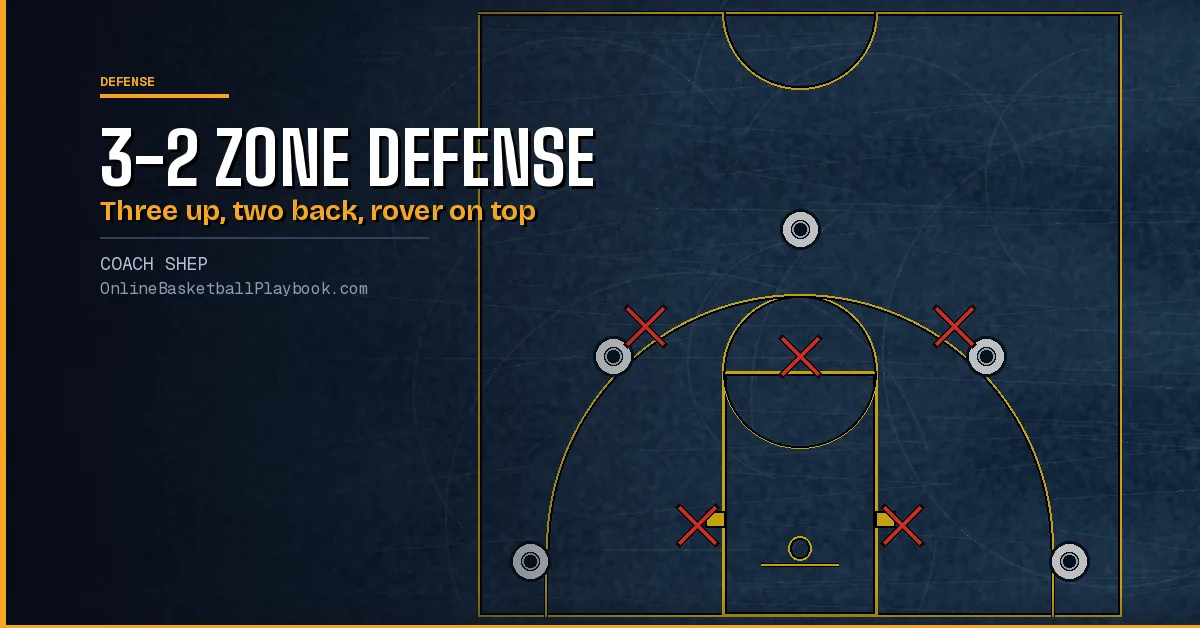
3-2 Zone Defense: Rotations, Weak Spots and Drills
How to run the 3-2 zone defense: the alignment, the rover, every rotation, the weak spots, the 3-2 matchup zone and the drills, plus when to pick it over a 2-3.
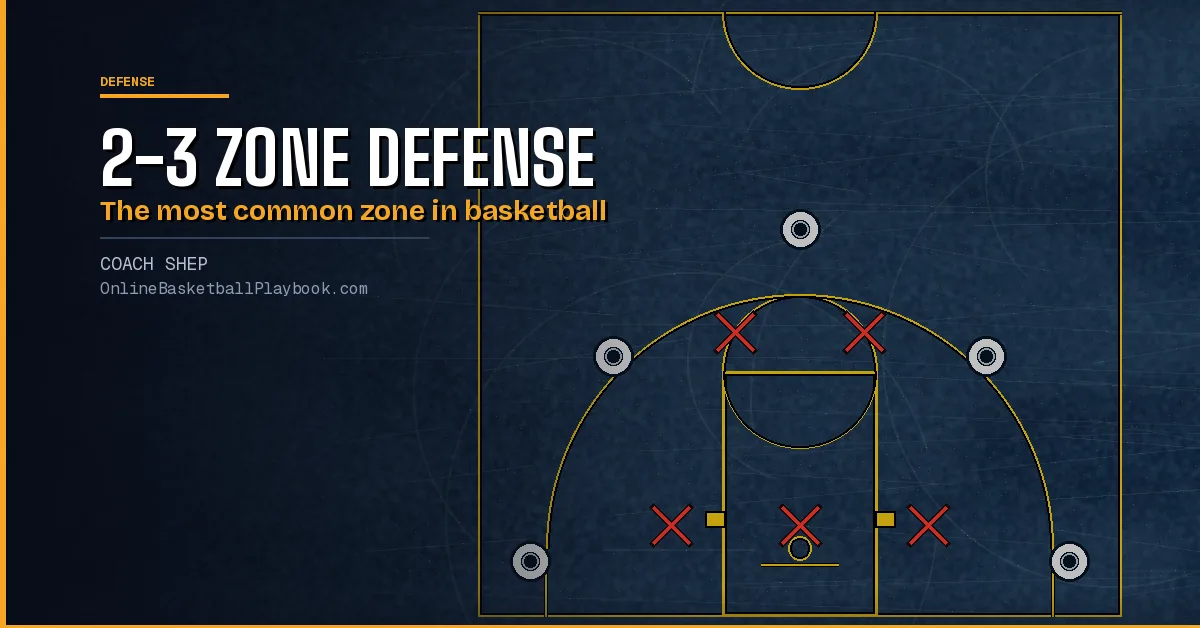
2-3 Zone Defense: Rotations, Weak Spots and Drills
How to play the 2-3 zone defense: the starting positions, how it shifts to the ball, where it leaks, when to trap, and the drills that install it.
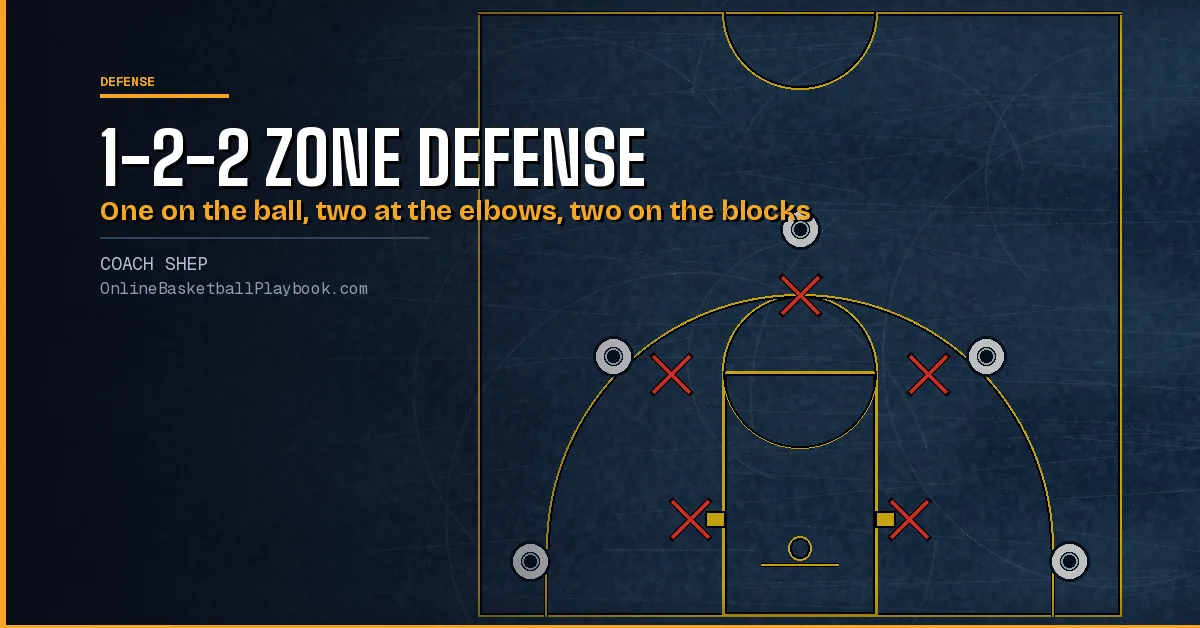
1-2-2 Zone Defense: Rotations, Weak Spots and Drills
How to run the 1-2-2 zone defense: the five roles, rotations for every ball spot, the corner trap, the high post problem, the variations coaches run and the drills.