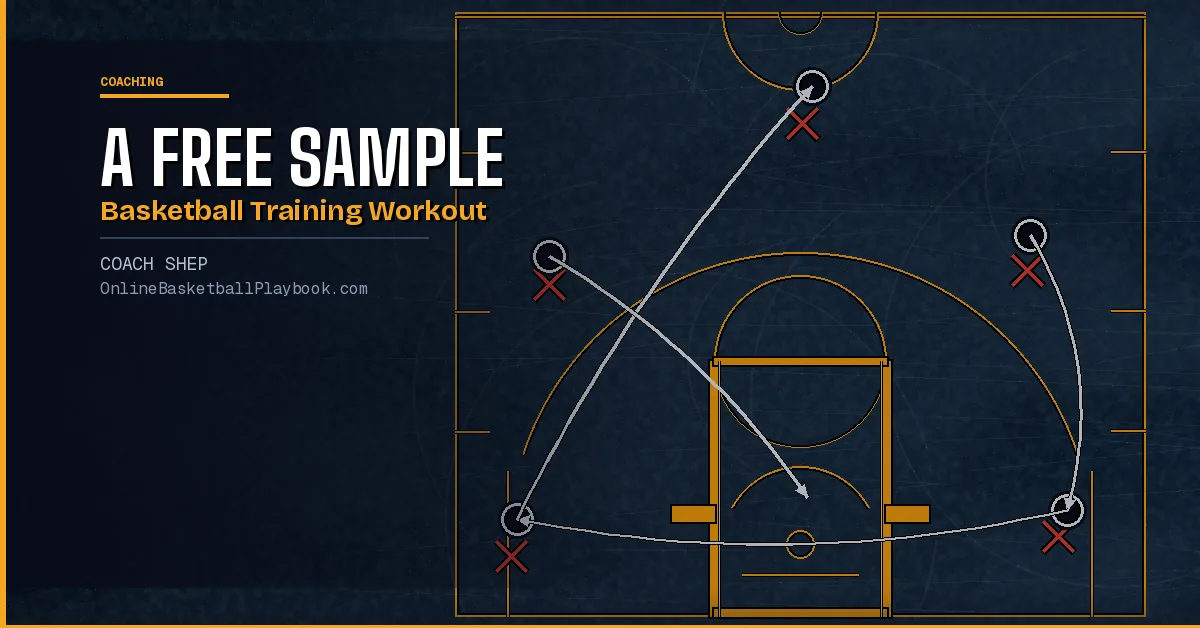
Most players waste gym time going through the motions. This free sample basketball training workout gives you a proven structure, a real plan with make-count goals, sequenced skill blocks, and a session that builds habits, not just reps.
Why Structure Beats Random Reps
Walk into most gyms and you will see players shooting around with no particular target, no clock, and no record of what happened. They leave having touched the ball for an hour. They will not remember a single number from that session. They will come back tomorrow and do the same thing.
That is not a workout. That is attendance.
The difference between a player who improves and one who plateaus almost always comes down to one thing: structure. A structured session has a plan before the first dribble, runs at game speed throughout, and tracks every meaningful number along the way. Coach Mac's foundational rule for individual training puts it plainly: every workout must have a plan, run at game speed, and track the shots. All three, every time, no exceptions.
Structure forces accountability. When you know you need to make 14 mid-range jumpers in 90 seconds, you stop drifting. When you write down that you went 11 of 14 yesterday, you have a number to beat today. That recorded number is what converts gym time into measurable development.
The free sample workout below is built on that premise. Every block has a target. Every block has a clock or a make count. You will finish the session knowing exactly how you performed, and you will have a baseline to improve on the next time you step on the floor.
The Three Non-Negotiables Before You Start
Before walking through the actual workout blocks, establish these three habits as prerequisites. Skip any one of them and the rest of the session loses half its value.
1. Write the Plan
Arrive with a written plan. Even a phone note counts. Know which blocks you are running, in what order, and what the make-count target is for each. Players who show up and decide on the fly what to work on spend the first ten minutes of every session just figuring out what to do. That decision fatigue bleeds into everything that follows.
The plan does not need to be elaborate. It can be six bullet points. What matters is that the decision is made before you pick up the ball, not during the warmup.
2. Game Speed or Nothing
Shooting at 70% speed in practice and expecting to perform at game speed in competition is a fantasy. Every footwork rep, every catch-and-shoot, every live-dribble pull-up should be executed at the pace you would use with a defender closing out. If you cannot make a game-speed rep, slow down only long enough to correct the mechanics, then bring it back up immediately.
Game-speed training also means landing every shot attempt with a sharp jump stop or a clean one-two, snapping the wrist through the release, and sprinting to the next spot, not jogging. Fatigue during training is a feature, not a bug.
3. Track Every Number
Bring a pen and a notepad, use a tracking app, or write in your phone notes. Log your make count after every block. Over time, a series of logged numbers becomes a development record. That record is the only way to know whether you are actually improving or simply becoming more comfortable with the same ceiling.
The discipline of writing it down also changes how you approach each rep. When you know the number is going on record, you stop allowing sloppy makes. You repeat a block that fell short. You push harder in the final thirty seconds. The log makes every session matter.
The Complete 60-Minute Workout
This session is built for a player with access to a single basket and a ball. No rebounder required. Each block includes a make-count target and a time window. Start a timer when you pick up the ball for that block, stop when the time expires or the target is reached, and log the result.
Block 1. Form Shooting (8 minutes)
Start three to five feet from the basket. One hand. Focus on wrist snap, elbow alignment, and follow-through. Make 25 in a row before you move. If you get to 20 and break form, start the count again. This block is not about range. It is about locking in the mechanical baseline that every other block builds on.
Do not rush this block because it feels easy. Easy is the point. You are grooving the motor pattern that falls apart under pressure. Every made layup, pull-up, or catch-and-shoot in the remainder of the session depends on the foundation you set here.
Block 2. Ball Handling (8 minutes)
Two-ball dribbling for the first four minutes: stationary pound dribbles, alternating, then one high / one low. Move into one-ball stationary: between the legs, behind the back, figure-eight. Final two minutes: move your feet. Dribble while shuffling side to side, then while moving forward and back. The target here is not a make count but a time-based standard: four full minutes without a dead dribble or a lost ball.
If you lose the ball three times in a row on the same move, slow down and fix the problem before speeding back up. Ball handling trained sloppy becomes sloppy ball handling under pressure.
Block 3. Finishing and Footwork (10 minutes)
Start with the Mikan drill: make 20 alternating layups without missing. Then move to a euro-step layup series from the right and left, ten reps each side. Finish with jump-stop one-dunk layups from the wing. Five right, five left. Target: complete all three sub-drills inside ten minutes, zero misses allowed on the Mikan before advancing.
For each sub-drill, focus first on the footwork, then on the finish. "What you correct first is what you care about most." If the footwork is breaking down, stop and walk through it at half-speed before resuming game pace.
Block 4. Spot Shooting (15 minutes)
Five spots: right corner, right wing, top of the key, left wing, left corner. Make 5 from each spot before moving. After completing all five spots, start over and do it again. Target: complete the full circuit twice inside 15 minutes. Log how many total makes it took to complete both circuits. That number is your benchmark.
All shooting comes off a catch simulation: toss the ball out ahead of you, catch it, square your feet, and shoot. No standing and catching in the same spot repeatedly. Every shot should involve footwork on the catch.
Block 5. Live-Dribble Pull-Ups and Mid-Range (10 minutes)
Drive from the top of the key to the right elbow and pull up. Drive to the left elbow and pull up. Alternate sides for 10 minutes. Make-count target: 14 made jumpers inside the time window. If you hit 14 early, add a counter-move (jab step into the pull-up) and keep going until the clock runs out.
This block connects the ball-handling from Block 2 to the shooting mechanics from Block 4. The pull-up is where those two skills have to live together under simulated pressure. Treat every drive as if a defender is shadowing your hip.
Block 6. Free Throws (5 minutes)
Shoot free throws now, while you are tired, not at the start of the session when you are fresh. Make 20 free throws inside five minutes. Log how many attempts it takes. A fatigued free throw in practice is closer to the real-game scenario than a fresh one will ever be. If you miss, you start the shot routine from the beginning. Bounce the ball the same number of times, same deep breath, same release point.
Routine is the entire game at the free-throw line. Build it now, in practice, when the pressure is lower.
Block 7. Competitive Finish (4 minutes)
Pick one move from today's session (a spot, a pull-up location, or a finishing angle) and compete against yourself. Set a four-minute clock and try to beat your personal best makes at that spot. Write the number down. This block closes every session with a competitive frame so that habit becomes automatic.
How to Track Progress and Stay Honest
After every session, your log should have seven numbers. One per block. Those seven numbers are your session signature. Over the next four weeks, you will start to see trends. Block 3 times are dropping. Block 4 totals are rising. Block 6 attempt counts are shrinking.
That data tells you where you are improving and, more usefully, where you are stalling. A stall in Block 3 means your footwork is capping your finishing. A stall in Block 5 means your pull-up mechanics need attention. The numbers point you at the problem so you do not have to guess.
The key evaluation principle is a component-based rubric rather than a raw make-percentage. A player who makes 6 of 10 pull-ups but consistently has a drifting elbow has a mechanical problem that will surface under defensive pressure. The make percentage hides the flaw. Breaking each skill into three to five component parts (stance, release, follow-through, footwork, landing) and rating each on a simple 1-to-5 scale reveals what the numbers cannot. Run that rubric on yourself before a training block and again at the end of preseason to see true development, independent of win-loss record.
Adjusting the Workout for Your Level
The session above is written for a mid-level high school player with a reasonably solid base. Here is how to scale it in either direction.
Beginners (Youth / Early High School)
Cut Block 5 (live-dribble pull-ups) and replace it with five more minutes of spot shooting at closer range. Reduce the Block 4 make-count from 5 per spot to 3 per spot. Drop the Block 6 free throw target from 20 makes to 10. Keep all three non-negotiables. A shorter workout with the same structure beats a longer workout with no structure every time.
Advanced (Late High School / College / Pro)
Add a signature-move series after Block 5. Take your two best scoring moves and drill each one with its counter: if your go-to is a jab-step pull-up, also rep the jab-into-drive and the shot-fake-and-drive. Make 10 of each combination before moving on. Extend the free throw block to eight minutes and require that 20 makes come consecutively. One miss resets the count.
You can also add a one-versus-challenge constraint to the competitive finish block: a cone or chair as a simulated defender. Drive around it, pull up over it. The visual pressure is minor, but the footwork adjustment it forces is real and translates to live defense faster than uncontested reps alone.
Keeping It Fresh Over 8–12 Weeks
Theme days work better than theme weeks. Assign a daily focus (Monday: finishing, Tuesday: ball handling, Wednesday: shooting, Thursday: pull-ups, Friday: conditioning) and hold that template for eight weeks. You touch every pillar of your game every single week. Make-count accountability runs inside each theme. The routine itself becomes the habit, and the habit is what compounds into real development.
Resist the urge to spend a full week on only one skill. A "shooting week" with no ball handling, finishing, or free throws produces a player who is temporarily sharper in one area and noticeably rusty in three others. Touch every pillar every week, and let the make-count targets inside each block handle the focus.
Adding Defense to Every Block
Individual workouts default to offense. That is natural. Offense is where the ball is and where make counts are easy to record. But the program builders who run the best player development programs agree on one principle: defense is a taught skill that belongs inside every workout block, not bolted on at the end when the player is too tired to care.
The practical version of this does not require a partner. After Block 3 (finishing and footwork), add a closeout-and-recover drill: sprint from the paint to the three-point line as if closing out on a shooter, break down your footwork, retreat on the drive, and rotate back to the paint. Five reps each side. After Block 4 (spot shooting), walk through a defensive slide series: two steps left, two steps right, retreat step on the drive, contest the shot. Thirty seconds of active defensive footwork before you move to the next shooting spot.
The Iowa workout card principle pairs every offensive category with a matched defensive drill. Dribble drives pair with first-step take-away footwork. Spot shooting pairs with closeout-and-contest. Free throws pair with box-out position and a simulated rebound chase. When you pair defensive work with offensive work inside the same session, the total time adds only five or six minutes, but the player who does it for twelve weeks is a different defender than the player who saved defense for team practice.
Defense is not a separate subject. It is the other half of every skill you are already training.
- Have a written plan before you touch the ball: Know every block, the make-count target, and the order. Decisions made at the door steal reps from the session.
- Every rep at game speed: If mechanics break down at full pace, slow down briefly to correct, then return to game speed immediately. Never finish a block at practice speed.
- Log seven numbers after every session: One per block. Compare against your previous session before the next one. A rising number means development. A flat number means something in that block needs a mechanics check.
- Shoot free throws tired, inside the session: Not fresh at the end as an afterthought. Block 6 belongs in the middle-to-late portion of the workout, after fatigue has already set in, so the routine is trained under realistic conditions.
- Pair a defensive rep with at least two offensive blocks: Closeouts after spot shooting, first-step take-away after pull-ups, box-out position after free throws. Defense does not require a partner, only the discipline to program it in.
Want more basketball coaching strategies and drills?
Join the Online Basketball Playbook newsletter →
Draw this play free in the play drawer →
Membership: the full library, playbook packs, and Pro drawing tools →
Keep Building
Related breakdowns
Guard Workout: Handles, Reads and Finishing You Can Print
A guard workout you can print: a full session with its standards, plus handle work, jab, closeout and ball-screen reads, finishing and shooting off the dribble.
Free Throw Shooting: Routine, Form and Drills
Free throw shooting starts with a routine the player never changes. Form cues, the mental side and drills that copy the fatigue and pressure of a game.
Basketball Workout Plan: How to Build One by Position
How to build a basketball workout plan: the blocks to include, the order, how long, make counts and game speed, position work, tracking, and where coaches disagree.