In January 1997, Allen Iverson crossed over Michael Jordan so hard that the moment is still replayed today. It became the signature image of an entire generation of ball handlers, proof that a 6-foot guard could break down anyone, including the best defender the game had ever seen, with footwork instead of size. Coaches still study the clip, but the real value for a coach isn't the highlight. It's understanding exactly what Iverson's feet, hips, and dribble hand were doing that made it work, and how to teach a version of it to your own players.
What Made Iverson's Crossover Different
Plenty of players in the 1990s and 2000s had a crossover dribble. What separated Iverson's was the combination of three physical traits working together: elite hand speed, an unusually low center of gravity for a guard his size, and a hesitation that sold the defender on one direction before he ever moved.
Because Iverson played so low to the floor, he didn't need a big, telegraphed dribble to change direction. The ball barely had to travel before he was already gone. Most defenders are trained to react to the ball and the hips. Iverson's hips stayed level and quiet during the hesitation, which meant the defender's first real cue was the crossover itself, and by then it was already too late to recover.
The other piece coaches often undersell is burst. A crossover by itself doesn't beat anybody. It's the acceleration in the first two steps after the ball changes hands that actually creates the separation. Iverson paired a slow, patient setup with an explosive first step, and that contrast is what made defenders freeze.
The Footwork and Biomechanics, Step by Step
Strip the move down to its mechanical parts and it becomes teachable. Here is the crossover broken into the sequence a player's body actually moves through:
1. Lower the base. Knees bent, hips down, feet wider than shoulder width. A crossover done standing tall is slow and easy to defend. Dropping the center of gravity is what allows a quick direction change.
2. Sell the direction with the eyes and shoulders, not just the ball. A hesitation or a shoulder lean in one direction forces the defender's weight to commit that way before the ball ever crosses.
3. Push the ball low and hard across the body. The dribble should go from one hand to the other close to the floor. A high, looping crossover gives a help defender or the on-ball defender's hands time to poke it away.
4. Change the feet with the ball, not after it. The outside foot plants and redirects at the same instant the ball is crossing, not a beat later. This is the single biggest timing detail separating a quick crossover from a slow one.
5. Explode out of the plant. The first two steps after the crossover should be the hardest, fastest steps of the whole move. This is where actual separation from the defender is created.
In-and-Out and Double Crossover Variations
Once a player owns the basic crossover, two common variations extend it against better defenders.
The in-and-out dribble fakes the crossover without actually sending the ball across. The hand pushes the ball toward the crossing motion, then brings it back to the same hand and attacks downhill in the original direction. It's built entirely on the defender's memory of the real crossover; if a player has never sold a live crossover, the in-and-out has nothing to sell off of.
The double crossover: Crossing the ball back and forth twice in quick succession works by attacking the defender's recovery step. The first crossover forces a hip turn and a step to recover; the second crossover, delivered before that recovery step plants, catches the defender moving the wrong way twice in a row. This variation depends entirely on hand speed and a low, stable base. Without both, a double move is just two slow crossovers instead of one fast one.
Coaching cue: Tell players to "cross at the ankle, not at the knee." A crossover that changes hands near the ankle stays low and tight to the body, which is faster and far harder to poke away than one that crosses higher, near knee level, where the ball is exposed to a reaching defender.
The Crossover and the Carrying/Illegal Dribble Rule
Any hard, low crossover dribble lives close to the line the rulebook draws around carrying, or what's officially called an illegal dribble. The rule penalizes a player who turns the hand far enough under the ball that it comes to rest, or noticeably stops and restarts, during a change of direction, not simply dribbling low or fast.
This is exactly why Iverson's crossover generated debate for years. A quick, low direction change can look like the hand is briefly under the ball, especially at full speed and from certain camera angles, even when the dribble is legal. Officials are trained to look for that momentary "carry" (the ball resting or pausing in the hand) rather than penalizing speed or a low release point by itself.
For a coach teaching this move, the practical takeaway is simple: teach players to push the ball across with the hand staying on top and to the side of the ball, not scooping underneath it. A crossover taught correctly should rarely draw a carrying call, even when it's fast and low to the ground.
A Coaching Progression to Teach the Crossover
Teach the crossover in stages rather than asking a player to do the whole move live on day one.
Stage 1: Stationary crossover. Feet set, low stance, crossing the ball back and forth in place. The only goals here are a low release point and keeping the hand on top of the ball.
Stage 2: Crossover with a hesitation. Add a one-count pause before the crossover, with eyes up, to build the habit of selling a direction before moving.
Stage 3: Crossover into a first step. Walk the ball, then jog it, adding the explosive first step immediately after the direction change. Speed is added gradually, never all at once.
Stage 4: Crossover against a passive defender. A coach or teammate shadows without actively contesting, so the player learns to read a real (if soft) reaction.
Stage 5: Crossover live, 1-on-1. Only once stages 1 through 4 are comfortable does the move get tested against a live, competing defender.
Common Mistakes Players Make Learning It
The same handful of errors show up over and over with players learning this move.
Standing too tall. Without a low base, the crossover is slow and the ball is easy to strip.
Crossing the ball too high. A crossover that changes hands near the waist or chest gives defenders and help defenders a much bigger window to reach in.
No hesitation before the move. Players who crossover immediately, with no setup, aren't selling anything. The defender never commits, so there's nothing to break down.
Weak first step after the crossover. Many players nail the hand-to-hand mechanics but coast out of it instead of exploding, which lets the defender recover even after being beaten.
Using only one speed. A crossover done at the same tempo every time becomes predictable. Teach players to vary the pace of the setup so defenders can't anticipate the burst.
Coaching cue: Have players practice the crossover dribble at three different speeds in the same drill set (slow, medium, and full speed) so the move doesn't become a single predictable rhythm a defender can time.
- Low base first. A crossover only works from a bent-knee, wide stance.
- Cross at the ankle, not the knee, to keep the ball tight and protected.
- Sell the direction with eyes and shoulders before the ball ever moves.
- Change direction with the feet at the same instant the ball crosses, not after.
- Keep the hand on top of the ball, not underneath, to stay clean of a carrying call.
- Build it in stages: stationary, hesitation, first step, passive defense, live 1-on-1.
Get free play diagrams, drills, and coaching guides delivered to your inbox.
Draw this play free in the play drawer →
Membership: the full library, playbook packs, and Pro drawing tools →
Keep Building
Related breakdowns
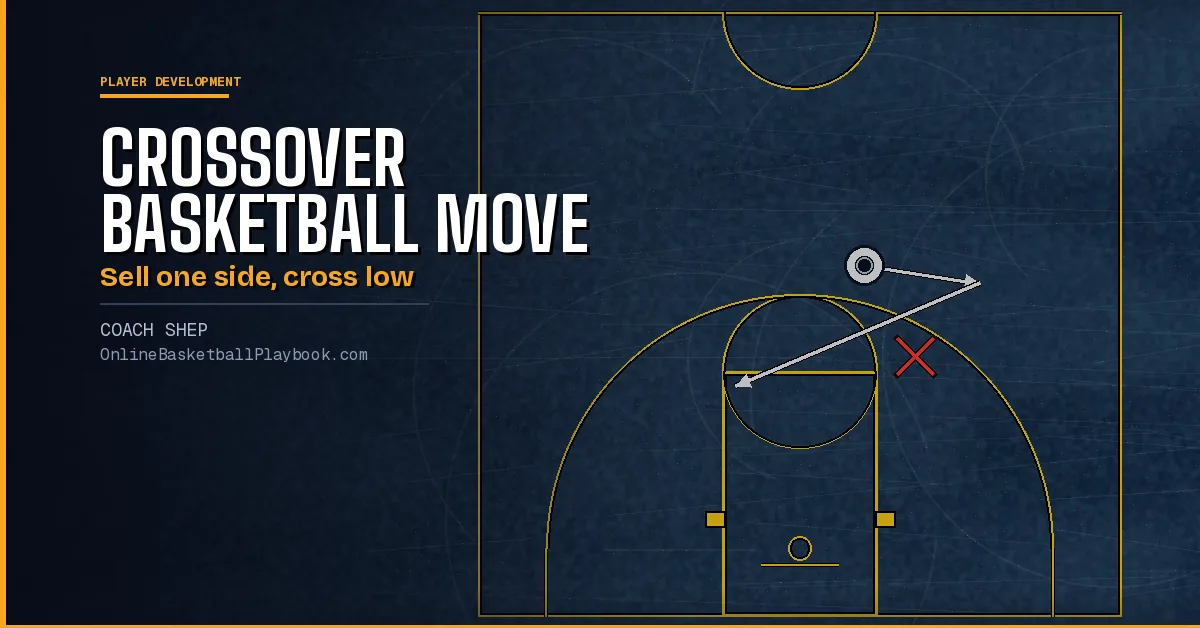
Crossover Basketball Move: How to Do It and Teach It
How to teach the crossover in basketball: the four steps, change of pace, footwork after the cross, the in and out counter, the read that follows and drills.
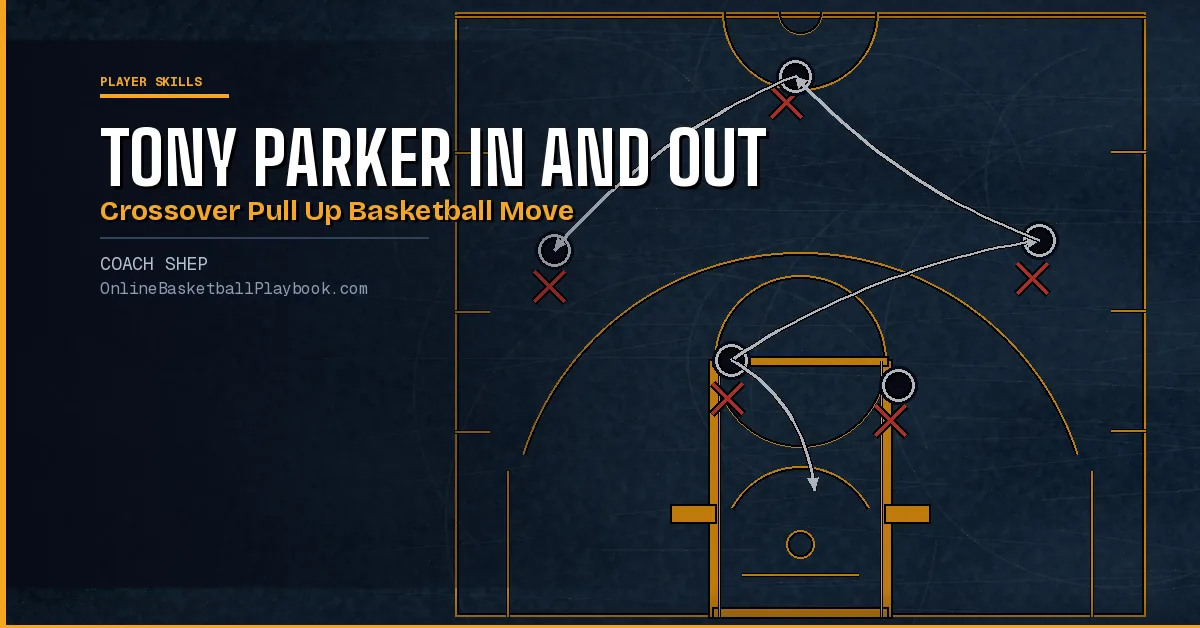
Tony Parker In and Out Crossover Pull Up Basketball Move
Tony Parker In and Out Crossover Pull Up Basketball Move
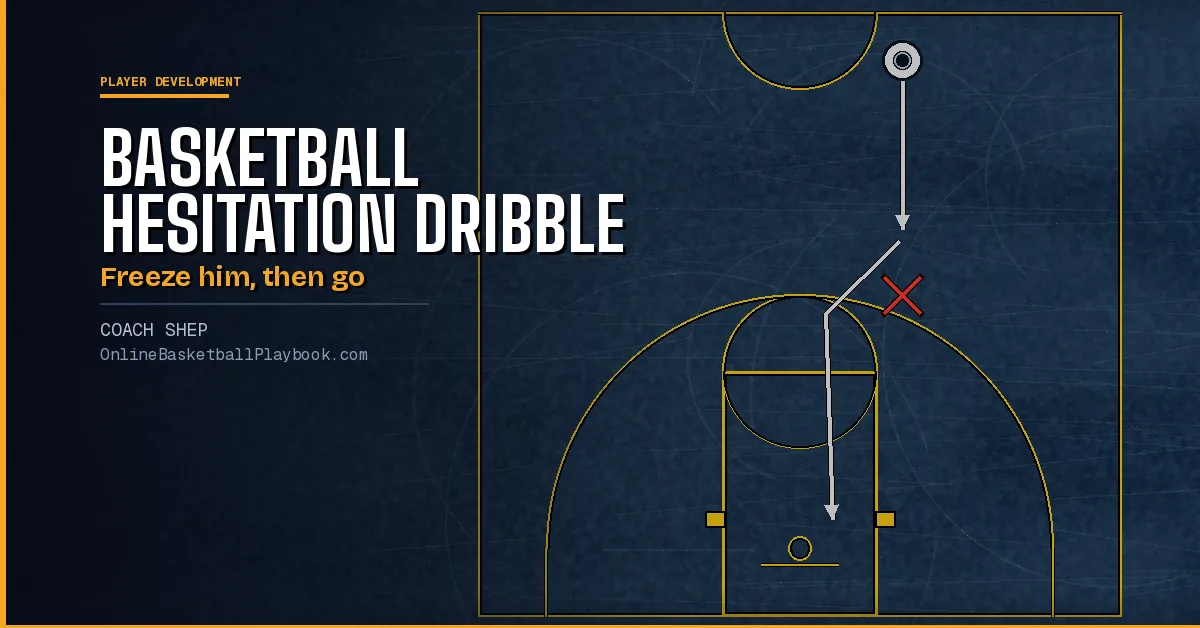
Basketball Hesitation Dribble: How to Do the Hesi Move
The basketball hesitation dribble step by step: the stop and rock back, selling it, when to use it, its crossover and pull-up counters, the hedge read and drills.