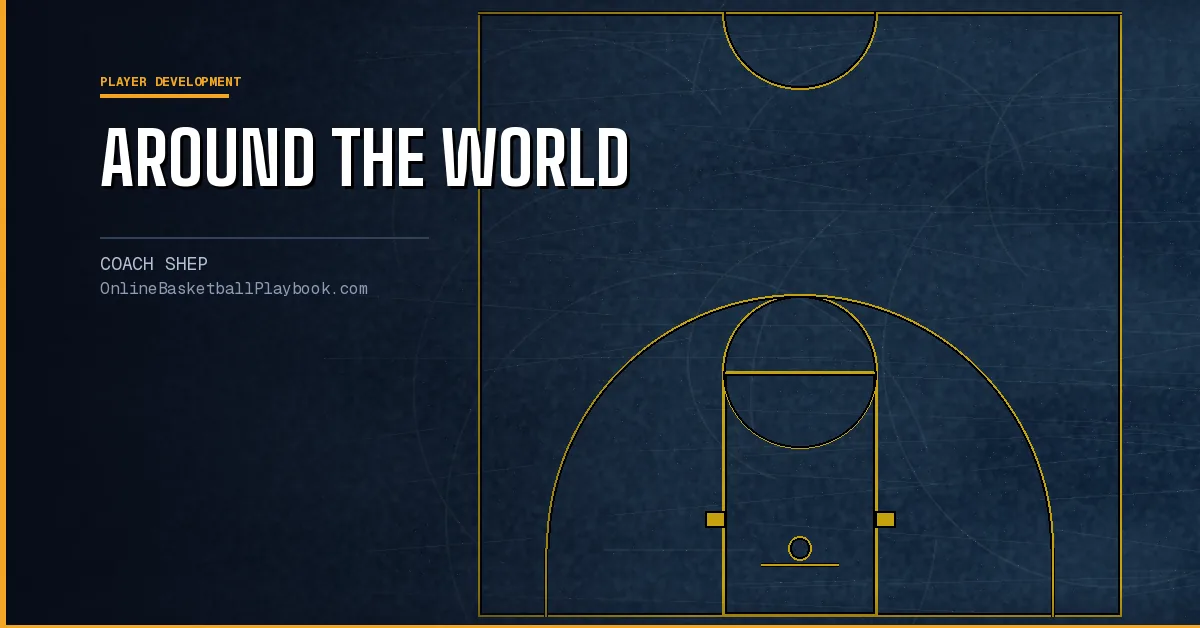
Around the World is a classic shooting game where players advance through a series of spots on the floor, one shot at a time. Make the shot and you move on to the next spot; miss, and you either hold your ground or gamble for another try. It is simple enough for a first practice and competitive enough that varsity players still argue about it, which makes it one of the most efficient shooting games a coach can run with a full gym.
The Standard Setup
Around the World uses a series of shooting spots arranged in an arc from one side of the basket to the other. The most common version uses five to seven spots, starting at one baseline elbow, moving out along the three-point line or mid-range arc, curling around the top of the key, and finishing at the opposite baseline elbow.
- Spot 1: Baseline elbow (left or right): Just off the block, roughly even with the front of the rim.
- Spot 2: Short corner / wing: Moving out toward the three-point line on the same side.
- Spot 3: Top of the key: Straight out from the basket, the game's midpoint.
- Spot 4: Opposite wing: Mirrors spot 2 on the other side of the floor.
- Spot 5: Opposite baseline elbow: The final spot, mirroring spot 1.
Coaches can add spots (a straight-on free-throw-line stop, a deep corner three, a second wing spot farther out) or trim the number down for younger players. The exact count matters less than the shape, which is a smooth sweep from one baseline to the other that touches every realistic catch-and-shoot area on the floor.
Basic Rules: How to Advance
The core rule is the same in every version of the game: make a shot from your current spot, and you move to the next one. Miss, and what happens next depends on which variant you're running.
- Make it: Advance to the next spot in the sequence. Keep shooting from spot to spot as long as you keep making shots.
- Miss it (standard rule): You stay at your current spot and wait for your next turn in rotation.
- Miss it (no-gamble variant): Some coaches run a simpler version where a miss simply ends the turn: no staying, no gambling, just pass to the next shooter and try again from the same spot next time up.
Turns rotate among however many players are shooting at that basket. The winner is whoever reaches the final spot first, though as covered below, several variations change exactly what "winning" means.
The Gamble: Basketball's Original Risk-Reward Shot
The feature that separates Around the World from a plain shooting drill is the gamble. In the most common variant, a player who misses is given a choice instead of simply stopping.
- Stay: Keep your current spot and pass the turn to the next player. Safe, no risk, but no progress either.
- Gamble: Shoot again from the same spot immediately. Make it, and you advance as normal to the next spot. Miss it, and you get sent all the way back to the first spot, losing all the progress you've built.
Some groups add a house rule that a player only gets one gamble per spot, or that certain "money spots" (often the final one or two before the finish) cannot be gambled at all and must be made outright. Either adjustment keeps the game moving and prevents one player from repeatedly stalling the group by gambling over and over from the same spot.
Common Variations Coaches Use
Around the World has been passed down informally for generations, which means most gyms run a slightly different version. The main variations coaches choose between are:
- Fixed number of spots: Some coaches lock the game at exactly five or seven spots regardless of gym size, so every group plays an identical course and results are comparable across the team.
- First to the last spot wins: The most common win condition. Whoever reaches the final spot first, with no requirement to shoot again, is the winner.
- Full lap required: A stricter version requires the winner to make a shot from the final spot and then make one more shot back at the very first spot to complete a full "lap," which rewards consistency over a single hot streak at the end.
- No-gamble version: As noted above, a simplified version for younger players removes the gamble entirely. Miss and the turn just passes, no risk of losing progress. This keeps the game moving faster and less punishing for beginners still building shooting confidence.
Why Around the World Builds Real Shooters
Around the World earns its place in practice because it stacks game-realistic elements on top of straightforward repetition. Every shot comes from a spot a player will actually be asked to shoot from in a real possession (the corner, the wing, the top of the key) rather than an arbitrary drill location.
The game also adds mild, low-stakes pressure. Shooting in front of teammates, with a turn on the line and a gamble decision to make, is a small step up in pressure from shooting alone in an empty gym, without the weight of an actual game situation. That middle ground is valuable: players get comfortable performing under a bit of scrutiny before they ever have to do it in a real game.
Because players only advance after making a shot, the game also naturally rewards focus on each individual attempt rather than rushing through a fixed rep count. A player who is locked in gets through the spots quickly; a player going through the motions gets stuck.
Coaching Tips for Running It With a Full Team
Around the World is easy to run with two players at one hoop, but it takes a little planning to use it efficiently with a full roster.
Split the team across every available basket in the gym. Most gyms can run three or four simultaneous games of Around the World at once. Groups of three to five players per basket keep the pace quick and the wait between turns short.
- Cap it with a time limit. Give each group a set window (five to eight minutes is typical) rather than playing every game to a finish. This keeps the whole team moving together instead of waiting on one slow group.
- Group players by skill level. Matching similar shooters together keeps the competition close and the gamble decisions meaningful. A group with a wide skill gap usually has one player finish immediately and everyone else stuck waiting.
- Assign an "honor system" spot-keeper per basket. With multiple simultaneous games running, you can't watch every hoop. Have one player at each basket track makes, misses, and turn order out loud.
- Use it as a practice opener or closer, not the whole session. Around the World builds shooting reps and competitive energy, but it doesn't replace structured shooting work off screens, movement, or game-speed reads. Pair it with those, don't substitute for them.
- Adjust the gamble rule for age and skill. Younger or less experienced groups do better with the no-gamble version; competitive older players usually want the full risk-reward rule.
- Track who wins over multiple sessions, not just one. A single game can be decided by a hot streak. Running it regularly gives a much better read on which players are actually your most consistent shooters from each spot on the floor.
Get free play diagrams, drills, and coaching guides delivered to your inbox.
Draw this play free in the play drawer →
Membership: the full library, playbook packs, and Pro drawing tools →
Keep Building
Related breakdowns
Basketball Shooting Form: Step-by-Step Mechanics
Basketball shooting form step by step, from the ready stance and grip to release and follow-through, with drill progressions and where coaches disagree.
Free Throw Shooting: Routine, Form and Drills
Free throw shooting starts with a routine the player never changes. Form cues, the mental side and drills that copy the fatigue and pressure of a game.
Competitive Shooting Drills: Scored Games and Records
Competitive shooting drills with a score on every shot: streak games, timed targets, Beat the Pro, plus and minus, 2-on-1 shooting and record boards.