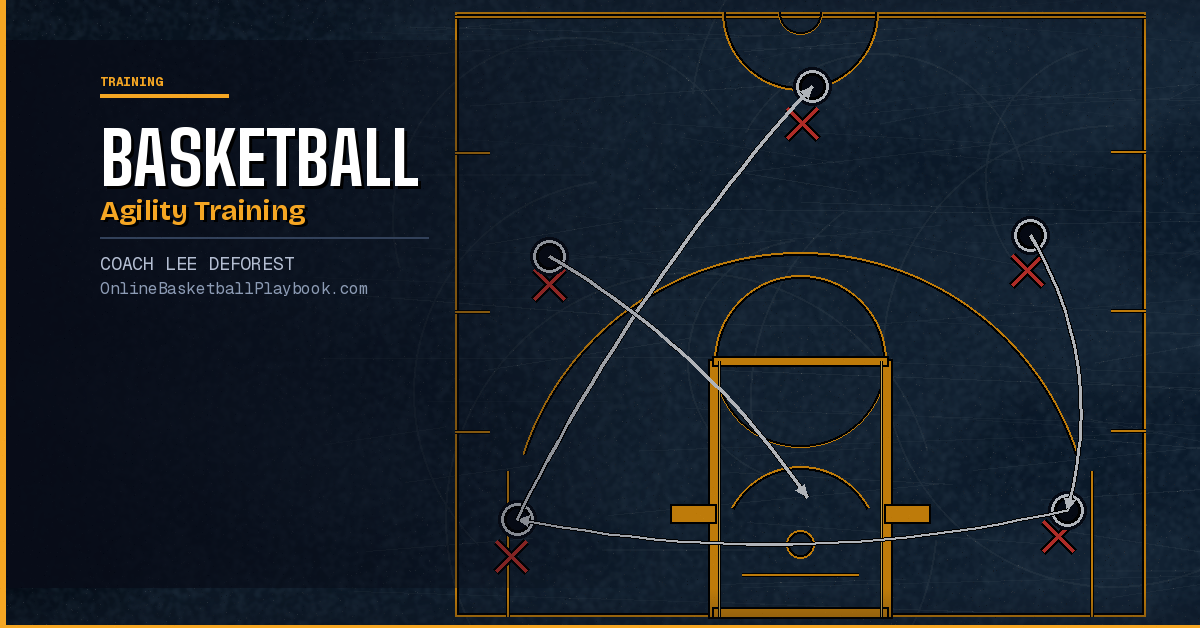

Court agility separates good players from great ones. These drills build the change-of-direction speed, quickness, and anaerobic fitness your players need to move with purpose on both ends of the floor.
Why Agility Training Matters in Basketball
Basketball is one of the most demanding team sports for lateral movement. Players make an average of 1,000 changes of direction per game — sprinting, stopping, cutting, and recovering in bursts that rarely exceed 10 seconds. That is the engine of the sport, and agility training is how you build it deliberately rather than hoping it develops by accident.
Agility on the court comes down to three physical qualities: first-step quickness (the initial burst off a jab step or defensive closeout), change-of-direction speed (the ability to decelerate, plant, and explode in a new direction without losing balance), and reactive agility (doing all of that in response to a defender, ball-handler, or cutter rather than a predetermined signal). Most drills train the first two. The best drills train all three by putting the ball in play.
The connection to winning is direct. Teams that move well defensively create more deflections and force more turnovers. Offensively, players who can get their hips around a defender before they react create open shots out of nothing. Agility is not an accessory to skill development — for most players, it is the platform skill everything else sits on top of.
The problem is that most teams treat agility as a one-size warm-up: a few high-knees, some ladder runs, done. That approach builds some foot speed. It does not build the basketball-specific quickness that transfers to the game. The drills in this guide are designed to bridge that gap.
The Anaerobic Foundation: Train It Right
Before building a drill menu, every coach needs to understand what energy system they are actually training. Basketball is almost entirely anaerobic — it runs on short, high-intensity bursts with incomplete recovery, not sustained aerobic effort. The implications for how you structure agility work are significant.
The target is a higher lactate threshold — the point at which fatigue and tightness begin to break down technique. The higher that threshold, the longer a player can move at full speed with clean mechanics before fatigue degrades their cuts and footwork. You raise it through all-out efforts of 60 seconds or less, with a work-to-rest ratio of 1:2 to 1:3. That means if a drill lasts 20 seconds, the player gets 40 to 60 seconds of rest before the next rep.
This is the piece most coaches skip. They run players hard and give them 10 seconds between reps because they want to "build toughness." What they actually build is cardiovascular fatigue tolerance — the ability to function while tired, which matters — but they sacrifice the neural quality of the reps. A player who is too gassed to cut cleanly is not training clean cuts. They are training sloppy cuts under fatigue, which is not what you want wired into muscle memory.
The better model: go all-out, rest fully, repeat. Early in a training cycle, lean toward 1:3 rest ratios. As fitness builds and the season approaches, compress to 1:2. This periodization approach — ramping intensity as the season nears — is how fitness peaks when it counts.
Basketball is anaerobic — insist on all-out efforts of 60 seconds or less with a work-to-rest ratio of 1:2 to 1:3. The target is a higher lactate threshold, delaying the fatigue and tightness that breaks technique.
— Conditioning & Fitness, Basketball Vault
Top Agility Drills for Court Movement
1. Suicide Variants (28–32 Second Range)
The standard suicide — baseline to the near foul line, back, to half, back, to far foul line, back, to far baseline, back — is one of the most transferable conditioning tools in the sport. The key is timing it. A player in basketball shape runs a suicide in 28–32 seconds. If they cannot hit that window, they are not in basketball shape, and the test tells you that directly.
The 30-Second Suicide variant adds a competitive element: players mark where they are when the clock hits 30, and the goal each session is to beat that mark. This turns a conditioning run into a measurable benchmark with a clear win condition. Players compete against their own previous number, which sustains engagement across weeks.
Run these with full rest between reps — a 30-second effort earns at least 60 seconds of recovery, ideally 90. Three to five reps per session is enough when executed at true maximum effort.
2. 17s — Side-to-Side for Time
The 17 drill runs players sideline to sideline 17 times in under 60 seconds. It is a direct test of lateral speed and deceleration — the player must stop cleanly at each sideline, touch down, and reverse direction without slowing into the turn or crossing their feet. Poor mechanics will show up here immediately.
Coaching cue: the stop should come from a low, bent-knee plant — not a drift-and-spin. Emphasize stopping with the outside foot, dropping the hips, and exploding back. If a player's time is slow, the culprit is almost always the deceleration, not the sprint.
3. Lane Slides
Defensive slide work in the lane — 15 seconds of continuous side-to-side slides without crossing the feet — is one of the best ways to build defensive footwork and lower-body endurance simultaneously. The lane width forces players to execute a full defensive stance shuffle, touch the lane line, and reverse. It is short enough to stay at true effort, and the confined space means there is no way to cheat the distance.
Progress this drill by adding a react element: a coach or partner points left or right, and the player must change direction on command. That reactive component is what makes the drill translate to actual on-ball defense.
4. The Z-Drill
Set up three cones in a Z or N pattern across the half court. Players sprint at an angle to the first cone, cut sharply to the second, cut again to the third, and sprint out. The Z-drill trains the two skills that most agility drills neglect together: acceleration into a cut and deceleration out of a sprint before the cut. Most players can run in a straight line. The Z-drill exposes who can actually change direction at speed without losing momentum in the wrong direction.
Run it in both directions and time it. The difference between a player's left-cut time and right-cut time tells you about asymmetries in hip mobility and plant-foot strength — information that has both performance and injury-prevention value.
5. Volleyball Runs (Change-of-Direction Circuit)
Volleyball runs are a court-length change-of-direction sprint where players hit multiple angles across the floor — not just a straight baseline-to-baseline dash. They force a combination of forward speed, diagonal acceleration, and repeated full-stop-and-go sequences across a long duration (typically 45–55 seconds), which approaches the upper boundary of the anaerobic window.
These are best used mid-training block when players have a base of conditioning, not on day one. The longer duration means form will start to break down near the end — and that is where coaching the deceleration mechanics matters most.
6. Cone Reaction Drills with a Ball
Place four cones in a box roughly 10 feet apart. A player stands in the center. A coach points to a cone — the player sprints to touch it, returns to center, and waits for the next signal. Add a ball: after returning to center, the player catches a pass, makes a move, and returns it before the next signal. Now you have a reactive agility drill that simultaneously conditions the player, trains their first step off a catch, and keeps their hands and eyes engaged the way a real game does.
This is the Greg Brittenham design principle applied practically: every conditioning drill should have a ball or skill attached whenever possible. It keeps the drill basketball-specific rather than pure athleticism, and it conditions the focus and hand-eye coordination that straight sprints cannot.
Integrating Agility Into Practice
The most common mistake coaches make with agility training is treating it as a separate block — something that happens before or after "real" practice. The better model folds agility into the practice structure itself, so the conditioning comes from the game pace and the drill design rather than from a dedicated sprint session bolted on at the end.
The principle is simple: the best conditioning is the game played hard. When you run your 4-on-4 segments at true game pace, remove dead time between reps, and make the losing team run — you are conditioning. The agility work is embedded in the defensive rotations, the transition cuts, and the closeout recoveries. A 12-minute scored 4v4 segment at full effort is one of the most demanding agility circuits you can run, and it is also basketball.
That said, dedicated agility blocks have a place, particularly early in a season or training cycle before game-pace reps are available. The sequencing should follow a simple logic: athletic base work (ankle strength, functional movement, quickness) comes first, then speed and agility work, then game-pace conditioning. This mirrors the order-of-operations framework that strength and conditioning science recommends: build the body's capacity before demanding maximum output from it.
For a practical weekly structure: one dedicated athletic-base and agility session per week (20–25 minutes of the drills above, with proper rest intervals), supplemented by game-pace 4v4/5v5 as the main conditioning engine on other days. Add a tested run — the 30-second suicide mark — once a week so players see a number and work to beat it.
Never use running as punishment. When conditioning has a competitive element — beat your time, losers go again, relay teams — players compete through fatigue instead of managing it. The moment sprints become punishment, you teach athletes to dread the work rather than attack it. Every conditioning rep should have a winner and a number.
Measuring and Tracking Progress
Agility training that is not measured is not managed. Players improve faster when they see a number go down week over week. Coaches make better programming decisions when they have data rather than subjective impressions. Two benchmarks cover most of what you need at the youth and high school level.
The 30-Second Suicide Mark is the simplest: players run a suicide and mark where they are when the buzzer hits 30 seconds. The goal is to reach the far baseline and improve their distance each session. It is self-motivating (players race their own previous line), easy to administer with any group size, and directly measures the anaerobic fitness that drives court speed.
The 300-Yard Shuttle — 12 trips baseline to foul line and back, averaged across two runs — is the standard full conditioning test for older players. It takes about 60–70 seconds per run at basketball-fit pace and requires 5 minutes of rest between attempts. The average of the two runs is the score. Test it at the start of a block, and again 4–6 weeks later. If the number has not dropped, the conditioning program needs to change.
For younger players, the 300-yard shuttle is too much volume. A timed Z-drill or a 17-second-cut count (how many full sideline-to-sideline cuts in 45 seconds) gives a comparable window into lateral quickness without the accumulated fatigue that the 300-yard shuttle demands.
The principle behind all of these is the same: pick a benchmark, re-test it on a schedule, and let the trend drive your training decisions. A single number is a data point. A trend across four test dates is intelligence.
Youth Agility: What Changes for Younger Players
Agility training for youth players is not a scaled-down version of adult training — it requires a genuinely different approach in structure, volume, and coaching emphasis. At younger ages, most athletic breakdowns are movement quality problems, not fitness problems. A 12-year-old who looks slow on the court usually needs better deceleration mechanics, not more sprints.
The priority for youth agility work is building the athletic base: ankle strength and stability (single-leg balance work, eyes closed), fast feet around a cone, and functional movement patterns like the lunge-to-knee-pull and the defensive-stance shuffle. These are the physical prerequisites that make every skill drill safer and more effective. Without this base, agility drill volume just layers stress onto mechanics that are not ready to handle it.
Volume should be low and quality should be non-negotiable. Two or three agility drills per practice, run at full effort with full rest, is enough for most youth players. The emphasis should always be on clean mechanics at the stop and at the plant — the skills that prevent ankle and knee injuries long before they become movement skills that help players get open.
Finally, youth agility training works best when it is embedded in competitive games rather than delivered as naked sprints and cone work. A reaction box game, a relay with a ball, a tag game that forces defensive sliding — these accomplish the same physical goals with far better engagement and far better transfer. At young ages, fitness comes through fun movement, not through mileage.
- Work-to-rest ratio: All-out agility efforts of 20–30 seconds need 40–90 seconds of full rest — compress the ratio as the season approaches, not from day one.
- Ball in every drill: Attach a catch, finish, or pass to each agility rep so you condition basketball focus alongside foot speed, not just raw athleticism.
- Benchmark weekly: Run the 30-second suicide mark every practice and record the distance — players compete against their own previous line, which drives consistent effort without external pressure.
- Never run as punishment: Every conditioning rep should have a competitive element (relay, beat your time, losers go again) so athletes learn to attack the work rather than endure it.
- Youth first step: For players under 14, prioritize deceleration mechanics and ankle stability over conditioning volume — most agility deficits at that age are technique problems, not fitness problems.
Want more basketball coaching strategies and drills?
See it drawn up
Related diagrams
Keep Building
Related breakdowns

Best Basketball Training Equipment for Player Development
The right training equipment is almost never the flashiest gear in the catalog. Here's what rebounders, ladders, weighted balls, and resistance bands actually train, and how to prioritize a limited budget.
The Best Basketball Plyometric Exercises for Explosive Power
The Best Basketball Plyometric Exercises for Explosive Power