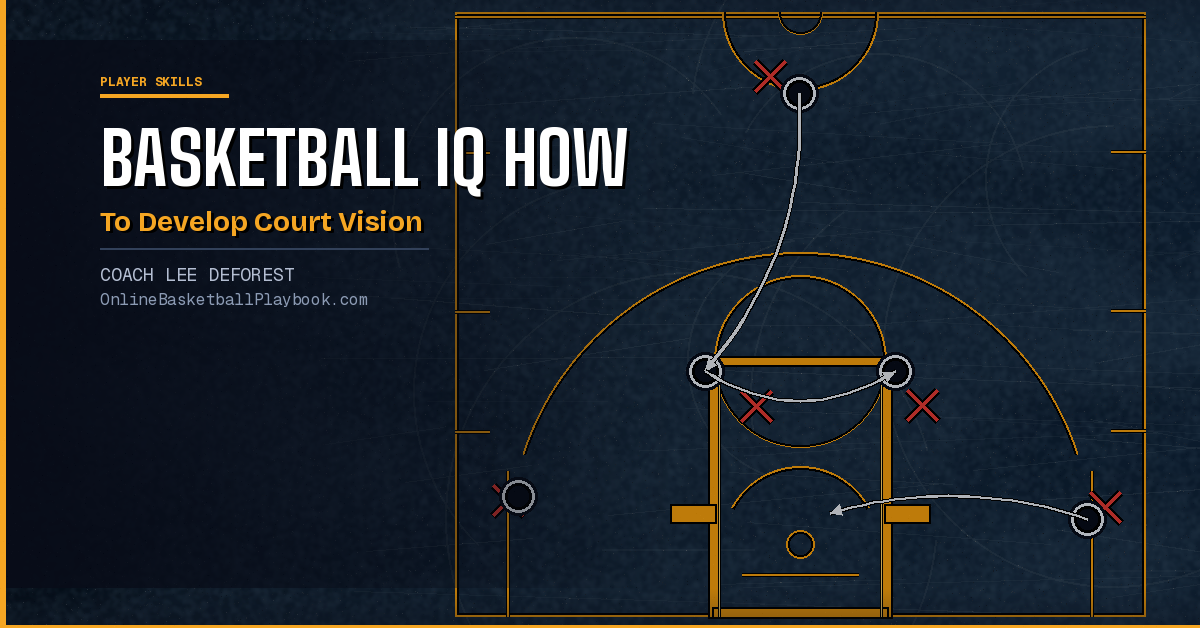

Court vision is not a gift some players are born with. It is a trainable skill — built rep by rep through the right drills, the right reads, and a coaching method that forces decisions instead of scripting routes.
What Court Vision Actually Is
Ask most coaches what court vision is and you get a description of the outcome — "he sees the whole floor," "she reads the defense before it happens," "he always finds the open man." That is not a definition. That is a highlight reel.
Court vision, more precisely, is the ability to perceive a defensive situation, identify which advantage exists, and act on it before the defense can recover. It breaks into three parts: perception (what the player sees), pattern recognition (what the player knows that visual information means), and decision speed (how fast the player acts on it).
None of those three parts is a talent. All three are teachable. The reason most players never develop strong court vision is not that they lack the genetic wiring — it is that their coaches never trained it directly. They ran plays. They scripted actions. They corrected results instead of rewiring the reads that produce them.
Ettore Messina put this plainly in his offensive clinics: players must learn to "decide while catching." The read happens during ball reception, not after. The player who waits until the ball is in their hands and then starts reading has already lost a half-step to the defense. Vision is not about what you see after the catch. It is about what you see on the way to the catch.
That distinction reshapes every drill you run, every rep you design, and every correction you make during practice. If a player makes a wrong decision, the question is not "why did you throw that pass?" The question is "what did you see when the ball was in the air coming to you?" Train the read at the right moment and the decision corrects itself.
The Core Problem: Routes vs. Reads
The most widespread problem in developing basketball IQ is that most practice time teaches routes instead of reads. A route is a scripted path: "if they set a ball screen here, the handler goes left and the screener pops to the elbow." A read is a live decision: "if the hedge is hard, go under; if the drop is soft, shoot; if the guard trails, reject and attack."
Routes are easier to teach and easier to evaluate in practice. The play runs correctly or it does not. But routes fail in games because defenses do not cooperate with the script. The moment a defense does something unexpected — a switch, a help rotation, a stunt — players trained on routes freeze. They have the play. They do not have the read.
Read-based systems flip the premise. Motion offense, pace-and-space, Princeton-style spacing — these are not systems built on plays. They are systems built on reads. The plays are the secondary layer. The primary layer is the decision framework: who has the advantage, where is the help coming from, what does that leave open. Coaching a read-based system without actually training reads is like teaching someone to drive with detailed turn-by-turn directions but no understanding of traffic. It works until the route changes.
The fix is not to run fewer plays. The fix is to redesign how practice reps are structured so that every terminal action requires a live decision against a real defender. That is what the advantage ladder does.
The Advantage Ladder: How to Build Vision Through Drills
The most effective framework for developing court vision at any level is the advantage progression — structured drills that start with a built-in numbers edge and make players solve it live, adding a defender each step so the read gets harder while staying realistic.
The ladder runs: 2v1 → 3v2 → 4v3 → 4v2-plus-2 → 5v3. Each step increases the complexity of the read without removing the advantage. The offense always has more bodies than the defense can cover cleanly, which means there is always an open player. The decision is which open player, at what moment, and with what action.
2v1: The Foundation Read
Two offensive players versus one defender. The read is binary: drive the lane and the single defender collapses, leaving the kick receiver open; drive the lane and the defender stays, meaning you finish. At this stage, players are learning the cause-and-effect logic of defensive positioning. They begin to see that the defender's movement creates the pass — or confirms the shot. Run this at game speed with live finishes. No walk-throughs.
3v2: Adding the Second Help
The offense has three players, the defense has two. Now the read has a second layer. Drive the lane; the bottom defender has to make a choice. If the defender sinks to the dunker spot, the trail three-pointer opens. If the defender stays on the kickout receiver, the second cutter is live. The offensive player is now reading two defenders simultaneously and learning to hold their decision until the second defender commits.
4v3 and Beyond
At 4v3, players are reading rotations on screen actions — which defender recovers, which one sinks, and where the rotation breakdown leaves a gap. The 4v2-plus-2 structure (four offensive players against two live defenders plus two restricted defenders who can only rotate after a pass) is particularly useful for training skip passes and the second-side read that generates the best shot in the possession.
Every rep in the ladder ends in a real read. There is no scripted finish. The terminal action — shot, pass, or penetration — must be chosen against a live defender in real time. That is what transfers the vision to games.
Constraints: The Coaching Tool That Isolates the Read
The advantage ladder tells you the drill structure. Constraints tell you which read you are coaching that day. A constraint is a rule layered onto the drill that eliminates some options and forces others into sharp relief.
Examples: "catch-and-shoot or catch-and-pass only — no fakes, no dribble." "Must penetrate on the catch." "One dribble maximum before a decision." Each constraint isolates a specific read so players cannot default to comfort moves. The player who always drives right cannot drive right when the constraint says "left side only." The player who always pulls up for the mid-range cannot pull up when the constraint says "finish at the rim or kick." Constraints accelerate learning because they force the brain to solve a narrower problem with full intensity.
Kevin Boyle's elbow-read drill takes this one step further: a coach stationed at the elbow calls the constraint each rep — hesitation, baseline-reverse, or drag-crossover — as the ball is in flight. The player does not know the constraint until the catch is happening. This trains the "decide while catching" read at game speed, with realistic reaction time, without making the drill a scripted route. The situation is controlled; the decision is live.
Quin Snyder frames the coaching method this way: identify the situation, attack it systematically with a drill at the right numbers, teach it to its finest points — foot angles, timing cues, verbal calls — and then hold the standard through accountability. The accountability comes after enough reps to build habits. Accountability before reps creates anxiety, not ownership.
Decisions are a trainable skill, and you train them by manufacturing the situation, limiting the options, and playing it live — the same teach-through-decisions logic, scaled from one action to a whole system.
— Teaching Decision-Making, Basketball Vault
The Four Stages of Decision-Making Development
Don Meyer's four stages of learning give coaches a precise map for where a player is in their development — and what the next rep should accomplish.
Stage one is unconscious incompetence: the player does not know they are making the wrong read. They see the defender and react from instinct — usually the wrong instinct, trained by years of making comfort moves. Coaching at this stage requires showing them what they are not seeing, not just correcting what they did.
Stage two is conscious incompetence: the player knows they are making the wrong read but cannot yet correct it under pressure. This is actually progress. The player can now identify the gap between what they see and what the right decision would have been. Drill reps at this stage should be slowed down just enough for the player to articulate the read before executing it.
Stage three is conscious competence: the player makes the right read, but it is effortful. They are running a mental checklist — "help is coming from the weak side, so I skip" — rather than seeing and reacting. Reps at this stage should be game-speed with game-pressure, pushing the player to process faster. The goal is to automate the checklist until it disappears.
Stage four is unconscious competence: the player reads the defense during the catch and responds before they consciously process what they saw. This is court vision as observers describe it — the player who "just knows" where to go. But it is not magic. It is thousands of advantage-ladder reps, correctly constrained, run at game speed, against live defenders, until the read is a reflex.
Meyer's instruction for coaches: "See the picture, sell the picture, then everybody paints the picture." Players who understand why a read exists execute it more consistently than players following a command. Explain the reason behind the constraint. Name the situation the drill is training. When players see the picture — the defensive rotation that leaves a specific player open — they can recreate it themselves in a game without prompting.
How to Build This Into Your Practice
Translating the advantage ladder and constraint method into a real practice structure requires three decisions: when to run decision drills, how to sequence them, and how to correct reads during live reps without stopping the learning.
Open With Advantage Reps
Put 2v1 and 3v2 decision-shooting at the start of practice, not the end. Early in a session, players are mentally fresh and can absorb the read. Running decision drills when players are physically exhausted at the end of practice produces sloppy reads that reinforce bad habits. Start with the read. Build game shape around it.
Sequence the Reads by Action Family
Jordi Fernandez-style drill ladders sequence reads within an action family: 1v1 gap-stunt closeout → 2v1 corner stunt → 2v2 short roll → 3v3 hit-and-get ball screen. Every drill in the ladder builds on the same underlying read — what does the help defender's positioning tell the ball handler — at escalating complexity. Players are not learning five different drills. They are learning one read at five depths.
Correct the Read, Not the Result
When a player makes the wrong decision, the correction lives at the moment of perception, not the moment of execution. "Why did you pass when you should have driven?" is the wrong question. The right question is: "When the help defender stepped up, what were your two options?" Walk the player back to the read. Name what they should have seen. Repeat the rep. If the correction happens after the play is over without identifying the read cue, players learn to feel bad about the result without knowing how to change the decision next time.
For younger players, Steve Ashworth's approach is instructive: let the play finish first, then ask "What did you see there?" Do not interrupt the rep with a correction mid-action. This teaches self-evaluation. The player who can identify their own read gap will correct faster than the player who waits to be told what they missed.
The fastest path to court vision is not more film — it is more constrained live reps at game speed. If your players watch video of the right read but never practice it under pressure against a real defender, they can describe the right decision without being able to make it. Reps transfer; knowledge without reps does not.
- Run 2v1 decision-shooting daily: start every practice with five minutes of 2v1 at game speed — offense reads the single defender and finishes or kicks. No warm-up walks, no scripted routes.
- Pick one constraint per session: select a constraint before practice — "catch-and-pass only," "must penetrate," "one dribble max" — and apply it to every advantage drill that day so players are solving the same read problem across all reps.
- Use the 1v0 → 1vC → controlled-advantage → game progression when installing any new action: introduce the movement with no defense, add a coach to guide the read aloud, move to a constrained advantage, then play it live — every new action deserves this ramp before live scrimmage.
- Correct reads with questions, not commands: after a wrong decision, ask "What did you see?" before telling the player what they missed — this builds self-evaluation and speeds up the read-training cycle at every age level.
Want more basketball coaching strategies and drills?
Keep Building
Related breakdowns
5 Exercises Basketball Players Should be Using to Develop Strength
5 Exercises Basketball Players Should be Using to Develop Strength
How to Develop and Use a Coaching Code of Conduct
How to Develop and Use a Coaching Code of Conduct
Developing a Long-Term Vision for Your Basketball Program
Developing a Long-Term Vision for Your Basketball Program