A bounce pass is a pass thrown so it hits the floor once before reaching the receiver, rather than traveling to them in the air. Coaches teach it specifically to get the ball under or around a defender's reach, bouncing it low and through a gap that a straight-line pass like the chest pass would never clear. It's a lower, slower pass by design, which makes the bounce spot the single most important piece of teaching it well.
What Is a Bounce Pass?
The bounce pass is exactly what it sounds like: a pass that hits the floor once on its way to a teammate instead of traveling to them through the air. Coaches teach it as the answer to a specific problem. A defender standing between the passer and the receiver with their arms up, closing off the direct passing lane. A chest pass thrown into that lane gets deflected. A bounce pass goes under the defender's arms and arrives clean.
It's a different tool than the chest pass, not a slower version of it. The chest pass is built for speed in open space. The bounce pass is built to solve a spacing problem. Getting the ball through a gap at floor level that isn't available higher up.
Mechanics: The Two-Hand Push
The two-hand bounce pass starts the same way a chest pass does (both hands on the ball, thumbs behind it pointing at each other, ball held near the body, and a step toward the target as the arms push out). The wrists snap on release the same way too, driving the ball down and out rather than straight ahead.
The difference is the target. Instead of aiming at the receiver's chest, the passer aims at a spot on the floor roughly two-thirds to three-quarters of the way to the receiver. Pushed with the same step-and-push motion as a chest pass, hitting that spot lets the ball come up off the bounce and arrive at the receiver's waist (a height they can catch and use immediately, whether that's shooting, driving, or passing again).
Why the Bounce Spot Matters
The bounce spot is the entire skill. Aim too close to the passer and the ball has too much distance left to travel after it comes up off the floor. By the time it reaches the receiver it's popped up high, often above the waist and sometimes as high as the shoulders, which defeats the purpose of going low under a defender in the first place.
Aim too close to the receiver and the opposite problem shows up: the ball is still low and hard, arriving at the ankles or shins in a short, sharp hop that's difficult to control cleanly. Both misses are avoidable with the same fix. Find the two-thirds-to-three-quarters mark and drive the pass at that spot, not at the receiver.
Coaching cue: "Aim at the floor, not at your teammate." Have players pick an actual spot (a seam in the floorboards, a scuff mark, a cone in a drill) and throw at that spot every time. Naming a target spot fixes bounce-pass accuracy faster than any verbal correction about arc or speed.
When to Use a Bounce Pass
The bounce pass earns its spot in the passing progression in a handful of specific situations. The clearest is getting the ball under a defender's outstretched arms. Any time a defender is playing the passing lane high, a bounce pass goes underneath where the chest pass can't.
Entry passes into the post are another core use. A post player working for position against a defender fronting or playing tight often has a passing window only at floor level, and a bounce pass threaded to the post player's outside hand gets it there without the defender getting a hand on it. Feeding a cutter driving hard to the basket is the third major use. A bounce pass timed just ahead of the cutter lands in their hands in stride, low enough to gather and finish without breaking speed.
The One-Hand Bounce Pass
Once players have the two-hand mechanics down, the one-hand bounce pass adds speed and deception. Thrown off one hand with a shorter, quicker push, often off the dribble, it gets the ball out and down to the floor faster than a player can reset into a two-hand grip, which matters in fast-break situations and tight driving lanes where a half-second delay lets the defense recover.
The tradeoff is control. A one-hand bounce pass is harder to aim accurately than the two-hand version, so it should be taught as an advanced variation layered on top of solid two-hand fundamentals, not as a replacement for them. Players who try the one-hand version before they've locked in the bounce spot on the two-hand pass tend to spray it wildly in both directions.
Common Mistakes to Fix
The most common mistake is bouncing the pass too hard. A hard, low bounce pass thrown with too much force jumps up past the receiver's hands before they can react to it, even when the bounce spot is correct. The fix is teaching players to match the push to the distance, not just fire every bounce pass at full speed.
The second mistake is aiming at the wrong spot entirely. Usually straight at the receiver's feet or straight out at their chest, both of which ignore the bounce mechanics altogether. The third is using a bounce pass in the open court where a chest pass would be faster and just as safe. The bounce pass is slower by design, so using it when there's no defender to get around costs a team tempo for no benefit.
Drills to Build Accuracy
Two drills build the bounce pass from mechanics to game context:
Two-line bounce passing with a marked target spot: Split players into two lines facing each other, and mark the correct bounce spot on the floor with a cone, a strip of tape, or a chalk line, two-thirds to three-quarters of the distance between the lines. Players bounce pass down the line aiming at the marked spot on every rep, which turns "aim at the floor" from a verbal cue into a visible target they can self-correct against.
Entry-pass reps into a post player: Set up a post player on the block with a perimeter passer working entry passes, starting with no defender and progressing to a live or token post defender. This connects the bounce pass to its most common game use and forces the passer to find the bounce spot at a game-realistic angle and distance, not just straight down a line.
- Same two-hand push mechanics as a chest pass, but aimed at the floor, not the receiver
- Bounce spot: two-thirds to three-quarters of the way to the receiver, so it arrives at waist height
- Use it to get under a defender's arms, on post entries, and to feed a cutter driving to the rim
- The one-hand bounce pass adds speed and deception once two-hand mechanics are solid
- Don't throw it too hard. It'll pop up past the receiver's hands even from the right spot
- Skip it in the open court; a chest pass is faster when there's no defender to go around
Get free play diagrams, drills, and coaching guides delivered to your inbox.
Draw this play free in the play drawer →
Membership: the full library, playbook packs, and Pro drawing tools →
Keep Building
Related breakdowns
Chest Pass in Basketball: How to Teach It
The chest pass is the fundamental two-handed pass in basketball. Here's the hand placement, step-and-push mechanics, common mistakes, and drills to teach it.
Overhead Pass in Basketball: How to Teach It
The overhead pass clears a defender's reach or covers longer distances than a chest pass. Here's the correct starting position, the most common mistake, and when to use it over other passes.
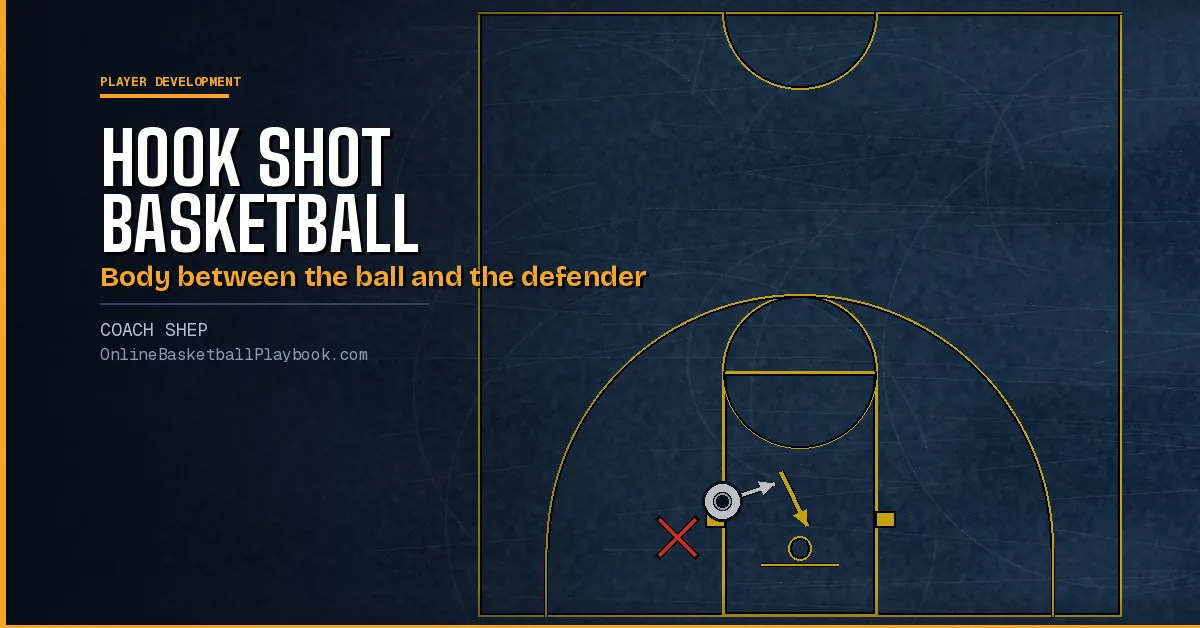
Hook Shot Basketball: How to Do It and How to Teach It
Hook shot basketball for post players and coaches: the classic hook, sky hook and jump hook, the footwork steps, when to use it, the pivot foot rules and drills.