The chest pass is the most fundamental two-handed pass in basketball. Thrown directly from the passer's chest to a teammate's chest, it travels in a straight line, arrives quickly, and gives the receiver the ball in the perfect spot to shoot, drive, or pass again. Every other pass in the game is a variation built off the mechanics players learn here first, which is exactly why it's the starting point for teaching passing to young players.
Hand Placement and Grip
Everything about a good chest pass starts with how the hands are set on the ball. Players should hold the basketball with both hands on the sides of the ball, fingers spread comfortably across the surface, and thumbs positioned behind the ball pointing at each other. This grip gives maximum control and sets up the wrist snap that gives the pass its speed.
The ball should rest at chest height, close to the body, elbows in rather than flared out. A common early mistake is letting the ball drift too low toward the waist or too high near the chin. Both positions make it harder to generate a quick, accurate release. Chest height keeps the pass compact and ready to fire the instant a passing lane opens.
Step-and-Push Mechanics
The chest pass is a step-and-push motion, not an arm-only throw. The passer steps toward the target with one foot, transferring weight forward, while extending both arms straight out toward the receiver. As the arms extend, the wrists snap and the thumbs rotate down and out, which is what puts backspin on the ball and keeps it traveling on a flat, direct line instead of floating or sailing.
Teach the sequence in this order: eyes up, step toward the target, push through with both hands, snap the wrists on release, thumbs finish pointing down and out. The follow-through matters: thumbs down and palms facing away from the body confirms the player pushed all the way through the pass instead of just flicking it.
Coaching cue: "Step and snap, thumbs down." If a player's pass is looping or losing speed halfway to the target, it almost always traces back to a missing step or thumbs that never rotated on release.
When to Use a Chest Pass vs. Other Passes
The chest pass is the go-to option any time a teammate has a clear, open passing lane at chest-to-shoulder height and there's no defender directly in the passing path. It's the fastest pass to throw and the fastest for a teammate to catch and use immediately, which makes it the first choice in open space, on the perimeter, and in most half-court ball movement.
A bounce pass becomes the better option when a defender is standing in the direct passing lane. Bouncing the ball under an outstretched arm gets it through where a chest pass would get deflected. An overhead pass takes over when the receiver is taller, farther away, or when the passer needs extra clearance over a low defender, such as skip passes across the court or entry passes into the post over a fronting defender.
Common Mistakes to Fix
The most common flaw is looping or lobbing the pass instead of driving it flat and hard. This usually happens when a player pushes from the elbows only, without the wrist snap, and it gives defenders extra time to step into the passing lane and steal it.
The second frequent mistake is failing to step into the pass. Passing from a flat-footed or leaning-back stance robs the pass of power and accuracy, forcing the receiver to reach or adjust. The third is telegraphing the pass, staring directly at the intended receiver before throwing it, which tips off the defense and invites a jump into the lane. Players should keep their eyes up and scan the floor so the pass isn't obvious until it's already released.
Footwork and Passing Lanes
Good passing starts before the ball ever leaves the hands. Players need to establish a strong, balanced base with a pivot foot set, so they can step toward the target without traveling and without losing sight of the whole floor. Pivoting to open the shoulders toward the receiver creates a cleaner, more direct passing lane and lets the passer see over or around a defender who is playing tight.
Encourage players to use a strong pivot to angle their body away from the nearest defender before releasing the pass. This small adjustment opens a passing lane that wasn't there a half-second earlier and is often the difference between a clean pass and a deflected one.
Drills to Teach and Reinforce It
Three drills cover the progression from basic mechanics to game-speed execution:
Two-line passing drill: Split players into two lines facing each other about 12-15 feet apart. Players chest pass down the line, step and snap on every rep, then jog to the back of the opposite line. This builds repetition on the core mechanics in a low-pressure setting.
Partner passing with footwork: Partners face each other and add a pivot before each pass: catch, pivot away from an imaginary defender, step, and pass. This layers in the footwork piece so players connect the passing motion to game-realistic movement.
Shuttle passing: Players move in shuttle formation, passing and following their pass to the back of the new line, increasing tempo each round. This adds conditioning and forces crisp, accurate passes at game speed, since a loopy pass in a moving drill gets punished immediately.
- Thumbs behind the ball, fingers spread, ball held at chest height
- Step toward the target and push through with both hands. It's a step-and-push, not a flick.
- Snap the wrists on release; thumbs finish pointing down and out
- Use it in open lanes; switch to a bounce pass when a defender is in the direct passing line
- Fix loopy passes by adding the step and the wrist snap back in
- Keep the eyes up and scanning so the pass isn't telegraphed before release
Get free play diagrams, drills, and coaching guides delivered to your inbox.
Draw this play free in the play drawer →
Membership: the full library, playbook packs, and Pro drawing tools →
Keep Building
Related breakdowns
Bounce Pass in Basketball: How to Teach It
The bounce pass gets the ball under a defender's reach instead of through it. Here's the mechanics, the exact bounce spot that makes it work, and drills to build accuracy.
Overhead Pass in Basketball: How to Teach It
The overhead pass clears a defender's reach or covers longer distances than a chest pass. Here's the correct starting position, the most common mistake, and when to use it over other passes.
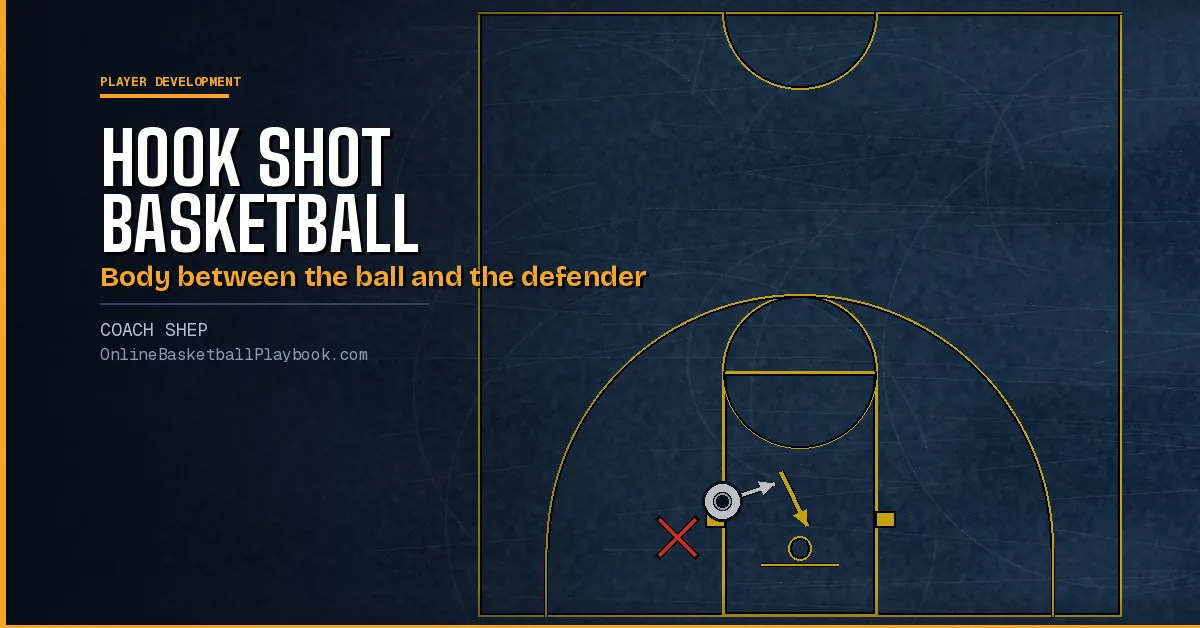
Hook Shot Basketball: How to Do It and How to Teach It
Hook shot basketball for post players and coaches: the classic hook, sky hook and jump hook, the footwork steps, when to use it, the pivot foot rules and drills.