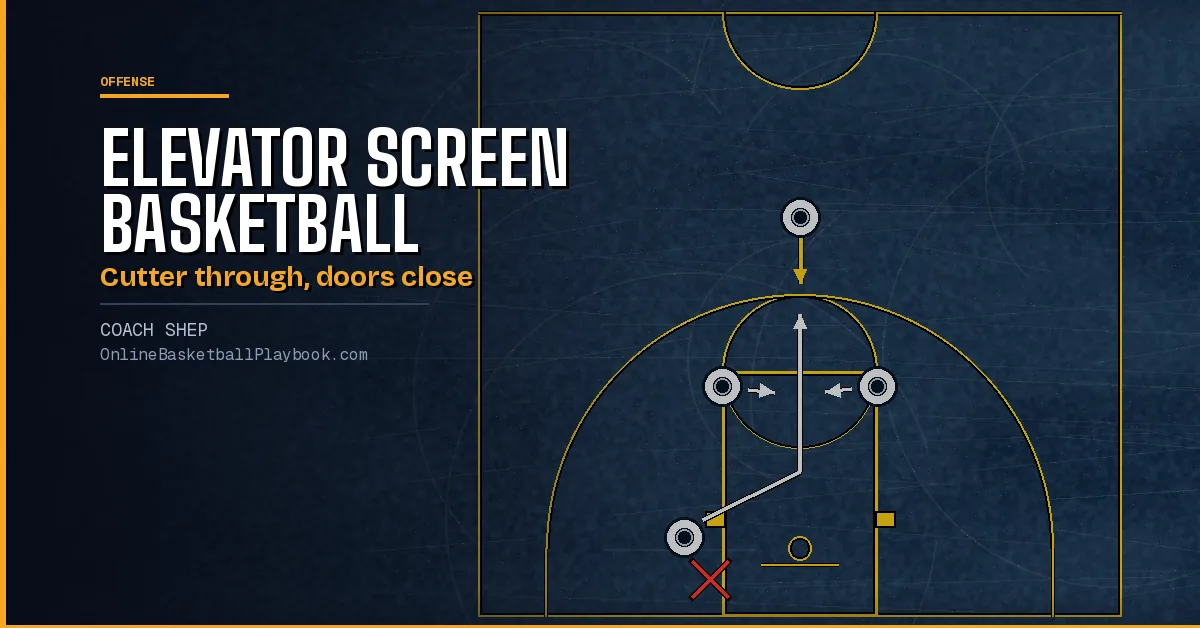
An elevator screen in basketball is an off-ball action built from two screeners and one cutter. The cutter, usually a shooter, runs between two teammates who stand just far enough apart for him to get through, and the moment he is through they step together like elevator doors and shut his defender out behind them. It is also called a gate screen or a fence.
Elevator screen basketball plays all share one goal, a catch with a clean look at the basket, and they all live or die on timing. This guide draws the base action, shows five ways to run it, explains how to keep it legal and covers what to do when the defense switches or jumps it.
Elevator Screen Basketball at a Glance
| Piece | What it does |
|---|---|
| The cutter | Usually the best shooter. Sets up his defender first, then runs through the gap and catches facing the basket |
| The two screeners | Stand just far enough apart for the cutter to get through, then step together behind him to close the gap |
| The passer | Delivers the ball as the cutter clears the doors. A ball handler who keeps the dribble alive can also attack instead |
| The best screeners | Two post players. Two guards invite an easy switch |
| The best use | A catch-and-shoot three. It is also called out of a dead ball, where the doors can be set before the defense moves |
| Names | Elevator, gate and fence name the same action |

How the Elevator Screen Works
The screen has three parts.
- The gap. The screeners stand just far enough apart to let the cutter through, then step together behind him. Close early or late and the defender gets through or the screen becomes a moving screen.
- The cutter's route. He reaches the gap while his defender is still trailing him, not before the screeners are set and not after the defender has already beaten him to the spot.
- The closing step. Both screeners step toward each other in the same instant the cutter clears.
Two choices decide how hard the action is to guard: who screens and what comes before.
- Screen with two post players. A catch at the three-point line only stresses the defense when the player catching it is a shooter, and two guards screening for a third guard just invite a switch.
- Change his direction first. The action works best when the cutter has to change direction or set a screen first, so his defender is already on the wrong side when the doors close.
- Set a cross screen or a back screen first. A cutter who sets one and then runs through the gap gives the screen a head start.
- Dribble away from the doors. A ball handler who dribbles away from the eventual doors holds the cutter's defender in the lane, which gives the screen a head start too.
Decide who the doors are and what the cutter does first, then rep it.
Timing the Screen Legally
Closing early or late is the usual way an elevator screen goes wrong. Close late and the defender is through. Close while the defender is arriving and the screener is moving at the moment of contact, which officials can call a moving screen. The books treat the screener's movement the same way at the levels below, with different wording.
| Level | What the book says that matters for the doors | Rule |
|---|---|---|
| NFHS | Check your state association rulebook. The NCAA comparison chart lists a vertical plane with the feet about shoulder width apart | DIFF, Screener row |
| NCAA men | No screen set while moving may cause contact. The screener stays inside his vertical plane and may not set so close to a moving defender that he cannot stop or change direction | Rule 4 Sec. 35 Arts. 2, 3 and 4 |
| NBA (2025-26) | After taking a legal position the screener may not move laterally or toward the opponent. Against a moving opponent he needs one to two steps of room | Rule 12B Sec. III (2) and (3) |
| FIBA (2026) | A screen is legal when the screener is stationary inside his cylinder with both feet on the floor at contact | Art. 33.7 |
So the closing step belongs before the defender gets there, and the screeners should stop moving before contact. Rep the timing until the doors close on the same beat every time.
NCAA men's Rule 4 Sec. 35 Art. 7 also bars screeners from lining up next to each other within 6 feet of a boundary and parallel to it so that contact occurs, which a pair of baseline doors should keep in mind. The full rule by level is on the moving screen and illegal screen pages.
Elevator Screen Plays
Dribble entry from a horns look
This play builds a whole offense around the elevator, from a horns alignment with the point guard at the top of the key, shooters in both corners and the two bigs at the elbows. The point guard dribbles to a wing.
The corner shooter on that side back-cuts to the rim, then sprints up through the gap between the bigs, who move together just far enough apart to let him through and then close. The point guard passes to him for a three.

The same play has a second entry, where a corner player V-cuts to the wing for the catch and the other corner player slides inside and comes up through the doors for the next pass. It also has an iso option. The ball handler keeps his dribble alive after the shooter cuts and attacks, with the bigs stacked above and a shooter spotted as the outlet if help comes.
Box Cross Elevator
A screen-the-screener look from a box, with the guards on the blocks and the bigs at the elbows.
- Dribble to a wing. The point guard dribbles to a wing.
- Cross-screen. A guard on the strong side steps toward the middle of the lane and cross-screens for the other guard, who cuts out to the corner or posts on the block.
- Turn the bigs in. As the cross screen is set, the two bigs turn in toward each other.
- Run up through the gap. Once the cutter clears the screen, the screener runs up through the gap for a pass at the top of the key and a three.
- Dive on a switch. If the defense switches, the big on the near side dives to the block and posts up against a guard.

Chin Elevator
A Princeton-style variation. It fits a Chin set because the cutter's route to the block is already in the continuity and only the finish changes.
- Swing the ball. The ball swings around the perimeter to a wing. A guard who passed first has cut off a back screen to the ball-side block.
- Form the doors. When the ball reaches the wing, two bigs step down to the ball-side elbow and form the doors.
- Come up through them. The guard touches the block, changes direction quickly and comes up between them to the slot, where the wing passes him the ball back for a shot.
The Princeton offense page has the rest of the set.

Horns Diagonal Elevator
This play uses misdirection to put the doors on the opposite side from the ball. The defense follows the hand-off, and the real action happens behind it.
- Throw and cut. From a horns set the point guard throws to a big at the elbow and cuts to the strong-side corner as the other guard walks into the block.
- Pin down and hand off. The other big sets a pin down for the weak-side guard, who runs just above the free-throw line for a dribble hand-off.
- Form the elevator. While that guard takes a couple of dribbles, the two bigs come together to form the elevator for the guard who walked to the block.
- Run to the opposite wing. He runs through it to the opposite wing for a throwback pass and a three.
Elevator off an entry cut
Hang 33 sets off a single entry cut, with elevator and cross-elevator finishes beside floppy, back-screen and pin-down finishes. The idea is that the entry looks the same every time, so the defense has to prepare for every finish. If your team already runs one entry, an elevator is an easy finish to add.
Pick one entry, learn its finishes, and rep it until the doors close on time.
Get the next coaching guide in your inbox
One email when a new guide or diagram set goes up. Free.
Elevator Screens Out of Bounds
The elevator also runs out of a dead ball.
- Sideline elevator. Two screeners stand together just above the free-throw line with a teammate in the corner. The shooter starts out by a sideline and runs between the screeners, who close behind him, and the inbounder passes to him for a three.
- Box Elevator. A baseline play that sends a back screen first and then an elevator for a mid-range or three-point shot.
- Late-clock set. One youth play keeps it for when only a few seconds are left.
- Double elevator. A baseline play. Two players screen for a shooter, then a new pair, with one of the first screeners, resets quickly and screens for a second cutter, who goes through for a pass and a layup.
The sideline out of bounds plays page has more sets and the inbound plays page draws the baseline set.
Rep the set until the inbounder and the shooter see it the same way.

Counters When the Defense Reads It
An action that works once gets scouted. The horns elevator offense builds three answers into the same shape, so the cutter and the screeners read the defense and not a script.
- Slip against a switch. If the defender of one big switches onto the cutter, that big slips the screen and cuts to the rim, with the cutter's old defender on his back, for the pass from the point guard.
- Diagonal cut. If the other big's defender switches onto the cutter, that big diagonal-cuts on the ball side for the pass. If he is well covered, the other big is the second option inside.
- The back-cut call. If the cutter's defender steps into his route and blocks the way to the doors, the cutter yells the call and back-cuts behind him for the pass.


The same offense adds a second pass-and-elevator rep, where the shooter who got the ball dribbles to the next wing and the other corner player comes through the doors. And when the first look is stopped, the offense can turn into a ball screen. Related reads for the screener are on the down screen and flare screen pages.
Read the defender, not a script.
How Defenses Try to Stop It
Three answers come up when coaches scout the action.
- Pressure the passer. Ball pressure takes away the pass, because the best shot in the world still needs a catch, and many elevator plays are built around one primary look.
- Trail the shooter's hip. A defender who stays glued to his man and commits to the trail leaves the screeners little room to close a legal gap, which is a harder test than fighting over the top late.
- Switch quickly. The defender of the screener nearest the ball takes the shooter and the shooter's defender steps up to the screener. It can create a size mismatch and, if it is quick, a steal.
The defending screens page covers the general rules.
Know how they guard it before you call the set.
Related Drills and Screens
For a menu of drills see drills to teach off-ball screens and for the rest of the screen family see basketball screens. Shooters who use the screens can work on the footwork in basketball shooting off screens.
Choices Every Staff Makes
Where do the doors stand?
- At the elbows. Near the free-throw line, for a cutter coming up to the top of the key or the wing.
- Staggered at the top of the key. A staggered pair, for a shooter running through to a three.
- At the ball-side elbow. The cutter comes up from the block to the slot.
Is it one action or two names? An elevator is a pair that closes together behind the cutter. A double stagger screen is a different action, with the cutter coming off one screener and then the next. Other systems use the two names for nearly the same movement, so write the job next to the name.
Base play or special call?
- A continuity with reads. The defense cannot scout one look.
- A set for a dead ball or the last few seconds.
Pick one name for your team and use it in every workout.
Want the printable playbook packs?
OBP Pro members get the premium playbook packs: the zone attack, out of bounds and practice plan PDFs, plus each new pack as it is finished. The membership page lists what is in each one. Or draw your own version free in PlayDraw.
See what OBP Pro includesQuestions Coaches Ask
What is an elevator screen in basketball?
An off-ball screen where a cutter runs between two screeners who then step together behind him, closing the gap so his defender cannot follow.
Why is it called an elevator screen?
The two screeners stepping together look like elevator doors closing behind the cutter.
Who should set an elevator screen?
Use two post players as the screeners and a shooter as the cutter. Two guards screening for a guard make the switch easy.
Is an elevator screen legal?
It is legal when the screeners are set and not moving into the defender at the moment of contact. Closing late or while the defender is arriving can be a moving screen. Check your own rulebook, and see the table above for NCAA men, NBA and FIBA.
How do you defend an elevator screen?
Pressure the passer so the catch never happens, trail the shooter closely so the screeners cannot close a legal gap, or switch quickly if you have an athletic big.
What is the difference between an elevator screen and a double screen?
A standard double screen is two screeners side by side for a cutter to come off. An elevator is a pair that stays open for the cutter to run through and then closes behind him.
More Guides From This Batch
- Sideline Out of Bounds Plays: SLOB Sets, Reads and Practice
- 3 Out 2 In Basketball Offense: Spacing, Actions and Reads
- Hook Shot Basketball: How to Do It and How to Teach It
- Fun Basketball Games for Practice: Scored Games for Any Team
Back to Basketball Screens and every Offense page.
Keep Building
Related breakdowns
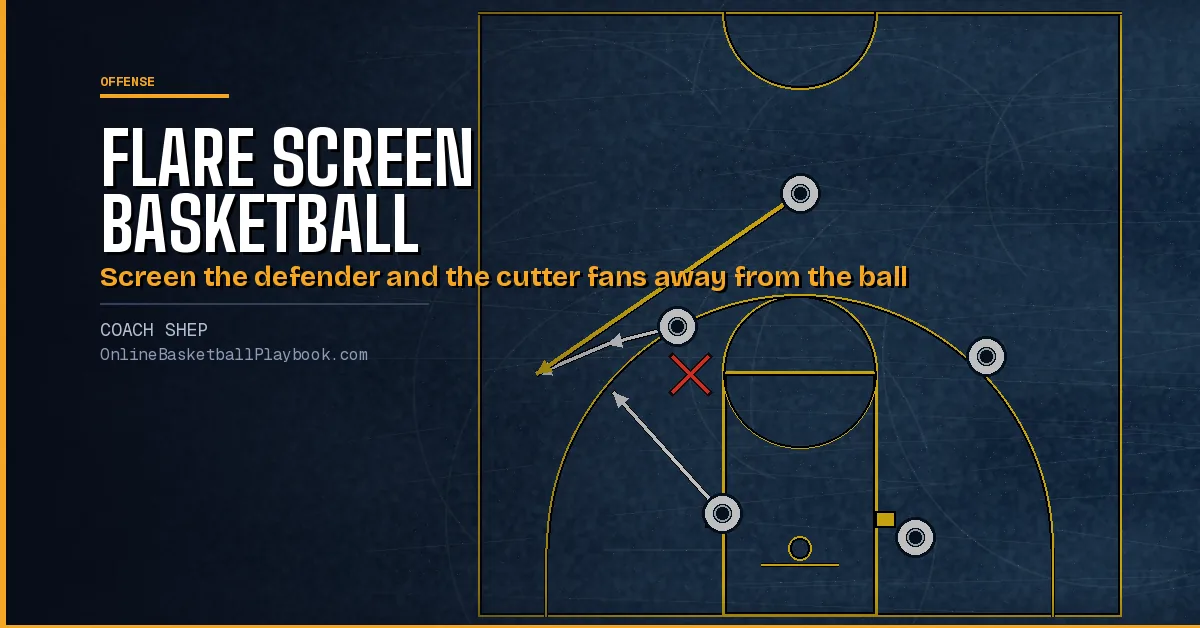
Flare Screen Basketball: How It Works, Reads and Counters
Flare screen basketball explained for coaches, with the screen, the cut, the pass, the three reads, where teams use it and how coaches teach and defend it.
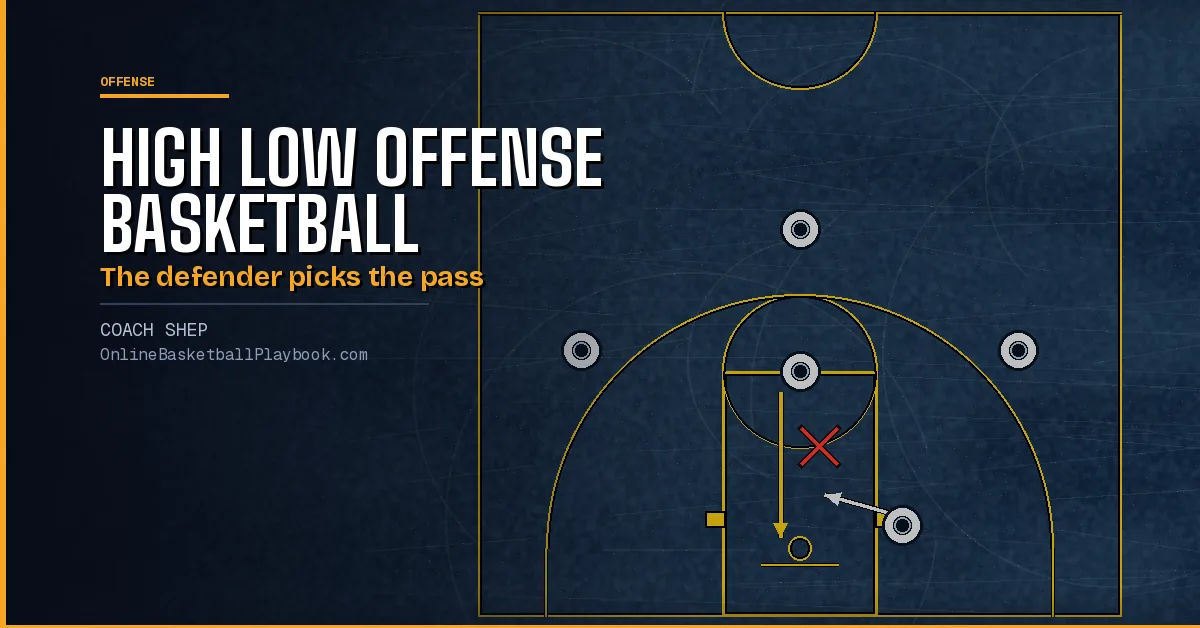
High Low Offense Basketball: Reads, Counters and Zone Rules
High low offense basketball explained: the two-post shell, the lob and bounce reads, answers to a front, down-screen reads, 1-4 low sets and the hi-lo against zones.
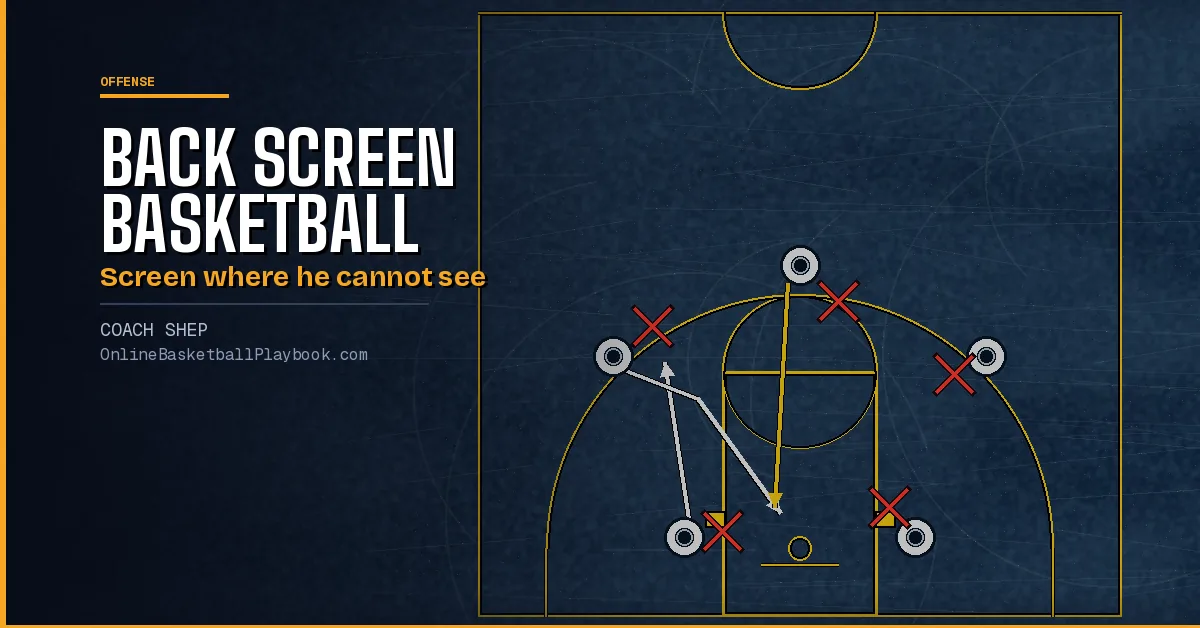
Back Screen Basketball: How to Set, Use and Defend It
Back screen basketball guide: what a back or rip screen is, setting it legally, the cutter's and screener's reads, the UCLA cut, chained actions and defending it.