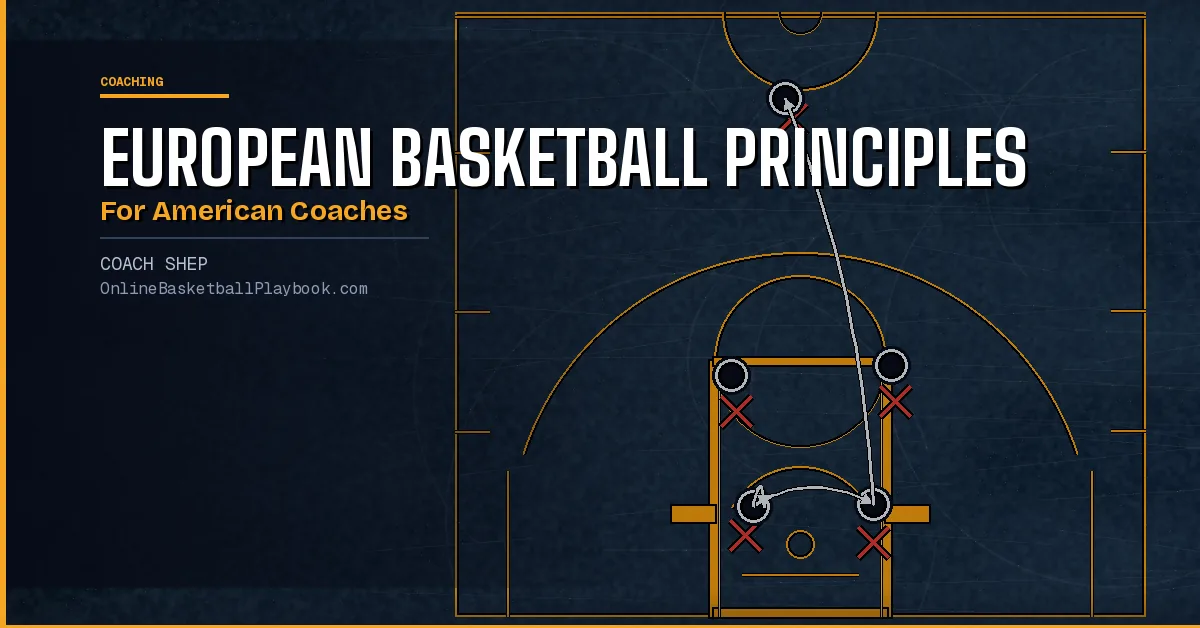
The best international programs have been teaching footwork, positionless spacing, and system basketball for decades. American coaches who study these ideas will develop smarter, more versatile players faster.
Footwork Is the Foundation, Not an Afterthought
Walk into any top European youth academy (EuroLeague club programs in Spain, Serbia, France, Lithuania) and the first thing you will notice is how much time they spend on footwork before any offense is installed. This is not accidental. It reflects a deeply held belief in European player development: if a player cannot stop, start, pivot, and land under control, none of the offensive complexity you add on top will hold up under pressure.
In American youth and high school programs, footwork often gets compressed into a pre-practice warm-up or buried inside a drill where the real objective is scoring. European coaches treat it as a standalone curriculum. They work through triple threat, pivot foot selection, live-ball versus dead-ball moves, and the finish family before they ever run a five-out or a pick-and-roll.
The "Quick" framework (quick starts, quick steps, quick turns, quick stops) organizes individual footwork into four teachable actions. The two-foot jump stop, landing simultaneously on both feet, preserves pivot foot choice and is treated as the non-negotiable foundation for all ball-handler decision-making. Once that stop is automatic, the entire offensive system becomes easier to teach because players are balanced before they read.
American coaches can steal this sequence directly. Spend the first two to three weeks of the season running nothing but footwork: triple threat, the jump stop, front and rear pivots, and live-ball drives (direct drive, crossover, jab-and-go). Do not run your offense until these are owned. The short-term sacrifice of offensive reps pays back all season long in fewer turnovers, better spacing, and cleaner finishes at the rim.
Positionless Basketball Starts in Practice
European club programs have been developing positionless players for decades out of necessity. Smaller national pools mean every player must be comfortable across multiple roles. The result is forwards who can handle pick-and-roll coverage, guards who post up smaller defenders, and centers who initiate offense from the perimeter. By the time these players reach EuroLeague or the NBA, position labels are nearly meaningless.
American coaches at the youth and high school level tend to lock players into positions early, often before their bodies and skills have settled. The point guard gets the ball-handling reps; the big gets the post drills. The division is clean and easy to manage, but it produces players who hit a ceiling when the game demands they operate outside their lane.
Positionless development does not mean every player runs every drill randomly. It means every player learns the principles that apply everywhere: how to read a defender, how to make a decision off a dribble handoff, how to finish in traffic, how to find the open man on a drive. These are not guard skills or big-man skills. They are basketball skills.
Practically, this looks like small-group skill work where a 6-foot-5 wing runs the same footwork progression as your point guard, and your lead guard goes through post-entry reads once a week. It looks like 3-on-3 and 4-on-4 with no designated positions, just principles. Players who are uncomfortable in new roles reveal the gaps their development needs to address, and that information is valuable before game day.
Decision-Making Is Coached, Not Assumed
One of the clearest differences between elite European youth programs and most American high school programs is how each treats decision-making. American coaches tend to teach actions (run this cut, set this screen, use this dribble move) and assume the decisions that connect those actions will develop naturally through repetition. European programs are more likely to make the decision itself the teaching object.
This shows up most clearly in how European coaches structure small-sided games. A 3-on-3 in a EuroLeague academy often has explicit decision rules attached: if your defender is in the passing lane, reverse the ball; if you catch with advantage, attack immediately; if the corner defender closes hard, skip. These rules are not whispered suggestions. Coaches stop play to name the decision and repeat the rule before resuming. The action follows the decision, and the decision is taught, not discovered accidentally.
American coaches can bring this into their programs without overhauling everything. The key is pausing repetitions at the decision point rather than at the finish. Instead of correcting a bad layup, rewind to the moment before the drive started and ask what the player saw. What did the defense give? What was the rule? Then run it again. Over a full season, this habit of naming decisions builds players who process faster because they have a vocabulary for what they are reading.
The three-move curriculum (direct drive, crossover, jab-and-shot) illustrates the principle at its most practical. Rather than teaching eight moves and hoping players select the right one in traffic, a narrow menu forces decision clarity. Players who master three moves executed with precision are more dangerous than players who know eight moves and hesitate at the choice. The constraint is the point. Fewer options, higher execution, better decisions under pressure.
Spacing as a Taught System, Not a Concept
Ask an American high school player what spacing means and they will usually say something like "spread out" or "give room." Ask a player developed in a top European academy the same question and they will describe specific floor positions, the angles those positions create, the reads that open when a defender helps off their spot, and the timing adjustments required when the ball moves to a new location. One answer is a concept. The other is a system.
European programs install spacing as part of their offensive language from early in development. Players learn not just where to stand but why (what defensive rotation that position threatens, what pass becomes available, what the next action should be based on how the defense responds). Spacing is a decision-making framework, not an instruction to move away from the ball.
American coaches who want to borrow this approach can start with one simple discipline: never let a player stand still without assigning meaning to where they are. If a player is in the corner, they should know what their defender's movement tells them to do next. If the defense collapses on a drive, every player on the perimeter should have a pre-assigned read, not a general instruction to "be ready." Specificity turns concept into system.
The five-out alignment is a useful starting point because every player on the perimeter has the same basic read set (drive, kick, shoot) and the floor geometry is simple to teach. But the European approach pushes past the alignment into the logic underneath it: what happens when two defenders help simultaneously? What is the rule when the ball goes baseline? Teaching those layers is what separates a team that runs five-out from a team that understands five-out.
Finish Menus Replace One-Move Players
A player who can only finish with their strong hand on the near side is easy to defend. The help rotates, the angle closes, and the one option vanishes. European player development programs address this by treating the finish at the rim as a menu, a collection of techniques the player selects based on what the defense gives. American programs often train one finish and build confidence in it, then discover the limitations when help defense improves.
The European finish menu typically includes: the regular layup, the opposite-hand layup, the power finish (two feet, absorb contact), the reverse (using the rim as a shield), the floater or runner off the proper foot, and the Euro step. Each is a distinct skill trained in isolation before being combined with reads. The player learns to match the finish to the defensive situation rather than commit to a technique before they see the help.
The Euro step and the floater are the two European exports that have most visibly changed how American coaches teach finishing at the high school and college level. Both require precise footwork: the Euro step demands a two-foot reading of the help defender's position and a lateral gather that stays legal; the floater demands that the player release off the correct foot with enough arc to clear the shot blocker without sacrificing touch. Neither works without the footwork base underneath it.
For American coaches, the implementation question is when to introduce each finish. The research and practice consensus points toward establishing power finishes first (two feet, balanced, absorbing contact) before layering in the more footwork-intensive options. A jump-stop-only layup rule for the first weeks of the season forces players to gather before finishing, which builds the physical habit that makes reverse layups and floaters learnable later without rebuilding mechanics from scratch.
Putting It Together for American Programs
None of these European principles require a complete overhaul of what you already coach. They are mostly about sequence and emphasis. Footwork before offense. Decision before action. Finish options before finish confidence. System logic before alignment.
The coaches who borrow most effectively from international programs do not copy entire systems. They identify the specific gap in their program (players who can't stop under control, or who freeze at decision points, or who have only one finish) and apply the European principle that addresses it. That targeted adoption is faster and more durable than importing a philosophy wholesale.
The pivot foot selection decision tree is one of the most immediately applicable tools: coaches teach players to decide before the catch whether they are about to shoot, pass, or drive, and to select their pivot accordingly. That one discipline (deciding before receiving) removes a full second of hesitation from every catch in your offense. At the high school level, one second is the difference between an open shot and a contested one.
Start small. Pick one European principle from this guide (the jump-stop-only layup rule, the three-move curriculum, the named decision rules in 3-on-3) and run it consistently for three weeks. Watch what happens to your players' processing speed and their composure when the defense takes away their first option. Those are the players European programs have been producing for thirty years. There is no reason American coaches cannot produce them too.
Before installing any new European concept, spend one full week drilling the two-foot jump stop until every player on your roster lands simultaneously on both feet after every killed dribble. Every footwork and finishing principle in this guide depends on that single habit being automatic under game pressure.
- Jump-stop-only layup rule (weeks 1–3): Require every player to gather with a two-foot stop before finishing, which eliminates drift, forces players to read help, and builds the footwork base needed for every advanced finish you will teach later in the season.
- Three-move live-ball curriculum: Direct drive, crossover, jab-and-shot. Master these three before adding anything else. Players who try to learn eight moves in October own zero moves by January. Three moves executed cleanly at game speed beat any defender.
- Name the decisions in 3-on-3: Attach an explicit rule to every small-sided game (if your defender helps, skip, and if you catch on advantage, attack immediately) and stop play at decision points, not finish points, to reinforce the read before the action.
- Finish menu progression: Build the rim-finish library in order (power finish, regular, opposite-hand, reverse (rim as shield), floater (correct foot), Euro step) so each technique has a complete footwork base before the next one is introduced.
- Pivot foot selection before the catch: Teach players to decide shoot/pass/drive before the ball arrives, then select pivot foot accordingly (front pivot off the inside heel for immediate shooters, reverse pivot for passers and drivers), eliminating the hesitation that turns good catches into contested possessions.
Want more basketball coaching strategies and drills?
Join the Online Basketball Playbook newsletter →
Draw this play free in the play drawer →
Membership: the full library, playbook packs, and Pro drawing tools →
Keep Building
Related breakdowns
Mentorship Program for Young Coaches: Match, Meet, Review
How to build a mentorship program for young coaches: set goals and a length, match on style and time, meet on a schedule, give one real job and review it.
AAU vs High School Basketball: How Coaches Work Together
A school coach's guide to AAU vs high school basketball: how the two seasons differ, how to place players and plan the summer, and how to coach an AAU team well.
Pat Summitt's Definite Dozen: The 12 Principles Explained
Pat Summitt's Definite Dozen: all 12 principles in order, plus the Tennessee identity, practice rules, game goals, offense and defense that sat beside them.