Every player wants to get better at basketball. Very few have an actual structure for doing it. The players who make the biggest jumps aren't the ones who "work hard" in some vague sense. They're the ones who show up with a repeatable plan that hits ball handling, shooting, athleticism, IQ, and recovery in the right proportions, week after week. This guide breaks down exactly what that structure looks like, so you can stop guessing and start building a game that holds up when it matters.
Ball Handling Fundamentals
Ball handling is the one skill that should be trained every single day, even if it's only for ten minutes. Unlike shooting, which can be affected by fatigue or gym access, dribbling drills need nothing but a ball and a few feet of floor space. There's no excuse for skipping it. Daily reps build the kind of low-attention control that lets a player handle pressure, change speeds, and protect the ball without thinking about it, which frees up mental bandwidth to read the defense instead.
Start every session with stationary work: two-ball dribbling, pound dribbles at different heights, crossovers between the legs, and behind-the-back combinations done slowly before they're done fast. Speed without control is just a faster way to lose the ball. Once stationary combinations feel automatic, move to dribbling on the move: cone or chair courses that force change-of-direction dribbling, full-speed layup finishes off the dribble, and live one-on-one moves against a coach or partner who actually applies pressure.
A common mistake is only practicing moves a player already likes. If a right-handed player avoids their left hand in drills, that weakness will show up in games under pressure, right when it's most costly. Split time deliberately: weak-hand dribbling should get at least as many reps as the dominant hand, even though it feels slower and more frustrating at first.
Shooting Form and Repetition
Shooting improvement starts close to the rim, not from three-point range. Form shooting, one or two feet from the basket, focusing only on a consistent release, follow-through, and arc, rebuilds the mechanics that break down once a shot is extended, pressured, or taken off the dribble. A player should be able to shoot 20 form shots in a row with identical mechanics before extending out to the mid-range, and then to game-range three-pointers. Skipping this step is why so many players have a good practice stroke that falls apart the moment a defender closes out.
The habit that separates players who actually improve from those who plateau is tracking makes, not attempts. "I shot for 30 minutes" says nothing about whether that was productive; "I made 150 out of 200 game-speed jumpers" is a number that can be compared week to week. Log makes from specific spots (both corners, both wings, the top of the key, the free-throw line) so weak spots on the floor show up clearly instead of getting buried in an overall shooting percentage.
Game-speed repetition matters more than standing-still repetition once form is solid. Catch-and-shoot reps off a pass, shots off one or two dribbles, and shots taken while slightly out of breath all transfer to games far better than shooting fresh and stationary for an hour. Mix in free throws at the end of every session, specifically when tired. Free throws are shot under fatigue in real games, so that's how they should be practiced.
Key point: Track shooting in makes-per-spot, not total attempts. A player who shoots 100 threes a day but never logs where the misses cluster will spend months guessing at a weakness that a simple spot chart would reveal in one week.
Conditioning and Athleticism
Basketball conditioning is not the same as distance running. The sport is built on short, explosive bursts (a closeout, a defensive slide, a first step past a defender, a sprint back in transition) separated by brief recovery windows. Training that only builds long, steady-state endurance doesn't transfer well to that pattern and can even work against the quickness a player needs on the floor.
Change-of-direction speed should be trained directly: lateral shuffles, cone drills that force a plant-and-cut, and reactive drills where a player changes direction on a coach's signal rather than a pre-set pattern. First-step quickness, the burst that gets a player past a defender or into passing lanes, responds well to short, near-maximal sprints of five to fifteen yards with full recovery between reps, not long jogging.
Interval-style conditioning that mimics game bursts (short sprint, short rest, repeat) builds basketball-specific endurance more effectively than a 30-minute steady jog. That said, general aerobic fitness still matters as a base, especially for younger or newer players. It just shouldn't be the only tool in the box once a player is already reasonably fit.
Basketball IQ Development
Physical tools and skills only go so far without the ability to read the game. Basketball IQ is trainable, and one of the most underused tools for building it is film. Not just watching highlights, but watching possessions with a purpose. A player who watches five minutes of film asking "where is the help defense coming from on this possession?" learns more than an hour of watching games passively for entertainment.
Learning to read defenses is a specific, teachable skill: recognizing when a defender is playing for the drive versus the pass, spotting a closeout that's off-balance, and identifying which defender is in help position before making a move. This can be practiced away from the ball entirely. Watching any live game or film clip and predicting what the offense should do next, then checking the prediction against what actually happened.
Spacing is the piece of IQ that separates players who "get it" from those who don't, and it's rarely taught explicitly. A player standing in the wrong spot can shrink the driving lane for a teammate without ever touching the ball. Understanding where to stand relative to the ball and the other four players on the floor, and adjusting instantly when the ball moves, is a skill worth deliberately studying, not something to leave to instinct.
Strength and Injury Prevention
Strength training for a growing athlete should prioritize movement quality and joint health over maximum weight on the bar. Bodyweight and lightly loaded work, squats, lunges, single-leg balance work, core stability, and controlled landing mechanics, builds the foundation that prevents the two most common basketball injuries: ankle sprains and knee issues tied to poor landing and cutting mechanics.
Landing mechanics deserve specific attention because they're rarely trained on their own. Practicing how to land from a jump, knees tracking over toes, absorbing force through the hips rather than the knees, reduces injury risk in a sport built around constant jumping and cutting. This is worth 5-10 minutes of dedicated work, not something to assume takes care of itself.
Any strength or conditioning program for a young athlete should be built or reviewed by a qualified strength coach or physical therapist familiar with youth training, particularly around growth-plate considerations and appropriate loading for the athlete's age and stage of development. This guide covers the general principles; it isn't a substitute for individualized guidance from a professional who has evaluated the athlete directly.
Building a Realistic Workout Schedule
The biggest planning mistake is treating skill work, conditioning, and rest as competing priorities instead of parts of the same schedule. A player training seven days a week with no planned rest isn't training harder than a player on a well-built five-day schedule. They're just accumulating fatigue that shows up as flat shooting, slower reads, and higher injury risk within a few weeks.
A workable week for a serious youth or high school player might look like: two days combining ball handling, shooting, and skill work; two days combining conditioning and strength work (kept separate from heavy skill days when possible); one day of lighter, game-like scrimmage or pickup play; and at least one full rest day with no organized training. Team practice and games get folded into this framework rather than stacked on top of it. A game night should replace a training day, not add to it.
Overuse injuries in young basketball players are almost always a volume problem, not a toughness problem. Growth plates, tendons, and connective tissue in a developing athlete need recovery time to adapt to training load, and pain that persists or worsens across a season is a signal to back off and get it evaluated, not a signal to push through. Building in rest isn't a compromise on the goal of getting better. It's part of how improvement actually happens.
Common Mistakes That Stall Progress
Most stalled improvement traces back to a handful of repeatable mistakes: training only strengths instead of weaknesses, measuring effort (time spent) instead of outcomes (makes, reps, reads), skipping recovery until an injury forces it, and chasing three-point range before the mid-range shot is reliable. None of these require more talent to fix. They require a more honest look at the current plan.
The other quiet killer is inconsistency dressed up as busyness, bouncing between drills, apps, and trainers without sticking to any one plan long enough to see whether it's working. A simpler plan followed consistently for eight weeks will outperform an elaborate plan abandoned after ten days, every time.
- Handle the ball every day, weak hand included. Even ten minutes matters more than an occasional hour.
- Shoot close before shooting far; track makes by spot on the floor, not just total attempts.
- Train change-of-direction speed and first-step quickness directly. Don't rely on distance running alone.
- Watch film with a question in mind (spacing, help defense, closeouts) instead of watching passively.
- Build landing mechanics and core stability into every week; get any youth strength program reviewed by a qualified coach.
- Schedule rest on purpose. Overuse injuries are a volume problem, and backing off is part of the plan, not a failure of it.
Get free play diagrams, drills, and coaching guides delivered to your inbox.
Draw this play free in the play drawer →
Membership: the full library, playbook packs, and Pro drawing tools →
Keep Building
Related breakdowns
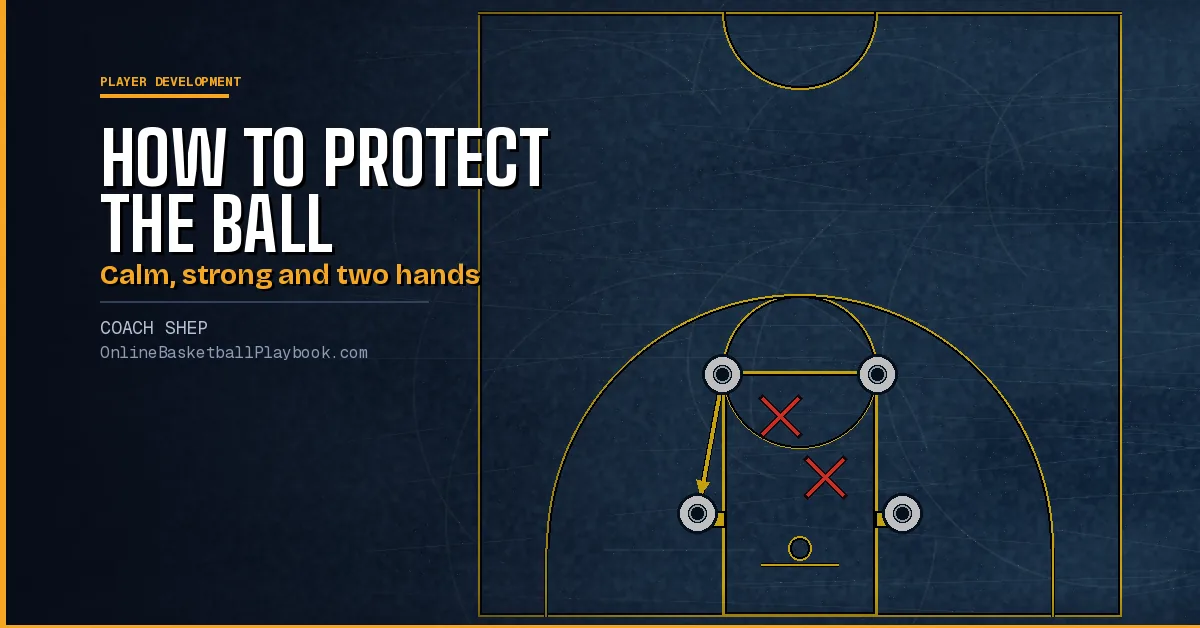
How to Protect the Ball: Ball Security and Fewer Turnovers
How to protect the ball in basketball: where turnovers come from, ripping and catching, the sure pass, beating a trap, ball security drills and pricing turnovers.
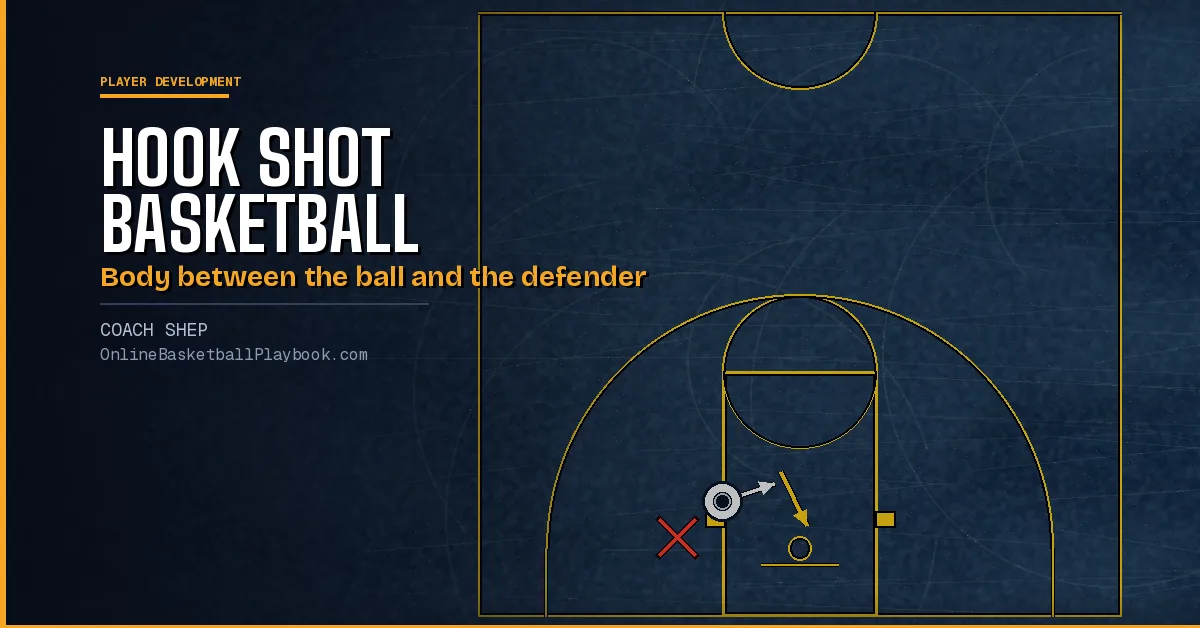
Hook Shot Basketball: How to Do It and How to Teach It
Hook shot basketball for post players and coaches: the classic hook, sky hook and jump hook, the footwork steps, when to use it, the pivot foot rules and drills.