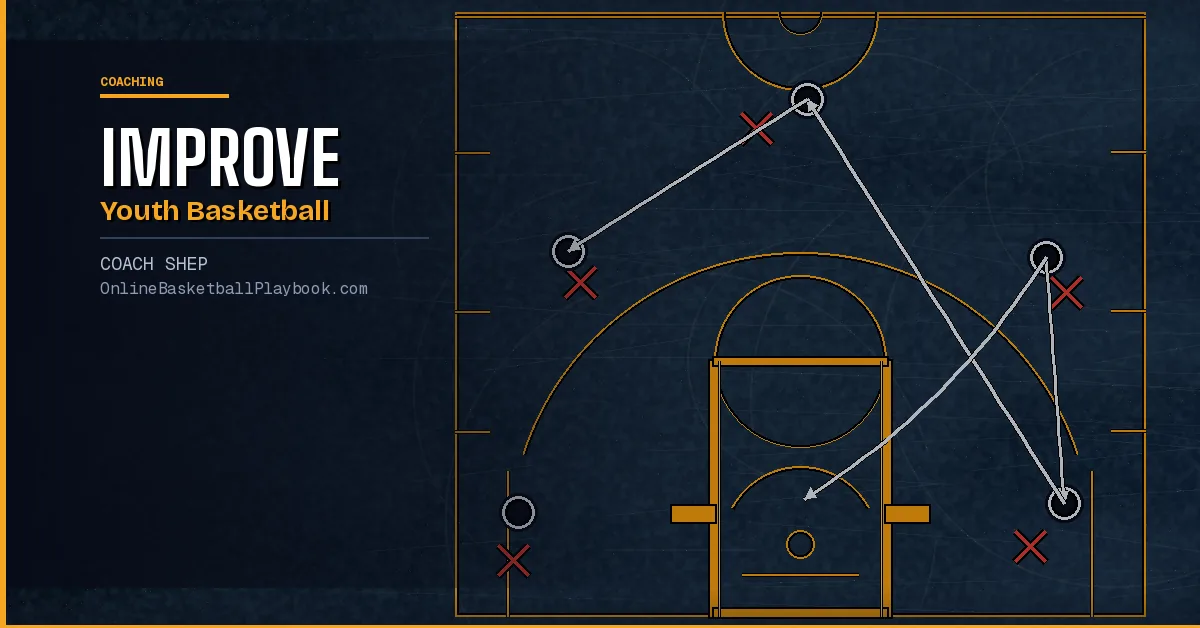
Most youth basketball programs focus on winning. The programs that actually develop players focus on something harder: making every kid better, keeping them engaged, and building a culture they want to return to next season.
Redefine What Success Means for Young Players
The most common mistake in youth basketball isn't a bad drill or a weak play call. It's measuring success by wins and losses before players have the skill base to compete meaningfully. When a coach defines success as "we went 8-2 this season," most players on that team may finish the year without a single personal milestone they can point to.
The better benchmark: at the end of your season, did every player improve one specific, measurable skill? And do they want to come back next year?
Those two questions strip away the noise. A kid who couldn't dribble without staring at the ball in September and can now push it up the court with their head up. That's a successful season, regardless of the team's record. A player who dreaded practice by November and didn't register for the spring session. That's a coaching problem worth diagnosing, no matter how many games the team won.
Redefining success this way changes how you run practice, how you give feedback, and how you set team goals. It also changes what you say to parents before the season starts, which matters more than most coaches realize.
For youth programs specifically, the greatest indicator of long-term success is retention. Players who come back compound their development year over year. Players who quit early (often because they never felt successful, didn't feel safe making mistakes, or stopped having fun) are a net loss that no win-loss record compensates for.
Structure Every Practice Around the Right Priorities
Planning is the single highest-leverage variable in youth basketball practice. A well-planned 60-minute session beats an unplanned 90-minute session every time, especially with younger players whose attention windows are short and whose energy burns fast and uneven.
The basic framework that works across age groups looks like this: 10 minutes of warm-up and movement work, 30 to 40 minutes of skill development delivered through structured games and drills, 10 to 15 minutes of small-sided scrimmage that puts the skill in a live context, and a brief cool-down with feedback and a positive close.
A few rules that make this structure work in practice:
New skills go first, not last
Attention and processing are highest at the start of practice. If you save the hardest technical skill for the end of the session (after kids have been running for 45 minutes), the lesson won't land. Introduce new concepts or corrections in the first 15 minutes, then reinforce them through games and scrimmage later in the session.
Keep every player moving
Long lines where most of the team stands waiting are the enemy of youth practice. The goal is a ball in every kid's hands as much as possible. Pair drills, small groups, and station formats keep everyone active and get more repetitions in the same amount of time.
Load one drill instead of switching constantly
Rather than running five separate drills in a session, take one drill and layer in complexity: start with the basic version, then add a constraint, then add light defense, then add a scoring element. This "loading" principle keeps players in flow, lets you read readiness before advancing, and eliminates the dead time of constantly resetting setup for a new activity.
End on a positive note, every time
The last five minutes of practice shape how players feel walking out the door. A short team huddle, a specific shout-out to something done well, and a brief preview of next session leave players energized rather than drained. Never end practice on conditioning used as punishment. It ties effort to negative associations that compound over a season.
Teach the Four Non-Negotiable Fundamentals
Youth basketball programs sometimes try to introduce too many concepts too early (zone defense reads, complicated offensive sets, position-specific footwork) before players have the physical vocabulary to absorb them. The result is confusion, frustration, and players who can't execute the basics under any pressure.
Four fundamentals cut through all of that. Build your entire teaching system around these, and everything else becomes easier to layer in later.
Ball-handling
Eyes up is the only real rule. A player who can dribble without watching the ball can see the floor, read the defense, and make decisions. For younger players (roughly grades 2 through 4), this means cone slaloms, basic right-hand and left-hand repetition, and stationary two-ball work to force the eyes up. For older youth players, add pressure defenders, two-ball combinations, and speed work so the skill holds under stress.
Passing
Passing accuracy at youth age is often underpracticed because coaches assume players will figure it out in games. They don't. Step to your target, follow through with two thumbs down, chest-level release. These need repetition in the same way shooting form does. Partner passing challenges and monkey-in-the-middle formats give players the reps they need while keeping the energy up.
Shooting
Close range first, always. The two most effective form cues for young players are "pizza waiter" (flat shooting hand under the ball, palm up like you're carrying a pizza) and "cookie jar" (reach up into the cookie jar on the follow-through, elbow above the rim). These are simple, visual, and they stick. Don't move to mid-range shooting until players can make five in a row from five feet with correct form.
Footwork and movement
The jump-stop and the pivot are the foundation of everything else. A player who can catch, jump-stop, and pivot under control has a body that can be coached. Add the triple-threat position, teach spacing concepts (stay four to five feet apart, cut to the basket, move on ball movement), and you have the building blocks of any offense. These don't need to be taught as advanced concepts. They can be introduced through games at any age.
The same four fundamentals apply across all age groups. What shifts is the drill vehicle, not the skill itself.
Build Culture Before the First Game
Culture isn't a speech you give once at the start of the season. It's what you repeat and what you allow every single practice. Programs that build strong culture do it through consistent small habits, not occasional team meetings.
The most effective culture-building tools are deceptively simple:
A team code of three words or a short phrase. Give the team something brief they can own and repeat. It should reflect how they want to play and how they want to treat each other. Reference it at the start of practice, during timeouts, and at the end of games. Repetition is what makes a phrase real rather than decorative.
A focus word to open every practice. Pick one word (effort, communication, spacing, compete) and frame the entire session around it. It gives players something concrete to think about when execution breaks down.
A shout-out circle to close every practice. Before players leave, they recognize one teammate for something specific. Not "good job today." Something real: "Marcus boxed out twice when he didn't have to" or "Jaylen kept talking on defense the whole scrimmage." This habit builds attention to teammates, positive reinforcement, and team identity over a season.
Rotating practice captains. Let different players lead a drill segment each practice. Ownership and responsibility accelerate development in ways that passive participation doesn't. Even a 9-year-old rises to the moment when given a leadership role with clear expectations.
Manage Parents Like a Coaching Fundamental
Parent dynamics are the most underestimated variable in youth basketball. A program can have excellent practice plans, skilled coaches, and motivated players, and still lose players mid-season because parent friction eroded the experience. Proactive parent management prevents most of it.
Hold a parent meeting or send a detailed written letter before the first practice. Cover four things: your playing-time philosophy and how decisions get made, game-day behavior expectations, the communication chain and how concerns should be raised, and how parents can actively support the team culture rather than just observe it.
Two specific rules worth implementing program-wide:
The 24-hour rule. No playing-time discussions on game day or within 24 hours of a game. This single boundary protects a coach's composure and the team's focus more than almost any other policy. When coaches enforce it consistently across every coach on a staff, parents learn quickly that it's real.
All concerns go through the head coach. When programs have multiple coaches, parents sometimes shop concerns to whoever they think will be sympathetic. A clear communication chain (all issues come to the head coach first) prevents this from fracturing staff relationships and creating inconsistent responses.
For older youth players (roughly 11 and up), involve the player directly in any significant discussion about their role. Part of development at that age is learning to advocate for themselves and ask questions. A parent meeting without the player present can undercut that growth.
Invite parents to be part of the culture, not just spectators of it. When parents understand what you're building (skill growth, retention, confidence, love of the game), most of them become allies rather than critics. The ones who push back hardest on these values usually came in with a different definition of success, which is exactly why the first meeting matters so much.
Track Progress Instead of Just Keeping Score
Youth coaches who track skill development, even informally, produce better players than coaches who rely on game performance alone to measure growth. The reason is simple: game performance is too noisy at young ages. A player can have a statistically poor game because of matchup, foul trouble, or team context, but still be developing at an excellent rate. And a player can look fine in a winning game while building bad habits that will cost them in two years.
Pick three to five specific skills to track across a season. Layup percentage with both hands. Passing accuracy under pressure. Defensive stance hold for five seconds. Free throw form check using consistent criteria. Grade each player on a simple yes/no or 1-to-5 scale every few weeks, and look for individual improvement trajectories, not just rankings.
Player self-assessments every two to three weeks add a layer that coaches alone can't provide. Ask players to answer three questions: What's one thing I've improved since last month? What am I still working on? How have I helped the team? The answers tell you what players are actually thinking about, where confidence is low, and where a short individual conversation might unlock a breakthrough.
End-of-season individual conversations are the highest-return investment a youth coach can make. Three to five minutes per player: what they improved, something you genuinely appreciated about how they competed, and one clear challenge for next year. Most players remember this conversation for years. It reinforces that the coach saw them as an individual, not just a piece of a roster. And it plants the seed for next season before the offseason even starts.
- Use "pizza waiter" and "cookie jar" cues for shooting form: Simple visual anchors that young players can self-correct without a coach prompting them every rep.
- Run the 4:1 practice-to-game ratio for ages 9–12: Canada Basketball's benchmark keeps trainable reps high and prevents scoreboard-chasing from compressing skill development time.
- Shout praise, whisper criticism: The communication rule that youth coaches most consistently reverse. Correcting loudly in front of peers kills the willingness to experiment and try new skills.
- Keep drill time to 3–5 minutes each: Short, scored, purposeful blocks with a ball in every player's hands maintain engagement and multiply reps across the full session.
- Write the season goal as skill improvement plus retention: Not a win target. Check both at the end of the year to know if the program actually worked.
Want more basketball coaching strategies and drills?
Join the Online Basketball Playbook newsletter →
Draw this play free in the play drawer →
Membership: the full library, playbook packs, and Pro drawing tools →
Keep Building
Related breakdowns
Basketball Fundraising Ideas for Youth and School Programs
Every basketball program eventually needs to raise money beyond what parents can cover. Here's a breakdown of product, event, service, sponsorship, and digital fundraisers, and how to pick the right mix.
Coaching Youth Basketball: Practices, Games and Parents
Coaching youth basketball for ages 6 to 14, with practice shapes by age, skills taught inside games, man-to-man defense, playing time, feedback and parent meetings.
Program Culture Case Studies: Four Programs, Four Models
Program culture case studies from Obradovic, Dean Smith, Kelvin Sampson and John Beilein: the rules, routines and enforcement each one used, side by side.