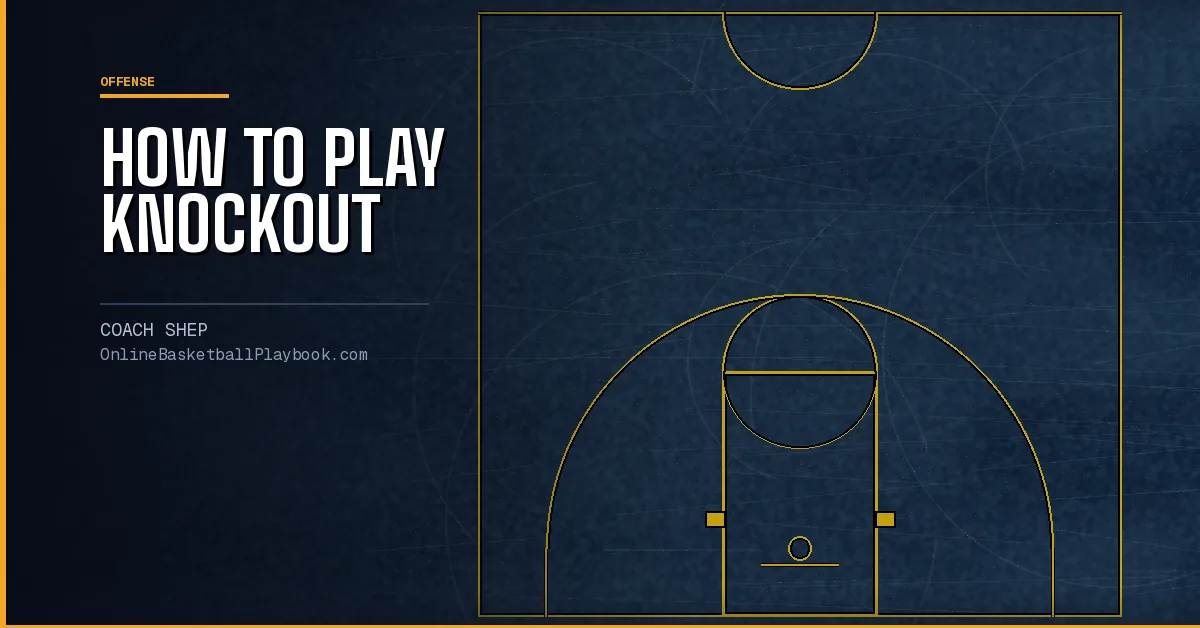
Knockout is one of the most popular warm-up games in basketball, and for good reason. It turns standing in a line waiting to shoot into a fast-paced, competitive elimination contest. Players line up at the free-throw line with two basketballs in play at once, and the goal is simple: make your shot before the player behind you makes theirs. Miss that race, and you're out. It's simple enough for a first practice of the season and intense enough that varsity players still get fired up over it.
Setup: What You Need
Knockout requires almost nothing to set up, which is part of why it's a go-to warm-up. All you need is one basket, a line of players, and two basketballs.
Have every player line up single file behind the free-throw line, facing the basket. The first two players in line each hold a ball. That's it. No cones, no extra equipment, no explanation beyond the rules themselves. Coaches can run this from the free-throw line for a shooting-heavy version, or move the line closer for a version that emphasizes quick post moves and putbacks.
Basic Rules, Step by Step
The rules are easy to teach in under a minute, but the pace of play is what makes it fun. Here's the sequence:
Player 1 (front of the line) shoots first. As soon as Player 1's shot is in the air, Player 2 can shoot their ball. Player 2 does not have to wait for Player 1's shot to land.
If Player 1 makes the shot, they pass the ball back to Player 3 (or wherever the line dictates) and go to the back of the line. If Player 1 misses, they must rebound their own ball and can shoot again from anywhere on the floor: layup, put-back, whatever gets it in fastest.
The race is simple: Player 1 has to make a shot before Player 2 makes theirs. If Player 2's shot goes in first, Player 1 is knocked out of the game and steps aside. If Player 1 makes their shot first, they're safe, and now it's a race between Player 2 and Player 3.
Play continues down the line this way until only one player remains (the winner).
How Players Advance Through the Line
Once a player makes their shot and survives their turn, they pass the ball to the next player waiting in line and jog to the back. This keeps the line moving and every ball in constant use. There's rarely a moment where a player is standing around with nothing to do.
Players who get knocked out step to the side. Depending on the coach's preference, eliminated players can rebound and pass out to keep the group organized, or just watch and cheer on the survivors. Either way, the game keeps compressing until it's down to a final head-to-head matchup for the win.
Common House-Rule Variations
Most coaches tweak the basic rules slightly to fit their team, gym space, or practice goals. A few of the most common variations:
Shot-type restrictions: Require a specific shot on the miss-recovery (for example, "make it must be a layup" or "no threes allowed") to control pace or emphasize a particular skill.
No offensive rebounding: Some coaches don't allow a player to rebound their own miss and shoot again; instead, a miss is an automatic elimination unless the next shooter also misses. This speeds the game up dramatically and rewards first-shot accuracy.
Sudden-death final round: Once the game gets down to the last three or four players, switch to a stricter rule (one miss and you're out, no rebounding) to create a tense finish everyone in the gym is watching.
Must-make-two variation: For older or more advanced players, require the shooter to make two shots in a row to eliminate the player behind them, which rewards streaky hot shooting and adds pressure to the second attempt.
Coaching Tip: If Knockout is dragging on too long with a big group, don't change the rules mid-game. Instead, shorten the line by splitting into two separate games at two baskets. A 15-player line takes forever to resolve. Two 7-8 player lines finish twice as fast and double the number of competitive reps each player gets.
Why Knockout Works as a Warm-Up
Knockout isn't just a fun way to kill five minutes before practice. It does real developmental work. Because a miss puts a player under immediate pressure to recover and shoot again, it trains the instinct to crash the offensive glass and finish a putback under duress, which rarely gets practiced in a standard shooting line.
The elimination format also builds pressure shooting. Players have to make a shot knowing the player behind them is one make away from knocking them out. That's a small taste of late-game free-throw pressure, delivered in a low-stakes warm-up setting where mistakes cost nothing but pride.
It also gets players mentally locked in before practice starts. A silent, half-awake shooting line doesn't wake a team up. A line where players are shouting, racing, and getting eliminated does. Knockout is genuinely competitive, and that competitive energy tends to carry into the rest of practice.
Coaching Tips for Running It with a Big Roster
Knockout scales well, but a few adjustments keep it efficient with a large group instead of turning it into a long line of standing around.
Run multiple lines at multiple baskets whenever the gym allows it. Splitting a 16-player roster into four lines of four means far more shots per player in the same amount of time, and you can run a mini-tournament where basket winners face off.
Set a time cap. Knockout can occasionally run long if players keep missing and recovering. Give each line a hard time limit (three to five minutes is typical) and whoever's left standing when time expires is declared the winner, or the top two survivors face off in a quick tiebreaker.
Use it as a transition activity, not a time-filler. Knockout works best as the bridge between arrival and the start of structured practice. It gets bodies moving and competitive juices flowing without needing much coaching oversight, which frees you up to set up the next drill.
- Line up at the free-throw line with two balls in play. No other equipment needed.
- Player 2 can shoot as soon as Player 1's shot is in the air, not after it lands.
- A miss means rebound-and-shoot-again from anywhere; getting beaten to a make means elimination.
- Common variations: shot-type restrictions, no-rebound misses, sudden-death final round, make-two-in-a-row.
- Split into multiple lines at multiple baskets for large rosters to maximize reps.
- Cap the time to keep the game from dragging when a line is slow to eliminate players.
Get free play diagrams, drills, and coaching guides delivered to your inbox.
Draw this play free in the play drawer →
Membership: the full library, playbook packs, and Pro drawing tools →
Keep Building
Related breakdowns
Basketball Quick Hitters: 25 Sets by Action and Formation
Basketball quick hitters sorted by the action you want, catch-and-shoot to post feed, with each set's formation, diagrams, the read and the counter.
Princeton Offense Drills: Breakdowns, Shooting and Live Reps
Princeton offense drills that teach the reads: spacing, backdoor and hand-off breakdowns, 3-0 Chin and wave drills, Point shooting, a drive drill and an install.
Four Corners Offense Basketball: Roles, Rules and Versions
Four corners offense basketball: the set, the chaser, the corner and post rules, three versions, when to run it, the shots it hunts and shot clock limits by level.