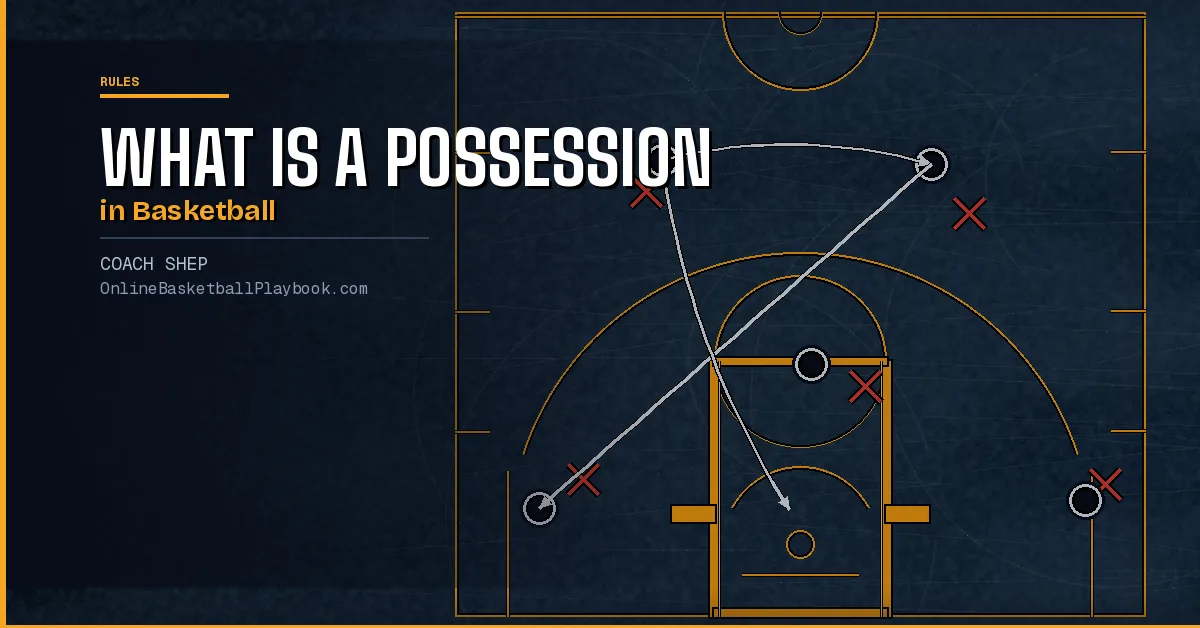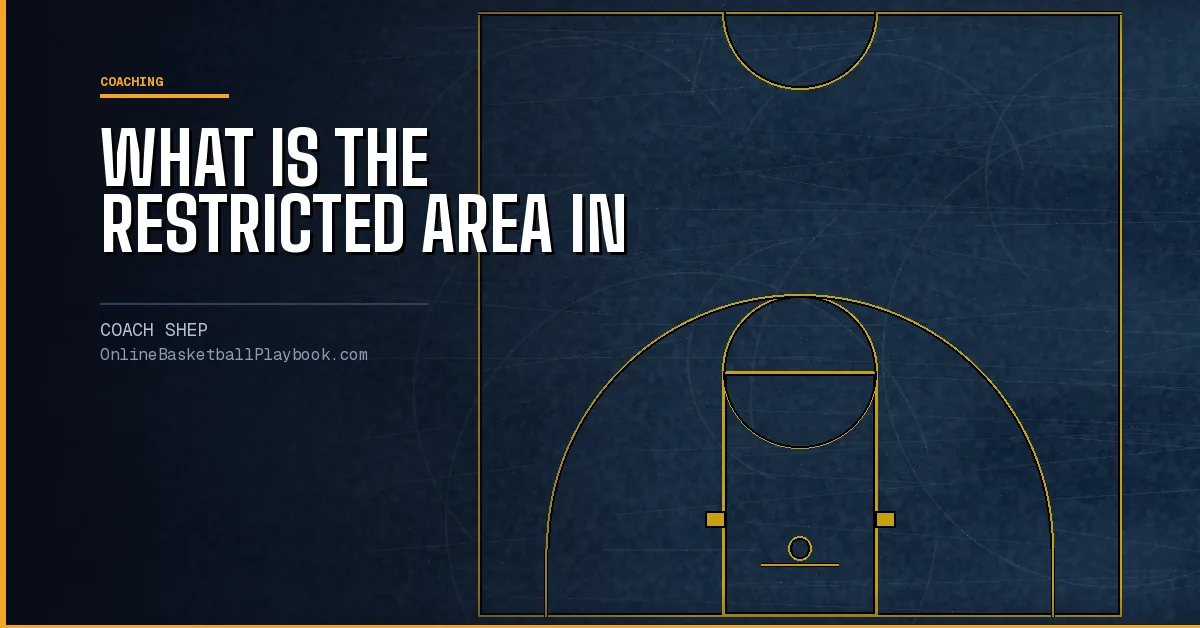
The restricted area is a semicircle painted on the floor directly under the basket. Any defender whose feet are inside that arc when contact occurs with a driving offensive player cannot draw a charge, no matter how early they got there or how legally they were set. It's one of the few basketball rules that removes judgment from the officials' hands almost entirely: feet in the arc means a blocking foul, full stop.
Why the Restricted Area Rule Exists
Before the restricted area existed, defenders learned they could plant themselves directly under the rim and simply wait. A driving player attacking the basket had nowhere to go. Any contact near the front of the rim could be called a charge, and defenders had every incentive to turn the highest-value scoring area on the floor into a trap. The rule was introduced to remove that incentive entirely.
The restricted area protects the offensive player in the most physically dangerous part of the court. A collision at full speed near the rim, with a player often airborne, carries real injury risk for both players, but especially for the one committed to a shot attempt with no ability to redirect their body. Taking away the charge option inside the arc discourages defenders from standing there and absorbing hits, and it encourages them to defend the shot instead of the collision.
It also cleans up one of the most inconsistent judgment calls in the sport. "Who got there first" is genuinely hard to officiate at full speed, especially in a scrum of bodies under the rim. The restricted area gives officials one objective checkpoint (feet location) that resolves the entire question before timing and positioning even come into it.
The Size and Shape of the Arc
In the NBA, the restricted area is a semicircle with a 4-foot radius measured from the center of the basket, extending out to the free-throw lane. That measurement has been part of the NBA rulebook for years and is the most commonly cited version of the rule.
At the college and high school levels, the arc is typically smaller, commonly cited around a 3-foot radius, though the exact number and even whether a given level uses a restricted-area arc at all can vary by governing body and has shifted over time as different levels have adopted or adjusted the rule. Always check your specific league or association's current rulebook rather than assuming the NBA number applies everywhere. If you coach across multiple levels (say, a high school program with a middle school feeder) don't assume the arc painted on one court matches the other.
Physically, the arc is usually painted directly on the floor, so players and coaches can see it in real time. Unlike some judgment-based rules, this one has a visible boundary. That's part of the point. A rule this consequential needed a line players could actually see and learn, not just a verbal standard.
How Officials Determine Feet In vs. Out
The restricted area rule is decided entirely by foot position at the moment of contact, not by where the defender's body, arms, or torso are. An official is watching one thing. Are both of the defender's feet outside the painted arc when the collision happens?
If a defender has established a legal guarding position with both feet outside the arc, and the offensive player then drives into them, the restricted area does not apply. The play reverts to the standard charge/block analysis (timing, legal position, who initiated contact). The restricted area only overrides that analysis when the defender's feet are inside the line.
Officials are trained to check feet first, before evaluating anything else about the play. That sequencing matters. If the feet are in the arc, nothing else about the defender's position (how early they got there, how squared up they were, how still they held) changes the outcome. It's an automatic blocking foul regardless of how "correct" the defense looked otherwise.
This is also why officiating crews position themselves to get a clear look at the restricted area specifically on drives to the rim. It's often the calibration point of the whole possession, and a missed read on feet position is one of the more common disputed calls in the sport.
What Happens With a Defender Partially in the Arc
A defender doesn't need both feet fully inside the arc to lose the ability to draw a charge. If any part of either foot is touching the arc line or the space inside it at the moment of contact, that defender is considered inside the restricted area for purposes of the call.
In practice, this means a defender who is retreating toward the basket as a ball handler drives (and plants with even one foot clipping the line) has not given themselves a legal charge opportunity. The whistle goes to the defense for a blocking foul, even if the contact looks clean and even if the defender was otherwise doing everything right.
This is one of the more common misunderstandings among younger players and even some coaches: the instinct is to think of the restricted area as an all-or-nothing zone, when in reality it only takes a toe on the line to void the charge.
The Restricted Area and Legal Verticality
The restricted area rule stops a defender from drawing a charge inside the arc, but it does not stop a defender from contesting the shot. This is a distinction that gets lost constantly, including at the coaching level. Being inside the restricted area does not mean a defender has to give up on the play.
A defender with feet inside the arc can still jump straight up (legal verticality) to contest a shot without fouling. If the offensive player initiates contact with a defender who jumped straight up within their own vertical space, and that defender didn't lean in, extend outward, or otherwise leave their cylinder of space, that's frequently a no-call or even an offensive foul on the shooter, restricted area or not.
The restricted area rule and legal verticality answer two different questions. Restricted area asks: "can this defender draw a charge?" Verticality asks: "did this defender foul while contesting the shot?" A defender standing in the restricted area loses the answer to the first question, but they can still win the second one by jumping straight up and staying within their own space.
Where defenders get in trouble inside the arc is when they drift into the shooter rather than going straight up, or extend their arms or hips into the shooter's landing space. That's a foul regardless of restricted-area status. The arc doesn't create it, poor verticality does.
Coaching Implications: Where to Teach Post Position
For coaches, the restricted area should shape where you teach post defenders and help defenders to actually plant their feet. Any defensive scheme that relies on "standing under the rim and absorbing contact" is teaching your players to draw blocking fouls, not charges. That's a wasted possession and a defender in early foul trouble.
If you want your team to draw charges on drives to the rim, teach the legal position spot to be outside the restricted area, generally a step or two further out than players instinctively want to go. The instinct for a help defender rotating over is to get as close to the rim as possible; the correct habit is to get to a legal spot with feet clearly outside the arc, square up, and hold.
For post defenders specifically, teach verticality as the primary rim-protection tool rather than positioning for contact. A shot-blocker who jumps straight up inside the restricted area is playing within the rules and protecting the rim; a defender camped under the basket hoping for a collision is giving away a foul on nearly every drive.
Common Mistakes Players and Coaches Make
The most common on-court mistake is a help defender rotating late, retreating toward the rim to cut off a drive, and planting right as they cross into the arc, turning what would have been a great habit (help defense, early rotation) into an automatic blocking foul because the feet landed a few inches too far in.
The most common coaching mistake is treating the restricted area as a minor technicality instead of building it into practice reps. If defenders only ever practice charge-taking in isolation, without a painted arc on the practice floor, they never build the spatial awareness to know where the line actually is under game speed.
The most common misunderstanding among parents and casual fans is thinking the restricted area means "no fouls can happen near the rim." It means the opposite in one specific way. It makes blocking fouls more likely there, not less, while leaving verticality and legal shot contests completely intact.
- Feet decide it, nothing else. Arms, torso, and timing don't matter once you're checking the restricted area, only where the defender's feet are at contact.
- One toe on the line still counts as in. Teach defenders to stop with real margin, not right up against the arc.
- Verticality still works inside the arc. A defender can't draw a charge there, but they can still legally contest a shot by going straight up.
- Check your level's actual rulebook. NBA is 4 feet. High school and college are typically smaller. Don't assume one number applies everywhere.
- Teach the spot, not just the concept. Have players physically stand on the line in practice so they know where it is under real speed.
- Camping under the rim is a losing habit. Any scheme built on absorbing contact in the restricted area is trading a live rim-protection possession for a cheap foul.
Get free play diagrams, drills, and coaching guides delivered to your inbox.
Draw this play free in the play drawer →
Membership: the full library, playbook packs, and Pro drawing tools →
Keep Building
Related breakdowns
Basketball Positions: What Each of the 5 Positions Does
The point guard, shooting guard, small forward, power forward and center, what each one does on offense and defense, and when to ignore the numbers.
High School vs College vs NBA Rules: What Changes for a Coach
High school vs college vs NBA rules: shot clock, three-point line, bonus, fouling out, timeouts, backcourt count and defensive three seconds, and what each changes.