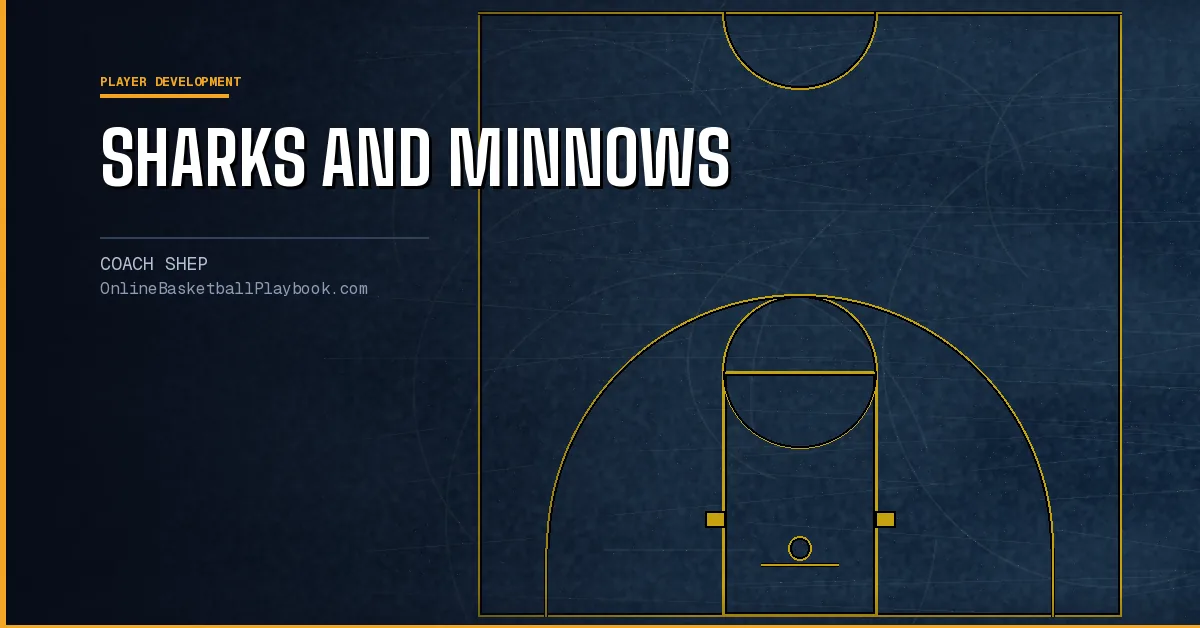
Sharks and Minnows is a dribbling-based tag game that turns basic ball-handling into a full-team competition. Every player who has a ball is a "minnow" trying to dribble safely from one baseline to the other, while one or two "sharks" stationed in the middle try to knock the ball away or force a mistake. It plays like recess, but it drills the exact skills coaches spend practice time chasing: ball protection, changing speed, and keeping the head up under pressure.
The Setup
Sharks and Minnows needs nothing more than a full court and a ball for most of the group. Pick one or two players to start as "sharks." They stand without a ball somewhere in the middle of the court, between the two baselines. Every other player is a "minnow". Each one gets their own basketball and lines up along one baseline, facing the open floor.
That is the entire setup. No cones, no extra equipment, and no explanation beyond "sharks are in the middle, minnows have a ball and start on the line." Because the setup takes under a minute, it is one of the easiest games to drop into a practice when you need a change of pace or a quick energy reset between drills.
Basic Rules
On the coach's signal, every minnow dribbles from their baseline toward the opposite one. The sharks move through the middle of the court trying to knock a minnow's ball away or pressure them into losing control of their dribble. A minnow is not allowed to just run past. They have to keep dribbling the whole way across.
If a shark knocks a minnow's ball loose, or if a minnow picks the ball up (a travel, a double dribble, or simply grabbing it to protect it), that player is out as a minnow. They leave their ball at the sideline and become a shark for the next round. Any minnow who makes it across the far baseline without losing their dribble is safe and gets to run it back the next round as a minnow again.
How the Game Escalates
The game gets harder every round by design. Each time a minnow loses their ball, they join the sharks for the next crossing. That means round one might have two sharks and eighteen minnows, but by round four or five the numbers can be nearly even, or even flipped, with more sharks than minnows left.
Play continues, round after round, until only one or two minnows remain uncaught. Those final survivors are usually working through a gauntlet of five, six, or more sharks converging on them at once, which makes for a natural, high-energy finish that the whole group ends up watching and cheering for.
Why It Works as a Ball-Handling Drill
Underneath the game format, Sharks and Minnows is asking players to do exactly what a coach wants from live ball-handling reps: protect the ball with your body, keep your head up to see defenders coming from multiple angles, and change speed or direction the instant real pressure shows up. A cone drill can teach the mechanics of a crossover, but it cannot replicate a defender closing from an unpredictable angle. This game can, over and over, every round.
Because the pressure is unscripted, players cannot rely on a memorized move. They have to actually read where the danger is coming from and react, which is the skill that separates a player who looks good in isolated drills from one who can actually protect the ball in a game.
The other advantage is buy-in. Players who might coast through a repetitive ball-handling drill will sprint, cut, and fight to protect their dribble in Sharks and Minnows because it feels like a game, not a chore. Elimination raises the stakes without the coach having to manufacture urgency. The format does it automatically.
Common Variations
Once the base game is established, a few simple constraints can shift what it emphasizes without changing the setup at all.
Weak-hand only: Minnows may only dribble with their non-dominant hand. This isolates weak-hand ball-handling under pressure, which is exactly the situation most players avoid in games.
Crossover-only moves: Minnows must use a crossover (or a specific move the team is working on) any time a shark closes within a few feet. This turns the game into a live rep of whatever move is currently being taught.
Timed rounds: Instead of full elimination, run each crossing on a clock. Anyone who still has their dribble when time expires is safe, win or lose. This keeps larger groups moving without long waits for stragglers and avoids one player being stuck as the last minnow for several rounds in a row.
Coaching Tips for Running It Safely
With a full team on the floor at once, collisions are the main risk to manage. Set a clear width for the playing area. Sideline to sideline is usually too wide for a large group, so consider narrowing the boundaries with visible lines or cones if the roster is large.
Keep the shark count reasonable in the early rounds. Starting with too many sharks ends the game before minnows get meaningful reps. One shark per eight to ten minnows is a reasonable starting ratio, adjusted up as the group thins out.
Remind players before the first round that this is a knock-away game, not a football tackle, hands on the ball only, no grabbing, no barreling into another player's space. A thirty-second reminder up front prevents most of the physical-play problems that show up once the game gets competitive.
- One or two sharks start in the middle, no ball: every other player is a minnow with their own basketball on the baseline.
- Minnows dribble baseline to baseline on the signal: losing the dribble or picking up the ball turns that player into a shark.
- Numbers flip every round: more sharks join each crossing until only one or two minnows survive.
- Constrain the move, not the game, for skill focus: weak-hand only or crossover-only turns this into a live rep of a specific skill.
- Use timed rounds for large groups: avoids long waits and keeps everyone moving instead of full elimination every time.
- Set boundaries and a no-grabbing rule up front: a crowded middle with a full team needs clear space and light contact only.
Get free play diagrams, drills, and coaching guides delivered to your inbox.
Draw this play free in the play drawer →
Membership: the full library, playbook packs, and Pro drawing tools →
Keep Building
Related breakdowns
Youth Basketball Dribbling Drills: Cone Drills and Games by Age
Youth basketball dribbling drills for kids: finger-pad work, eyes-up games, cone dribbling drills, line drills and harder drills by age.
Basketball Dribbling Drills: Beginner to Advanced
Basketball dribbling drills from beginner to advanced. Stationary series, moving drills, two-ball work and pressure drills, with how to run each block.
Basketball Drills for 12 Year Olds: Dribbling, Passing and Games
Basketball dribbling drills for 12 year olds, passing and cutting drills, decision games and a 90-minute practice, all written for players this age.