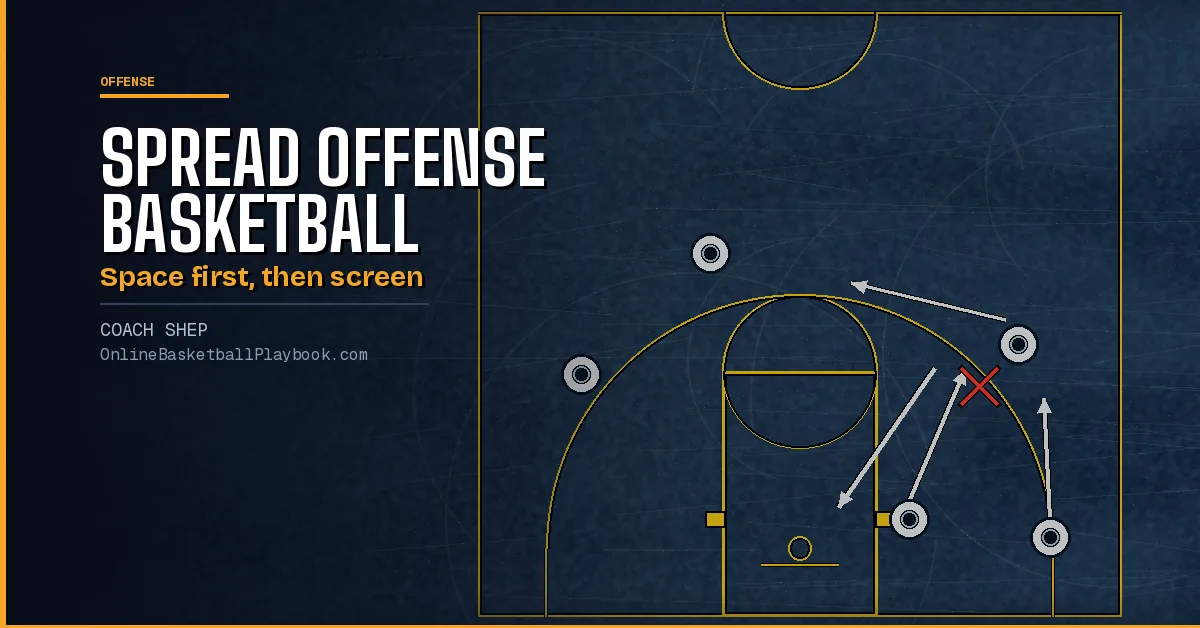
Spread offense basketball is not one offense. Several different systems carry the name, and what they share is the first step: spread all five players wide before anything else happens, so every player has his own gap and the middle of the floor stays open. Billy Donovan's Florida offense is the most fully documented system, a spread pick and roll in which the ball screen is the system itself and not a called play.
Other systems run a two-big pick-and-roll continuity, a 3-2 alignment with no post, a 2-1-2 spread built to beat traps, and a 5-out spread used to hold the ball late in games. This spread offense basketball guide sorts out which is which, then covers the alignments, the spacing rules, the reads and the personnel each system asks for. It sits in the offense section with the other systems.
What Spread Offense Means
The word spread names at least five offenses, so ask which one a coach means. Billy Donovan's Florida spread pick and roll is the one this page teaches in full, because it has the most detail.
- Spread the floor. It starts from 1-4 High or 4 Flat, with every player in his own gap.
- Run the pick and roll. The ball screen is the whole offense, early and in the half court, and not a called play.
The other four systems use the word spread for different jobs: a two-big spread pick and roll (Brad Stevens at Butler), a 3-2 no-post spread, a 2-1-2 spread against traps and a spread delay. They get their own sections below. Write the job next to the name.
Spacing Comes First
Donovan puts it plainly: everything the offense does is based on spacing. He adds the spacing of the pick and roll itself and wants players to start very spread out, with every player in his own gap and nobody clustering. Without that spacing, a pick and roll is just a bad screen. The general case for spacing, the gaps between defenders and how coaches measure distance, is on what is spacing in basketball.
Spacing only helps if the spacers can shoot. In Željko Obradović's spread pick and roll, the answer to a switch requires the corners near the line and every perimeter player able to shoot the three. Donovan asks the same of the bigs: a big who pops to the arc punishes a switch, and a big who rolls punishes a defense that does not switch. Spread first, then screen.
The Florida Spread Pick and Roll in Brief
Donovan's offense starts from one of two named alignments.
- 4 Flat. Four players spread around the arc and one post.
- 1-4 High. The two bigs start at the elbows and the guards stay wide.
Florida also draws different starts. A baseline start puts three players along the baseline with two in the slots. The flat-screen start has the guard just past half court, two guards on the wings, one big on the low block and the other big about two feet above the arc. No rule says when to call each alignment.


The offense uses two kinds of ball screen.
- Flat screen. Florida uses it to start a play or to save a late clock so the point guard can make a play. Donovan has said he likes the flat ball screen. In his flat-screen start the 4 is the flat screener, and where the point guard is being guarded decides how far the 4 comes out. The 4 must give the point guard at least one step to make a move.
- Wing screen. It is used for a roll or a pop by the screener.
Florida picks the screener from the matchups. If an opposing big has poor feet against ball screens, the player he guards sets the screen. Donovan also draws a little-to-big screen, the 1 screening for the 5, against a big who does not handle screens well. Pick the screener before the possession starts.
Spread Offense Basketball Spacing Rules
Two Donovan rules keep the floor spread while the screen happens. Both are rules, not reads.
- Same-side rule. When two players end up on the same side, one stays in the corner and the high one holds the sideline. If both drift in, the screen has nowhere to attack.
- Corner lift. When the handler uses a wing ball screen, the ball-side corner lifts into the spot he left, so four shooting spots stay filled after the drive.


The second big has a job on every screen.
- Flat screen. The low big slides to the baseline behind the backboard and the screener steps back behind the arc, so the guard can score, kick or dump the ball off.
- Perimeter screen. The other big posts on the ball-side block, and when the screener rolls, that post sprints out to catch and throw a high-low pass.
Donovan rarely wants the hard pass to the roller and prefers that high-low.
Donovan also wants the ball in the middle of the floor. He asks for the ball in the alley between the elbows, and his rule is that the ball in the middle takes away help. A player who gets the ball to the middle has done his job, and everyone else must get open.
Get the next coaching guide in your inbox
One email when a new guide or diagram set goes up. Free.
Screener and Handler Reads
Florida gives two ways to decide what the screener does, with no rule for when Donovan used which.
| Question | Read the defender | Fixed roles |
|---|---|---|
| Roll, slip or pop | The screener reads his defender's height before contact: a high hedge means slip, contain or drop means roll, a switch or sag means pop | Fixed roles: some players always roll and some always pop. A big who shoots or can drive suits the pop, a paint-only big suits the roll |
| Handler's order | Attack the rim, then the roller, then the popping screener | Rarely the roller. Hit the second big for the high-low |
| Against the switch | The screener pops, since a switched guard cannot guard a big at the arc | Attack the big who has a small man on him |
| Against a hedge or trap | Slip before the screen is set | Half blitz: turn the corner and throw back to the big. Full blitz: keep the dribble alive and play four on three |
Donovan bans a soft dribble before the pass and any pass to a guarded man. His counters for the trap, the switch and the blitz, including the pitch back to the 4 when two defenders go to the ball, are drawn on spread pick and roll offense.
The fixed-roles approach makes the guard responsible for the first read.
- Guard. He always attacks, never dribbles away from the basket, squares up in triple threat, jabs baseline to keep the defense honest and comes off the big's hip.
- Roller. He waits until the guard is completely off the screen, opens up, never turns his back on the ball and rolls diagonally to the low block.
- Popper. He also waits, sprints away with his hands up, shoots if the rotation is late and shot-fakes and drives on a hard closeout.
The full set of ball-screen reads across coaches is on pick and roll, and the coverage answers are on how to attack every ball screen coverage. Know your one job.
Running It Early
For Donovan, early offense is the same pick and roll run sooner, with the same reads, from a drag screen or a step-up screen. If the defense recovers, the team walks into 1-4 High or 4 Flat and runs it again. The transition rules, the trail pass and every entry are on the spread pick and roll page, and more on early actions is on early offense basketball.
The shot plan is short. Donovan lists four ways to get open threes: transition, dribble penetration, post kick-outs and offensive rebounds. Later, his stated goal is a three, a post feed or an action to the rim, and he does not want shots with a foot on or just inside the three-point line. Run the same reads, only sooner.
A Two-Big Spread Pick and Roll
Brad Stevens' Butler ball-screen package uses the same name for a different structure, with two bigs and three perimeter players. The point guard passes to the wing and speed-cuts away. The ball-side big sprints to set the ball screen and the weak-side big sprints to a lift spot at the top of the key.
- First look. When the lifted big catches, his first look is the rolling big.
- Trade jobs. If nothing is there, he dribbles at the next perimeter player and then sprints into the next ball screen and the first screener loops out to the lift spot, so the bigs trade jobs and the action keeps going.

It has four options off the same start:
- Weak-side lift. The weak-side big lifts high to the top of the key, as drawn above.
- Weak-side duck-in. The weak-side big ducks in hard in front of the rim, and the screener pops.
- Lift, then duck-in. The first screen looks like the weak-side lift, and on the second screen the weak-side big ducks in instead of lifting.
- Guard movement. Given only in diagrams with little text, it appears to change the guard spacing off the same two-big engine.
Run one start and change the weak-side big's job.
A 3-2 Spread With No Post
The 3-2 no-post spread is a passing continuity with three players high, two low and no post player. All five spots are interchangeable, so every player has to pass and handle the ball. The point passes to a wing and cuts to the basket, and the next player replaces him in the middle. A cutter who is not fed clears to a corner, and the corner fills the wing behind him. The cutting cue is to expect the ball late, near the basket.

Its counter for pressure is one rule: any overplayed player back-cuts at once and does not fight the denial. A ball handler whose defender overplays the passing lane has a green light to drive, kick out and clear to the opposite corner. The back-cut and pass-and-cut habits are taught on pass and cut motion offense. Everyone passes, everyone handles.
Spreads Against Traps and for the Clock
A 2-1-2 spread against traps. This early offense is built to attack traps, double teams and full or half court zone presses, not to serve as a half-court set. It puts two players high, a skilled player in the middle and two low.
- Skilled middle. The middle spot goes to a highly skilled player who can face up.
- Ball to the middle. Both baseline players back-cut.
- Ball to a baseline corner. The middle player rolls hard to the rim.
- Escape to the opposite corner. Its one escape rule: when a corner or guard is trapped, the pass goes to the opposite corner. Dribbling is only for getting out of trouble.
More on beating pressure is on press break basketball.
A spread delay. This 5-out, open-post spread is for teams without a shot clock that need to protect a lead or run out a half.
- L-cut and catch. The opposite wing L-cuts to the lane line and then cuts hard up to the top of the key and catches the pass.
- Cut through and fill. The passer cuts through to the opposite corner, and the next player rotates up to fill.
- Score on cuts. The scoring counters are a wing back cut against an overplayed L-cut, a back screen by the player who just cut through, a corner back cut at any time and a give and go.
- Hunt layups. Its coaching point is to hunt layups off the cuts, and a three is not the target shot late in a delay.
The full delay game is on basketball delay game offense. Whichever spread you run, spread the floor first.
Who a Spread Fits
Florida is specific about personnel. Donovan calls versatile bigs a requirement, and the fixed-roles approach matches the action to the big a team has: pop with a big who shoots and roll with a big who plays in the paint, and Donovan adds little to big against an opposing big who handles screens poorly. The guard has to read the screen and attack first.
Donovan builds those players in a skill block.
- Skill work before practice. It runs 30 to 40 minutes, three times a week, with every shot charted and the totals posted.
- Perimeter workout. It includes coming off an elbow screen for a pull-up.
- Post workout. The post sets the screen at the arc and rolls to the short corner or steps back for a three.
- Show the whole offense first. Players see where it is going, then each learns his role inside it.
The other spreads ask for different players.
- 3-2 no-post spread. Five players who can pass and handle.
- 2-1-2 trap spread. One skilled middle player.
- Spread delay. Patient cutters and a team that accepts a low score.
Two close relatives are dribble drive motion offense, which keeps the same empty middle but starts with a drive instead of a screen, and 5-out motion offense. The defensive side of these offenses is on how to defend spacing offenses. Match the spread to the players you have.
Want the printable playbook packs?
OBP Pro members get the premium playbook packs: the zone attack, out of bounds and practice plan PDFs, plus each new pack as it is finished. The membership page lists what is in each one. Or draw your own version free in PlayDraw.
See what OBP Pro includesQuestions Coaches Ask
What is a spread offense in basketball?
An offense that spreads all five players wide before it attacks. The most fully documented system is Billy Donovan's Florida spread pick and roll, and the name is also used for a two-big pick-and-roll continuity, a 3-2 no-post passing offense, a 2-1-2 spread against traps and a 5-out delay.
What alignments does the spread pick and roll use?
Donovan names 4 Flat, four players around the arc and one post, and 1-4 High, two bigs at the elbows with the guards wide.
Does a spread offense need a post player?
It depends on the system. The Florida spread uses one or two bigs who screen, roll or pop. The 3-2 spread has no post at all, and every player handles the ball.
What is the same-side spacing rule?
When two players end up on the same side, one stays in the corner and the high one holds the sideline, so the ball screen still has room to attack.
Is a spread offense good for a team without a shot clock?
The spread delay is built for it. It runs a 5-out L-cut pattern to control the clock and scores on back cuts and give and go cuts.
More Guides From This Batch
- Basketball Coaching Tips: Practice, Talk, Games and Parents
- Basketball Coaching Philosophy: Examples and a Template
- List of Basketball Violations: Every Violation by Level
- 131 Offense Basketball: The 1-3-1 Set vs Man and Zones
Back to Offense and every Offense page.
Keep Building
Related breakdowns
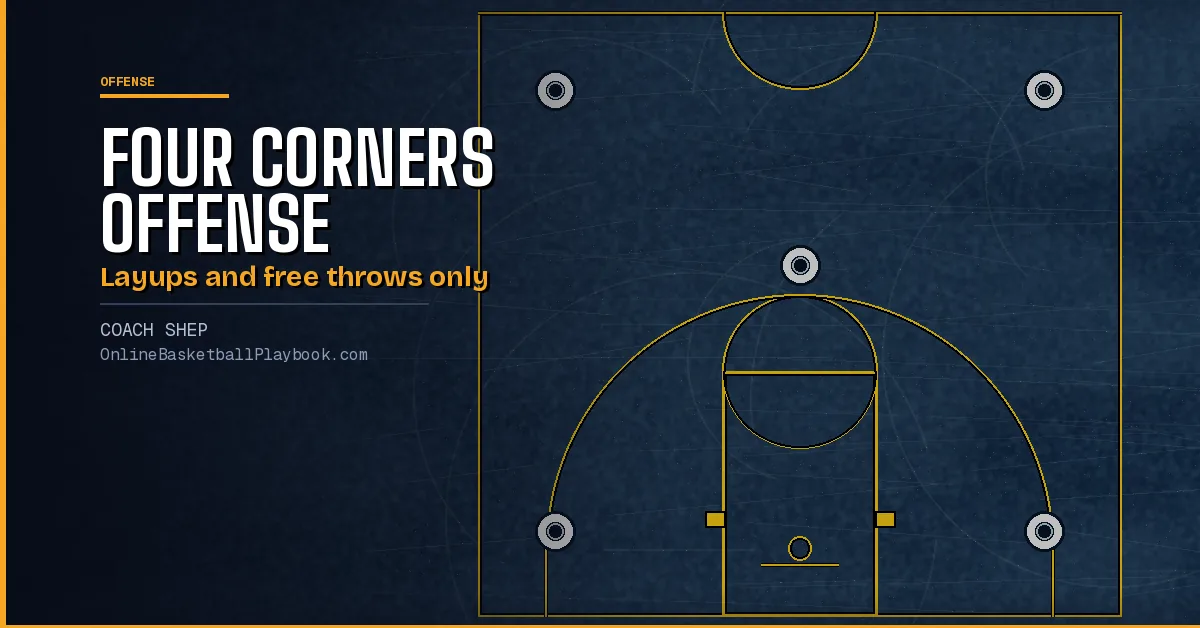
Four Corners Offense Basketball: Roles, Rules and Versions
Four corners offense basketball: the set, the chaser, the corner and post rules, three versions, when to run it, the shots it hunts and shot clock limits by level.
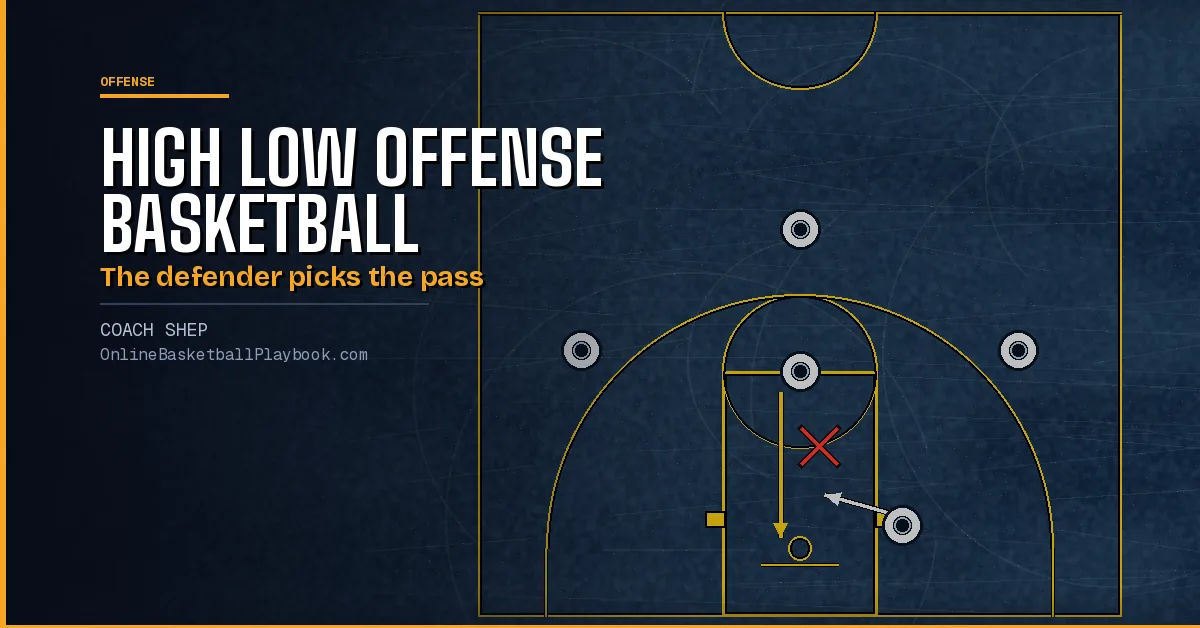
High Low Offense Basketball: Reads, Counters and Zone Rules
High low offense basketball explained: the two-post shell, the lob and bounce reads, answers to a front, down-screen reads, 1-4 low sets and the hi-lo against zones.
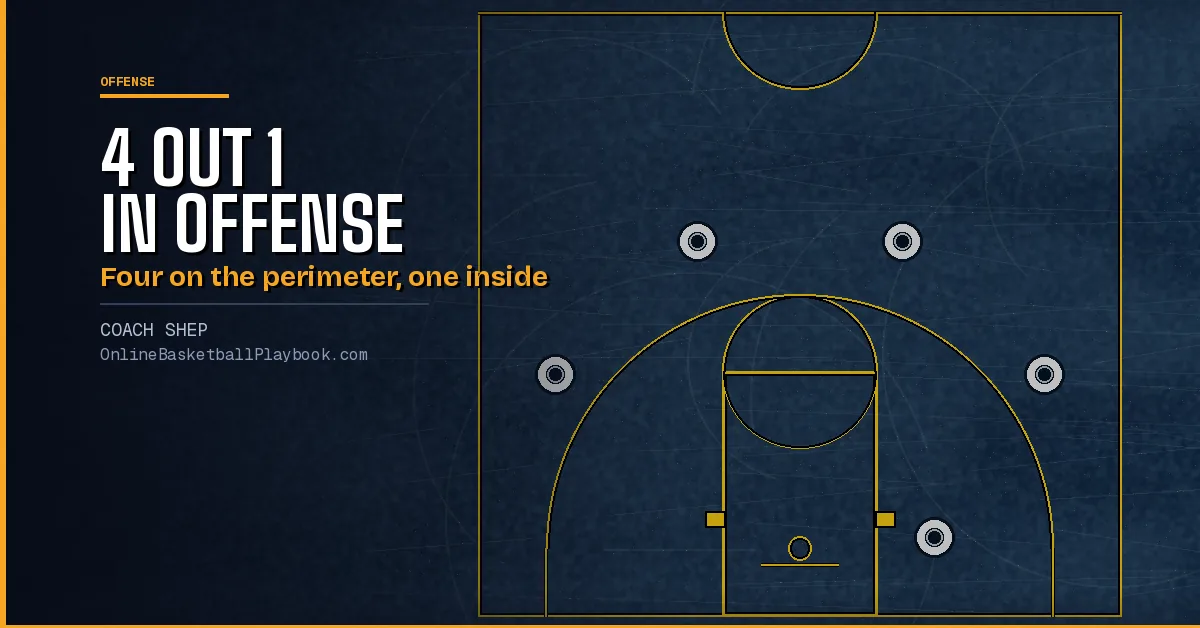
4 Out 1 In Motion Offense: Rules, Spacing and Sets
How to run the 4 out 1 in motion offense: spacing, the six rules, what the post does, pass-cut-fill, screens, quick hitters, zone adjustments and how to install it.