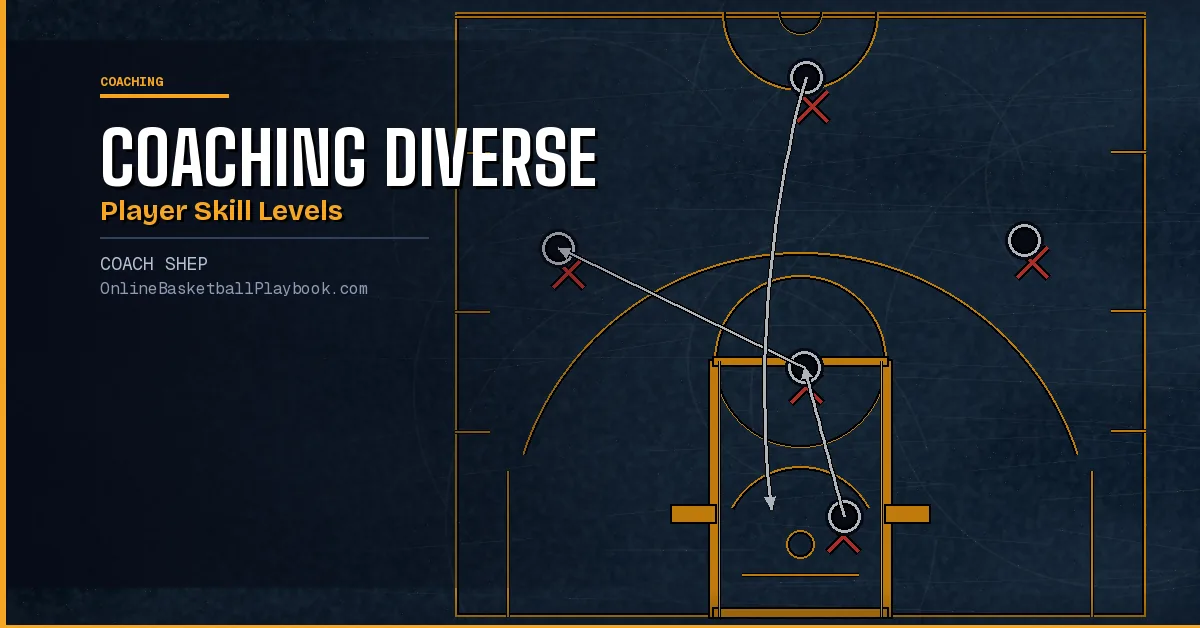
Every roster has a spread, elite handlers next to players still building their fundamentals. The coaches who develop whole teams do one thing differently: they structure practice so every player is challenged at the right level, every day.
Assess First, Then Build
Before a single drill runs, you need a working map of your roster. That means watching your players, not in a game, but in a low-stakes individual skill environment where they can't hide behind the pace. A short pre-season skill audit, even fifteen minutes of individual ball-handling and finishing, tells you things game film won't: how a player recovers balance, whether they can shoot off tired legs, and whether their dribble requires conscious attention or is automatic.
Once you have that picture, divide your roster into at minimum two tracks: players who can execute moves with no defender and players who can execute moves against live pressure. These aren't permanent labels, they're the starting point for how you structure daily reps. The goal is always to move players from track one to track two within a season.
The most common coaching mistake at this stage is skipping the assessment and organizing players by position instead of skill maturity. A 6'4" wing who can't maintain balance off a one-dribble pull-up needs track-one work regardless of what they do on film. Build the skill first, then layer in decisions.
What to Look For
Balance is the organizing skill. Watch whether players return to a sound base (feet under the shoulders, eyes up, same distance between feet on recovery) after every rep. A player who finishes a move leaning, wide, or frozen has not yet internalized the skill. That player needs the foundational battery before you add reads and live defense. Tracking this across your roster in the first week of practice shapes your entire development plan for the season.
Tiered Individual Skill Batteries
The fix for a diverse-skill roster is not one-size-fits-all drills, it is a tiered battery where the structure is identical but the complexity scales. This approach comes directly from how the best guard development programs are built: the drill progressions move from form-work, to no-defender execution, to live defensive pressure, all within the same session. Every player runs the same skeleton; the difficulty of their station is calibrated to where they are.
A practical three-tier structure looks like this. Tier one handles the foundational mechanics: jump stops, pivot foot selection, and stationary ball-handling. The two-ball battery (together, alternate, shoulder, crossover, push-pull) works well here because every player can do it simultaneously without needing a basket. Tier two adds movement: full-court ball-handling with one specific move per repetition, pull-up jumpers off a two-dribble sequence, and finishing layups using the correct foot. Tier three introduces live pressure: a passive then an active defender, the same moves, but now with a real read to make.
The critical design principle is that every player is working at their actual edge, not the team's average. Players who master tier one in a week move up. Players who need three weeks stay until it is solid. You are not slowing the team down, you are preventing the mistake of pushing players into reads before they have the underlying mechanics.
Two-Ball Handling as a Shared Starting Point
One structural advantage of two-ball battery work is that it functions as a great equalizer. Your most advanced guard and your least experienced player can both do stationary two-ball handling simultaneously. Eyes up, around the head, around the legs, behind the back. These reps don't require a basket, don't require a defender, and don't require different instructions. The challenge scales naturally: more advanced players run the non-stationary sequences at full speed to half court, changing moves on jump stops without stopping the dribble. Less advanced players slow down and focus on keeping eyes up throughout. Same drill, same practice time, two different challenge levels.
Use a Named-Move Library to Unify the Room
One of the highest-leverage things a coach can do across skill levels is create a shared vocabulary for moves. When every player on the roster uses the same names for the same actions, communication time drops, film sessions get shorter, and players begin making self-corrections without a coach present.
The approach comes from how elite programs teach: name each move after a player who made it famous. The Nash hesitation: knee up, read, pull-up or pull-back dribble pump-fake. The Parker rule: never expose yourself when the defender goes under the screen. Stop behind it and take the free pull-up instead of running past it. The Bodiroga body fake: shoulders fake, ball stays in front, hands switch. Explicitly not a crossover, so the live dribble and the shot fake stay alive simultaneously.
These names do three jobs. They credit the originating player, which builds culture. They give players a specific film-study assignment, which builds self-directed learning. And they give the coach a one-word cue on the floor instead of a two-sentence description during a drill, communication efficiency that compounds across hundreds of practice repetitions.
The practical install: introduce one named move per week of pre-season workouts. Post a short video clip of the player running the move. Let players work on it in their individual time before it shows up in the team battery. By the time you are three weeks in, even your lowest-skill players have a shared vocabulary with your most advanced guards, and that shared language accelerates learning at every tier.
Constraint Games That Level the Playing Field
Individual skill batteries develop technique. Constraint games develop decision-making under pressure, and they work across skill levels because the scoring system does the teaching rather than constant coach interruption.
The No Paint Drill is a clean example. Score one point for two feet in the paint and two points for penetrating to the charge circle. The game teaches guards when to drive and when to kick without a single lecture. A less advanced player learns the basic habit of attacking downhill. A more advanced player learns to read the closing gap and make the right second decision. The same drill, the same scoring system, two different layers of learning occurring simultaneously.
The Paint Game works similarly, scoring closeout-and-gap skill without any shots taken. Again: the scoring mechanism is the instruction. Coaches at lower skill levels tend to over-explain before players can feel what good decision-making looks like. Constraint games bypass that bottleneck entirely.
For screen reads specifically, running a two-on-two drill that requires players to read whether the defender goes over or under the screen and adjust their cut accordingly gives you the foundational off-screen read in a live context before you have to explain the concept at length. Players encounter the situation, make a choice, see the outcome, and adjust. The less advanced player builds basic read recognition. The advanced player practices the precise footwork of each option. Same environment, scaled learning.
Designing Your Own Constraint
The formula for building constraint games is straightforward: take the decision you want to teach, strip out everything that is not that decision, and build a scoring system that rewards making the right choice. You do not need elaborate setups. Two players, a half-court, and a clearly defined scoring rule is usually enough. Add defenders when the read is solid at the two-player level.
Train Reads, Not Just Moves
A mistake common in mixed-skill practices is treating skill development as purely physical, teaching the hesitation dribble without teaching when to use it. Players who only know the move will use it indiscriminately. Players who know the read will deploy it at the right moment against the right coverage.
The skeleton offense concept is the bridge between individual skill work and live team basketball. In its simplest form, it means running your offensive actions against a passive defender so players can practice the decision, go-under vs. go-over off the screen, stop and shoot vs. keep attacking off the show, without the chaos of a full five-on-five environment. The skill is already there from the battery. Now the player learns where in the offense that skill lives.
Two reads are worth teaching at every skill level from the first week. The first: come to a stop and create contact when a defender is in your path. Most players at the youth and high school level avoid contact because they have not been taught to lean on the defender and use the body as a tool. Teaching this read and making it a named action so players recognize when to apply it immediately increases how effectively your lower-skill players get to the line. The second read: hesitate off the show, attack the recovering defender. When a help defender steps up to stop penetration and then retreats, there is a window of vulnerability. Players who have learned to read that retreat instead of immediately pulling up or passing will score more efficiently regardless of where they are on the skill spectrum.
The key implementation principle: introduce reads only after the underlying move is mechanically sound. A player who cannot execute a hesitation dribble without looking at the ball should not yet be asked to read a defender coming off the screen. Sequence matters. Mechanics first, reads second, live pressure third.
Build Conditioning Into Skill Work
One of the most practical strategies for managing mixed skill levels in practice is designing drills where skill work doubles as conditioning. When a player is tired, their mechanics reveal themselves in practice. A pull-up jumper on fresh legs and a pull-up jumper on the fourth repetition of a circuit are entirely different challenges. And the second one is closer to game conditions.
The make-11 circuit is built on this principle. Players run a nine-or-ten-shot circuit off real game actions (elbow catch-and-shoot off the dribble, handoff catches, side pick-and-roll into the lane) and finish with five-spot shooting on tired legs. The target is a real shooting percentage, not a fresh-legs number. That distinction matters for developing an honest read of where each player actually is.
From a mixed-skill standpoint, the make-11 structure works because every player can participate but the quality of their execution at fatigue reveals their actual development stage. The advanced guard is reading the defense on their last two shots of the circuit. The developing guard is focused on maintaining footwork when tired. Both are being pushed. The circuit does not need to change. The players self-differentiate by what they are working on within it.
A second design principle: attach conditioning naturally to the end of skill stations rather than running them separately. Sprints after skill work, not before, keep the technical focus intact for the majority of practice while still building the physical base. Players should always finish skill work with at least partial fatigue so the mechanics are pressure-tested at the right moment.
When running a tiered practice for the first time, resist the urge to explain every tier publicly. Assign stations with individual instructions during the warmup because most players already know roughly where they are skill-wise, and quiet placement respects that without creating a public hierarchy that distracts from the work.
- Run a short pre-season skill audit before organizing practice groups: watch for balance recovery, eyes-up dribble, and shot mechanics under mild fatigue, not just game position.
- Use two-ball battery drills as your daily equalizer: stationary for developing players, full-court with move changes for advanced players, all happening simultaneously with no extra setup time.
- Introduce one named move per week during pre-season, post a film clip of the pro player for self-directed learning, then add a cue word coaches can use in practice without stopping the drill.
- Sequence every skill station mechanics first, passive-defender reads second, live defensive pressure third. Never push a player to the read stage before the underlying move is automatic.
- Attach conditioning to the end of skill stations using a make-target circuit so players always take their last few shots on tired legs. This reveals honest mechanics and matches the actual game environment.
- Choose one constraint game per week to replace a traditional lecture and let the scoring system teach the decision, then discuss after players have already felt the right choice in their body.
Want more basketball coaching strategies, drills, and tools?
Join the Online Basketball Playbook newsletter →
Draw this play free in the play drawer →
Membership: the full library, playbook packs, and Pro drawing tools →
Keep Building
Related breakdowns
Basketball Coaching Leadership: 5 Strategies That Hold Up
Basketball coaching leadership in five habits: state who your program is, keep a few standards, build culture in practice, declare roles and develop player leaders.
Strategies for Coaching Against Highly Skilled Opponents
Strategies for Coaching Against Highly Skilled Opponents