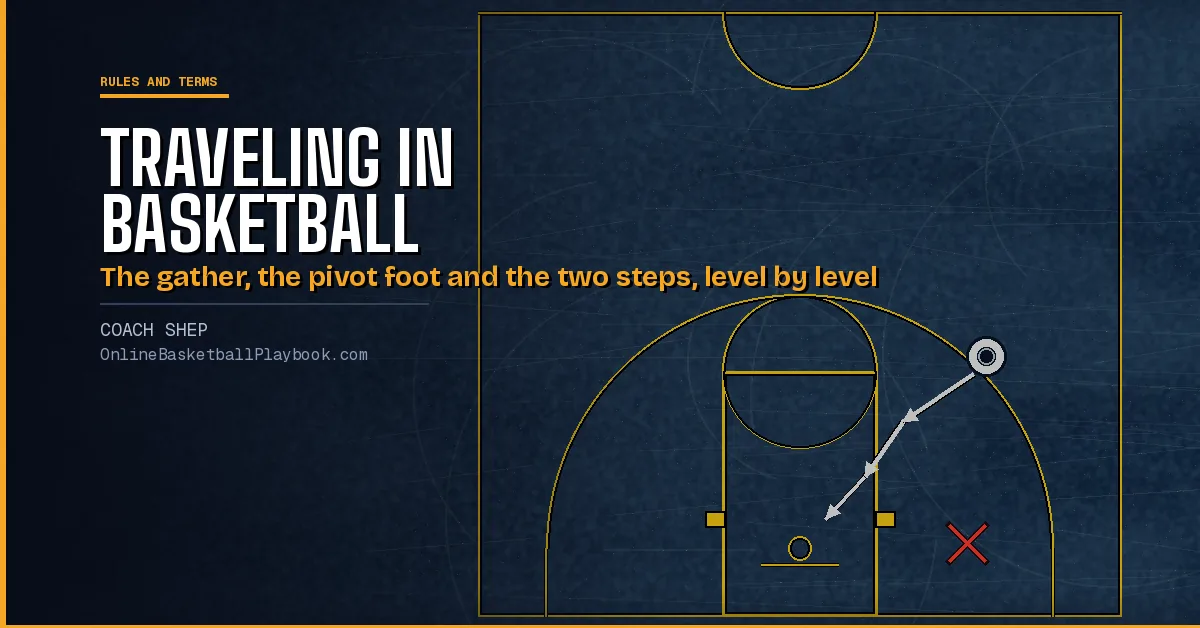
Traveling in basketball is moving one or both feet illegally while holding the ball. The rule is the same idea in every book read for this page, and the details are not. The NBA counts steps from a defined gather. FIBA counts two steps. The NCAA describes how the feet land when a player stops and where the pivot foot comes from. The NCAA women's book changed its jump-stop wording for 2025-26 and 2026-27. Every rule below carries its level and rule number. Rule books change each year, so confirm the edition your league uses. High school rules come from the NFHS. The current NFHS book is not freely available, so for high school the page says to check your state association rulebook.
Traveling in Basketball Rule at a Glance
| Point | NFHS | NCAA men (2026-27) | NCAA women (2026-27) | NBA (2025-26) | FIBA (2026) |
|---|---|---|---|---|---|
| Rule number | Check your state association rulebook | 9-5, with 4-22 jump stop and 4-27 pivot | 9-5, with 4-19 jump stop and 4-23 pivot | Rule 10 Sec. XIII, with Rule 4 Secs. III, VIII and IX | Art. 25 |
| Defines "gather" | Check your state association rulebook | No | No | Yes, Rule 4 Sec. III | Counts steps from gaining control |
| Steps after the catch or gather | Check your state association rulebook | Described by how the feet land, not by a count | Same as men | Two steps to stop, pass or shoot | Two steps to stop, pass or shoot |
| Jump stop wording | Check your state association rulebook | Lands "simultaneously" on both feet | Lands at "approximately the same time" | Jump off one foot on step one, land on both feet for step two, no pivot. A two-foot jump means release the ball before either foot returns | Jump off one foot on step one, land on both feet for step two, no pivot |
| Penalty | Check your state association rulebook | Throw-in at the designated spot nearest the violation | Same as men | Loss of ball on the sideline nearest the spot, not nearer the baseline than the foul line extended | Throw-in nearest the infraction, not directly behind the backboard |
The Pivot Foot
In the NCAA, NBA and FIBA books the pivot works the same way. The player holding the ball takes one step or several in any direction with one foot, and the other foot, the pivot foot, stays planted where it touched the floor.
- NCAA men. Rule 4 Sec. 27 defines the pivot, and Rule 9 Sec. 5 Art. 1 says a player shall not travel with the ball.
- NCAA women. Rule 4 Sec. 23 gives the same definition, and Rule 9 Sec. 5 Art. 1 and 2 match the men's book.
- NBA. Rule 4 Sec. VIII defines the pivot with the other foot in contact with the floor, and Rule 4 Sec. IX defines traveling as progressing in any direction while in possession beyond the limits in Rule 4 Sec. VII and Rule 10 Sec. XIII.
- FIBA. Art. 25.1.1 defines traveling as illegal movement of one or both feet beyond the limits in the article while holding a live ball, and Art. 25.1.2 defines the pivot the same way.
- NFHS. Check your state association rulebook for the high school definition and rule number.
Catching the Ball Standing Still

In the NCAA, NBA and FIBA texts, a player with both feet down at the catch can choose either foot to pivot on. Whichever foot comes up first leaves the other as the pivot.
- NCAA men and women. Rule 9 Sec. 5 Art. 3 and 5. Once the pivot foot comes off the floor it cannot touch down again until the ball has left the hands on a pass or a shot.
- NBA. Rule 10 Sec. XIII(a) and (d). Either foot may be the pivot. If the player lifts the pivot foot he must pass or shoot before it comes back down.
- FIBA. Art. 25.2.1. The foot that stays down becomes the pivot as soon as the other lifts. A player may jump off the pivot foot to pass or shoot, and neither foot may land before the ball is gone.
- NFHS. Check your state association rulebook.
Catching on the Move: the Gather and the Steps

This is the part of the rule with the most differences between books.
| Level | What the text says |
|---|---|
| NBA, Rule 4 Sec. III and Rule 10 Sec. XIII(b) | The gather is the point where the player gains enough control to hold the ball, change hands, pass or shoot, or cradles it. While dribbling it is two hands on the ball or letting it rest, a hand under the ball brought to a pause, or enough control to hold, change hands, pass, shoot or cradle. After the gather a progressing player may take two steps to stop, pass or shoot, or one step before releasing the ball if he has not yet dribbled. The first step is a foot or both feet touching after the gather. The second is the other foot, or both feet together |
| FIBA, Art. 25.2.1 | A player who catches while progressing, or at the end of a dribble, may take two steps to stop, pass or shoot. To start a dribble the ball must leave the hand before the second step. The first step is when a foot or both feet touch after gaining control, and the second is the other foot or both feet together |
| NCAA men and women, Rule 9 Sec. 5 Art. 4 | A player who catches while moving, or ends a dribble, may stop and set a pivot foot by how he lands. Landing on both feet together allows either foot as the pivot. Landing on one foot then the other makes the first foot down the pivot. Jumping off one foot and landing on both gives no pivot foot. With one foot already down, that foot is the pivot when the other steps. The text does not use the word gather |
| NFHS | Check your state association rulebook for the wording on stopping after a catch while moving |
Once the player stops on step one with both feet down or landing together, the NBA and FIBA let him pivot with either foot. If he lands on one foot first, only that foot can be the pivot.
The term "zero step" does not appear in the NBA, FIBA or NCAA texts read for this page. In the NBA and FIBA texts the count starts at the gather or the gain of control, and the first step is the first foot touching the floor after it.
The NCAA men's 2026-27 points of emphasis list traveling. The item says pre-dribble and split-step travels are not being called consistently, and it asks officials to identify the pivot foot after a player creates space.
The Jump Stop

- NCAA men. Rule 4 Sec. 22. The player has one foot on the floor, jumps off it and lands "simultaneously" on both feet, or has both feet off the floor, lands on one foot, jumps off it and lands on both together. In either case there is no pivot foot. A dribbler with one foot down who jumps off it and ends the dribble in the air may land on both feet and use either as the pivot.
- NCAA women. Rule 4 Sec. 19. The same patterns, with the landing described as "approximately the same time" on both feet. The women's rule changes for 2025-26 and 2026-27 list this as a change to Rules 9-5.4.a.3, 9-5.4.b.2 and 4-19.
- NBA. Rule 10 Sec. XIII(b). A progressing player who jumps off one foot on the first step may land on both feet together for the second step, and then may not pivot with either foot. If he jumps with both feet he must release the ball before either foot returns.
- FIBA. Art. 25.2.1 says the same, and adds that a player who lands from the air on both feet together has a pivot as soon as one foot comes up, the one still down.
- NFHS. Check your state association rulebook.
Starting a Dribble

- NCAA men and women. Rule 9 Sec. 5 Art. 5.b and 6.b. The pivot foot has to stay down until the ball is released for the first dribble. With no pivot foot, both feet stay down until then.
- NBA. Rule 10 Sec. XIII(c) and Rule 4 Sec. VIII(b). The ball must be out of the hand before the pivot foot leaves the floor.
- FIBA. Art. 25.2.1. The pivot foot has to stay down until the ball is released, and a player who is progressing has to release it before the second step.
- NFHS. Check your state association rulebook.
Hops, Falling and Throw-Ins
- Hops. NBA. Rule 10 Sec. XIII(h). After ending a dribble or gaining control a player may not touch the floor consecutively with the same foot.
- Hops. FIBA. Art. 25.2.1 says a player may not touch the floor consecutively with the same foot or both feet after ending a dribble or gaining control. The 2024 interpretations, 25-5, call a jump off the left foot, a landing on the left and then the right foot, and a shot a travel.
- Falling. NCAA men and women. Rule 9 Sec. 5 Art. 7. Falling to the floor while holding the ball without keeping a pivot foot is traveling.
- Falling. NBA. Rule 10 Sec. XIII(e). A player who falls with the ball may not gain an advantage by sliding.
- Falling. FIBA. Art. 25.2.2. Falling and sliding is legal. Rolling or trying to stand up while holding the ball is a violation. A player lying on the floor may gain control, pass or start a dribble while lying, and standing up while holding it is a travel (2024 interpretations 25-1 to 25-3).
- Throw-ins. NCAA men. Rule 7 Sec. 6 Art. 8.c. Pivot foot restrictions and the traveling rule are not in effect for a throw-in. The other books are not covered in the sources used for this page.
For related violations, see the basketball rules hub, the double dribble rule, what a carry is, the violations list and the backcourt violation page. For footwork you can teach, see pivot foot, pivot footwork and the Euro step, which is a move that has to stay inside these step rules.
Get the next coaching guide in your inbox
One email when a new guide or diagram set goes up. Free.
Penalty by Level
| Level | Penalty | Rule |
|---|---|---|
| NFHS | Check your state association rulebook | Check your state association rulebook |
| NCAA men | Ball to the opponents for a throw-in at the designated spot nearest the violation | Rule 9 penalty with Rule 7-3.2 |
| NCAA women | Same as men | Rule 9 Sec. 5 penalty |
| NBA | Loss of ball, on the sideline nearest the spot of the violation but no nearer the baseline than the foul line extended | Rule 10 Sec. XIII |
| FIBA | Ball to the opponents for a throw-in from the place nearest the infraction, except directly behind the backboard | Art. 22.2 |
Traveling is a violation, not a foul. The ball changes hands and no free throws are shot.
Questions Coaches Ask
What is traveling in basketball?
Moving a foot or both feet in any direction beyond what the rules allow while holding the ball. The limits come from the pivot foot rules and, in the NBA and FIBA, the two-step count after a gather.
How many steps can you take in basketball?
In the NBA and FIBA texts, two steps after the gather or after gaining control to stop, pass or shoot. The NCAA writes the limit through its pivot-foot and landing rules instead of a count. Check your state association rulebook for NFHS wording.
What is the pivot foot?
In the NCAA, NBA and FIBA texts, the foot that stays at its point of contact while the other foot steps. When a player catches with both feet down, the other foot becomes the pivot the moment one lifts.
Is a jump stop traveling?
A legal jump stop is not. At the NCAA, the NBA and FIBA, a player who jumps off one foot and lands on both feet together has no pivot foot. He may lift a foot to pass or shoot, but the ball must be gone before it comes back down, and he cannot lift either foot to start a dribble. NCAA 9-5.6.a, NBA Rule 10 Sec. XIII(b) and FIBA Art. 25.2.1 cover it. A player who is in the air with both feet and lands on both together can still pivot on either foot (NCAA 9-5.4.a.1 and 4-22.2, NBA XIII(b), FIBA 25.2.1). The NCAA men's book says "simultaneously" and the NCAA women's book says "approximately the same time."
What is the zero step in basketball?
It is a coaching term. It does not appear in the NBA, FIBA or NCAA rule texts read for this page. In the NBA and FIBA texts the first step is the first foot touching the floor after the gather.
Is traveling a foul?
No. It is a violation. The opponents get the ball for a throw-in, or in the NBA on the sideline nearest the spot.
Want the printable playbook packs?
OBP Pro members get the premium playbook packs: the zone attack, out of bounds and practice plan PDFs, plus each new pack as it is finished. The membership page lists what is in each one. Or draw your own version free in PlayDraw.
See what OBP Pro includesMore Guides From This Batch
- Basketball Offense: Systems, Actions and Sets Explained
- 1-2-2 Press: Roles, Traps, Rotations and Breakdowns
- 2-1-2 Zone Defense: Rotations, Weak Spots and Personnel
- Triangle and 2 Defense: How It Works and How to Beat It
Back to Basketball Rules and Regulations and every Rules and Terms page.
Keep Building
Related breakdowns
Technical Foul in Basketball: Rule, Penalties and Calls by Level
What a technical foul is in basketball, what draws one, what it costs in free throws and when it ejects a player or coach, labeled by NFHS, NCAA, NBA and FIBA rules.
Flagrant Foul in Basketball: Rule, Penalties and Calls by Level
Flagrant foul basketball rules by level: what makes contact flagrant, flagrant 1 vs flagrant 2, free throws and the ball, ejections, replay and FIBA 2026.
Basketball Shot Clock Rules: Length and Resets by Level
Basketball shot clock rules at the NFHS, NCAA, NBA and FIBA levels: the length, what counts as a try, and when it resets on rebounds, fouls and kicked balls.