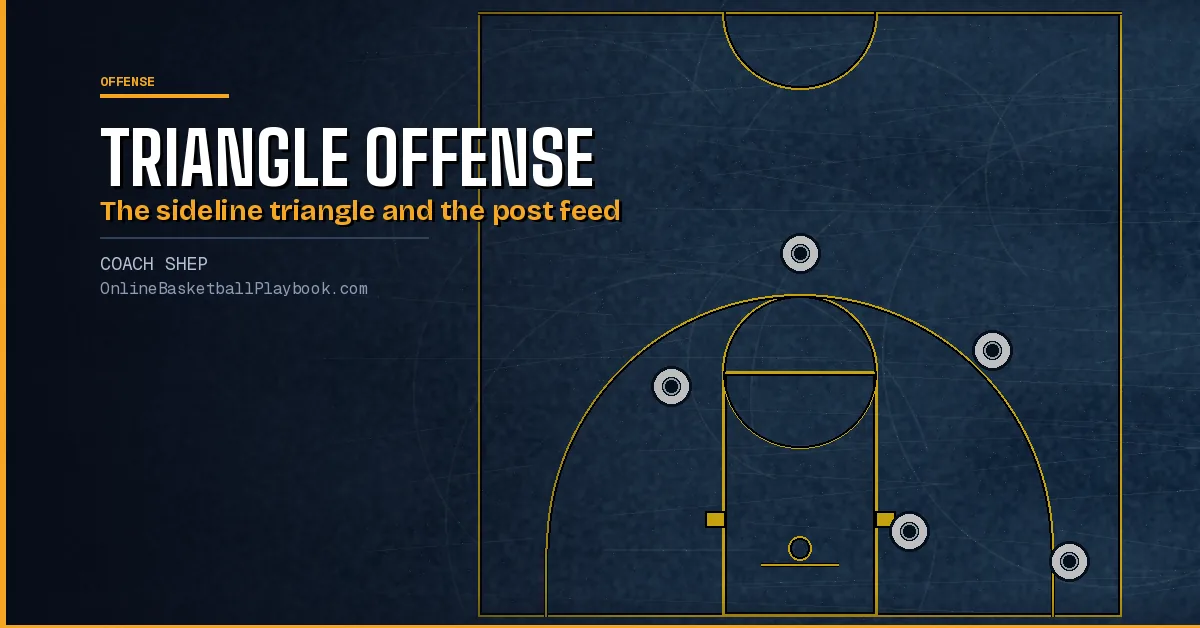
Triangle offense basketball is a system of reads, not a set of plays. Tex Winter developed it from the work of Sam Barry, and Phil Jackson's Bulls and Lakers made it famous. Three players form a triangle on one side of the floor, two more play a two-man game on the other side, and every player reads the defender to decide what happens next. This guide covers the spacing, the entries, the line of deployment, the four reads off the wing, post splits, counters and how to teach it without installing all of it.
The Triangle Offense at a Glance
| Piece | What it is | Job |
|---|---|---|
| Sideline triangle | Post, wing and corner on the ball side | Gets the ball to the post and creates the cutting |
| Weak-side two-man game | A guard at the top of the key and a player at the weak elbow | Balances the floor and gives a second scoring side |
| Post split | The passer cuts first after a post feed | Turns the feed into a cutting action |
| Pinch post | A weak-side elbow player used as a hub | Hand-offs, layups and screens on the weak side |
What Is the Triangle Offense?
The triangle is a triple-post, sideline-triangle offense. It is positionless and read-based, so it looks like it has little set pattern. Players fill spots and react to defenders. It differs from free-lance motion because five specific spots are always filled, and it resembles motion because nobody waits for a call. Because it can be started in many ways and set up on either side, it is hard to scout.
Winter built it on seven principles. Use them as a checklist for any offense you run.
- Penetrate the defense, starting with the fast break.
- Keep the spacing, which he was fanatical about.
- Move the ball and the players with purpose. Each player is without the ball most of the time.
- Give the ball handler options. He must be able to pass to all four teammates.
- Rebound on offense and keep defensive balance on every shot.
- Fill any spot, so positions are interchangeable.
- Use individual talent within the team.
Triangle Offense Spacing and Positions

Spacing is 15 to 18 feet between players, far enough that a trap leaves a shooter open and close enough for crisp passes. Winter scaled it by level, with high school a little tighter than college and the pros wider. Cones on the floor help a team learn the distances.
After an entry, five spots are filled. The corner player is often a guard who can shoot and create. The trigger or wing holds the ball and his pass decides what happens. The post stands on the high side of the block on the line between the ball and the basket. The trail is the other guard at the top of the key. The opposite player stands a step off the weak-side mid-post. Two post players and three perimeter players is the usual split, though anyone can play any spot.
Triangle Offense Entries
The strong-side guard passes to the wing and then fills the corner. The ways he gets there give the offense its entries.
- Outside cut. Pass, cut behind the wing and into the corner.
- Slice cut. Pass, move toward the wing and cut away to the corner.
- Blur screen cut. Pass, then cut inside, brushing off the post.
- Basket cut. Pass and cut to the basket off the center before filling the corner. The other guard always fills the middle.
- Dribble entry. The guard dribbles at the wing, which tells the wing to go to the corner. The post goes to the high post and the weak-side forward cuts to the low post.
The weak side fills as well. Either the weak-side guard cuts to the basket or uses a back pick from the weak-side forward, or the weak-side forward cuts into the corner and the guard takes his wing. Other entries include the post popping to the corner, a weave hand-off and a pass reversal to the other side. A reduced version for high school teams needs only three entries: the inside cut, the dribble entry and the post pop.
The Line of Deployment

The ball, the post, the post defender and the basket form an imaginary line. When the post holds that line, the defender must stand behind him and the pass is easy. If the defender overplays the baseline or the high side, the passer throws to the open side of the post. Players who learn this theory get the ball to their center even when opponents work hard to deny it.
Different denials call for different answers.
- Half front from the high side. The wing passes to the corner and the corner feeds the post.
- Half front from the low side. The wing passes to the guard at the top of the key and he feeds the post.
- Full front. The post seals and a lob goes over the top.
- Played from behind. The post turns and attacks.
Passing quality is what holds this together. Winter asked for three habits. The receiver acts within about three seconds, with a pass, shot or drive. The passer throws to the open side, a rule Winter said even the best players often break, so the passer must see the receiver's defender as well as the receiver. And the passer uses peripheral vision and a purposeful fake instead of staring at the target.
The Four Reads off the Wing

Once the triangle forms, the wing reads in a fixed order.
- The post. This is the first look, and the post split follows it.
- The weak-side guard at the top of the key. He can shoot, duck in to the post, dribble weave with the corner player or work a pinch post action.
- The backdoor of the weak-side wing. The weak-side forward flashes to the elbow, the guard cuts backdoor and a drop pass is available.
- The strong-side corner. The wing passes to the corner, makes a banana cut to the basket and the post screens and rolls if the corner player drives.
Each read leads to more options, so the offense is deep, but the one-two-three-four order anchors the players. The weak-side players have named spots as well. One is the garden spot, the weak-side corner in prime catching position. The other is the freeze spot at the weak-side post.
Post Splits

After a post feed, the passer is the first cutter. Whoever feeds the post cuts first. The wing cuts on the baseline side of the post and the corner player cuts as close behind him as he can. That creates a two-man game around the post without a call. Variations include a change-of-pace cut that sets a screen, a split where the wing sets a down screen for the point guard after the feed, and a high-post split where both cutters go the opposite way if the defense overplays the basic split. When the offense wants the post alone, both perimeter players can clear and screen the weak side so he plays one on one.
If nobody is open, the offense recycles. The ball reverses and the triangle reforms on the other side.
The Weak-Side Two-Man Game and the Pinch Post

The weak side is not a spectator. A guard at the top of the key and a player at the weak elbow play a two-man game that keeps the defense honest. Coaches pick two or three of the options and leave the rest.
- A high-post pass with the passer cutting off the post for a hand-off or a layup, then a dribble weave with the player coming off a down screen.
- An on-ball screen from the pinch post. The screener stays as a safety.
- A post pop that resets the action to the start.
- A dribble to the wing that signals a screen for a curler. If the defender trails, curl. If he goes under, step back.
Counters and Pressure Releases

Every denial has a named answer, so the offense never stalls.
- Blind pig. The guard at the top of the key is denied. The weak-side forward flashes to the high post, catches, and the denied guard cuts backdoor for a drop pass.
- Wing reverse. If neither the wing nor the guard at the top of the key is open, pass to the post at the elbow while the wing cuts backdoor. A drop pass back to the wing is available.
- Fronted post. Throw over the top or reverse the ball.
- Sagging wing defender. Dribble penetration.
- Denied reversal. Back door. If the backdoor entry pass is denied, a lob.
Get the next coaching guide in your inbox
One email when a new guide or diagram set goes up. Free.
Wing Denial and Extra Looks
When the wing pass is denied, reverse the ball to the other side, including a skip pass from the low post to the far wing. Any player, not only the designated post, can play the low post to exploit a size mismatch or a defender in foul trouble.
- Runner or circle. One guard clears to the corner so the post and wing run a two-man pick and roll.
- Clear. The wing isolates one on one.
- High-post split, three cutters. The three-cutter version of the high-post split sends three players through.
- Wing screens opposite. A guard screens for the weak-side post after cutting through.
- Double team on the post. The post moves to the short corner or the elbow, depending on where the trap comes from. Or the offense creates a two on one on the weak side, or skips to the vacated wing.
Who the Triangle Fits
The triangle needs a post who can both score and pass, and players who pass well enough to meet the three-second and open-side rules. Winter warned that very skilled players often abandon the offense, and that without constant work on chest, halo and overhead passes, footwork and ball handling it will not be run correctly. The offense is detailed and slow to learn. The memorization load is high and the coach gives up control, so the age-band view does not recommend it for youth teams.
| Approach | How it is used | Pick it when |
|---|---|---|
| Whole system | The triangle is the base offense and every player learns the reads | You have a passing post, high-IQ players and years to teach it |
| One situational look | An elbow-entry base offense, with the triangle used when a low post is in the game, one side three-three and the other two-two | You have a post for part of the game and a different base |
| Parts only | Line-of-deployment feeds, the three-second rule and post splits inside your offense | You want the best ideas without the whole tree |
Winter treated the triangle as the whole offense. The one-package version uses it as one look inside another base. The simplified version is recommended from high school up, with three entries and two or three two-man options. The triangle also works against zone, because its reads respond to spacing and movement.
How to Teach the Triangle
Teach it in layers, whole to part and back to whole.
- Spacing first. Mark the five spots on the floor and have players find them.
- Passing. Chest, halo and overhead passes, with the three-second clock and a fake before each delivery.
- Two on two entries. Pick the inside cut, the dribble entry and the post pop.
- Pairs weak-side two-man game. Shoot off the pinch post action.
- Three on three sideline triangle. Add the post feed and the split.
- Four on four shell. Combine entries and the two-man game.
- Half and full court scrimmage. Then play it live.
Pressure on the entry pass is its own problem. A pressure scout aims a full-court disruption package at the wing entry pass, because hitting the first pass before any cut or split takes away the reads the offense depends on. Pick only two or three weak-side options.
Questions Coaches Ask About the Triangle Offense
What is the triangle offense in basketball?
A read-based system with a sideline triangle of post, wing and corner on one side and a two-man game on the other. Players fill spots and react to the defender.
Who invented the triangle offense?
Sam Barry originated it at USC and Tex Winter, who played for him, developed it. Phil Jackson used it with the Bulls and the Lakers.
What spacing does the triangle use?
About 15 to 18 feet between players. Tighter spacing works for younger teams.
What is the line of deployment?
The line from the ball through the post and his defender to the basket. It tells the passer whether to feed the post or pass to the open side.
Can a high school team run the triangle offense?
Yes, with a post who passes and shoots. The simplified version is recommended from high school up, with three entries and two or three two-man options.
How does the triangle compare with the Princeton offense?
Both are read-based and patient with a strong high-post role and backdoor answers to denial. The triangle gives the wing a numbered order of reads once the triangle forms, while Princeton keys each set off a pass or a dribble. See the Princeton offense.
Other continuity systems are on Continuity Offense Basketball, and the flex offense is a simpler read-and-cut option. The post feed is easier with the work on Basketball Post Moves, and spacing is covered on What Is Spacing in Basketball. Compare it with motion offense, 5 out and the 4-out 1-in offense. Every system sits under Offense.
Want the printable playbook packs?
OBP Pro members get the premium playbook packs: the zone attack, out of bounds and practice plan PDFs, plus each new pack as it is finished. The membership page lists what is in each one. Or draw your own version free in PlayDraw.
See what OBP Pro includesMore Offense and Press Guides
- Princeton Offense: Cuts, Reads and Sets
- 1-2-1-1 Diamond Press Basketball: Roles, Traps and Install
- 4 Out 1 In Motion Offense: Rules, Spacing and Sets
Back to Continuity Offense and every Offense page.
Keep Building
Related breakdowns
3 Out 2 In Basketball Offense: Spacing, Actions and Reads
The 3 out 2 in basketball offense explained: alignment, actions off every pass, the high-low counter, drive rules for the posts, add-on plays and who fits it.
Dribble Drive Motion Offense: Spacing, Reads and Install
The dribble drive motion offense explained: 4-out 1-in spacing, the Drop, Drag and Rack zones, the read off a drive, shot diet, weak spots and the install.
High Low Offense Basketball: Reads, Counters and Zone Rules
High low offense basketball explained: the two-post shell, the lob and bounce reads, answers to a front, down-screen reads, 1-4 low sets and the hi-lo against zones.