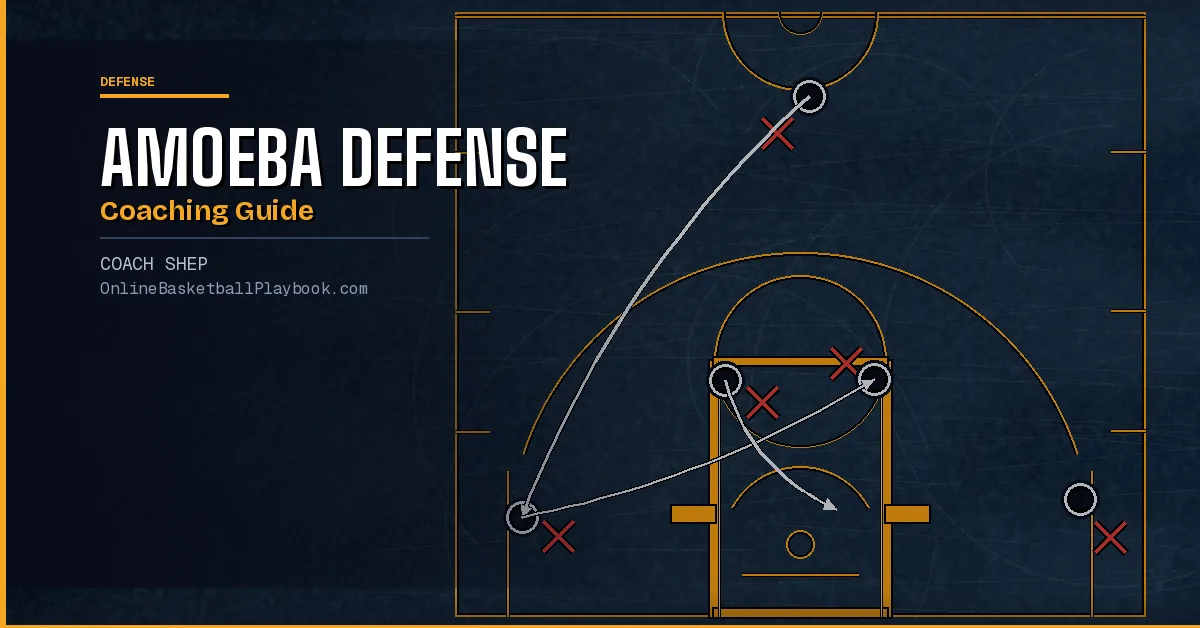
The Amoeba Defense is a chaotic, pressure-based system that blends full-court trapping with constant defensive shape-shifting. It has no fixed alignment. Defenders swarm the ball, deny passing lanes, and force turnovers before the offense can set up.
What Is the Amoeba Defense?
The Amoeba Defense was developed by Henry Iba and later popularized at the college level as an unconventional pressure system that refuses to give the offense a predictable look. Unlike a standard zone or man-to-man scheme, the Amoeba has no fixed starting alignment. It adjusts its shape continuously based on where the ball is and where the offense wants to attack. The name comes from biology: just as an amoeba changes form to engulf whatever it encounters, this defense morphs to surround the basketball. Several half-court versions start it from a 1-1-3 look, covered on 1-1-3 zone defense.
At its core, the Amoeba Defense operates on full-court or three-quarter-court pressure, combined with aggressive trapping, ball-denial, and constant rotation. Defenders do not stay attached to individual players or zones in the traditional sense. Instead, they key on the ball, deny the nearest passing lane, and collapse on any trap trigger, typically a dribble into a corner or a slow inbound. The result is controlled chaos designed to confuse ball-handlers, disrupt offensive timing, and generate easy transition buckets off turnovers.
The defense has been used at multiple levels (high school, college, and in modified forms at the professional level), often as a change-of-pace weapon rather than a base system. Teams that run it as their primary defense tend to play at a very high pace, intentionally fouling the shot clock with traps to force quick decisions and live with the occasional foul or skip pass against them. Teams that use it as a situational package deploy it in the final minutes of halves, after dead balls, or when the opponent's best ball-handler is fatigued.
What makes the Amoeba particularly difficult to prepare for is that it is not a single defense. It is a defensive philosophy with multiple wrinkles. A coach can install a trapping Amoeba with full-court run-and-jump principles, a half-court Amoeba where defenders switch assignments mid-possession, or a hybrid that looks like a zone until the ball is picked up. Opponents who scout a standard 2-3 zone or 1-2-2 press will find the Amoeba does not behave like either one.
Core Principles and Rules
Every version of the Amoeba Defense shares a common set of principles that govern how defenders move, when they trap, and how they recover. Understanding these principles is more important than memorizing any specific alignment, because the defense demands that players make real-time decisions rather than execute a scripted rotation.
Principle 1: Ball Pressure Is Non-Negotiable
Every possession starts with maximum pressure on the ball-handler. The on-ball defender's job is to make the catch uncomfortable, speed up the dribble, and force a direction, ideally toward the sideline or a corner where a trap is waiting. Soft on-ball defense kills the Amoeba. If the ball-handler has time to survey the floor and pick apart the defense, the system breaks down immediately. On-ball pressure has to be sufficiently aggressive that the ball-handler's eyes go down, their footwork speeds up, and their vision narrows.
Principle 2: Anticipate, Do Not React
Trap defenders cannot wait until the ball arrives in the corner before rotating into position. They must read the ball-handler's body language (the dip of the shoulder, the angle of the dribble, the speed of the drive) and begin moving into trap position early. In the Amoeba, defenders who react after the fact are always a step late. The trapping pair needs to arrive at the same time the ball does, cutting off both the retreat dribble and the escape path. This requires defenders to be reading two things at once: the ball and their nearest passing lane assignment.
Principle 3: Denial Over Help
When a trap is set, the three remaining defenders do not collapse into the paint as they would in a standard help defense. Instead, they each pick up the nearest outlet receiver and play full denial, chest to the passing lane, hands active, no easy dump-off passes. The trap only works if the ball-handler genuinely cannot find an outlet. A 2-on-1 in the trap is meaningless if the ball-handler can immediately throw a soft pass to an unguarded teammate. Denial positioning is what converts a trap into a steal or a five-second call.
Principle 4: Rotate on the Skip
Every coach who installs the Amoeba must train skip-pass rotations explicitly, because the skip pass is the offense's primary answer. When the ball is skipped (thrown over the trap to the opposite side of the floor), the defense must rotate quickly and collectively. The nearest defender sprints to the ball, the deep defender drops to protect the rim, and the remaining two pick up the nearest threats. This rotation has to be practiced at game speed repeatedly before it becomes reliable. A poorly executed skip rotation gives the offense a wide-open corner three, which is the exact shot that deflates the Amoeba system.
Principle 5: Foul Discipline
Aggressive trapping defenses foul more than passive zone schemes. The Amoeba is no different. Coaches must establish clear rules about when to reach and when to contain. Reaching fouls on clean catches give the offense free throws and kill momentum. The standard rule: defenders in a trap can swipe at the ball only when the dribble is picked up. While the ball-handler is live, the trap's job is to reduce the angle of vision and force a rushed pass, not to steal the ball with a swipe. Contact fouls on live dribbles are the most damaging because they send the offense to the line and restart their half-court set with fresh spacing.
Personnel Requirements
The Amoeba Defense is not for every roster. It demands specific physical and mental attributes that not every group of players has, and trying to install it with the wrong personnel leads to easy layups and quick foul trouble rather than the turnovers the system is designed to generate.
The ideal Amoeba roster is deep, athletic, and conditioned well above average. Because the defense is so physically taxing (constant sprinting, active hands, repeated trap-and-recover sequences), teams need at least eight or nine players who can execute the system at full speed. A six-man rotation cannot sustain Amoeba pressure for 32 or 40 minutes. Substitutions need to happen in waves that keep the energy level high. The moment the defense slows down and becomes passive, the entire psychological effect disappears.
Individually, the best Amoeba defenders share three traits: lateral quickness, basketball IQ, and competitive composure. Lateral quickness lets them stay in front of ball-handlers during the initial pressure phase and recover after a skip pass. Basketball IQ, specifically the ability to read passing lanes and anticipate where the ball is going, separates good Amoeba defenders from great ones. Composure matters because opponents will score against the Amoeba. Transition layups happen. Open threes happen. Defenders who mentally collapse after giving up a basket cannot run this system. The Amoeba accepts some costs in exchange for a higher volume of turnovers, and players have to buy into that trade.
For the trapping positions specifically (typically a pair of wing defenders or a wing and a guard), quickness and length are both valuable. Long wingspans in a trap make it harder for the ball-handler to see over the top of the pressure, reducing passing vision and increasing the chance of a high-risk lob that gets intercepted. Smaller, quicker trappers can succeed as well if they understand angles and arrive early enough to cut off the baseline escape.
Before committing to the Amoeba as your base or primary change-of-pace defense, confirm your roster has: (1) at least 8 players with above-average conditioning, (2) two or three defenders who can guard the ball in space without fouling, (3) at least one player who reads passing lanes intuitively and can become a trap-and-intercept specialist, and (4) a coaching staff willing to commit daily practice time to skip-pass rotations and trap timing drills.
How to Run the Amoeba Defense
Installing the Amoeba begins on the inbound. The moment the ball goes live after a made basket or dead ball, defenders sprint to their pressure positions, typically a 1-2-1-1 or 2-2-1 initial alignment depending on which Amoeba variant is being used. The specific alignment matters less than the intent: every defender is immediately active, and the ball-handler feels pressure before they have taken a single dribble.
The Inbound Trap
The first trap opportunity is the inbound pass. Two defenders shadow the inbounder and the primary receiver, trying to make the initial pass difficult and get a hand in the passing lane. If the inbound catch comes to a ball-handler near the sideline (especially in the corners), the trap triggers immediately. The on-ball defender and the nearest wing defender form the trap while the remaining three lock down the three closest passing outlets.
The Run-and-Jump
One of the most disorienting elements of the Amoeba is the run-and-jump. As the ball-handler advances up the floor, a defender who appears to be playing an off-ball position suddenly sprints at the dribbler from the side or from behind, forcing a jump stop or a rushed pass. Meanwhile, the original on-ball defender rotates to pick up the nearest outlet. If the ball-handler fails to see the run-and-jump coming, they pick up their dribble in traffic, creating a live trap situation with no dribble left to escape.
The run-and-jump is the component that most often catches opponents off guard in the first quarter. Scouting reports can describe it, but experiencing it in a live game is different. The ball-handler has to make a split-second decision about whether to pass or stop, and they are making that decision under pressure from an unexpected angle. Well-coached teams will recognize the run-and-jump after two or three possessions and start throwing early outlet passes to counteract it. That is why Amoeba teams must vary the timing and angle of the run-and-jump throughout the game.
Half-Court Continuation
If the ball crosses half-court without a turnover, the Amoeba does not simply drop into a standard set. Defenders continue applying pressure in the half-court, looking for ball-screen traps, dead-ball traps when a ball-handler picks up the dribble, and post-entry traps when the ball goes into the low block. The half-court Amoeba looks more like a scramble zone than a traditional defense, with defenders rotating to the ball while maintaining denial on the nearest passer. Coaches who want a cleaner half-court look will often transition to a 2-3 zone or man after two or three half-court possessions, using the full-court Amoeba as a disruption tool and the half-court zone as a recovery defense.
How Offenses Attack It and How to Counter
Every defense has an answer, and the Amoeba is no exception. Understanding how offenses attack the system is essential for coaches who want to deploy it effectively, because the counters need to be trained before the game, not discovered during it.
The most reliable answer to the Amoeba is the early offense. Teams that push the ball immediately after made baskets (before the Amoeba can reset its pressure alignment) neutralize the defense's best attribute: organized pressure. When the ball is advanced before the defense is set, the traps are late, the denial positions are not established, and the defense is scrambling rather than organized. Amoeba coaches counter this by conditioning their team to sprint back into pressure positions immediately after giving up a basket, and by making the inbound pass itself difficult rather than conceding a clean catch and then trying to trap.
The second reliable answer is the patient point guard. If an offense has a ball-handler who is comfortable under pressure, can change speeds, and makes quick short passes rather than holding the ball, the Amoeba trap triggers repeatedly but never closes. The ball gets advanced in two-pass sequences (short pass to a wing, immediate reset) before the trap can form. Amoeba coaches address this by switching which defender applies on-ball pressure and by varying the timing of the run-and-jump so the ball-handler cannot get into a comfortable rhythm.
The third answer is the high-low passing game into the post. Once the defense is focused on perimeter pressure, a skilled post player can slip into the mid-post or short corner and receive a direct entry pass before the Amoeba can adjust. From there, the post player can score or kick out to the opposite wing. Amoeba teams counter this with a designated back defender whose primary job is post denial and rim protection, even if that means conceding some perimeter coverage.
When to Deploy the Amoeba
The best Amoeba coaches are selective about when they use the defense. Deploying it every possession of every game is physically and mentally exhausting for players, and opponents who see the same system for 32 minutes will find a counter by the second half. The Amoeba is most effective as a situational weapon, a tool pulled out at specific moments in the game to change the possession dynamic.
The most common deployment situations include: the final two minutes of the first half, when the opposing offense is trying to run a clean set rather than pushing the pace; after a run of three or four consecutive offensive possessions without a basket, when the team needs a jolt of defensive energy; against a team that has been slow to advance the ball and tends to hold it on the perimeter; and at the start of the second half, when the opponent has not adjusted yet and the Amoeba can generate two or three early turnovers before being scouted and countered.
You can also use the Amoeba as the base defense against weaker opponents (teams with limited ball-handlers or poor passer decision-making) and reserve your standard zone or man defense for more capable offenses. This inversion of the standard approach can work well when the talent differential is significant, because the Amoeba generates an extreme number of turnovers against teams that panic under pressure.
Regardless of when it is deployed, the Amoeba must be practiced at game speed regularly to be effective. Defenses that only see the system in walk-throughs will execute it slowly and tentatively in games, which produces neither turnovers nor consistent rotations. The trap timing, the skip-pass rotation, the run-and-jump angle, and the denial positioning all have to be automatic, meaning they need to be drilled at full intensity at least twice per week during in-season practice.
- Trigger the first trap on the inbound. Make the offense earn every possession from the start.
- Run skip-pass rotations at game speed every practice; slow rotations give up open threes
- Rotate your best on-ball defender every 4–5 minutes to keep energy and pressure high
- Designate one back defender as post and rim protector so the trap doesn't collapse inside
- Vary the run-and-jump timing; if it comes at the same moment every time, the offense adjusts
- Foul discipline: no reaching on live dribbles, trap the angle, swipe only on a picked-up ball.
- Use the Amoeba in 2–3 minute bursts tied to timeouts or dead balls for maximum impact
Want more defensive breakdowns like this delivered to your inbox?
Join the Online Basketball Playbook newsletter →
Draw this play free in the play drawer →
Membership: the full library, playbook packs, and Pro drawing tools →
Keep Building
Related breakdowns
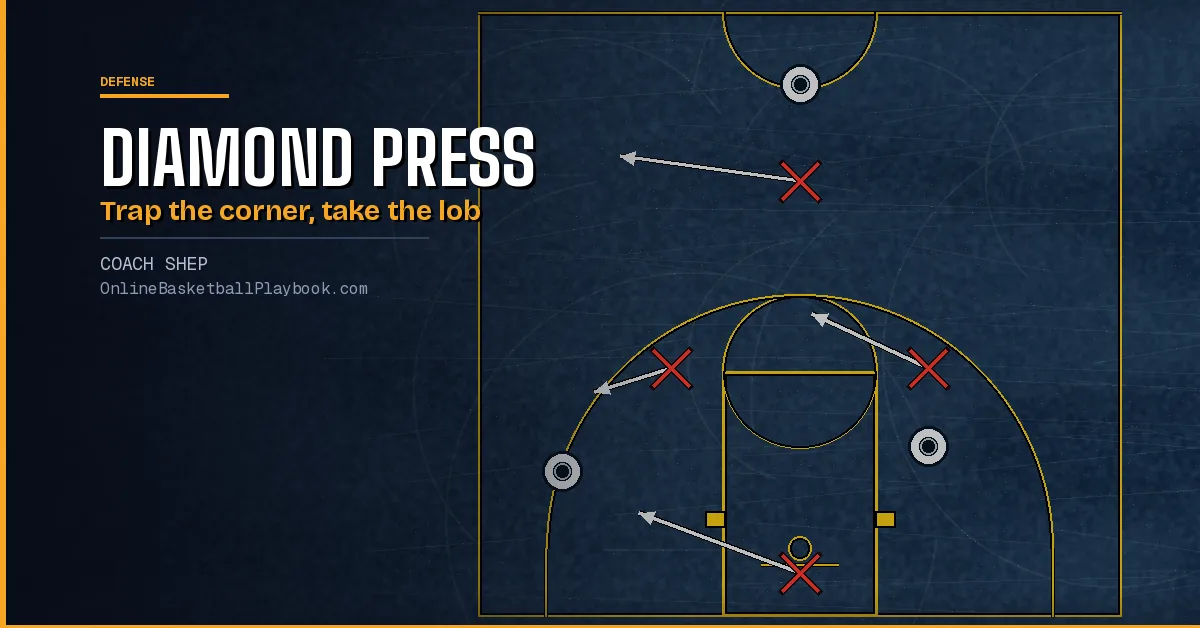
1-2-1-1 Diamond Press Basketball: Roles, Traps and Install
How to run the diamond press in basketball: who plays each role, how to trap the corner, what to do on the reversal and the lob, and how to install it step by step.
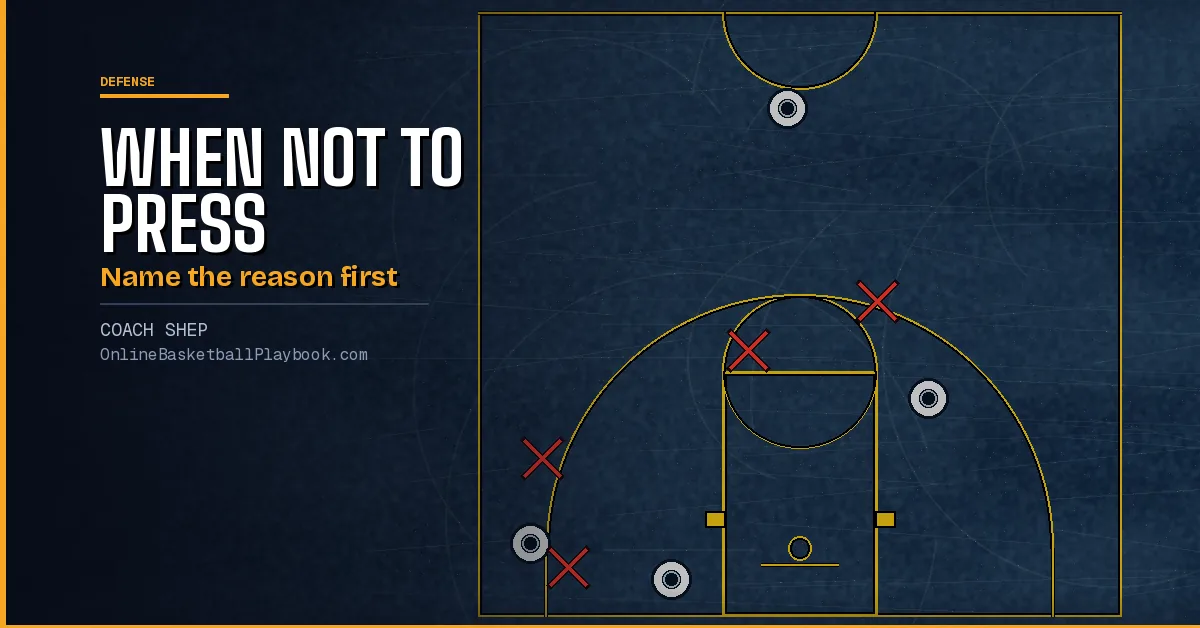
When Not to Press: Bad Reasons, Thin Benches, Poised Guards
When not to press in basketball: the bad reasons, the roster you need first, the opponents who beat it, the moments to drop it and the youth limits.
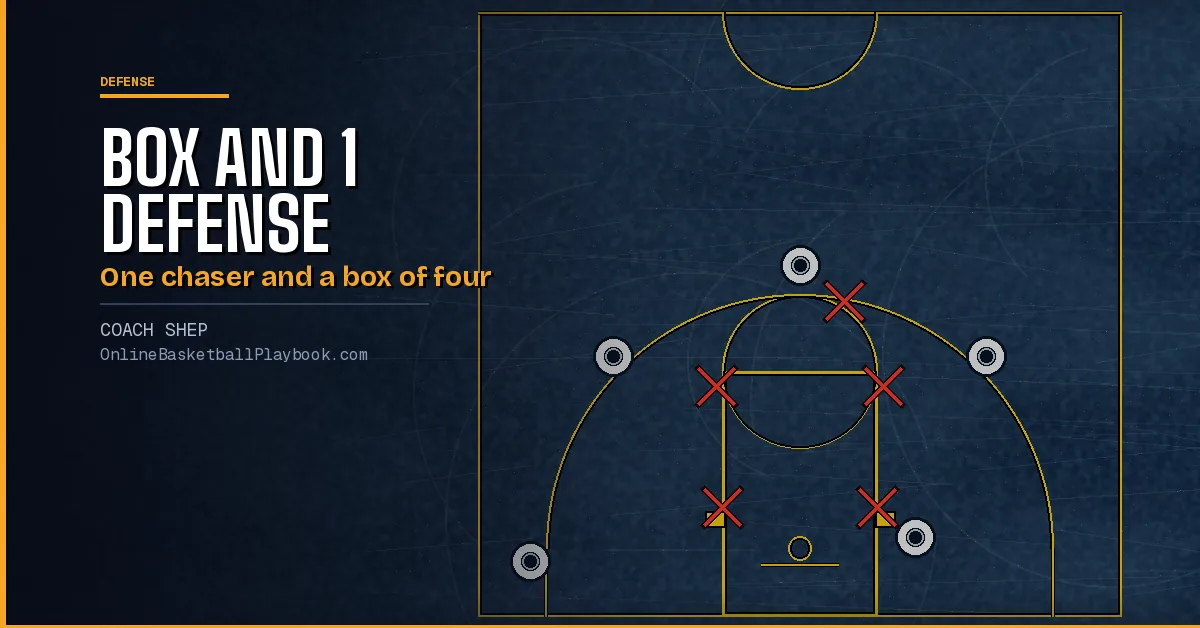
Box and 1 Defense: How It Works and How to Beat It
What the box and 1 defense is, how the chaser and the box play, when coaches call it, where it leaks, and how an offense beats it with a decoy star.