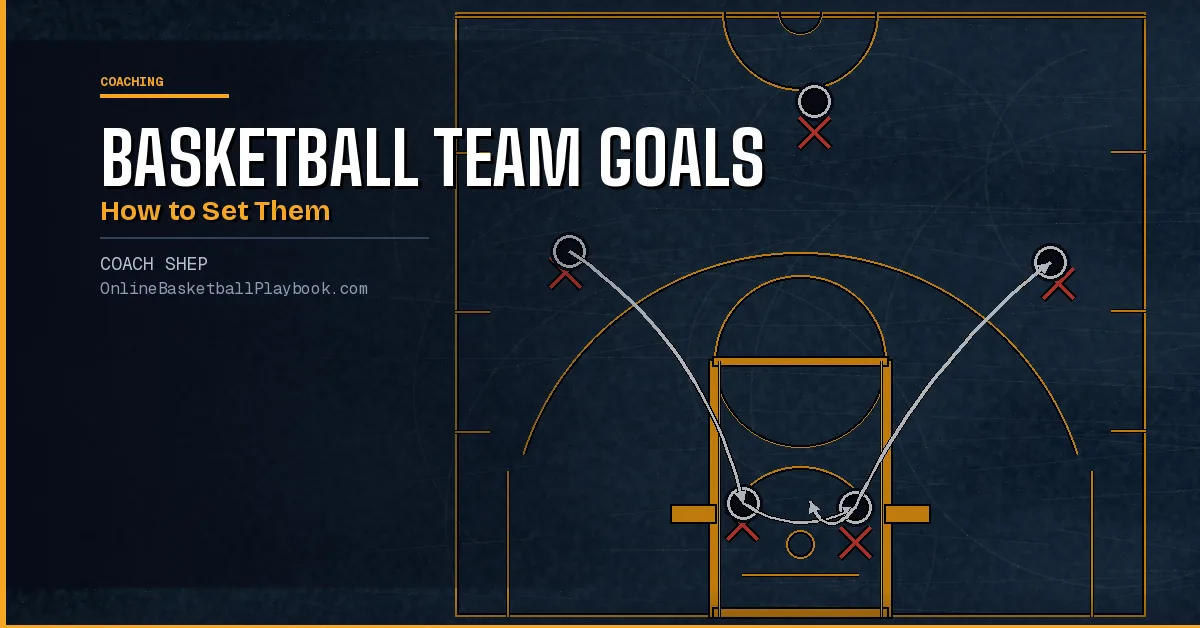
Most teams set goals wrong. They pick a record, post it in the locker room, and wonder why it doesn't move anyone. This guide shows coaches how to build a goal-setting system that actually drives behavior and builds culture.
Why Most Team Goals Fail
Walk into almost any high school or college locker room and you'll find a poster on the wall: "State Champions." Maybe it's a championship bracket filled in with the team's name at the top. The coach set that goal in October. By January, nobody references it, and the team is playing without any real direction about how to get there.
Outcome goals set in isolation are one of the most common and costly mistakes coaches make. When a team's only stated goal is a championship or a winning record, players have no behavioral map to follow. They know where they're supposed to end up, but they have no idea what they're supposed to do differently on Tuesday's practice or Wednesday's game.
The second failure mode is top-down goal-setting. Coach calls a team meeting, announces the goals, and expects buy-in. It rarely works. Players nod. They don't internalize it. The goals belong to the coach, not the team. When adversity hits, a three-game losing streak, an injury, a tough stretch of the schedule, those externally imposed goals offer no real anchor.
A third failure is vagueness. "Play harder." "Defend better." "Be more consistent." These aren't goals. They're wishes. Goals need to be specific enough that at any moment, a player or coach can look at the scoreboard, the stat sheet, or a video clip and immediately know whether the goal is being met or not.
The research on goal-setting, and the practical experience of elite coaches, points in the same direction: effective team goals are layered, specific, owned by the players, and tied directly to daily behaviors. Everything else is decoration.
The Three Levels of Team Goals
A complete team goal structure has three distinct layers. Each layer feeds the next. Strip any one of them out and the whole system weakens.
Outcome Goals
These are the results you're chasing: championships, conference titles, a specific win total, a postseason berth. Outcome goals matter. They give direction and create a shared vision. The mistake is treating them as the only layer.
Outcome goals live at the top of the pyramid. They answer the question "Where are we going?" But they don't answer "How do we get there?" And that gap is where most programs get lost. A team that posts "Win the conference title" without building the layers beneath it has a destination but no road.
Set one or two outcome goals. Make them ambitious but realistic. A team that went 10-14 last season shouldn't post "State Champions". It's too distant to feel achievable, so players quietly stop believing in it. A target of "finish above .500 and make the playoffs" connects ambition to credibility. Building a strong basketball team culture starts with goals your players actually believe they can reach.
Performance Goals
Performance goals sit in the middle layer. They translate the outcome vision into measurable on-court benchmarks. Examples: hold opponents under 60 points per game, shoot 70% from the free throw line, force 15+ turnovers per contest, hold opponents to under 40% field goal percentage.
These are numbers your coaching staff can track directly. At any point in the season you can pull the stat sheet and answer: "Are we hitting our performance goals?" When the answer is yes and you're still losing, that tells you something important about your targets. When the answer is no and you're winning anyway, that tells you something too. Your benchmarks might not be the right ones, or you're getting lucky in ways that won't sustain.
Performance goals are especially powerful for basketball player development because they give individual players specific targets that connect to the team's larger mission. A post player knows that 70% free throw shooting is a team goal. Suddenly his individual development has collective meaning.
Process Goals
Process goals are the daily behaviors that produce the performance numbers that drive the outcomes. These live closest to what a player can actually control on any given day. They're the foundation of the pyramid. And most teams never build them.
Process goals might look like: sprint back on defense every possession without exception, take only high-quality shots within the offensive system, communicate on every screen, call out ball-you-man on every defensive possession. These aren't outcomes. They're habits. And habits, compounded over a season, produce outcomes.
Building Process Goals That Drive Behavior
The hardest part of goal-setting isn't the big picture. It's translating vision into daily behavior. Process goals are where that translation happens, and building them well requires the coaching staff to think clearly about what actually produces wins.
Start with your defensive system. If you run help defense principles as your foundation, what are the specific behaviors that make that system work? Players rotating on time. Communicating before the ball moves. Getting to help position before the drive gets there. Each of those behaviors can become a process goal with a measurable standard: "We rotate to help position before the ball moves. If we do it right, zero layups in transition."
Then move to offense. What behaviors drive your offensive success? Ball movement, defined as touching the paint before shooting. Decision-making, defined as never forcing a shot with a defender within two steps. Rebounding effort, defined as all five players crashing every possession unless designated otherwise by scheme.
The specificity matters. "Work hard" is not a process goal. "Sprint back on every defensive possession so that when the ball crosses half-court, you're already in your defensive position" is a process goal. You can watch film and count. You can point to a clip and say "this is what it looks like when we do it right" or "this is what it costs us when we don't."
Keep the process goal list short. Three to five behavioral standards per phase of the game, offense, defense, transition, is enough. Too many process goals and players can't hold them all in working memory. The goal is to build habits, and habits form one at a time.
Setting Goals With Your Team, Not For Them
Player ownership is the variable that separates goals that motivate from goals that are forgotten by November. When players set the goals themselves, with coaching guidance, the goals become theirs. When they hit an obstacle, they're fighting for something they chose, not something imposed on them.
The process doesn't need to be complicated. At the start of the preseason, give each player a simple worksheet: What do you want to accomplish individually this season? What do you think the team needs to accomplish to have a successful year? What do you think you need to do personally to help the team get there?
Collect the responses before the team meeting. Look for themes. When you bring the team together, present what you heard: "Here's what your teammates said. Here's where there's alignment. Here's where there's a gap." Let the team discuss. Let them argue. A team that argues about goals in October is a team that cares. That's exactly what you want.
From that conversation, build the goals collaboratively. The coaching staff guides the process, rules out anything unrealistic or counterproductive, and helps translate vague aspirations into specific, measurable targets. But the final goals should feel like the team's words, not the coach's bulletin board material.
Write the goals down. Post them somewhere visible in the locker room or practice facility. Revisit them at the start of every week in team meetings. Reference them when making in-game decisions. The goals only stay alive if you keep bringing them back into the conversation.
Tracking and Accountability Systems
Setting goals without a tracking system is like running a practice without a basketball practice plan: You might get something done, but you won't know if it worked. Accountability is the mechanism that turns goals from aspirations into standards.
For performance goals, the stat sheet does most of the work. Build a simple tracking sheet, one page, updated after every game, that shows this week's numbers against the season target. Defensive field goal percentage. Turnover forcing rate. Free throw percentage. Transition defense stats. Offensive rebounding rate. These numbers tell you at a glance which goals you're hitting and which need attention.
Review them openly with the team. Not as punishment. As information. "We're at 68% from the line this week against our 70% goal. Here's why we think that happened. Here's what we're going to do about it in practice." That conversation treats players as serious athletes capable of processing information and adjusting. Most players respond to that treatment with heightened engagement.
For process goals, film is the tool. Pull clips from practice and games that show the process goal being executed correctly and incorrectly. A two-minute film session focused on one process goal, defensive rotation timing, for example, does more than a ten-minute lecture. Players see themselves. They see the outcome that follows correct and incorrect execution. The behavior becomes concrete.
Peer accountability is the most powerful layer, and the hardest to build. When a player calls out a teammate for a process goal violation, not with hostility, but with ownership of the standard, you have a team that polices itself. That only happens when the goals are genuinely theirs. You can accelerate it by designating veteran players as "standard-holders" with an explicit responsibility to reinforce the team's process goals during practice.
Your goal-tracking system doesn't need to be complex. A simple one-page sheet updated after every game is enough to keep the team focused on what matters and quickly identify which areas need more practice attention before the next opponent.
Adjusting Goals Midseason
Goals are not permanent commitments carved into stone. They're working documents. A goal that made sense in October may need revision by January, not because the team is soft or lacking ambition, but because the team learned something real about itself through competition.
There are two legitimate reasons to adjust a goal midseason. The first is new information. If a key player gets injured and the performance goals assumed their production, adjusting the numbers reflects reality rather than denial. The second is discovery. You learn during the season that a goal was tracking the wrong thing. If your offensive rating is exactly where you targeted but you're losing games, maybe the metric isn't capturing what wins.
Adjust the numbers when needed, but never abandon the process goals. Process goals are behavioral standards. They don't depend on opponent quality, lineup health, or shooting variance. "We sprint back on every possession" is not a goal you adjust when you're 4-8. If anything, it becomes more important. Process goals are the identity of the team. And identity is exactly what a struggling team needs to hold onto.
When you adjust a goal, do it openly with the team. Explain the reasoning. Connect the adjustment to what you've learned. A team that watches its coaches update targets based on real information learns that your goal-setting is serious. It's connected to reality, not just motivational theater. That builds more trust than rigid adherence to targets that no longer make sense.
End-of-season goal reviews are equally important. Schedule time after the season, before the next one begins, to review every goal you set. Which ones did you hit? Which did you miss? Where were the goals set too high or too low? What did you learn about which process goals actually predicted performance? That review feeds directly into next year's goal-setting process, and over multiple seasons, your goal-setting gets sharper and more calibrated to what actually drives your program.
- Layer your goals: Outcome goals give direction, performance goals give benchmarks, process goals give daily behavior targets. You need all three.
- Get player input before setting anything: Use a simple preseason worksheet to surface what players want and build ownership into the goals from day one.
- Keep process goals short and specific: Three to five behavioral standards per phase of the game, offense, defense, transition, is enough for players to internalize and actually hold.
- Track performance goals every game: A one-page tracking sheet reviewed weekly keeps goals alive and gives the team real feedback instead of vague impressions.
- Use film to reinforce process goals: Two minutes of targeted film beats ten minutes of lecture. Players see the behavior and its consequence in real time.
- Adjust targets when reality demands it, but never abandon behavioral standards: Process goals are your identity; they don't change with the score or the standings.
- Review goals after every season: Use what you learned to make next year's goal-setting sharper and more accurately calibrated to what actually drives wins in your program.
Get free play diagrams, drills, and coaching guides delivered weekly.
Draw this play free in the play drawer →
Membership: the full library, playbook packs, and Pro drawing tools →
Keep Building
Related breakdowns
How to Become a Basketball Coach: Paths, First Jobs and Steps
How to become a basketball coach: where coaches start, youth, school, club and college paths, entry jobs, coaching education, networks and mentors.
Basketball Scouting Report Template and How to Fill It Out
A printable basketball scouting report template with team, offense, defense, player and game plan sections, the questions to ask and how to brief players.
Basketball Tryouts: Sessions, Drills, Scoring and Cuts
A coach's guide to basketball tryouts, with session plans, drills and scrimmages, evaluation forms, what to look for, and how to tell players the decision.