Basketball player development is the work that turns gym time into skill a player can use in a game. Plenty of players shoot around for an hour and improve very little, and the difference is structure. A session with a plan, game speed and a make count builds skill. A session without them fills time.
This guide covers the three non-negotiables of a workout, how to progress a skill from no defender to a game situation, how to score and track reps, how to find and fix errors, how to build a signature move and how to program a season.
Basketball Player Development at a Glance
| Piece | What the coach asks for |
|---|---|
| Plan | A written sequence of skills, drills and time blocks |
| Speed | Game speed, the tempo the player needs in a game |
| Tracking | Makes, not attempts, counted against a clock, an opponent or a record |
| Order | Form and footwork first, then the move, then a game shot |
| Progression | No defender, a coach who triggers a read, a small advantage, then the game |
| Correction | Find the cause of the miss and give one short cue |
| Season | A menu of workouts by time, level and goal |
The Three Non-Negotiables of Every Workout
- A plan. Aimless gym time does not develop anyone.
- Game speed. Practice runs at the tempo the player needs in a game, because that is the only way the work transfers.
- Tracking. Chart attempts and makes.
Development is bigger than the skill layer. It has five tracks that advance together.
- Mental ability. Coachable and confident.
- Physical ability.
- Skill level.
- Basketball awareness. Decisions and reading momentum.
- Intangibles. Courage, intensity and communication.
Awareness and intangibles make skill usable under pressure. Plan, speed and tracking come first, every workout.
Part-to-Whole Skill Progression
Install any skill in a fixed order. The order comes from a pick-and-roll teaching progression and works for any read-based skill.
- Introduce it (1v0). Footwork, timing and mechanics with no defender.
- Coach-guided read (1vC). The coach shows a cue the player must read. The player now practices a read, not just a move.
- Controlled advantage (1v2). Finish through pressure.
- Game situation. Live defense with real consequences.
Then scale the numbers from one to two to three to four. Players learn reads, not memorized routes. Within a drill, start with form and footwork, add the move second and finish on a game-realistic shot. What the coach corrects first signals what he values most, so fix the footwork before the shot.
Add players one at a time, and never skip the read.

Score and Track Every Rep
Reps are built on makes, not attempts. Every block gets a target, a window and a recorded result. Make fourteen in ninety seconds. Make twenty of each. A player chasing a number competes against the clock, a partner or his own record, and he knows where he stands.
- Give every drill a failure condition. Four in a row from five spots, or two in a row at each of five spots in under two minutes. A make goal is what turns a shooting exercise into a drill, and a plain "shoot 100" rep never creates the pressure of a miss.
- Post the records. Shaka Smart's shooting sheet lists a record for named drills. Posting the make chart creates competition too.
- Match the number to the player. Keep a menu of make totals, such as 100, 200 and 300, and pick by the player and the day.
- Read the log. A make count over weeks shows which skills are moving and which have stopped, and that should change the drill or the teaching.

Chase a number every block.
Form Before Volume
Build the shot in order. Start close to the basket and move out only while the motion holds. A one-handed form shot is a common opener, with the hand under the ball, the elbow under the hand and a high follow-through. Progress from form shots to no-jump shots to jump shots, counted across rounds. Count a make only when the form is correct.
Footwork and hands separate shot-makers from shot-takers more than volume does. Low to high, step into the shot and never shoot off the heels. A form fix usually dips before it recovers, so stay patient. The details are on Basketball Shooting Form.
Earn the range with form first.
Game Shots, Game Spots, Game Speed
Block shooting grooves form. Movement shooting builds the shot a player will take. Mix them. Shoot off the catch, off the pull-up and while moving to new spots. Add a contest, a screen or a hand-off to make a drill game-real.
- Earn the shot with an action. Do not spot up cold. Build each drill around a realistic movement before the shot, such as a zipper cut, a baseline drive, a ball screen or a drive-and-kick. The player responds to a read before he shoots.
- Add a closeout. A three-player drill has the shooter catch and read a closeout on every rep.
- Train the pull-up. Shaka Smart's Texas battery drills the one-dribble pull-up as its own scored shot, next to the catch-and-shoot three.
- Pair shooting with handling. Shots come off the dribble in games, so build the handling that creates them.
- Shoot free throws tired and counted. Bake ten into the workout after the second turn and ten after the last, so they are shot tired. Do not take them fresh as a cool-down.

Scored closeout games add a numbers layer. A 2-on-1, 3-on-2 and 4-on-3 sequence on a three to four minute clock, with a point for a made three and a point for a drawn foul, keeps the defense outnumbered by one and forces it to communicate under a live scoreboard.
Make every shot look like a game shot.

Get the next coaching guide in your inbox
One email when a new guide or diagram set goes up. Free.
Build a Signature Move Series
Give every player a primary action he can go to from any angle. Then build a series around it. The primary move plus two or three counters that punish the defense for taking the first option away. The counters are what let the move survive the defender's reaction.
Run the primary move first, drill each counter in order, then chain them together in read-and-react work. Position should not limit the skills a player trains, so guards do post work and forwards do guard skills. See Basketball Finishing Moves and Basketball Shot Fake for counters.
Know your primary move and its counters cold.
Error Detection
In individual teaching, the coach's primary tool is watching a rep, finding the cause of the error and giving a cue before the next rep. A coach who sees only the outcome, a miss or a fumble, corrects outcomes. A coach with a mental model of the skill at each phase corrects causes.
- Diagnose before prescribing a drill. The cause of a miss is rarely what the player thinks it is. Decide whether the problem is shot selection or mechanics before changing anything, and start with what the player does well.
- Keep the talk short. Hal Wissel keeps instruction brief and the player's confidence high.
- Fix what breaks first. Footwork before the shot.
- Score the parts. Rate each key part of a skill from 1 to 5, and have the player self-score too. A player can make six of ten with a drifting elbow that will show up under pressure, and a make count alone hides it. The player compares against his own earlier score, not a teammate's.
Find the cause, give one cue and move on to the next rep.
Programming a Season
Development accumulates through deliberate programming. Keep a workout library, and carry a menu so the session fits the day and does not go stale. Vary basic and advanced workouts, shorter and longer sessions and different make counts, and organize by time, level and goal. A specialty three-point block and a position-specific block belong in the menu.
Compare current make counts against a baseline at regular intervals. Which skills improved, which stalled and where is the player getting reps without value? Adjust the program to the data and not to habit.
Keep the menu fresh and the numbers honest.
Where Coaches Split on Player Development
How much work. Match the load to the player and the level.
- 1,000 makes a day. An elite-level target, five days a week.
- 25 minutes. A cap on an individual workout.
- 45 to 60 minutes. With three or four motivated players this is enough if the intensity is high and the skill is then placed against body-to-body defense.
Shot selection standard. Define it out loud, whichever way you set it.
- Earn a shooting license. Players earn and renew it through a make count.
- Set team percentage goals.
Match the work to the player, then count what he makes.
Coach Cheatsheet
- Every session has a plan, game speed and counted makes.
- Progress each skill from 1v0 to a read to a small advantage to the game.
- Form, then the move, then a game shot.
- Give every drill a make goal and a failure condition.
- Build each player's primary move into a series with counters.
- Correct the cause, not the miss, with one short cue.
- Shoot free throws tired and counted.
- Review make counts against a baseline and change the program.
Questions Coaches Ask About Basketball Player Development
What is basketball player development?
It is the structured work of building a player's skills through workouts with a plan, game speed and counted reps.
How do you structure a basketball skill workout?
Start with form and footwork, add the move second and finish on a game-realistic shot. Score each block with a make count against a clock, an opponent or a record.
How do you progress a new skill?
Teach it with no defender, then with a coach who triggers a read, then in a small advantage, then in a game situation. Add players one at a time.
How many shots should a player take?
Targets vary widely. An elite target is 1,000 makes a day, and weekly tiers of 500 to 1,500 makes also appear. Count makes and adjust to the player.
How do you fix a player's shot?
Find the cause before choosing a drill, fix one thing at a time in the order it breaks and expect the shot to dip before it improves.
All skill pages sit under the Player Development hub. Related guides include Creating a Player Development Program, Guard Skill Development Drills, Finishing and Footwork Drills, How to Build a Shooter and Free Throw Shooting.
Want the printable playbook packs?
OBP Pro members get the premium playbook packs: the zone attack, out of bounds and practice plan PDFs, plus each new pack as it is finished. The membership page lists what is in each one. Or draw your own version free in PlayDraw.
See what OBP Pro includesMore Coaching Guides
- Motion Offense: Spacing, Rules, Actions and How to Install It
- Man-to-Man Defense: Stance, Positioning, Help and Drills
- Full Court Press Defense: Types, Rules and How to Install It
- Basketball Shot Fake (Pump Fake): How to Do It and Teach It
Back to every Player Development page.
Keep Building
Related breakdowns
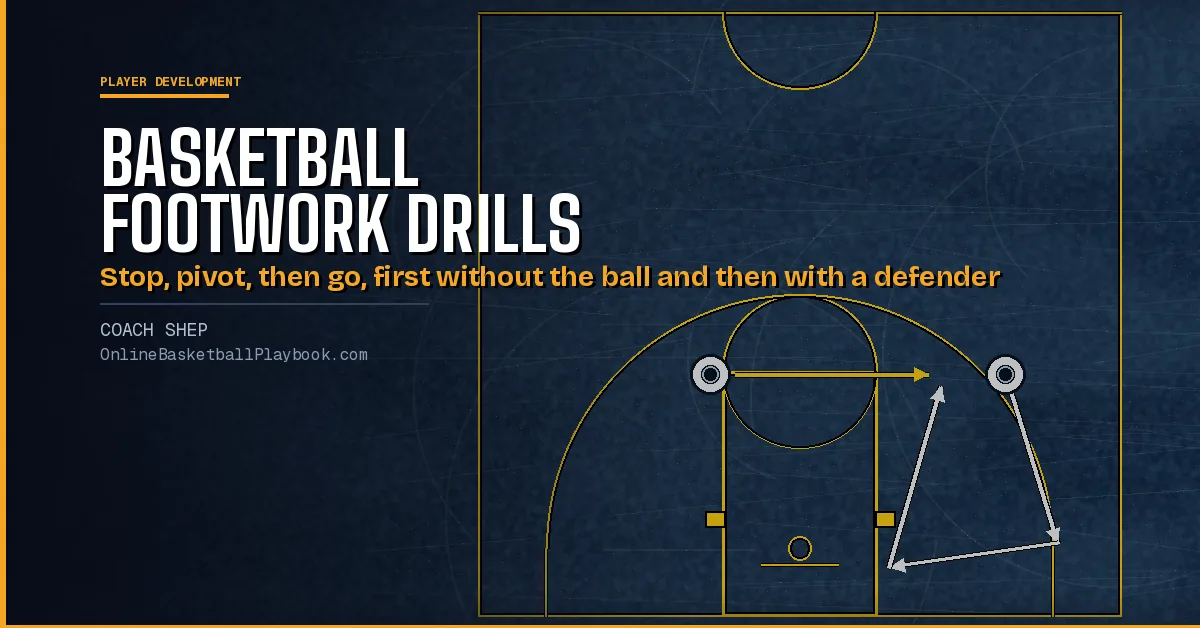
Basketball Footwork Drills for Teams and Individual Workouts
Basketball footwork drills for stops, pivots, cuts, jab moves and defensive slides, from the box drills to 30-minute workouts and where coaches differ.
Individual Basketball Workouts Mid Season
Individual Basketball Workouts Mid Season
Master Your Game with Our Top Basketball Skill Training Program
Master Your Game with Our Top Basketball Skill Training Program