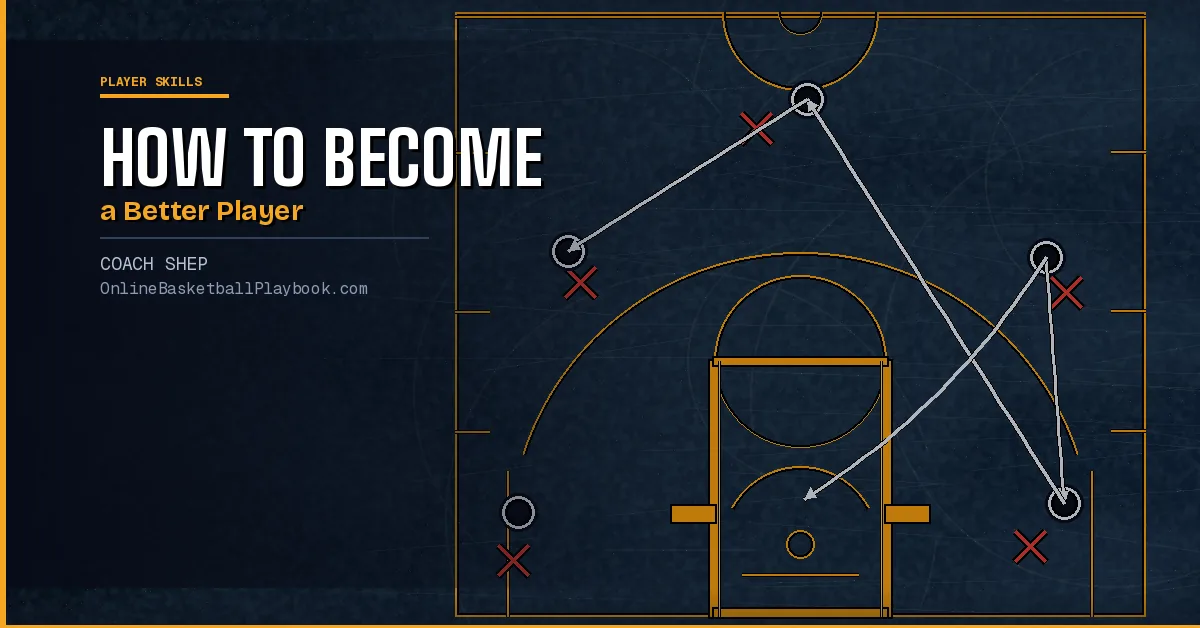
Getting better at basketball comes down to a handful of disciplines most players skip: structured workouts, deliberate repetition, and competing every day at game speed. This guide gives you the exact framework to develop faster.
Structure Your Workouts Like a Pro
The single biggest separator between players who improve and players who plateau is whether they go to the gym with a plan. Aimless gym time (shooting around, doing the same three moves) produces marginal results at best. A structured workout has a purpose, a sequence, and a way to measure results.
Every effective individual workout follows a part-to-whole progression. You introduce a skill in isolation (1-on-0), then add a coach or defender for reads and reactions, then push into competitive game situations. You don't skip to the end. You build the skill layer by layer until it holds up under pressure.
Equally important: your makes drive your reps, not your attempts. Instead of "do 50 pull-up jumpers," the target becomes "make 20 pull-up jumpers in 90 seconds." That structure forces quality and keeps your mind engaged. Every block has a number to beat and a recorded result. Keep a log. Date it. When you hit your numbers, raise the standard.
Pair your skills deliberately too. If you're working on your pull-up off the dribble, you're already handling, so add a shooting sequence directly off the dribble actions rather than isolating each skill in a silo. And shoot free throws tired, inside the workout, not fresh at the end when your heart rate is back to baseline. Free throws in games come when you're exhausted; train them that way.
Check out the full breakdown in our Basketball Player Development guide for drill progressions you can plug directly into your sessions.
Master the Fundamentals First
There is no shortcut past the fundamentals. The players who look smooth and effortless at the high school, college, or pro level got there by doing the boring work (shooting form, footwork, ball handling) thousands of times before it felt natural. If your fundamentals crack under pressure, no amount of athletic ability rescues you.
Shooting Form
Start with form before you start with range. Every great shooter has a repeatable, consistent release: the same elbow angle, the same follow-through, the same set point, every single time. If your basketball shooting form varies shot-to-shot, you're guessing, not shooting. Do form shots close to the basket first, then gradually extend your range as the motion locks in. Do not let bad habits bake in at distance.
The "form → move → game-shot" sequence matters here. Start with your footwork and form, layer in the dribble move that creates the shot, and finish on a real game action, a catch-and-shoot off a pin-down, a pull-up off a two-dribble attack. Your workouts should simulate exactly how you get your shots in live play.
Ball Handling
Ball handling is not just dribbling. It is reading defenders, creating angles, and making decisions under pressure, all while keeping the ball on a string. Daily ball handling drills build the touch and confidence needed to attack closeouts, beat traps, and make plays in traffic. Work both hands equally. Work at game speed, not workout speed. Your weak hand in a drill becomes your weak hand in a game.
Footwork
Most players underestimate how much footwork separates good players from great ones. Pivoting efficiently, establishing a legal gather step, getting into your shot quickly, sealing defenders in the post, all of it is footwork. Work on your basketball footwork drills as a separate emphasis in your sessions, not as an afterthought. The player with better footwork almost always wins the possession.
Build Your Basketball IQ
Skill gets you open. Basketball IQ helps you know what to do once you're there. Players with high basketball IQ read the defense before it reacts, make the right pass instead of the highlight play, and consistently put themselves in advantageous positions. This is a learnable skill, not just something you're born with.
The fastest way to build IQ is to study the game. Watch film, not just highlight reels, but possessions. Watch what happens away from the ball. Watch where help defense comes from. Watch how ball movement creates open shots. Then take what you see on film and test it in live play. Theory without reps is just theory.
Understanding basic offensive principles accelerates your IQ development dramatically. The motion offense framework, for example, teaches players to read defenders and make decisions based on spacing and movement rather than memorized routes. Once a player understands spacing and cutting principles, they stop being a passive participant in an offense and start being a decision-maker.
Defensively, IQ shows up in anticipation. The best defenders are rarely surprised because they've studied tendencies and understand help principles deeply. Reading a dribble screen, recognizing a flare cut, knowing when to jump a passing lane. These are all IQ skills that come from study and repetition. See our guide on Basketball IQ Development for a deeper breakdown on how to train this systematically.
Watch at least two full possessions, one offensive, one defensive, from the perspective of a player at your position every single day. Over a season, that compounds into hundreds of situations your brain has already processed and filed before you face them live.
Defense and Conditioning
Defense is the fastest way to earn more playing time, and conditioning is what allows you to play defense for 32 minutes instead of 12. Most players focus almost entirely on offense in their individual workouts, which is understandable, because offense is more fun to practice. But coaches play the players they can count on to compete defensively when it matters, and that means getting your conditioning and defensive habits right.
Defensive improvement starts with stance and positioning. A wide base, active hands, and disciplined foot movement are non-negotiable. You cannot guard anyone if you are upright and flat-footed. Then layer in help-side positioning, closeout technique, and communication, the team defensive elements that make individual defense effective within a system.
Conditioning should match what you need in a game. A basketball player does not run at a steady pace. The game is sprints, stops, direction changes, and recovery. Train accordingly. Suicide sprints, defensive slides, and transition drills are more sport-specific than steady-state jogging. Your basketball conditioning drills should have you working at game-like intensities with short recovery windows, not comfortable paces you could hold for twenty minutes.
Understand help defense principles at a deep level. Knowing where you're supposed to be when the ball goes to the wing, when to stunt, when to rotate, this is what allows a team defense to function. Individual defensive skill matters, but players who understand the system make everyone around them better. Study the help defense principles that coaches build their schemes around.
Compete and Track Your Progress
Practice without competition develops mechanics without results. You need to test your skills under pressure, against defenders who are also trying to win, in situations where there are consequences to mistakes. That competitive environment is what turns practice habits into game habits.
But competition alone is not enough. You also need to track your progress. Log your workouts: what you worked on, how many makes you hit, what you struggled with. Every few weeks, go back and look at where you were. Are your makes-per-minute going up on your shooting drills? Are you finishing at the rim at a higher rate? Tracking creates accountability and reveals the areas that need more attention.
Set specific, measurable goals for each session and each month. "Shoot better" is not a goal. "Make 70% of mid-range pull-ups off the dribble in a timed drill" is a goal. The specificity forces a clear result. You either hit the number or you didn't. That clarity drives real improvement faster than vague intention.
Compete in every drill, not just in scrimmages. If you're doing a shooting drill, race the clock. If you're doing a 1-on-1 finishing drill, keep score. The competitive mindset in practice translates directly to performance when the game is on the line. Players who coast through workouts tend to coast when games get hard.
Daily Habits That Separate Players
The players who improve fastest share a set of habits that have nothing to do with athleticism. They show up consistently. They work on their weaknesses instead of only doing what they're already good at. They ask questions and seek coaching. They take care of their body. These habits compound over a season and over a career in ways that talent alone cannot match.
Work your weaknesses every single session. If your left hand is your weak hand, start every ball handling session left-hand dominant. If you're a poor free throw shooter, shoot free throws at the end of every practice while you're tired. The discomfort of working a weakness is what eventually closes the gap. Comfort in workouts creates ceiling. Discomfort creates growth.
Seek out good coaching. A knowledgeable coach watching your footwork, your shooting form, or your defensive positioning can identify errors that you cannot see yourself. Error detection is one of the most valuable inputs in player development. If you don't have a coach in every session, film yourself and review the film. The camera doesn't lie about your balance, your release point, or your footwork.
Recovery matters more than most players treat it. Sleep, nutrition, and hydration directly affect your ability to perform and absorb the work you're putting in. A player who trains hard but sleeps five hours a night and eats poorly is competing against their own recovery. Take it seriously year-round, not just in-season.
Finally, understand your role and embrace it. Not every player is a scorer. Some players add value through rebounding, defense, passing, or simply being in the right place. Becoming excellent at your specific role (at the reads and habits and techniques required for that role) makes you far more valuable than a player who is average at everything but excellent at nothing. Study the game at your position, and go deep on what separates good role players from elite ones.
- Go to every workout with a written plan. Know what skills you're targeting before you touch the ball
- Track your makes, not just your attempts, and record results after every session to measure real progress
- Work your weak hand, weak foot, and weakest skills first in every session. Not last, when your energy is gone
- Shoot free throws tired inside the workout, not fresh at the end. That's when you'll shoot them in games
- Film one session per week and review it: check your footwork, your release, and your decision-making in live drills
- Study defensive positioning and help principles. Coaches give minutes to players they trust on that end of the floor
- Set a monthly measurable goal and evaluate it directly. Specific targets drive faster improvement than general intentions
Get free play diagrams, drills, and coaching guides delivered weekly.
Draw this play free in the play drawer →
Membership: the full library, playbook packs, and Pro drawing tools →
Keep Building
Related breakdowns
How to Get Better at Basketball: A Practical Guide
Getting better at basketball takes a repeatable structure, not vague effort. Here's how to actually train ball handling, shooting, conditioning, and basketball IQ, and how to schedule it without burning out.
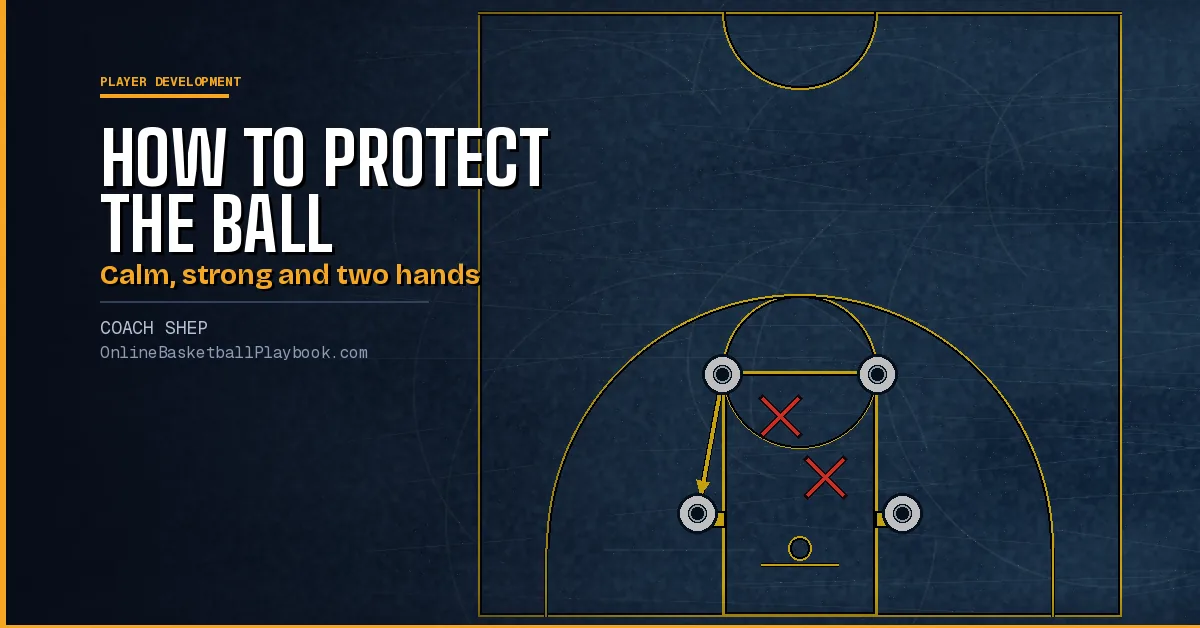
How to Protect the Ball: Ball Security and Fewer Turnovers
How to protect the ball in basketball: where turnovers come from, ripping and catching, the sure pass, beating a trap, ball security drills and pricing turnovers.
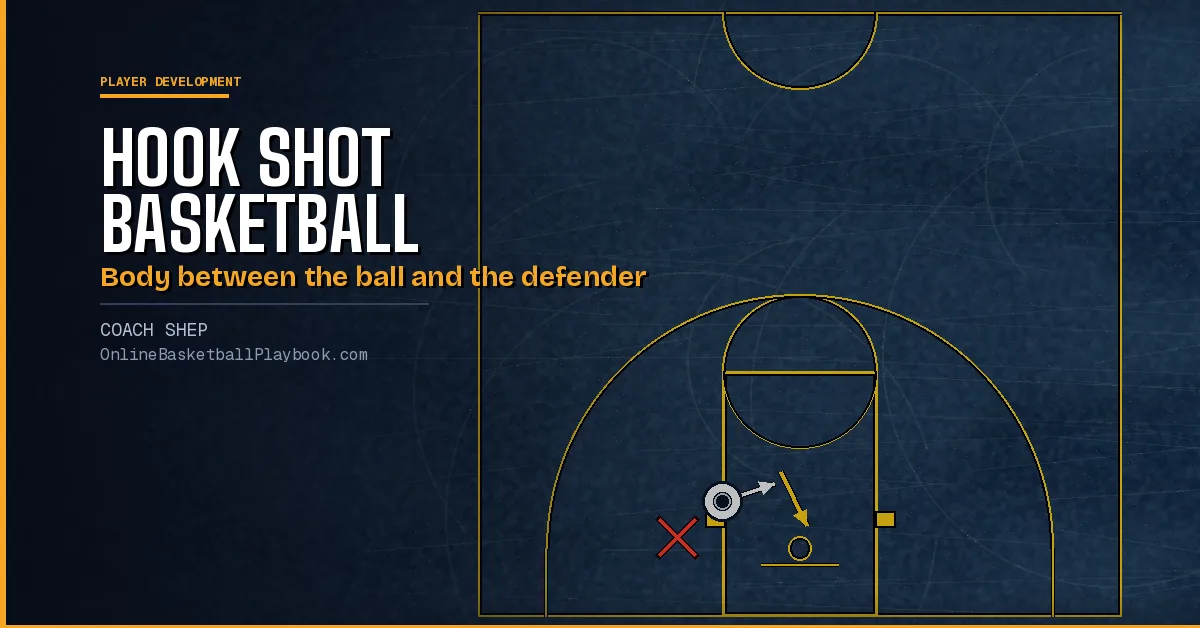
Hook Shot Basketball: How to Do It and How to Teach It
Hook shot basketball for post players and coaches: the classic hook, sky hook and jump hook, the footwork steps, when to use it, the pivot foot rules and drills.