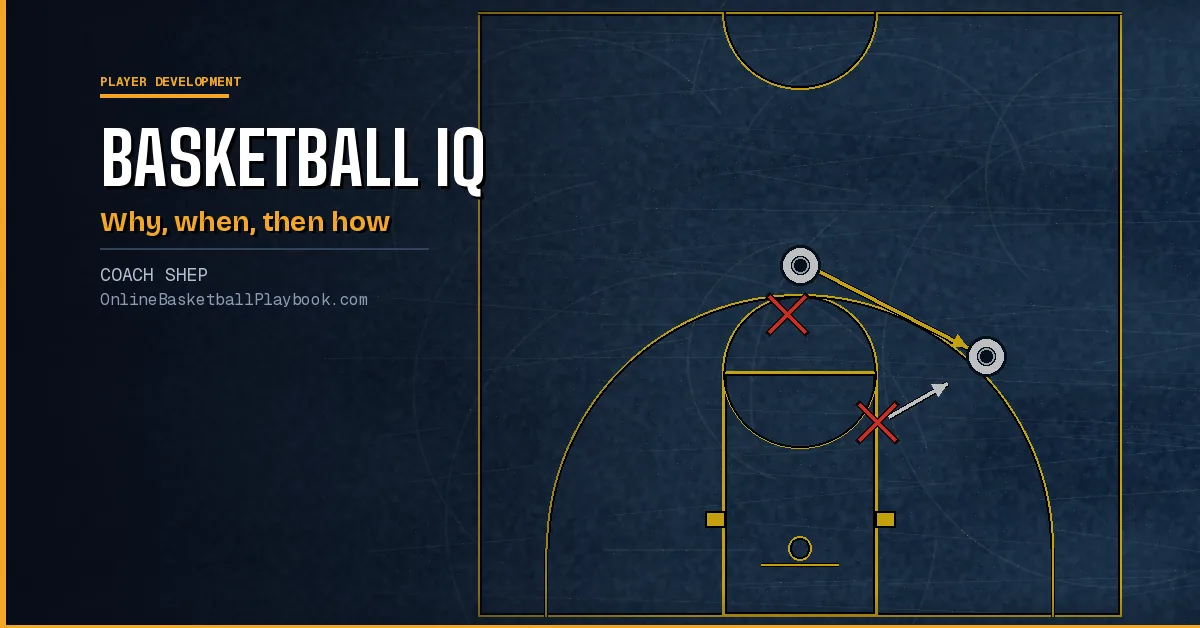
Basketball IQ is knowing why and when to use a skill, not only how to do it. A skill is worth little until a player applies it at the right moment, and once athletic ability evens out, reads, timing and situational mastery decide games. A high-IQ player reads small cues, sees the next moment coming, knows the score, the clock, the fouls and his own role, and handles the special situations at the end of quarters and games.
Basketball IQ is taught, not born. The drills and constraints that teach reads are on how to teach basketball decision-making, a shorter overview is on how to improve your basketball IQ, and the work that builds the skills underneath is on basketball workout plan in the player development section.
What Basketball IQ Means
Basketball IQ is reading small cues and acting on them before the play happens: the arc of a shot, an opponent's eyes, where a defender stands. It has been compared to a chess player thinking several moves ahead. The teaching frame has three parts:
- Why. The problem the action creates for the defense.
- When. The cue that tells the player it is time.
- How. The footwork and the skill itself.
A player who only knows how looks good in a drill line. A player who also knows why and when can find the right play when the defense takes away the first one. The working sequence for young players is short: see it, recognize it, react to it. Teach the read, repeat the decision and the habit follows.
Every skill you teach gets its why and its when on the same day as its how.
The Reads Players Learn
Basketball IQ becomes coachable once it is broken into reads. Teach these nine, each with a simple if/then:
- The on-ball defender. Before the catch, is he denying, sagging, ball-watching or overplaying? If he denies the pass, back cut.
- The driving lane. Is it open, and where is the help? Finish if the lane stays open, pass if the help commits, jump stop and reset if it closes.
- The help defender. On a drive he has to stay home or commit. If he stays, keep going. If he commits, a teammate is open.
- The closeout. A short, controlled closeout takes away the drive, a hard flying closeout is open to a shot fake and drive, and a defender who stays back gives up the shot.
- Screens. The defender trails, cut tight around the screen to the rim. He goes under, fade or pop. He jumps the lane, back cut. They switch, find the new matchup.
- Teammates and spacing. Do not bring your defender to the ball.
- Advantages. Recognize a 2-on-1 or 3-on-2 and make the simple play.
- Defensive reads. Why a defender rotates, helps or recovers, not only where he stands.
- Game situation. Score, clock, fouls and possession.

The closeout read starts before the ball arrives. The shooter reads the defender's distance and closing speed on the pass, so on the catch he already knows whether to shoot, dribble once away from the closeout or sell a pump fake and go. The wing's shoot-or-drive decision is the same read in a 2-on-2: shoot if the defender sags, drive and read the help if he closes out hard.

Teach one read at a time, and name the cue the player is looking for before you name the answer.
Think Ahead and the Game Slows Down
Quickness is mostly thinking. Anticipation is the key, and Larry Bird is the classic example of a slow-footed player who anticipated well. A player who analyzes his opponent knows what is coming:
- On defense, know his habits. Does he drive, spot shoot, play out of triple threat, go left or right?
- The defender sags. Expect the pull-up.
- The defender switches. Expect the screener to roll or pop.
- The defender fights through the screen. Drive and finish.

Thinking ahead also means moving efficiently. Straight lines and sharp angles beat arcs, and a defender closes about 15 feet per dribble, so cut down the dribbles. Do not hesitate: doing nothing is worse than doing something wrong.
Basketball is also a game of time. Five kinds of time run at once:
- Tempo. How fast a team plays.
- Rhythm. How the parts work in time with each other. John Wooden's line was "Be quick but don't hurry."
- Reaction time. A cut exists to destroy the defender's cushion and shorten his reaction time.
- Clock time. The game clock and the shot clock.
- Referee time. The counts an official keeps. Against a press, let the official place the ball after a score so teammates reach their spots.
Mike Krzyzewski puts it shorter: always think next play.
Teach players to see the next play before this one ends.
See the Whole Floor
High-IQ players read the whole floor, not just their own man. The contrast coaches draw is between "my turn" and "our turn" players:
- My turn. Dribbles the air out of the ball, forces shots, stands still off the ball and gets frustrated without it.
- Our turn. Sprints lanes and screens, cuts and spaces, passes up good shots for great ones and treats every possession as the team's.
Steve Nash, a two-time MVP, never averaged more than 13 shots a game. A point guard's IQ adds the details: control the tempo, always know time, score and possession, be the coach on the floor and use the scouting report. The full position job is on point guard play in basketball.
Know your teammates well enough to hit the right one at the right time.
Points Prevented
A stop is worth as much as a basket. Defensive IQ is awareness, and awareness can matter more than athletic ability.
- Awareness over athleticism. Brad Stevens says awareness can make a marginal athlete a very good defender, more than a great athlete with marginal awareness.
- Habits first. He puts 60 percent of awareness on practice habits and 40 percent on the opponent, and uses lots of 4 on 4.
- Freedom earned. He uses four levels of competence and gives players with "mature freedom" room to make reads.
- Sell it with a number. Butler was allowing 45 percent shooting, and three more stops a game would have made it 39.
- Stops bring you back. The best way back from ten or more points down is stopping the other team, not forcing shots.
A smart defender knows why he rotates, not only where to stand.
Rebounding Is a Read
Rebounding is anticipation. Assume every shot misses, since over 50 percent of field goal attempts and 35 percent of free throws do.
- Flight time. The 2 to 3 seconds between the release and the moment the ball can be rebounded. Great rebounders get position during it.
- Location. Where the ball lands depends on the shot's angle, its distance and the shooter's touch, and most long rebounds land opposite the shooter.
- The wing shot. A shot from the wing bounces to the opposite side about 70 percent of the time. Shots from the top of the key are the hardest to read.
- Guess every rep. Train the read by having rebounders guess the bounce direction on every rep. Dennis Rodman, as Isiah Thomas told it, counted the ball's rotations.

The technique half is on box out drills. Move while the ball is in the air, not after it hits the rim.
Shot Selection
Shot selection is the most visible IQ decision. A good shot passes five tests:
- High percentage for the player taking it.
- Expected by his teammates.
- Reboundable by two teammates.
- Leaves time for the defense to get back.
- Fits the time, the score and the situation.
Two limits come with it:
- Under 35 percent. A three is not a good shot for a player under about 35 percent from the arc.
- Flying closeout. It is not a good shot against a defender flying at the shooter, where a shot fake and drive is better.
To measure it, grade every shot Easy, Open (no defender within six feet), Contested or Bad. A good offense gets Easy plus Open above 50 percent, and a good defense holds the opponent to Contested plus Bad above 50 percent. The full guide is on basketball shot selection.
A good shot is a team decision, and the player who takes it should know why it was good.
Get the next coaching guide in your inbox
One email when a new guide or diagram set goes up. Free.
Score, Clock and Special Situations
Players should track the game state without being told: score, clock and fouls, so they know whether the team needs a two or a three. Situational mastery is the part of IQ that wins close games, and it covers end of game, out of bounds, free throws and the press. Rules of thumb players can carry:
- Fouls by the quarter. Keep personal fouls at or below the quarter number.
- Four-minute games. Break each quarter into four-minute segments and win each one.
- Two for one. Late in a period, shoot early enough to get one more possession.
- Up three, foul. Foul rather than let the opponent shoot a game-tying three.
- Guard only the arc. In a three-point game with almost no time left, guard only the three-point line.
- Let it go. Usually let a ball headed out of bounds under the opponent's basket go.
- Trapped in a corner. Bounce the ball off the defender's foot, or call timeout in a big spot.
Coaches split on the last shot of a quarter:
- Start at 8. Be in position at about 10 seconds and start the action at about 8, leaving time to shoot and crash for a second effort.
- Shoot at 4 or 5. Move into the offense near 10 seconds and get the shot up at 4 to 5, leaving time for a putback but not for the opponent to score. The common error is waiting too long and forcing a bad shot.
The plays for those moments are on last second basketball plays, and the coach's side of the clock is on basketball clock management. Rehearse the situation before the game hands it to you.
How to Teach Basketball IQ
Coaches agree that IQ is built. They differ on how, and most use more than one of these:
- Teach the read. Name the cue, repeat the decision and let the habit form.
- Play more. Cues like a defender off balance or no help behind him are absorbed through repeated live play, not individual skill work alone. Small-sided 2v2 and 3v3 games give players repeated read reps.
- Ask, don't tell. After the play, ask "What did your defender do? Where was the help?" and let players make mistakes instead of whistling every one, because decisions do not grow in a player who is afraid to decide.
- Watch film to learn. Watch with questions: how are they guarding ball screens, which shots are they allowing, are they keeping spacing, which matchups are they hunting?
- Know the scouting report. Let it change decisions, such as closing out an elite shooter differently from an elite driver.
- Know the system cold. A player who knows the offense, the defense, the rotations and the set plays is never lost and can fill another role.
- Keep the offense simple. Keep the offense simple and put the work into execution, so players have room to read.
Constraint games and advantage drills that force reads are on how to teach basketball decision-making. Whatever mix you choose, every practice needs reps where a player has to see something and decide.
Questions Coaches Ask
What is basketball IQ?
Knowing why and when to use a skill, not only how. A high-IQ player reads small cues, anticipates the next play, tracks score, clock and fouls, and handles special situations.
Can basketball IQ be taught?
Yes. It is built by teaching reads with simple if/then rules, by live small-sided play, by film watched with questions, and by asking players what they saw instead of telling them.
How do you improve basketball IQ as a player?
Watch games to learn rather than to enjoy, know your team's system and the scouting report, play more live games, and read your defender before you catch the ball.
What does high basketball IQ look like on defense?
Awareness: knowing why to rotate, help or recover, reading the opponent's habits, and treating a stop as worth as much as a basket.
What is the 70 percent rebounding rule?
A shot from the wing bounces to the opposite side about 70 percent of the time, so the rebounder on the far side moves toward the rim while the ball is in the air.
Want the printable playbook packs?
OBP Pro members get the premium playbook packs: the zone attack, out of bounds and practice plan PDFs, plus each new pack as it is finished. The membership page lists what is in each one. Or draw your own version free in PlayDraw.
See what OBP Pro includesMore Player Development Guides
- Competitive Shooting Drills: Scored Games and Records
- How to Protect the Ball: Ball Security and Fewer Turnovers
Back to Basketball Workout Plan and every Player Development page.
Keep Building
Related breakdowns
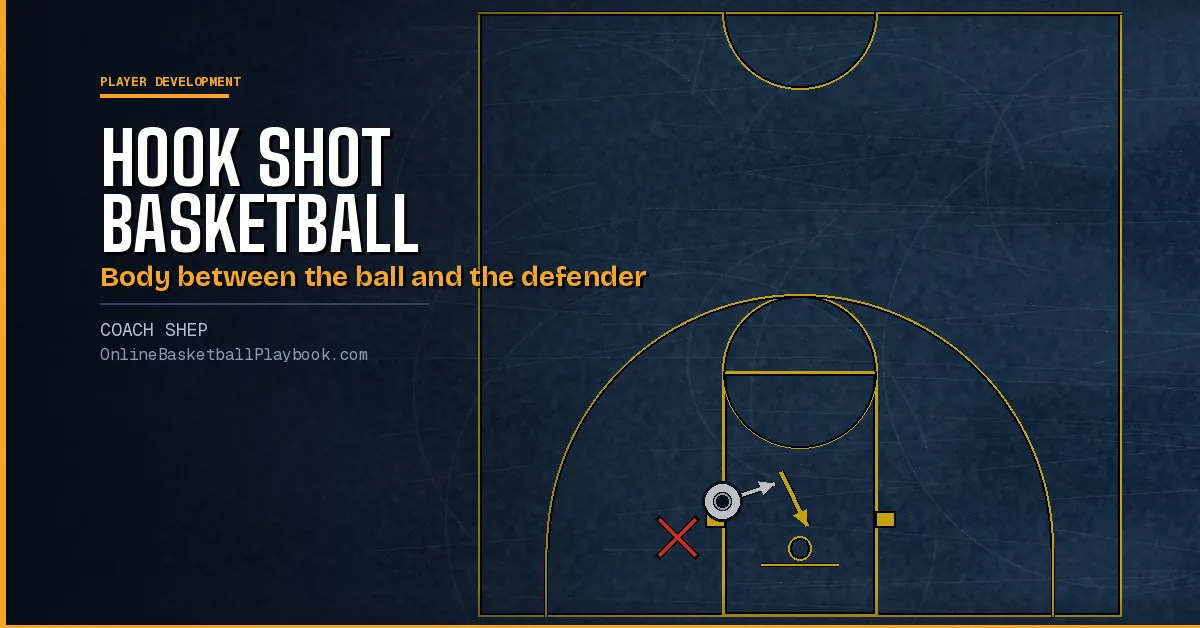
Hook Shot Basketball: How to Do It and How to Teach It
Hook shot basketball for post players and coaches: the classic hook, sky hook and jump hook, the footwork steps, when to use it, the pivot foot rules and drills.
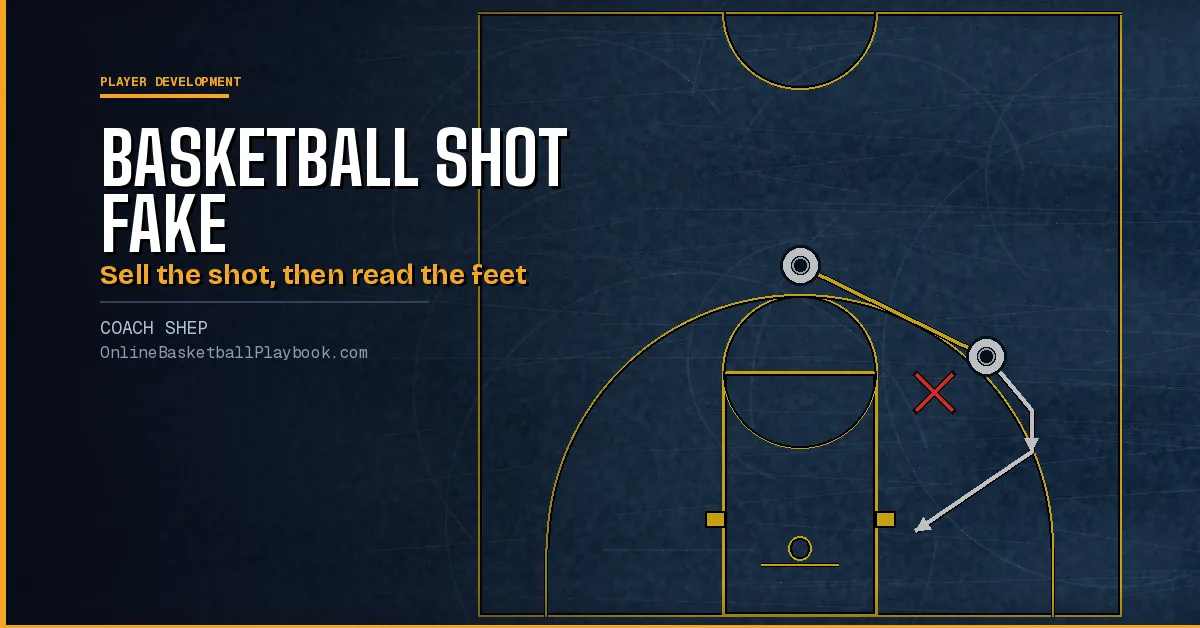
Basketball Shot Fake (Pump Fake): How to Do It and Teach It
The basketball shot fake, also called the pump fake, works when it looks like the real shot. The mechanics, the pivot foot footwork, the read and the drills.
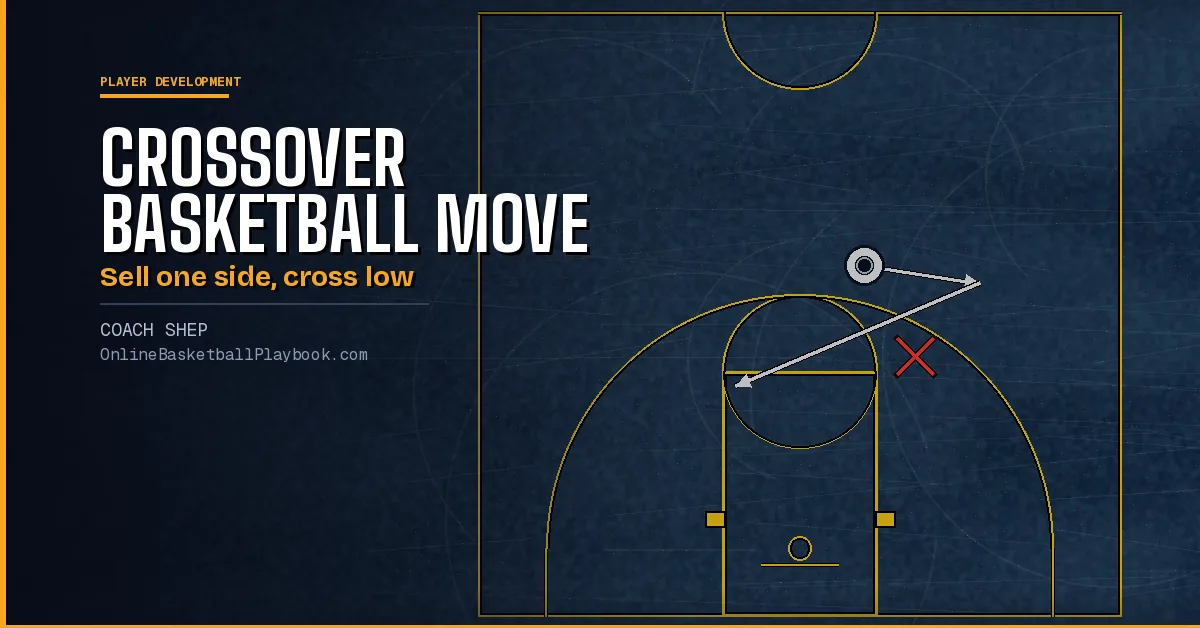
Crossover Basketball Move: How to Do It and Teach It
How to teach the crossover in basketball: the four steps, change of pace, footwork after the cross, the in and out counter, the read that follows and drills.