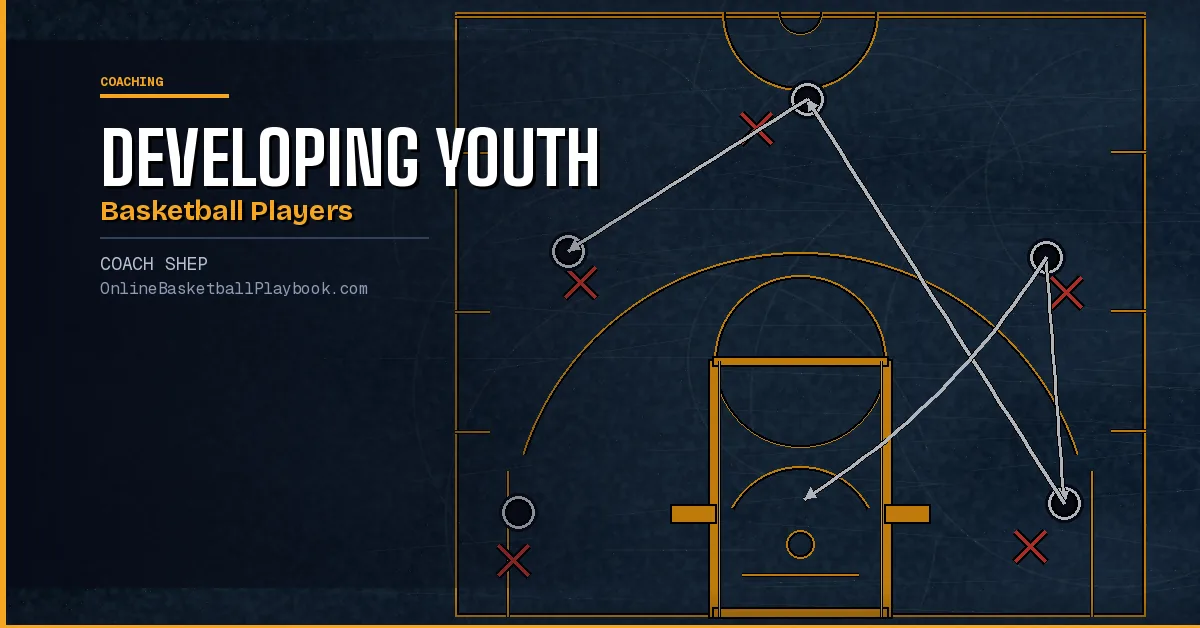
Developing youth basketball players starts with one truth: if they don't love the game, nothing else matters. Build fun, movement, and foundational skills in the right order and you'll create players who actually stick with the sport.
Why Fun Comes Before Everything
Every youth coach wants to teach defense schemes, run plays, and win games. Those instincts are natural, but they're also the fastest way to lose young players before they ever develop.
The research on youth sport dropout is consistent: kids quit when it stops being fun. Not when they lose. Not when it gets hard. When it stops being enjoyable. That means a coach's first job isn't to teach a crossover or explain zone defense: It's to make sure every single kid walks off the court wanting to come back.
Fun at the youth level doesn't mean chaos or lack of structure. It means active time over standing time. It means games over lectures. It means every kid touches the ball, every kid succeeds at something, and every kid leaves feeling better about themselves than when they arrived.
When you get this right, you don't have a motivation problem. Kids will practice in the driveway on their own. They'll ask their parents to sign up again next season. They'll become the self-driven players every coach eventually wants to coach.
When you skip this step and go straight to serious instruction, you might win a few more games at the eight-year-old level. But you lose the players by middle school. They burn out, check out, or drift to other sports that were more enjoyable when they were young.
Movement Before Basketball Skills
Before a young player learns to dribble, they need to be able to move. This sounds obvious until you watch a group of six-year-olds try to change direction and realize half of them nearly fall over every time they do it.
Young children have a high center of gravity and limited body control. They struggle to stop quickly, change direction under control, and coordinate their hands and feet at the same time. Teaching a crossover to a kid who hasn't developed basic coordination is like teaching advanced calculus before addition. The foundation isn't there yet.
The movement patterns that matter most at the youth level are push and pull, lunge and squat, bend and twist, throw and catch, jump, jog, and run. These aren't fancy athletic movements. They're the building blocks that athletes in every sport share. A coach who spends ten minutes per practice on agility, balance, and coordination is investing in a player's entire athletic future, not just basketball.
Once basic movement is solid, you layer in the simplest basketball skills: athletic stance, basic footwork, dribbling with the dominant hand, chest passes, and form shooting from close range. This is player development done right, building the base before the house.
Footwork is especially underrated at this age. A player who learns to jump-stop, pivot legally, and move their feet on defense early will have a massive advantage later. Most coaches skip footwork because it isn't flashy. The coaches who emphasize basketball footwork drills early are the ones who produce fundamentally sound players five years down the road.
How to Structure Youth Practice
Youth players have short attention spans, limited stamina, and no internal pacing mechanism. They will run until they drop and then crash. Practice structure has to account for all of that.
Sessions at the youngest levels (six to eight years old) should run 45 to 60 minutes maximum. Anything longer produces diminishing returns and cranky kids. The structure within that window matters as much as the length.
Put the most important new skill at the very beginning of practice, when attention and energy are highest. If you spend the first twenty minutes on a warm-up game and then try to introduce a new concept, you've burned your best teaching window on something that didn't require it.
Keep each activity to three to five minutes. Drill, then game. Drill, then game. The transition keeps energy up and prevents the glazed-over look that signals a kid has mentally left the building. Build your basketball practice plan around this rhythm and your practices will feel completely different.
Limit lines. Every minute a kid spends standing in a line is a minute they're not touching a ball, not moving, and not having fun. The ideal setup gives every player a ball for individual skill work. If you only have ten balls and twenty kids, reorganize your drills before you accept long lines as inevitable.
Always end on a positive note. A fun game, a team cheer, recognition of something a specific player did well. The last two minutes set the emotional tone for the drive home. If practice ends on a punishment drill or a lecture about mistakes, that's what kids remember.
Water Breaks Are Not Optional
Young athletes don't regulate body temperature the way adults do. They also don't recognize thirst reliably. Build scheduled water breaks into your practice plan every 15 minutes, regardless of whether anyone asks. This isn't softness. It's physiology.
Skill Progression by Age
Trying to teach the same skills to a six-year-old and a twelve-year-old is a mistake that wastes practice time and frustrates players at both ends. Development isn't just about size. It's about cognitive readiness, attention span, and motor control.
Ages 6–8: The FUNdamental Stage
At this age, the goals are simple: love the game, move your body, and learn to dribble with one hand. Players at this stage are egocentric. They're not truly reading teammates or opponents yet. That's developmentally normal, not a character flaw.
Decision-making should be reduced to two choices maximum. Shoot or pass? Dribble right or left? More options than that create paralysis, not learning. The game should feel manageable and achievable every session.
Ball handling drills, form shooting from five to seven feet, and simple passing games cover everything a six-to-eight-year-old needs. Defensive concepts can be introduced simply (get between your player and the basket), but don't expect real team defense at this age. Focus on individual on-ball effort.
Ages 9–11: Skill Building
Players at this age start to develop peripheral awareness and can begin reading simple situations. They can understand that passing to an open teammate is better than forcing a dribble, and they can start to learn off-ball movement.
This is when ball handling drills get more sophisticated: weak hand development, speed dribbling, and dribble moves under light pressure. Shooting form becomes a real focus, with emphasis on consistency and repetition rather than range. Basic screening actions and reading the defense become teachable concepts.
On defense, help principles can be introduced. A simple shell drill builds awareness of where teammates are and where help responsibilities come from. Keep it two-on-two or three-on-three before moving to full five-on-five defensive concepts.
Ages 12–14: System Introduction
Players in this range can handle more complexity. They can learn a motion offense concept, understand spacing, and execute a simple set play. They can learn basic defensive rotations and communicate on the court.
This is the age where a team can begin to look like a team, not just five individuals playing near each other. The habits built in the earlier stages pay off here. Players with good footwork, ball handling, and shooting form have the tools to absorb system-level instruction. Players who skipped those foundations struggle to keep up.
Guaranteeing Success for Every Player
One of the most important and most overlooked responsibilities of a youth coach is setting up situations where every player (not just the best player) experiences genuine success.
When the only way to succeed on your team is to be the most talented player, most of your roster never feels successful. They feel like passengers. And passengers quit.
Success has to be redefined at the youth level. A player who couldn't dribble without looking at the ball in September and can do it confidently in December has succeeded, even if they're still the ninth-best player on the team. A player who learned to set a legal screen, or make a crisp chest pass, or take a charge has succeeded. Track those individual wins and make them visible.
This requires knowing each player's starting point. You can't recognize growth you haven't measured. Take mental or written notes at the first practice: who can jump-stop? Who can dribble left? Who panics when closely guarded? Those baselines become your actual scorecards for the season.
A player's first two years in basketball largely determine whether they'll still be playing at sixteen. Make those years about belonging, growth, and love of the game, and the skill development follows naturally from players who want to be there.
Encouragement matters, but it has to be specific to land. "Good job" washes over kids. "That jump-stop was perfect. Your feet were set before you caught the ball" sticks. Specific praise teaches players what to repeat and signals that you're actually watching them, not just managing a group.
Limit criticism in the early years. Not because standards don't matter, but because a kid who feels criticized at eight years old shuts down. Use the positive coaching model: catch them doing it right, then redirect when they're wrong rather than calling out mistakes in front of the group.
Building Habits and Team Culture Early
The habits a player builds in youth basketball are the habits they carry into high school. Coaches who understand this treat every practice as a character-building opportunity, not just a skills session.
Effort habits (sprinting to position, communicating on defense, setting solid screens) can be expected and reinforced starting at age six. The technical execution will be imperfect. The habits of effort and communication can be real from day one.
Building basketball team culture at the youth level looks simple: celebrate teammates, take care of equipment, be on time, listen when a coach or teammate speaks. None of that requires advanced basketball knowledge. All of it shapes the kind of player and teammate they become.
Accountability at the youth level is gentle but real. Players should understand that the team counts on them (to show up, to try, to support their teammates). That's a developmentally appropriate version of building accountability without the pressure that crushes young athletes.
The goal of youth basketball development isn't to produce the best twelve-year-old players in the county. It's to produce eighteen-year-olds who have the skills, the habits, the love of the game, and the character to compete at the next level, in basketball and in life. Every decision in practice should be filtered through that lens.
- One ball per player: Eliminate lines and maximize touches every practice.
- New skill goes first: Teach when attention is highest, not after twenty minutes of warm-up.
- Two choices max: Keep decisions binary for players under age nine to build confidence, not confusion.
- Track individual growth: Know each player's starting point and celebrate measurable improvement, not just talent.
- End every practice on a win: A fun game, a cheer, or specific praise ensures players leave wanting to return.
- Movement before plays: Prioritize agility, balance, and footwork before any system or set-play instruction.
Get free play diagrams, drills, and coaching guides delivered weekly.
Draw this play free in the play drawer →
Membership: the full library, playbook packs, and Pro drawing tools →
Keep Building
Related breakdowns
Coaching Youth Basketball: Practices, Games and Parents
Coaching youth basketball for ages 6 to 14, with practice shapes by age, skills taught inside games, man-to-man defense, playing time, feedback and parent meetings.
Cutting Players: What to Say and How to Say It
Cutting players: what to say on day one, in the meeting and to parents, the words to use and avoid, what to hand the player, and how to keep the door open.
Coaching Communication: How to Explain Basketball to Players
Coaching communication for basketball: the teaching order, fewer and clearer words, how to correct a mistake, one team vocabulary and calls taught inside the drill.