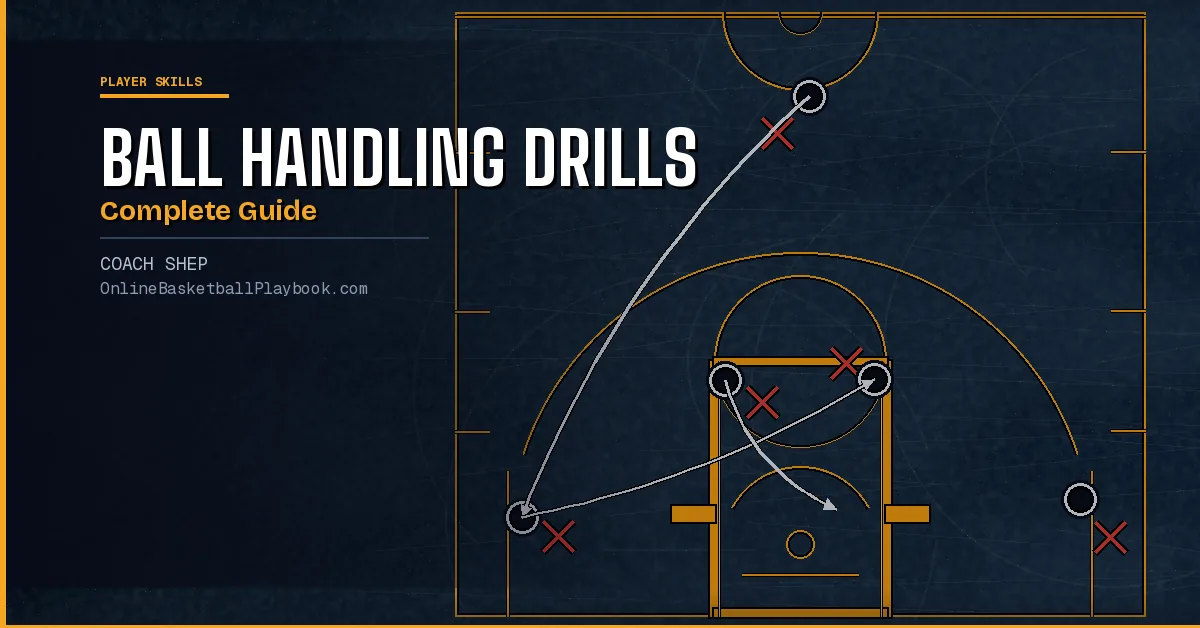
A reliable handle separates players who hesitate from players who attack. These drills build the dribble control, court vision, and change-of-direction speed every guard and wing needs to compete at the next level.
Why Ball Handling Is the Foundation Skill
Most players practice ball handling in isolation: a few Spider dribbles, some figure-eights, then they move on. That approach misses the point. Ball handling is not an end in itself; it is the tool that lets you read the floor, get into your spots, and make decisions without burning mental energy just to keep the ball alive.
The best guards in history, whether running an offense at the high school level or in the NBA, share one quality: the ball does not slow them down. Their handle operates on autopilot, which frees their eyes to scan the defense, identify cutters, and pick the right moment to attack.
That principle should shape every dribbling session you run. The goal is not to become a dribbling entertainer. The goal is to burn the handle into muscle memory so deeply that you never have to think about it during a game. When the ball handling is automatic, your mind is free to play basketball.
This guide organizes drills by category (stationary, two-ball, on-the-move, and live-ball decision work) so you can build each layer before combining them. Work through the sections in order when you are starting a new training block. Once the basics are solid, pull individual drills and insert them into your existing workouts.
Stationary Dribbling Drills
Stationary work is where technique is built. You cannot develop a clean crossover or a crisp behind-the-back dribble if your body position is sloppy. Every stationary rep should start in an athletic stance: feet shoulder-width apart, knees bent, back flat, eyes up. These are not optional details. They are the foundation that makes every other skill work.
Spider Dribble
Position yourself in your athletic stance with the ball on the floor between your feet. Dribble the ball in a pattern: right hand in front, left hand in front, right hand behind, left hand behind. The ball stays low and the pattern is quick. Do 30 seconds forward, then reverse the direction. This drill builds independent hand control and keeps you comfortable with the ball below your center of gravity, where it is hardest for defenders to steal.
Pound Dribble Series
Start with your dominant hand and pound the ball hard, elbow below the waist, fingertips controlling each bounce. Count 30 reps, then switch. From there, move to the crossover: hard pound with the right, push the ball low and flat across your body to the left, hard pound with the left, push it back. The key word is low. A high crossover is a gift to the defender. The ball should travel at shin height or below when crossing. Do 20 crossovers, then add a hesitation. One stutter dribble in place before each crossover. The hesitation mimics what you will do against a live defender.
Between-the-Legs and Behind-the-Back
Between-the-legs dribbling is a change-of-direction weapon, not a showboat move. Practice it while walking in place: step with the left foot, dribble through the legs with the right hand to the left, step with the right foot, dribble back through with the left hand. Keep your eyes forward. The moment you look at the ball, the drill stops teaching you anything useful for games.
Behind-the-back takes longer to groove. Start slowly: from a stationary stance, sweep the ball around your hip from right hand to left. Your right hand should be the initiator. It wraps the ball behind you rather than slapping it. Once the motion feels clean, pick up the pace and add a step-through to simulate turning the corner on a defender.
If the ball is bouncing above your waist during stationary dribbling drills, slow down and pound harder. Height is the enemy of ball security. A low, firm bounce is faster to control and much harder to deflect.
Two-Ball Handling Drills
Two-ball work is one of the most efficient tools in player development because it forces both hands to operate simultaneously. There is no dominant hand to lean on. Both hands are equally responsible, and your brain has to manage double the input. Players who commit to two-ball work for four to six weeks consistently report that their weaker hand catches up faster than they expected.
The first rule of two-ball dribbling: eyes up from the very first rep. Do not build the habit of looking at the balls. They are on the floor where you put them. Trust your hands and keep your chin up.
Simultaneous Pound
Both balls bounce at the same time, same height. Start with 30 seconds of stationary simultaneous dribbling. Then add a walk forward and back. Then add a side shuffle. The goal is to keep the rhythm perfectly synchronized. Any break in rhythm means one hand is slower than the other. That is the hand that needs more solo work.
Alternating Pound
Right ball hits the floor as the left ball reaches its peak, and vice versa. This is harder than it sounds because your brain wants to sync them. Stay with it. Alternating pound builds the kind of ambidextrous touch that lets you switch hands mid-attack without losing a step. Do 30 seconds stationary, then walk the length of the court and back.
Two-Ball Crossover
Cross both balls at the same time from right to left and back. Your stance needs to be wide enough that the balls have room to pass in front of your body. This drill is advanced. Do not rush to it until the simultaneous and alternating pounds are clean. When you can do 20 consecutive two-ball crossovers without looking down, your hands are starting to operate at the level you need for live-game ball handling.
Add the around-the-head and around-the-legs variations once the crossover is solid. The around-the-head drill (circling one ball around your head while simultaneously dribbling the other at your side) looks strange in the gym but does exactly what it is designed to do: it overloads the coordination system so that standard one-ball skills feel simple by comparison.
On-the-Move and Change-of-Direction Drills
Stationary and two-ball work build the foundation. This section is where you turn that foundation into a threat. Defenders are not cones. They read your hips, react to your speed, and try to force you sideways. These drills put you in motion and train you to change speed and direction without losing the ball or your balance.
Full-Court Change-of-Direction Series
Start at one baseline with the ball in your right hand. Attack at full speed for three dribbles, then execute a hard crossover and accelerate in the other direction for three dribbles, then between-the-legs, then behind-the-back. Each change-of-direction move gets one attempt. Do not hesitate, do not slow down before the move. The entire drill is done at game speed. Walk back and repeat with the left hand initiating. Do four to six trips per session.
Hesitation Dribble and Pull-Back
The hesitation is the most underused change-of-speed weapon in player development. Too many players rely only on change of direction. Change of speed is equally effective (often more so) because defenders have to honor your speed before they can honor your direction.
Practice this at half court: drive at a cone or a chair at three-quarter speed, then plant your outside foot hard and pause for one beat (the hesitation), read the imaginary defender, then decide: pull-up jump shot, one more dribble to attack, or pull-back to reset. The pull-back is the counter: one hard dribble back away from the pressure, then re-attack from a new angle. Training the read alongside the move is what separates skill work from real development.
Change-of-Angle Dribble
This drill teaches you to stop your momentum, fake one direction, go backward, and open up a new angle of attack. Start driving baseline, stop sharply, fake the continuation, then reverse your direction and push toward the elbow. Think of it as parallel-parking in reverse. You are using your body to clear space, then re-entering the lane from a different angle. Add this to your live-ball work once the footwork is clean.
Live-Ball Decision Drills
The most important shift in any player's development is the move from skill drills to decision drills. A player can do every drill in this guide perfectly and still dribble too much in games if they never practice reading and reacting with the ball in their hands. Live-ball decision drills bridge the gap.
One-on-Zero Skeleton Reads
Set up a passive defender (a coach, a teammate, or even a chair) and practice your reads in real time. Come off a simulated screen at the elbow. The defender is told to either go under the screen or fight over it. Your job is to read that choice before you catch the ball and react correctly: pull-up if they went under, drive if they fought over. Do not pre-decide. Let the read dictate the action.
The discipline here is coming to a stop and creating contact before your decision. Do not drift. Do not float. Stop your feet, feel the pressure from the imaginary defender, and then attack. Players who float through their reads in skeleton work will float through them in games.
Two-Dribble Decision Series
This drill has a strict constraint: you get exactly two dribbles from the catch before you must shoot, pass, or stop. Two dribbles. No more. The restriction forces you to make your decision before you pick up the ball, which is exactly what game-speed defense demands. Work through each spot on the floor (wing, elbow, slot, corner) and execute the two-dribble constraint from each one. Add a passive defender at the point of attack once the footwork is consistent.
Live-ball decision drills only work if you hold the constraint. The moment you allow a third dribble "just this once," you have taught yourself that the rule does not apply under pressure. It does. Keep the standard.
Putting It All Together: Sample Weekly Plan
Consistency beats volume. A player who does twenty minutes of focused ball handling four days a week will develop faster than a player who does a two-hour session once a week. The training effect compounds when the reps are frequent and the technique is clean throughout every session.
Here is a practical weekly structure for players in the off-season or during a training block between seasons:
Monday: Stationary Foundation (15 minutes): Pound dribble series both hands, Spider dribble, crossover series, between-the-legs walking drill. Eyes up every rep. If you look at the ball, start the set over.
Tuesday: Two-Ball (15 minutes): Simultaneous pound, alternating pound, two-ball crossover, around-the-head variation. Keep your chin up and your stance wide.
Wednesday: On-the-Move (20 minutes): Full-court change-of-direction series (four trips), hesitation and pull-back at half court, change-of-angle drill. Finish every rep with a decision. Shot or pass, not another dribble.
Thursday: Rest or Light Shooting: Let the motor patterns consolidate. Ball handling development happens during recovery, not only during the reps.
Friday: Live-Ball Decisions (20 minutes): Skeleton reads off screens, two-dribble decision series at all spots, finish with five-spot shooting on tired legs to simulate late-game conditions. This last piece matters because your handle has to hold up when you are fatigued, not just fresh.
Saturday: Full Integration: Combine all categories in one session. Start with stationary, move to two-ball, then on-the-move, finish with live-ball. This is your game-simulation session. Stay at game speed throughout and do not reset to slow down the reps.
Track your sessions. Note which drills broke down and where your weak hand lost its grip on the rhythm. Those are the spots that need extra volume the following week. Development is not linear, but consistent attention to your weaknesses closes the gap faster than any other approach.
- Eyes up on every dribbling rep. Looking at the ball in practice means looking at the ball in games
- Keep crossover and between-the-legs dribbles at shin height; a high dribble is a turnover waiting to happen
- Use two-ball drills to force your weak hand to match your strong hand. Four to six weeks of consistent two-ball work levels them out
- Train reads alongside moves: hesitation is not complete until you've made a decision at the end of it
- Finish every session with reps on tired legs. Your handle must work when the game is on the line, not just when you're fresh
- Hold the constraints in decision drills. Two dribbles means two dribbles, every time
Want drills, plays, and coaching tips delivered every week?
Join the Online Basketball Playbook Newsletter →Draw this play free in the play drawer →
Membership: the full library, playbook packs, and Pro drawing tools →
Keep Building
Related breakdowns
Basketball Drills for 10 Year Olds: Shooting, Handling, Offense
Basketball drills for 10 year olds: shooting drills and rim height, dribbling games, passing, footwork, layups, a simple offense and practice plans.
Why Players Miss Layups and How to Fix It
Why Players Miss Layups and How to Fix It
Basketball Ball Handling and Dribbling Workout
Basketball Ball Handling and Dribbling Workout