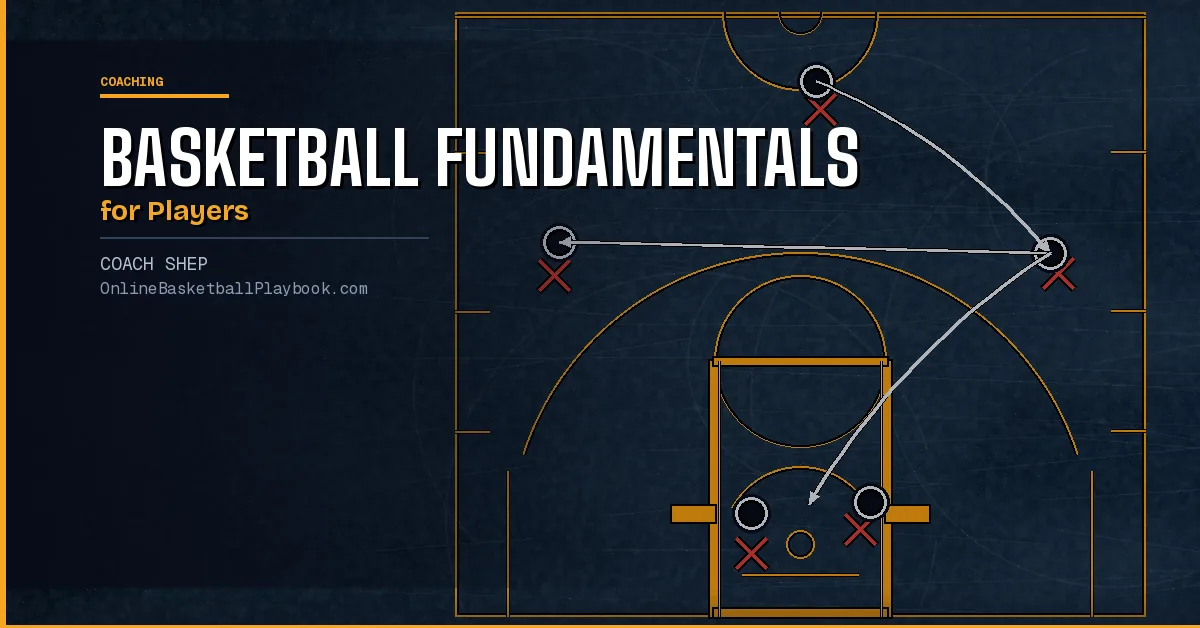
Every great player, from youth leagues to the pros, is built on the same foundation. These ten basketball fundamentals are the skills coaches look for first, practice most, and trust when games are on the line.
1. Shooting Form and Mechanics
No skill gets more repetitions in practice than shooting, and for good reason. A player who can score consistently forces the defense to account for them at all times. It opens everything else up on offense. But consistent scoring starts with consistent mechanics, and consistent mechanics require deliberate repetition before any game pressure arrives.
The foundation of a good shot is the same regardless of level: feet squared to the basket or slightly staggered, knees bent on the catch, elbow under the ball, guide hand on the side, and a full follow-through with the wrist relaxed. The release point matters. A higher release is harder to contest and more consistent. Players who shoot from too low or too far back in their motion lose accuracy under fatigue and pressure.
Good basketball shooting form also requires rhythm. The catch, the gather, the rise, and the release should be one connected motion, not a series of stops and starts. Players who are "mechanical" in a negative sense have broken that rhythm somewhere. Repetition in low-pressure settings ingrains the rhythm so it survives high-pressure moments.
Shooting from the mid-range, from three, off the dribble, and off pin-down screens all require slight adjustments to the base form. Start with the foundational set shot and form shooting close to the basket. Build range only after the form is locked in. If you want a deeper breakdown, the guide on how to shoot a basketball walks through the full progression step by step.
2. Ball Handling and Dribbling
The dribble is a tool, not a feature. Too many players dribble because they can, not because it serves a purpose. The first thing to teach is when to dribble: attack a gap, advance the ball in transition, escape pressure. The second thing to teach is how to do it without looking at the ball, so the player's eyes can stay on the defense and their teammates.
Strong ball handling drills train the hands and build the confidence to make moves under pressure. Low dribbles protect the ball. Crossovers, between-the-legs, and behind-the-back moves are only useful when the basic pound dribble and low dribble in traffic are already automatic. Players who lack that foundation will expose themselves under defensive pressure.
Ball handling is also about protecting the basketball. Every turnover is a possession lost and usually a defensive transition for the opponent. Teach players to keep the body between the defender and the ball, to dribble with the outside hand when driving along the baseline, and to pick up the dribble only when they have a clear outlet, never in traffic with no options.
Ball handling workouts done in isolation are useful, but they must be practiced against resistance to transfer. Use live 1-on-1 dribble-drive drills, shell drill progressions, and full-speed repetitions so players feel real defensive pressure before they see it in a game.
3. Footwork and Body Control
Footwork is the most underrated fundamental in basketball. The difference between a foul and a clean play is often one step. The difference between a blocked shot and an open look is a jab step. Players who move well with the ball and without it create advantages out of nothing, and they do it because their feet are disciplined.
The triple threat position is where most footwork begins. From triple threat, a player can pass, shoot, or drive with equal threat value. The jab step tests the defender. The rocker step draws the defender off balance. These moves require precise foot placement. A sloppy pivot foot turns a fundamental skill into a travel or a charge.
Consistent work on basketball footwork drills builds the muscle memory players need to move legally and efficiently under game pressure. Dropstep moves in the post, closeout footwork on defense, and jump-stop landings on the catch are all worth drilling in isolation first, then building into game-speed reps.
Body control, the ability to stop, change direction, and absorb contact without losing balance, separates good athletes from good basketball players. A player can be fast and still slow on the court if they can't stop and change direction efficiently. Lateral quickness, stopping on balance, and the ability to take contact while finishing at the rim are skills built through repetition and proper technique, not just raw athleticism.
4. Individual Defense
Defense is the fundamental coaches control most directly. Effort and technique, not talent, determine how well a player defends. That makes individual defense one of the most teachable and most evaluated skills in basketball. Coaches at every level will find playing time for a player who defends consistently, even if that player's offensive game is still developing.
The defensive stance is the foundation: feet wide, knees bent, back flat, hands active. From that stance, a player can slide laterally, contest shots, and recover on drives without fouling. Players who stand straight up on defense are always a half-step late and always reaching, which leads to fouls.
On-ball defense requires staying in front of the ball handler, forcing them baseline or toward help depending on the scheme. Off-ball defense requires awareness of both the ball and the offensive player, a concept trained through the shell drill, which is the best foundational defensive teaching tool in basketball. Help position, deny position, and closeout technique are all built through that drill.
Understanding help defense principles is essential for any player who wants to compete at a high level. Individual defense doesn't exist in isolation. Every player on the floor is responsible for helping teammates when they get beaten. A player who can guard their own player and be in the right spot to help is exactly what coaches are looking for.
5. Passing and Decision-Making
Passing is one of the clearest expressions of basketball IQ. A player who passes well sees the floor, respects their teammates, and understands timing. The best passers don't just make the safe pass, they make the pass that puts a teammate in a better position than they were in before they caught it.
The chest pass, bounce pass, and overhead pass are the three foundational throws. Each has a specific use case: chest and bounce passes for standard spacing scenarios, overhead passes for skip passes and outlet passes in transition. All three require stepping into the pass, throwing with both hands until the release point, and hitting the target in a catchable position, on the shooting pocket side, not behind them or below the waist.
Passing drills teach the mechanics, but decision-making drills teach when to use each pass. The biggest passing error most players make isn't a bad throw. It's a late decision. The read should happen before the ball is in the player's hands, not after. Pre-read the defense, see the opening, and deliver when the window appears.
Good passing also requires communication. Eye contact, verbal cues, and consistent footwork on the catch-and-release all reduce turnovers. Players who work through passing drills with full game-speed intensity build the timing and accuracy they need when the pass has to be right the first time.
6. Rebounding
Rebounding is the fundamental that requires the least skill and the most effort. Every player on the floor, regardless of position or offensive role, can contribute to rebounding if they want to. The player who boxes out on every shot, pursues the ball with two hands, and secures the possession before attempting an outlet is doing something coaches value highly.
Boxing out is the foundational technique: find your man, make contact before the ball hits the rim, create space between your body and the defender, and go get the ball. The box-out takes effort and body awareness. Many players watch the ball instead of doing the work first. Players who do the work first, even when they don't end up with the rebound, change the team's rebounding percentage dramatically over a full game.
Offensive rebounding requires anticipation and relentlessness. Reading where a shot is likely to miss based on the trajectory and spin, then pursuing that spot with both hands high, is a skill that takes repetition. Rebounding drills that create competitive situations, where effort is the determining factor, build the habit faster than any amount of explanation.
Defensive rebounding is about securing the possession and converting it cleanly. After the box-out, the rebounder should chin the ball, elbows wide, ball held firmly at chin height, before making any outlet decision. A careless outlet pass after a good box-out wastes the entire effort.
Coaches who build strong rebounding teams train it daily and grade it separately from other offensive and defensive metrics. Track offensive and defensive rebound percentage as its own stat in practice. Players respond to what gets measured. A team that outrebounds opponents consistently wins more close games. The extra possessions are the margin.
7. Basketball IQ and Court Awareness
Basketball IQ is the ability to process what is happening on the floor faster than the speed of the game. Players with high IQ make the right decisions before the defense can react. They know where their teammates are without looking, they anticipate rotations, and they understand how to use their positioning to create advantages for themselves or others.
IQ is developed through film study, through intentional repetition of read-and-react scenarios, and through playing with and against players who are ahead of you developmentally. The more a player understands the game conceptually, why a motion offense works, what the defense is trying to take away, when to use a screen versus reject it, the faster their decisions become under game pressure.
Court awareness is the spatial component of IQ. A player with strong court awareness always knows where the help defender is, where the nearest teammate is, and how many dribbles they have before they reach the sideline. That awareness lets them make decisions without looking, which is what separates players who play fast from players who just move fast.
Film study accelerates IQ development faster than almost anything else. Watching your own games back, not just highlights, but possessions where you made the wrong read, teaches pattern recognition that carries into live play. Even fifteen minutes of intentional film study per week, focused on two or three reads the player wants to improve, compounds over a season.
Developing basketball IQ is an ongoing process. It accelerates when coaches explain the why behind every drill and concept, not just the what. Players who understand the purpose of what they are practicing make better decisions in live play because they have a mental model of how the game is supposed to unfold, and they can adjust when it doesn't.
8. Conditioning and Athleticism
A player whose fundamentals break down in the fourth quarter due to fatigue hasn't fully mastered those fundamentals yet. Conditioning is the substrate underneath every other skill. The shooting form that looks perfect in a walkthrough has to survive 32 minutes of real defense. Footwork that is sharp in warm-ups has to stay sharp when a player's lungs are burning.
Basketball conditioning is best trained in ways that mimic the game: short explosive bursts, lateral movement, and full-court sprints mixed with recovery. Steady-state aerobic work has a place, but it shouldn't be the primary conditioning method for a sport built on repeated sprint efforts separated by short recovery windows. Train the energy system you'll actually use.
Athleticism (speed, strength, vertical, and lateral quickness) amplifies every other fundamental. A player who improves their first step becomes a better ball handler and a better defender at the same time. A player who gets stronger in the lower body improves both their rebounding position and their shooting stability under contact. Athleticism and skill development are not separate tracks.
Recovery is the other half of conditioning. Sleep, hydration, and nutrition determine how quickly a player can train again after a hard session. Players who neglect recovery accumulate fatigue across a season and see their fundamentals erode over time, not because they stopped working, but because the work stopped landing.
Basketball conditioning drills that incorporate the ball, like full-court layup sequences, transition drills, and competitive defensive slides, build conditioning and skill simultaneously. The player who stays in great shape arrives at every practice and game ready to learn and ready to compete. That reliability, maintained across an entire season, is what separates players who develop from players who fade.
9. Communication and Team Play
No fundamental on this list exists in isolation. Basketball is a team sport, and even the most individually skilled player has to communicate to succeed at the highest levels. Communication on defense, calling screens, talking through rotations, directing help coverage, is what separates a group of defenders from a defensive unit.
Talking on defense should be a non-negotiable standard set in the first week of practice. Call out screens. Name your man. Communicate switches. Help your teammates help themselves by giving them information in real time. Teams that talk are harder to score against, not because their individual defenders are better, but because the unit functions as a coordinated system where no one is ever left guessing.
Offensive communication matters equally. Setting screens with intent, calling for the ball at the right time, and acknowledging missed assignments all require a culture of honest, supportive communication. The pick-and-roll only works when both players understand the read. Motion offense continuity depends on players signaling cuts and reads before they happen: a nod, a look, a verbal call.
Team play is a skill that has to be coached explicitly, not assumed. Players who grew up in isolation-heavy environments have to learn to share the ball, trust teammates in open spots, and find satisfaction in the assist as much as the score. That shift in orientation requires consistent reinforcement from the coaching staff and a team culture that rewards the right behaviors, not just the ones that show up in the box score.
Building basketball team culture around communication standards creates an environment where players hold each other accountable without the coach having to drive every correction. When that culture is established, the team gets better even in the practices the coach isn't watching as closely.
10. Competitiveness and Mental Toughness
Every coach at every level has seen a player with elite physical tools who couldn't compete when the game got hard, and a player with average tools who outperformed expectations because they refused to back down. Competitiveness and mental toughness are fundamentals. They just aren't measured in the same way as shooting percentage or turnover rate.
Mental toughness shows up in specific moments: how a player responds after a bad turnover, whether they stay disciplined in a game they're losing by twenty, how hard they sprint on a fast break when they're exhausted. These are choices, and they become habits when practiced consistently in the training environment before games ever happen.
Competitiveness is not the same as aggression. The most competitive players are often the most composed. They stay process-focused when the result is going sideways, they make the next right play instead of forcing something to make up for the last mistake, and they bring the same energy to a scout-team rep in practice as they do to a rivalry game. That consistency is what coaches mean when they talk about a player being "wired right."
Mental toughness can be trained. Putting players in uncomfortable situations in practice (sprinting when they're already tired, shooting free throws after a conditioning set, finishing possessions when they're frustrated) builds the tolerance for discomfort that translates into clutch performance. The goal is to make game-level stress feel familiar, not surprising.
Coaches who build competitive practice environments, where effort and intensity are graded every day, not just on game nights, develop players who compete automatically. The basketball player development process has to include regular competitive stress so players learn how to manage it before the scoreboard matters. That preparation is what makes the difference when the game is on the line.
Don't try to coach all ten fundamentals equally in every session. Build a structured basketball practice plan that cycles through these areas, prioritizing the skills your team needs most and returning to each one consistently across the season.
- Shooting form must be locked in before adding range. Start close, build out.
- Ball handling under pressure is different from ball handling in isolation; train both.
- Defensive stance and effort are the first things to evaluate; technique is the second.
- Footwork errors cause travels, fouls, and missed shots. Drill it daily at game speed.
- Rebounding is an effort fundamental; grade it separately and hold every player accountable.
- Communication on defense is a standard, not a personality trait. Require it from day one.
- Conditioning must be trained through game-like work, not just distance running.
Get free play diagrams, drills, and coaching guides delivered weekly.
Draw this play free in the play drawer →
Membership: the full library, playbook packs, and Pro drawing tools →
Keep Building
Related breakdowns
Master Your Game: The Ultimate Basketball Workout Home Regimen
Master Your Game: The Ultimate Basketball Workout Home Regimen
Why Players Miss Layups and How to Fix It
Why Players Miss Layups and How to Fix It
Basketball Passing Fundamentals and Drills
Basketball Passing Fundamentals and Drills