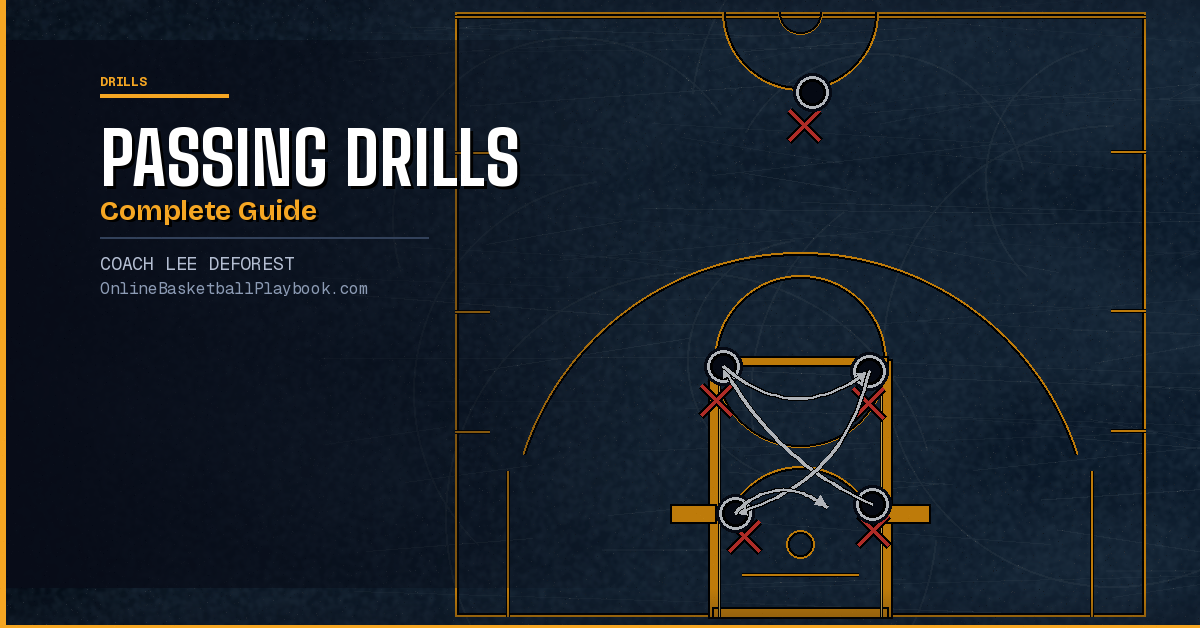

Passing wins games. The best offenses in basketball are built on players who make the right read and deliver the ball on time. This guide covers every drill category coaches need to develop sharp, decisive passers from practice day one.
Why Passing Drills Matter
Ask any coach what separates a good offensive team from a great one and the answer almost always comes back to ball movement. Turnovers kill possessions, slow your offense, and energize opposing defenses. Conversely, teams that move the ball quickly and accurately create the kind of open looks that make scoring feel effortless.
The problem is that passing is the most undercoached skill in basketball. Shooting gets reps. Ball-handling gets reps. Passing drills are often an afterthought — a brief warm-up before the "real" practice starts. That neglect shows up in games: players who telegraph passes, throw off-balance, stare down targets, or simply don't see the open man.
Deliberate passing drill work addresses all of that. When players practice passes under game-like conditions — pressure, movement, reads, fatigue — their decision-making sharpens. They start to see the floor differently. They anticipate. They throw passes that arrive early enough for the receiver to shoot off the catch, not after a dribble to re-balance.
Beyond mechanics, structured passing drills build trust. Players who have practiced finding each other in drill situations are more likely to trust each other in live action. That trust is the invisible ingredient in every high-assist offense.
"Constrain to coach the diet. Rules force behavior."
— Offensive Breakdown Drills, Basketball Vault
That principle is the heart of good passing drill design. You constrain the drill — limit dribbles, restrict the passing lane, require a catch-and-shoot — so the behavior you want becomes the only option. Players don't practice the right habit occasionally; the drill makes it mandatory every rep.
Fundamental Passing Drills
Before any team can run advanced read drills, the fundamentals have to be solid. That means mechanics: footwork on the catch, triple-threat positioning, pivot and pass sequencing, and the basic pass types. Skipping this layer and going straight to game-speed reads is like teaching algebra before arithmetic. Players look confused because the foundational movements aren't automatic yet.
Two-Line Passing
The classic two-line chest-pass drill gets dismissed as boring, but it's a high-volume repetition tool. Two lines face each other roughly 12–15 feet apart. Players exchange chest passes, emphasizing: stepping into the pass, thumbs rotating down on release, and catching with two hands and locking in a pivot foot. Run this for 90 seconds, then switch to bounce pass, then overhead. The key coaching point is catching in triple-threat every time, not letting sloppy catch habits creep in because "it's just a warm-up drill."
Partner Passing with Footwork Constraint
Same two-line setup, but now you add a footwork constraint. After each pass, the passer must sprint to a cone, touch it, and return to the line before the ball comes back. This takes the drill from pure mechanics into a conditioning context and forces players to catch under slight fatigue — which is far more representative of game conditions. You can layer in a pivot requirement: every catch must include a jab step before the next pass goes.
One-Hand-Behind-Back Passing
A simple constraint that pays big dividends: make players throw chest and bounce passes using only their weak hand. This exposes every mechanical flaw that the dominant hand has been masking. Players who look polished in two-hand drills will struggle here, and that tells you exactly where individual work is needed. Run this sparingly — five minutes per session — but run it consistently throughout the pre-season.
Stationary Passing Circle
Five or six players in a circle, one player in the middle. The middle defender must tip or steal each pass that goes skip-direction across the circle. The passer must read the defender's position and choose: throw the skip and test the defender, or find the safe pass around the circle. This is the simplest "read" drill in the game and a natural bridge between mechanics and decision-making.
Game-Speed Read Drills
Game-speed read drills are where passing skill actually transfers to live action. The defining feature of these drills is that the passer must make a real read — look at a defender, process a position, choose a target — rather than simply executing a pattern they already know is coming.
The best read drills share three traits. First, they isolate one decision. If the passer has to make three reads simultaneously, you're not training any of them effectively. Second, they operate at game speed. A drill run at 60% speed trains 60% speed decision-making. Third, they include consequences: a correct read leads to a score, an incorrect read leads to a turnover or a contested shot. Players take reads more seriously when there's something at stake.
Drive-and-Kick Reads (2-on-1)
One ball-handler drives downhill against a single defender. A shooter spots up in the corner. The driver reads the defender: if he collapses to stop the drive, the kick-out pass goes to the shooter. If the defender cheats to the shooter, the driver finishes at the rim. Simple binary read, but run at game speed with a live defender, it's demanding. Build volume by running continuous reps — five drives per player, track makes versus turnovers, keep score.
Skip-Pass Reading
Set up in a 5-out alignment: one player at the top, two wings, two corners. The top player drives middle, collapses the help, and skips to the weak-side corner. The corner shooter must be "ready before the pass" — feet set, hands out, eyes on the ball before it arrives. The coaching standard here is that every catch should be a shot or a live-ball catch in shooting position, not a fumble and reset. Run ten reps per player and track shooting percentage off the skip.
Overloaded Side Passing (3-on-2)
Three offensive players work against two defenders on the strong side of the court. The offense must move the ball to find the open man — either the skip to the weak side or a quick reversal through the high post. The constraint: no more than two dribbles per possession. This forces players to pass their way to open looks rather than creating off the dribble. Keep score: offense gets a point for a made shot off a two-pass-or-fewer possession; defense gets a point for a stop or a possession that requires three or more dribbles.
Scramble Passing (3-on-2 Outnumbered)
The classic scramble drill, sometimes called the Scramble or Texas 3-on-2, puts three offensive players attacking two defenders in transition. The first pass decision comes immediately — can the ball advance ahead to the wing, or does the defense force a slow-it-down reset? This outnumbered situation trains players to see and exploit numerical advantages before the defense recovers. Rotate defense in after each possession.
Advantage/Disadvantage Drills
Advantage and disadvantage drills are arguably the most transfer-rich category in basketball practice. They put players into situations where the numbers favor the offense (advantage) or the defense (disadvantage), forcing players to pass their way to the right outcome rather than relying on individual talent to bail them out.
The core insight behind advantage drills is that basketball is a game of constantly shifting numbers. A pick-and-roll creates a 2-on-1. A missed rotation leaves a corner shooter open. A defensive hedge gives the ball-handler a clear drive lane. Teams that read these situations and make the right pass exploit them. Teams that don't turn easy advantages into contested isolation attempts.
2-on-1 Full Court
Two offensive players advance against one defender to half-court, then the drill becomes live with a second defender sprinting back. The first pass decision must happen before the second defender arrives — usually a bounce pass to the trailing player for a layup or a pull-up. The constraint: the ball handler may take only one dribble after receiving the initial outlet pass. This forces the lead pass to be made early and accurately.
5-on-3 Shell Passing
Five offensive players in a 5-out set, three defenders in a shell alignment. The offense must complete four passes before shooting. Any pass that a defender touches — even without a steal — resets the count to zero. This drill isn't about fast decisions; it's about precise ball placement and reading defensive hands and positioning. Passes have to be on target, on time, and away from the nearest defender's reach. The reset penalty makes players think before they pass, not after.
4-on-4 Blood Passing
A competitive small-sided game with a strict rule: a drive must be followed by a kick-out pass. Players who drive and shoot — rather than drive and kick — turn the ball over. Scoring the drill works best with a simple ledger: +1 for a made shot off a kick-out, -1 for a drive-and-shoot, -2 for any turnover on a pass. The negative consequence for turnovers keeps players from throwing reckless skip passes just to get the ball moving. It teaches the difference between moving the ball and moving it wisely.
Full-Court Passing Drills
Full-court passing drills serve double duty: they build conditioning and they train the passing decisions that most directly reflect transition offense. Every fast-break situation in a game demands quick reads, confident outlet passes, and the ability to make accurate passes while moving at speed. Players who struggle with full-court passing drills will struggle in transition offense — it's that direct.
Three-Man Weave
The three-man weave remains one of the most effective full-court passing drills ever designed. Three players advance the ball end-to-end using only passes — no dribbling except the final two dribbles into the layup. The passing pattern (throw, run behind the receiver, cut to the outside lane) replicates the spacing and timing of transition offense. Common coaching errors: letting players drift instead of sprint after the pass, and accepting lazy passes that make the receiver slow down to catch. Demand sprint cuts and passes that lead the receiver toward the basket, not back toward the passer.
Outlet Passing Drill
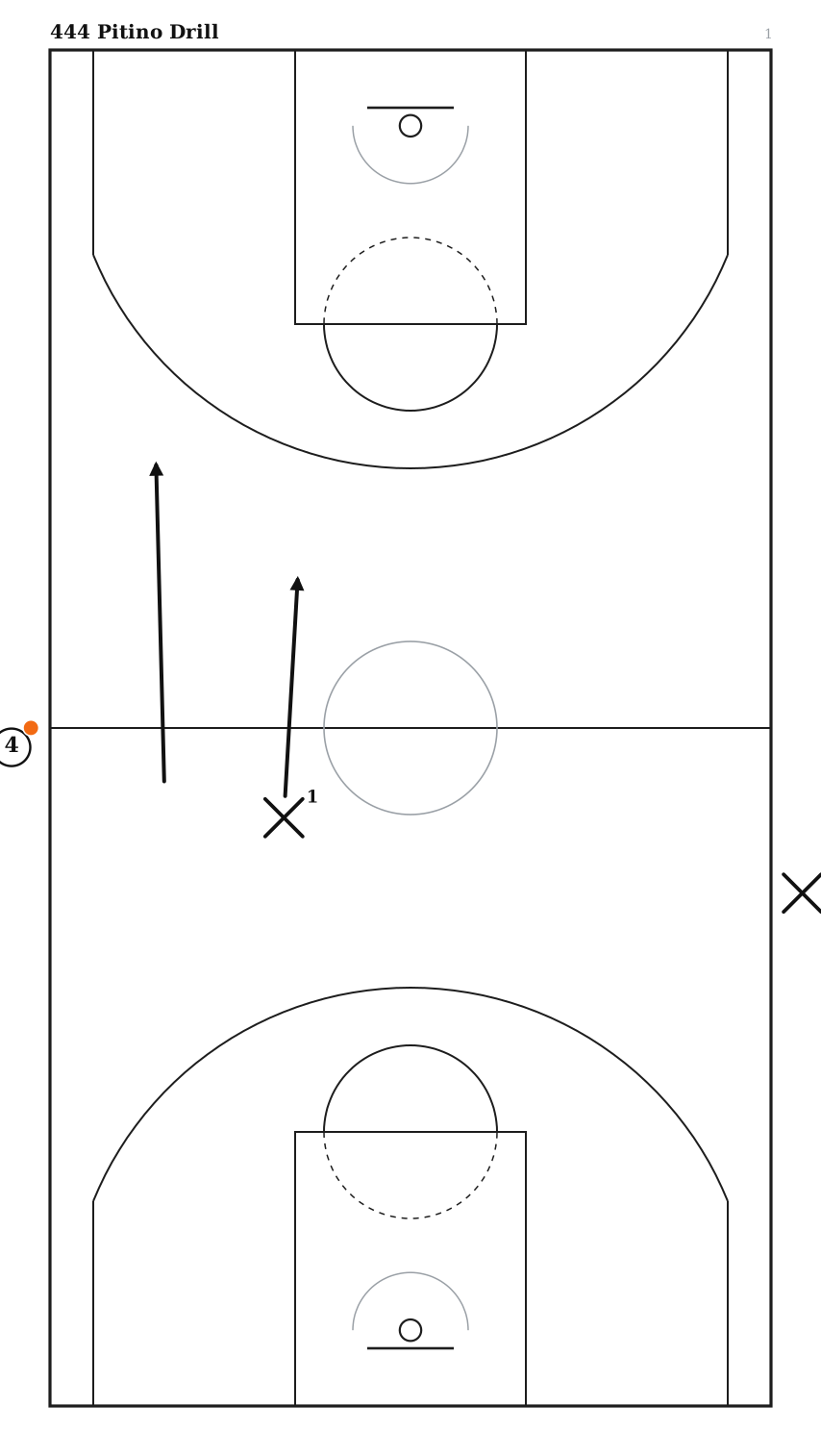
A rebounder catches a made or missed shot, pivots, and outlets to a guard who is already sprinting the sideline. The key teaching point is the guard's timing: he should be at the hash mark and moving away from the rebounder when the pass arrives. Players naturally want to stop and wait for the pass. Breaking that habit — running away from the ball and trusting the pass to catch up — is the difference between a slow outlet and a fast-break opportunity. Run this at both ends, alternating possession.
Full-Court Speed Layups with Passing Constraints
Two players run the floor from baseline to baseline. The ball must change hands at least three times before the layup attempt. Both players must be moving forward (no backwards passes) for every exchange. This builds the habit of advancing passes rather than safe lateral passes that stall the break. Track makes and misses: players who miss layups in this drill are also usually the ones who haven't earned a clean catch-and-shoot opportunity, so the data reveals both finishing and passing issues simultaneously.
Duke 21 Score-and-Recover Passing
A shooter receives a pass in the corner, shoots, then must sprint to touch half-court and return to defend before the next group attacks. The passer on the next rep must read the recovering defender and decide: throw early to beat the recovery, or wait and take the open shot. This scores-and-recovers structure turns every passing repetition into a live read under time pressure. It also builds the kind of conditioning that makes players' decision-making hold up in the fourth quarter when their legs are tired.
Building a Drill Progression for Your Team
The single biggest mistake coaches make with passing drills is treating them as a fixed menu — run the same two or three drills every practice without any deliberate progression. Players get comfortable with what they know, and comfort is the enemy of development. A well-designed passing drill progression has a clear arc: establish mechanics, introduce reads, add defenders, increase speed, then compress under competitive scoring.
Week one of pre-season should be almost entirely mechanics. Two-line drills, weak-hand work, circle passing. The goal isn't entertainment; it's repetition of correct technique until the movements are automatic. Players will be frustrated. They should be — this is where the bad habits get surfaced and fixed.
Weeks two and three introduce the first-level reads. Drive-and-kick. Skip-pass reading. Simple 2-on-1 decisions. The constraint here is that every drill should isolate exactly one decision. Don't stack decisions. If players are choosing between a drive-and-kick and a drive-and-finish at the same time as they're deciding which of three shooters to find, they're not training any of those decisions effectively — they're just playing basketball, which they were already doing.
Mid-season is when you introduce advantage/disadvantage drills and begin scoring the drills. Points for correct reads. Negative points for turnovers. Competition between pairs or small groups. The scoring layer is what takes a good drill and makes it great — players who are keeping score attend differently to every rep than players who are just going through the motions.
Late season, the drills should closely mirror the reads your actual offense requires. If you run a motion offense built on drive-and-kick principles, your passing drills should look like drive-and-kick reads. If your offense is built on skip passes and weak-side action, your drills should build those habits. The drill library should serve the offense, not the other way around.
One final principle: never let a drill run so long that the quality degrades. Five minutes of sharp, game-speed passing drills beats fifteen minutes of sloppy, fatigued reps. Set a timer. Keep intensity high. Rest between sets. Players who are tired and bored make the same mistakes every rep, and repetition of mistakes isn't practice — it's reinforcement of bad habits.
- One read per drill. Isolate a single decision — don't stack reads on beginners.
- Game-speed reps only. Slow drills train slow decisions. Set the pace standard before the first rep.
- Score every drill you can. Points for correct reads, penalties for turnovers — competition sharpens attention.
- Catch in triple-threat every rep. Hold the standard from day one; it becomes automatic by mid-season.
- Progress mechanics → reads → defenders → competition. Don't skip ahead; each layer depends on the one before.
- Quality over volume. Stop the drill when intensity drops; five sharp minutes outweighs fifteen sloppy ones.
Get more drill progressions, play diagrams, and coaching frameworks delivered to your inbox.
Join the Free Newsletter →See it drawn up
Related diagrams
Keep Building
Related breakdowns
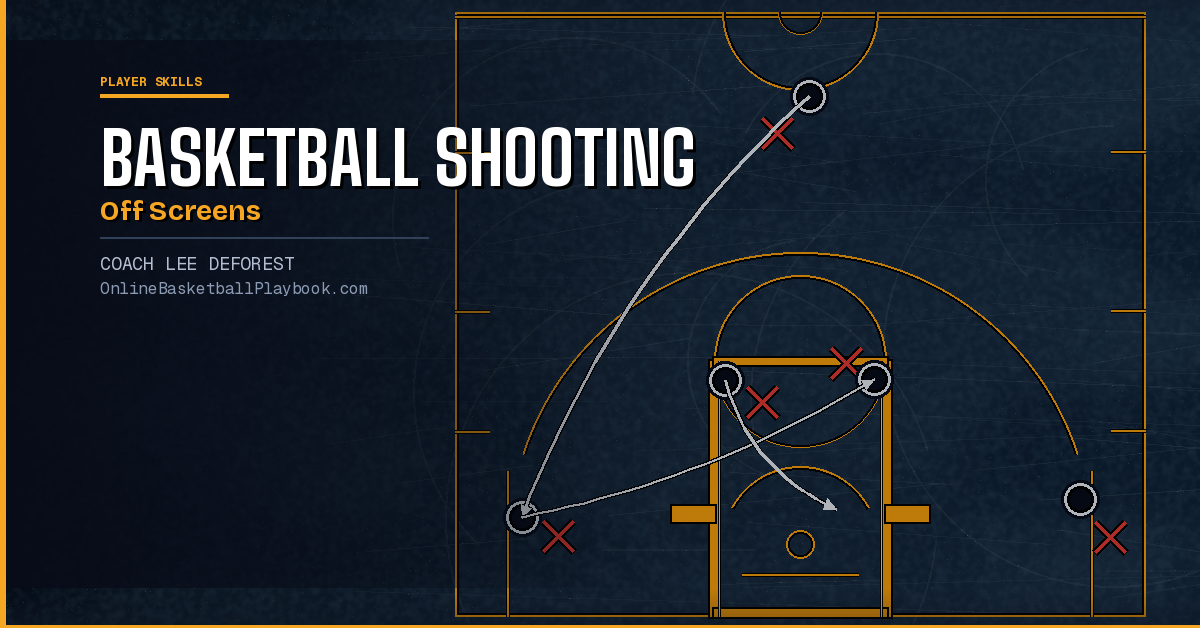
Basketball Shooting Off Screens: Complete Guide
Basketball Shooting Off Screens: Complete Guide
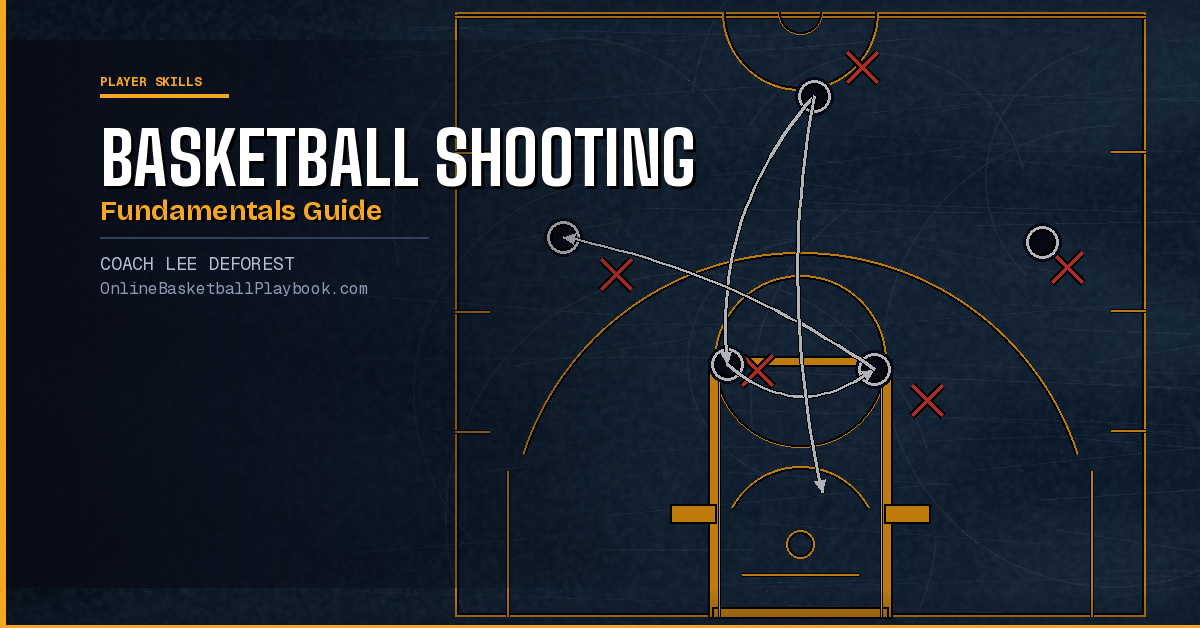
Basketball Shooting Fundamentals: Complete Coach Guide
Basketball Shooting Fundamentals: Complete Coach Guide