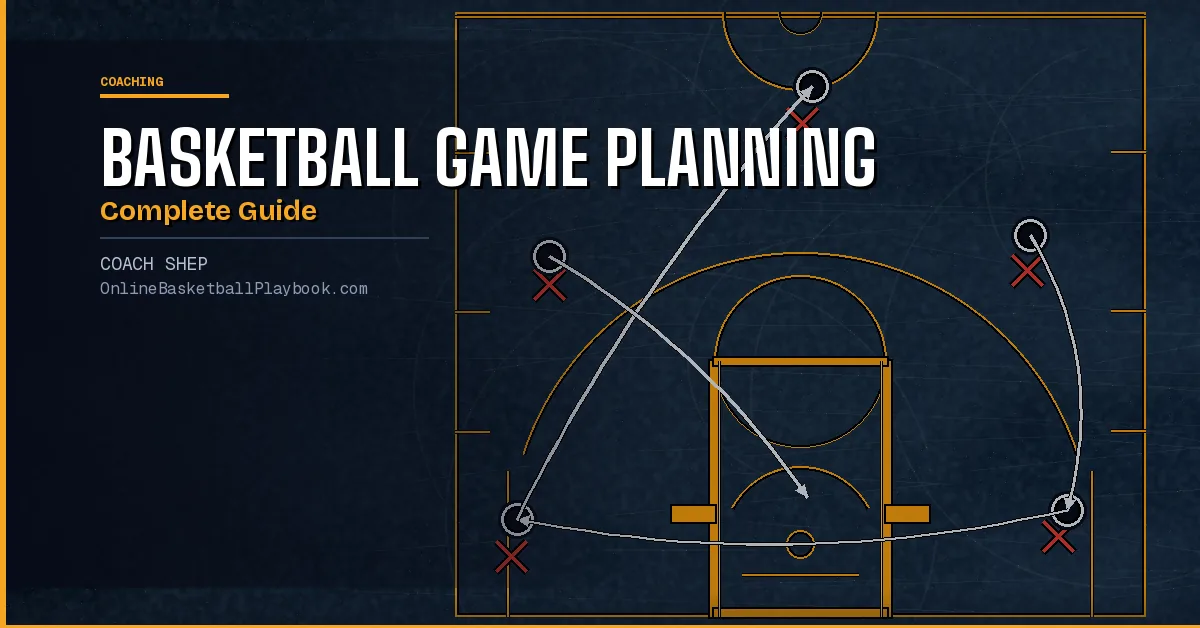
A sound game plan is the difference between reacting and competing. This guide covers scouting, offensive and defensive strategy, special situations, halftime adjustments, and the in-game decisions that determine outcomes.
Scouting the Opponent
Effective game planning begins with honest scouting. You need a clear picture of what the opposing team does well, where they struggle, and how they tend to respond to pressure. Scouting without a filter produces noise. Scouting with a clear checklist produces actionable intelligence.
Start with their offensive tendencies. Does the team like to run in transition or do they prefer to set up half-court actions? Where do their best scorers catch the ball? Who handles the ball under pressure? How do they attack ball-screen defense? These questions focus your preparation on what actually happens in games, not theory.
Defensively, identify how the opponent guards ball screens and post catches. Do they switch everything? Do they hedge hard and recover? Understanding their defensive scheme tells you which motion offense actions will create the most stress. A team that switches all ball screens is vulnerable to slip actions and skip passes. A team that hedges hard is exploitable with the roll man on the short roll.
Compile a short scouting report: three offensive tendencies, three defensive tendencies, and their key personnel matchups. Resist the urge to hand your players a ten-page document. The most useful scouting reports are one page. The information players can recall under game conditions is what matters, not the volume you collect.
Film review should be purposeful. Watch two or three recent games. Look for repeated patterns, not outliers. If a team runs a specific baseline out-of-bounds play every quarter, that is worth preparing for. If they hit one lucky half-court shot all season, ignore it. Your preparation time is finite. Spend it on what is repeatable.
Building Your Offensive Plan
A strong offensive game plan starts with your personnel, not your playbook. Before considering what action to run, ask which of your players creates the biggest advantage against this opponent's defensive personnel. Offense begins with identifying the mismatch and designing actions to expose it repeatedly.
The best offensive game plans are simple. Fewer actions, executed with precision, beat a wide variety of plays run with hesitation. Players should not be recalling what play comes next. They should be reading the defense and reacting. This is the heart of basketball IQ development: your system must be simple enough that players can apply it, not just rehearse it.
Pace and Spacing
Decide early in the week what pace you want to play at. If your team is longer and more athletic than the opponent, pushing tempo is logical. If the opponent is physically superior, slowing the game reduces their possessions and keeps the game manageable. This decision should influence your practice schedule. If you want to run in transition, you need to spend time on fast break execution and outlet passing before Wednesday.
Spacing is the foundation of half-court offense. Regardless of the set plays you install, your floor spacing principles must be sound. Five-out spacing creates the most driving lanes and keeps help defenders from loading up. If your personnel can shoot from the perimeter, use it. If not, prioritize spacing that keeps the paint clear for your best driver.
Targeting the Defense
Once scouting reveals a defensive tendency, your offensive plan should have a specific counter. Against a team that runs a 2-3 zone defense, you want to attack the gaps on the wings, move the ball quickly, and look for the high-post entry that collapses the zone's middle. Against man-to-man, you want ball movement and off-ball cuts to tire defenders. Your plays should not be random. They should be targeted weapons against the specific weaknesses scouting identified.
Choosing and Installing Your Defense
The defensive game plan answers one question: what do we need to take away from this opponent? Not everything, just the things that hurt you most if left uncontested. Build your defensive scheme around that answer.
Personnel matchups matter here as much as scheme. Assign your most disruptive defender to the opponent's primary ball handler or leading scorer. Force them to their weak hand. Make them catch the ball where they don't want it. These are simple decisions that pay dividends across forty minutes without requiring complex scheme adjustments.
Deciding on Primary and Secondary Defense
Most teams use a primary defensive scheme and a secondary look. Your primary defense should be your best-executed system, whether that is man-to-man, zone, or a combination. The secondary defense is designed to disrupt rhythm, speed up the offense's decision-making, or protect a foul situation. Many coaches keep a full-court press defense as their secondary look to apply after made baskets in key moments.
Help defense principles must be consistent regardless of the scheme. Every player needs to know their help responsibilities, who rotates when the ball penetrates, and how the team closes out on shooters. Drilling the help defense principles that anchor your system is more valuable than installing a new play. Defense is trust. Players must trust that when they take away the first option, a teammate takes the second.
Defending Their Best Actions
After scouting, you identified the opponent's top two or three offensive actions. Now you install specific coverages. If they rely heavily on ball screens, walk through your ball-screen defense coverages in practice. If they run a lot of baseline cuts, emphasize your weak-side help principles. This targeted preparation is more effective than general defensive principles rehearsed in isolation.
Do not over-install. Two or three specific defensive adjustments, repped at game speed, are worth more than seven half-learned coverages. The game plan works when players make the right read automatically. That requires repetition, not volume.
Special Situations Every Team Must Prepare
Special situations are where underprepared teams lose games they should win. Last-possession scenarios, out-of-bounds plays, press breaks, and end-of-quarter situations are all predictable, yet most teams spend far too little practice time on them.
Your team should have a defined play for every end-of-game scenario: trailing by one with eight seconds, tied with four seconds, up two with twelve seconds and the opponent inbounding. Walk through these situations in practice, not just the play itself but the clock and foul management decisions that surround them. Players should execute these moments on autopilot.
Baseline and Sideline Out-of-Bounds
Every team needs at least two baseline out-of-bounds plays and one sideline out-of-bounds play. Basketball inbounds plays are some of the highest-leverage possessions in the game. You have a stationary ball, time to set a screen, and a clear starting position. Yet many teams run the same look every time and get it scouted by halftime. Rotate your sets and make sure each player knows their role in all of them.
Press Break
If the opponent runs a full-court press at any point, your team must have a practiced press break ready. A press break is not just about getting the ball up the floor. It is about attacking the press aggressively enough that the opponent stops running it. Teams that break the press confidently and immediately push for the advantage remove the press as a tool. Teams that panic and call time-out reward it.
Foul Situations and Clock Management
Know the foul situation and bonus timing before every game. Establish with your team the minutes of the half when fouling intentionally is and is not on the table. Set a simple rule: when we are down X points with Y minutes left, we foul. Remove the in-game calculation so the decision is automatic and consistent.
Halftime Adjustments and In-Game Management
The halftime adjustment is one of the most misunderstood moments in coaching. Most coaches try to do too much. The best halftime adjustments address one or two concrete issues, not a complete overhaul of what you installed all week.
Before you can adjust, you need honest data from the first half. What shots did the opponent get that you didn't account for? Where did your offense break down? Was it execution, personnel matchups, or scheme? Differentiate between a scheme problem and an effort or focus problem. Over-adjusting scheme when the real issue is concentration is a coaching mistake that compounds confusion.
In-Game Timeouts
Use timeouts strategically, not reactively. Stopping a run of five or six unanswered points is a legitimate use of a timeout, but only if you have something specific to say. A timeout where you walk to the huddle without a plan wastes the possession and fails to reset your team's energy. Before calling timeout, know your message and your next possession action.
Timeout conversations should be short. Three things maximum: what the defense is giving us, what we are running, and a word on defensive assignment for the next trip. Players cannot absorb detailed instructions in sixty seconds. Keep it simple, keep it confident, and get back on the floor.
Substitution Patterns
Game planning includes knowing your substitution rotation in advance. Who comes in when the starter needs rest? Who plays alongside whom? Matchup-based substitutions in the middle of a game can disrupt chemistry. Plan your substitution groups before tip-off so you are managing them, not reacting to them. Build your bench rotation into the basketball practice plan during the week so those groups have real reps together.
Implementing the Game Plan in Practice
A game plan that never gets repped is not a game plan. It is a document. The translation from film room to gym floor is the most important step, and it requires disciplined practice structure and honest prioritization of time.
Early in the week, focus on your team's base offense and defense. Install any new set plays or scheme adjustments in the middle of the week when players have enough context to absorb them. Reserve the final practice before the game for walk-throughs of the opponent's specific tendencies, your out-of-bounds sets, and special situations.
Teaching the Why, Not Just the What
Players execute the game plan better when they understand why an action works, not just how to run it. If you are screening the weak-side defender on the baseline inbounds because their help rotation is slow, tell your players that. When they see the rotation start to tighten in a game, they will self-adjust because they understand the logic behind the action.
This is the difference between a team that can run plays and a team that can play. Teaching the reasoning turns your game plan into a living decision framework, not a script. Effective basketball practice structures time around decision-making, not just repetition of mechanics.
Scouting Report Walkthrough
Dedicate fifteen to twenty minutes per week to a film or walk-through session where players see the opponent's key actions with their own eyes. Show them the ball-screen coverage you will use, then rep it against a scout team running the opponent's actions. Hearing about a tendency is one layer of preparation. Seeing it and defending it against live motion is the layer that sticks under game conditions.
Keep the scout team's execution honest. If the opponent runs a specific action well, the scout team should run it with purpose, not casually. The goal is to give your players a realistic preview so game night feels familiar rather than foreign.
The most common mistake in game planning is installing too much. Your players can execute three offensive actions with confidence or ten with hesitation. Confidence wins games. Cap your game plan at what your team can truly own by tip-off, then execute it relentlessly.
- Scout with a checklist: three offensive tendencies, three defensive tendencies, and key personnel matchups. Keep it to one page.
- Match your offense to your personnel first: identify which of your players creates the biggest mismatch, then build actions around that advantage.
- Drill special situations every week: last-possession scenarios, inbounds plays, and press breaks should be automatic, never improvised.
- Keep halftime adjustments to two things: identify the one or two concrete issues and address those. Do not rebuild the game plan in fifteen minutes.
- Use timeouts proactively, not reactively: stop runs early and come in with a specific message and next-possession action ready.
- Rep the game plan at game speed: use a scout team running the opponent's actions at full speed so your players see and defend real situations, not walk-throughs.
Get free play diagrams, drills, and coaching guides delivered weekly.
Draw this play free in the play drawer →
Membership: the full library, playbook packs, and Pro drawing tools →
Keep Building
Related breakdowns
Basketball Season Planning: The Four Phases of the Year
Basketball season planning: plan backward from March, the four phases of the year, the post-season review, summer plans, preseason install and the in-season week.
High School Basketball Coaching: Complete Guide
High School Basketball Coaching: Complete Guide
Basketball for Beginners: Complete Skill Guide
Basketball for Beginners: Complete Skill Guide