
Inbounds plays are free possessions — your offense controls the spot, the start time, and the spacing. Use them right and you manufacture layups, open threes, and easy post touches from dead balls most teams waste.
SLOB vs. BLOB: Why the Design Logic Differs
Coaches often treat sideline and baseline inbounds as interchangeable sets — same players, same reads, same blocking schemes. That's a mistake. The two situations share vocabulary but not logic, and the differences are significant enough to demand separate design thinking.
On a baseline inbound (BLOB), your offense is operating directly beneath the basket. You have less court to spread into, more defensive congestion near the rim, and a harder time getting the inbounder back into the play once the ball is live. The geometry forces you toward one-action scoring: a lob, a quick post entry, or a back-cut layup. If that first action is denied, you're scrambling.
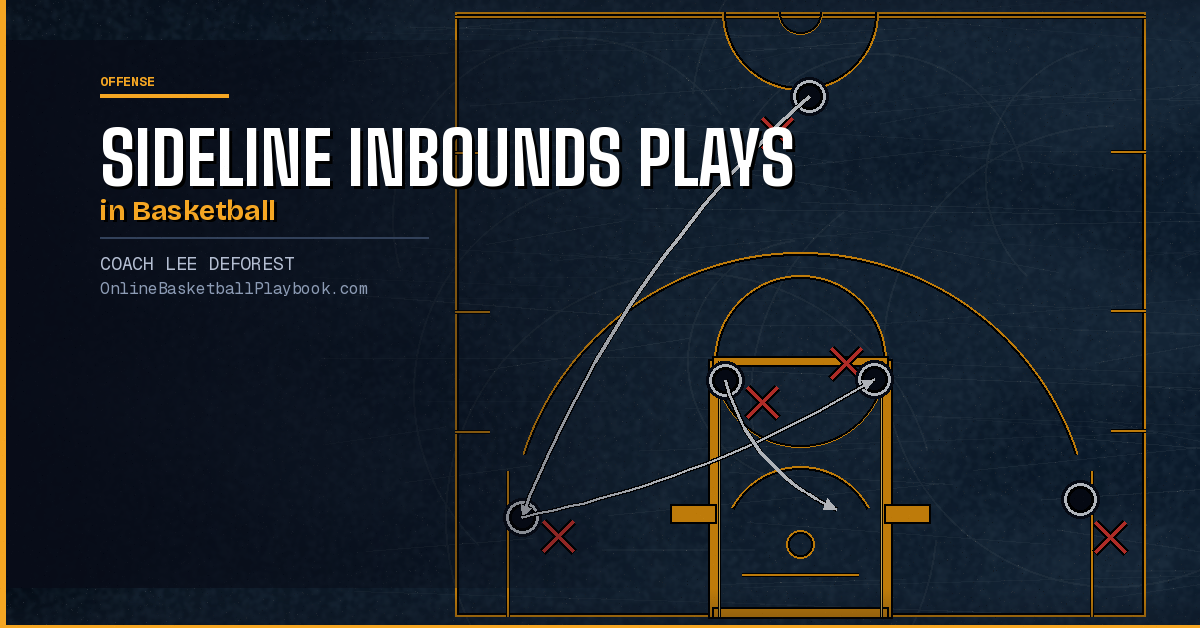
A sideline inbound (SLOB) changes everything. Your team is farther from the basket — often fifteen to twenty-eight feet away — and that distance actually works in your favor. You have full sideline court to spread into, the inbounder re-enters the play naturally after the pass, and you don't need to resolve the possession on the first catch. The inbounder becomes a fifth option for the second action, which gives your play a built-in recovery mechanism that BLOBs rarely have.
"The SLOB is the most natural after-timeout vehicle in basketball because the offense controls the spot, controls the start time, and re-enters the inbounder cleanly."
— Online Basketball Playbook Vault, SLOB Plays Concept
Understanding this distinction shapes every decision you make in your playbook. A BLOB demands a crisper, more terminal design. A SLOB can be a scoring play or a half-court offense entry — and the best SLOB packages do both, letting the defense determine which path you take. When your players know this distinction, they stop being passive during inbounds situations and start reading and reacting like a real offense.
How to Build a Sideline Inbounds Play
The most common failure in sideline inbounds design is treating the play like it has to score on the first pass. Coaches draw up one decoy and one cutter. If the cutter is covered, the point guard catches a check-up pass and the play is dead. That's not a play — it's a hope.
A well-designed SLOB runs in two sequential phases. Phase one gets the ball inbounds safely. Phase two is the scoring action. Separating these phases is the single biggest structural upgrade you can make to your inbounds package.
Phase One: Getting the Ball In
The most reliable phase-one mechanism is a screen-the-screener (STS) action. One player sets a screen for a teammate cutting toward the ball, then receives a back-screen himself. This creates two threats for the inbounder to read — a primary cutter and a screener popping open — and forces the defense to cover two men simultaneously. If both are covered, the inbounder can hold the ball and reset without a five-second violation panic.
A simple flash cut to the ball is also effective as a phase-one option at the youth and high school level, where defenses don't have the footwork or rotation speed to deny everything. The key is that phase one is built for safety and reliability, not for scoring.
Phase Two: The Scoring Action
Once the ball is inbounded, the scoring action begins. Because the inbounder re-enters the play naturally on a SLOB, you have a full five-man offense to work with immediately. The most effective phase-two actions off a SLOB are: a pick-and-roll with the inbounder, a dribble handoff (DHO) continuity, or a direct entry into your half-court base offense. Your players already know those actions — the SLOB simply becomes a structured entry point into familiar reads.
The position of your best scorer matters in SLOB design. Most defenses cheat their best defender onto your best offensive player during inbounds situations, so run your decoy action away from him, then get him the ball in phase two when the defense has shifted. That sequencing — move the defense in phase one, exploit the shift in phase two — is the core of why two-phase SLOB design is so much more effective than single-action sets.
Baseline Inbounds: Getting a Shot Under the Rim
Baseline inbounds plays demand a different kind of discipline. You're starting under your own basket, which means every scoring action has to be manufactured within a tight space with five defenders already positioned between you and the rim. The margin for error is thin, and the difference between a layup and a turnover often comes down to the quality of a single screen.
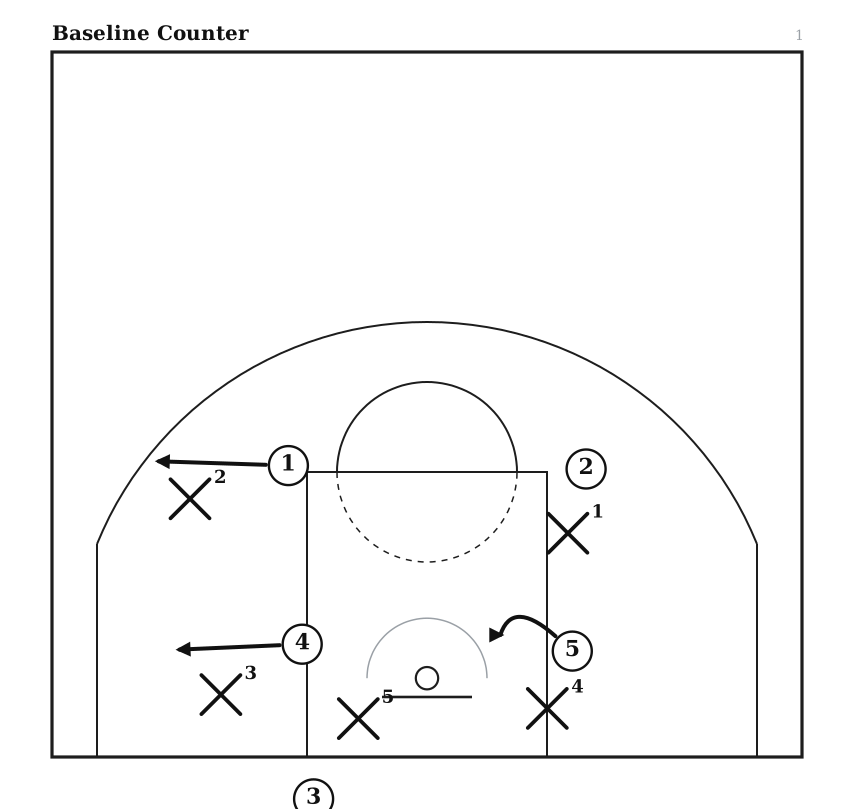
The most reliable BLOB structures share three traits: they present multiple cutters simultaneously, they use screens at angles that are difficult to fight through, and they give the inbounder a safe escape valve when the primary action breaks down.
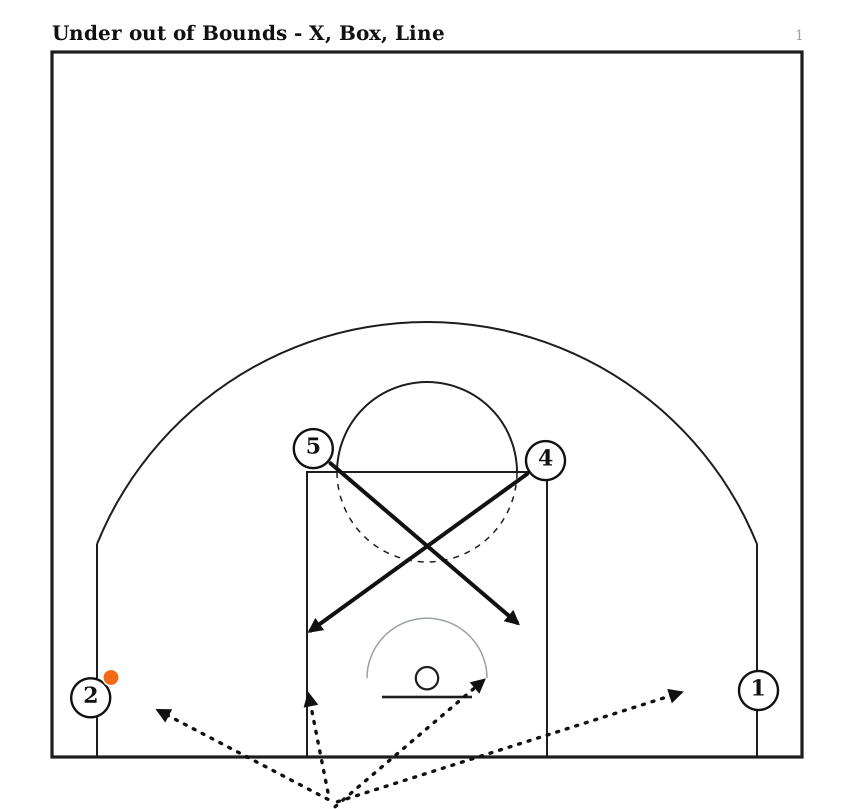
Box Formation
The box set is the foundation of most BLOB packages. Four offensive players form a box around the lane — two at the elbows, two at the block — and the play begins with simultaneous cuts in multiple directions. The most common reads from box are: the block player cutting baseline off a back-screen, the elbow player diving to the rim after setting a cross-screen, and a pop to the corner for a catch-and-shoot three.
What makes box so effective is that it forces the defense to account for all four players at the same time. When defenders have to choose who to help on, someone comes open. The coach's job is to read the defense before calling the play and know which defender is most likely to over-help — then run the action that attacks that tendency.
Stack Formation
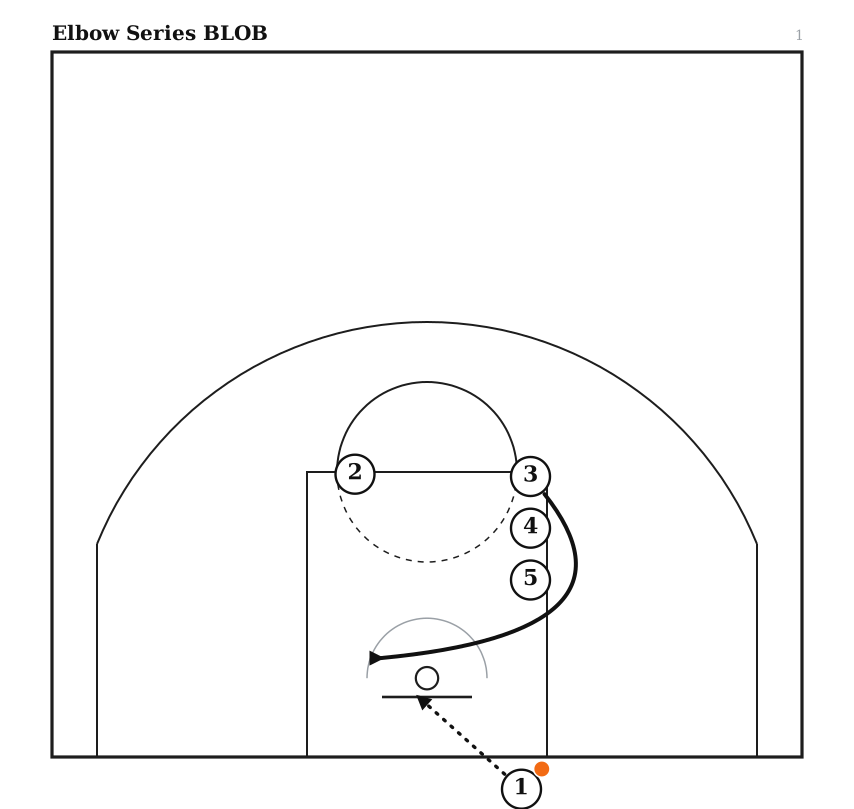
The stack aligns three or four players in a vertical line at the elbow or on the block. Players peel off the stack in sequence, using the bodies in the line as natural screens. Stack is harder to guard than box because the staggered timing of the cuts forces defenders into direct collision paths — you can't help when someone is standing in your way.
Stack works best when your fastest player is at the front of the line and your best screener is in the middle. The front player cuts baseline, drawing the defense. The middle player uses that movement as a pick and cuts to the ball-side corner or elbow. The back player is the safety valve near the three-point line.
Every baseline inbounds play needs three things: a primary cutter, a secondary cutter, and a safety valve for the inbounder. If your play has only one or two of these, the defense doesn't have to make a hard choice — and your inbounder will panic under pressure.
Best Inbounds Sets at Every Level
The right inbounds play depends on what your players can execute, not just what looks good on a whiteboard. A play that requires precise timing and multiple screen reads is a disaster if your team hasn't drilled it. Here are the most reliable sets at each competitive level, ranked by effectiveness against average opposition defense.
Youth and Middle School: Keep It Simple
At the youth level, the best inbounds play is usually your simplest one. A single back-screen with a quick give-and-go cuts open more layups than elaborate stack sets, because youth defenders are still learning to fight through screens and close out on shooters. Run a simple two-man action, get the ball inbounded, and let your players play. The more cuts you add, the more collision risk you create among your own players.
High School: Introduce Structure
High school is where two-phase SLOB design starts paying off. Defenses are more organized but still prone to over-helping on the primary action. Box sets with a clear escape valve work well on BLOBs. On SLOBs, a screen-the-screener entry into a standard pick-and-roll is highly effective because most high school teams are comfortable defending either the STS or the PnR in isolation, but struggle when they're sequential.
Motion SLOBs — where the play flows directly into your base motion offense after the inbound — are particularly efficient at this level because you're not adding new vocabulary. You're just using the same reads your team already knows, with a controlled entry point.
College and Above: Read-Based Systems
At the college level and above, defenses are too good to be beaten by designed plays alone. The best programs use BLOB and SLOB packages that present multiple options and let the inbounder and ball-handler make the right read in real time. The play draws the defense into a committed position, then the players attack the advantage that creates. Scripted one-action plays get scouted quickly. Read-based packages are harder to prepare for because the action isn't predetermined.
Using Inbounds Plays After Timeouts
Timeouts exist to give your team an advantage — but only if you actually draw something up. Far too many coaches call a timeout, tell the players to "just execute," and watch a rushed pass turn into a shot-clock violation. Inbounds plays after timeouts are one of the highest-leverage design moments in the game. You control the clock, the spot, and the matchups, and the defense hasn't moved yet.
The sideline inbound is the standard after-timeout vehicle for a reason: it puts the ball in play on the side of the floor you choose, gives your team a moment to set up before the pass, and naturally flows into your half-court offense once the ball is live. If you have a SLOB package your team has drilled, calling timeout and using it is almost always a better option than letting a scramble possession continue.
After-timeout baseline inbounds plays should be your highest-percentage scoring sets. When you're down two with twelve seconds left, you don't want to read a complex phase-two action — you want a clean look at the rim or a catch-and-shoot three from your best shooter. Build one or two terminal BLOBs specifically for late-clock, need-a-basket situations, and practice them until every player knows every cut without thinking.
The other underused after-timeout option is the short-clock SLOB that gets the ball to your best free-throw shooter so he can draw a foul. Position him as the first option, set a screen to create body contact, and let him attack downhill on the catch. It's not a highlight play, but it wins games in the last twenty seconds more often than a contested three.
Common Inbounds Mistakes and How to Fix Them
Even well-coached teams make the same inbounds mistakes year after year. Recognizing these errors — and building the fixes into your practice habits — separates a good inbounds package from a great one.
Mistake 1: Designing plays that only work against zone or only work against man. Most inbounds plays are drawn up against one defensive look. When the defense switches to the other, players freeze. The fix is to build tag reads into every play so that players know how to adjust when the defense changes alignments at the last second.
Mistake 2: Not practicing the five-second count under real pressure. Five seconds is shorter than coaches realize when a defender is in the inbounder's face. Practice inbounds situations with a live defender on the inbounder and a coach counting loudly. If your team can't execute under that pressure in practice, they won't execute in the fourth quarter.
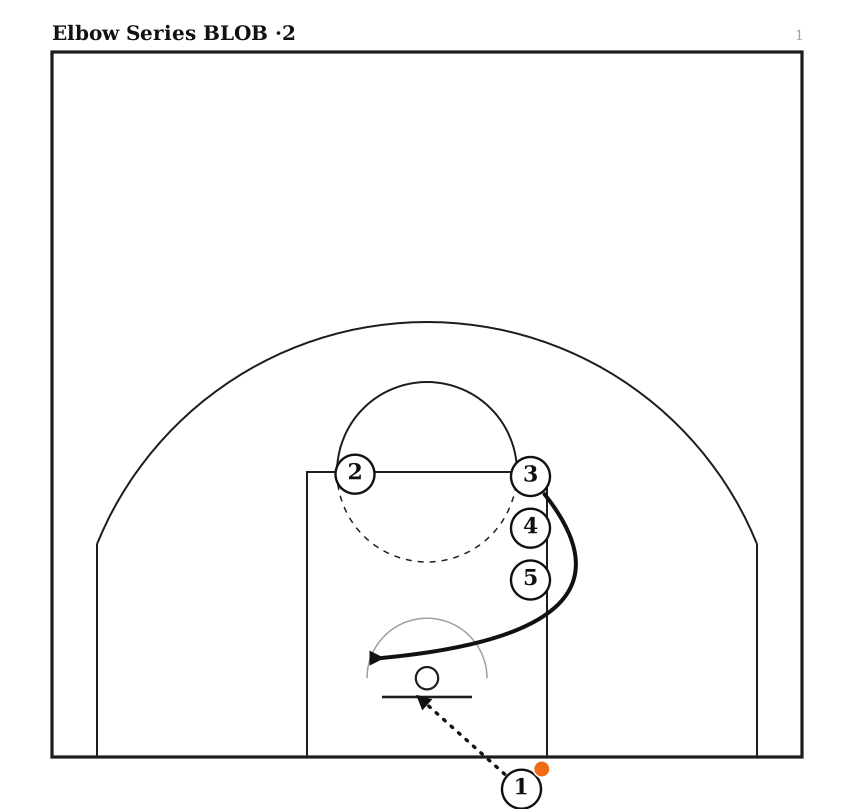
Mistake 3: Running the same play every time. Once your opponents have scouted your favorite BLOB or SLOB twice, they'll front every cut before it starts. The solution isn't to draw up ten new plays — it's to have two or three variations off the same formation. Same starting alignment, different second action. The defense sets up for what they've seen and gets beat by the variation.
Mistake 4: Ignoring the inbounder after the ball is live. On a SLOB especially, the inbounder is a real offensive threat the moment he steps inbounds. Defenses often forget about him. Build at least one read into your SLOB sets where the inbounder pins a lazy defender for a quick return pass. That simple wrinkle — training the inbounder to be active after passing — creates free baskets several times a season.
Mistake 5: Using your worst ball-handler as the inbounder. Coaches often put their weakest player on the sideline because he's "just passing it in." But the inbounder sets the tempo, reads the defense, and must enter the play quickly. Put a player who can make quick decisions in that role, even if he's not a starter. The five-second clock punishes hesitation.
- Run two-phase SLOBs: phase 1 = get the ball in safely; phase 2 = score
- Every BLOB needs a primary cutter, a secondary cutter, and a safety valve
- Build 1–2 variations off every formation so defenses can't front the same cut twice
- Train the inbounder to be an active offensive threat after the ball is live on SLOBs
- Practice the five-second count with a live defender on the inbounder every week
- Keep late-clock BLOBs terminal: one clean look, no phase-two reads needed
- Use SLOBs as the standard after-timeout vehicle; flow directly into your half-court offense
Want more sets, diagrams, and play-calling guides delivered to your inbox?
Join the Free Newsletter →See it drawn up
Related diagrams
Keep Building
Related breakdowns
The Best Basketball Plyometric Exercises for Explosive Power
The Best Basketball Plyometric Exercises for Explosive Power