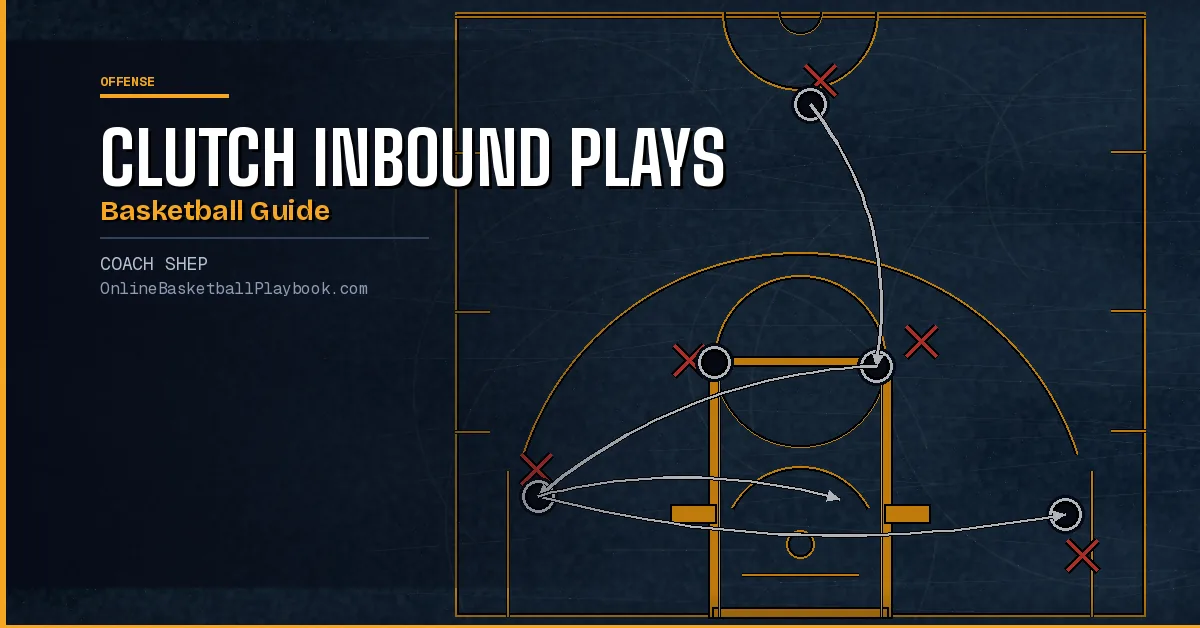
When the game is on the line and you need a basket from a dead ball, most defenses know it's coming. The teams that score anyway have a handful of rehearsed inbound plays built for exactly that moment.
Find any out-of-bounds play by formation in the play finder.
Why Inbound Plays Decide Close Games
Dead-ball situations at the end of a game are the most undercoached area in basketball at every level below the NBA. The offensive team knows a play is coming. The defense knows a play is coming. The question is whether your players have rehearsed it enough to execute it without hesitation under crowd noise and fatigue, and whether the design of the play forces a defender to make a decision they haven't practiced.
Most coaches spend 80 percent of practice time on transition offense, half-court sets, and defense. Inbound plays get a few minutes at the end of a session, run once or twice, and then forgotten until a game demands one. That imbalance shows up when you need a basket with 12 seconds left and your team looks confused at the sideline. Developing your basketball IQ around special situations means building a small library of three to five inbound plays your team knows cold, not a playbook of twenty options they barely recognize.
The other reason inbound plays deserve serious attention is that they are scripted. You get to design exactly what happens. Unlike motion offense or transition, you are drawing up every cut, every screen, and every option before the play starts. That is an enormous advantage if you use it. The defense has to react; your offense acts. The question is whether your design forces a hard decision from the defense, or whether it just sends cutters in random directions and hopes someone gets open.
The foundational principle is simple: every inbound play should have a primary action, a clear second option, and at least one wrinkle that punishes the defense for overplaying the obvious read. Without all three, experienced defenses will shut you down. With all three, even a well-prepared defense has to gamble somewhere.
Baseline Out-of-Bounds Plays (BLOB)
Baseline out-of-bounds situations are the highest-leverage inbound scenarios in basketball. You are close to the basket, the scoring range is short, and a well-executed play can generate a layup, a lob, or a catch-and-shoot corner three. The problem is that defenses know all of this too, so baseline inbound plays have to be designed with deception layered in.
The Stagger Into a Dive
One of the most reliable BLOB actions at any level is a stagger screen set by two of your non-primary scorers that pulls the defense toward the corners. After the stagger, your best cutter dives hard to the basket behind the attention drawn by the stagger action. This works because most defenses practice stopping the stagger receiver but fail to track the screeners after they set their screens.
The inbounder should be your best passer, not necessarily your best scorer. Getting the ball in cleanly is the first job. Many coaches make the mistake of putting their primary option on the ball, which reduces the team's scoring threat and makes the play easier to defend. Your passer stands out of bounds at the corner of the lane and reads the dive. If the dive is open, the entry is a strong two-handed pass at a catchable height. If it is contested, the skip to the corner is the release valve.
The Box Set Baseline Action
The box formation gives you a symmetrical starting point with four players in a rectangle near the lane. From this look, you can run a cross screen followed by a down screen, creating a double action that is extremely difficult to guard when executed with proper timing. The primary option comes off the down screen for a mid-range or three-point look. The secondary option is a lob to the player sealing in the paint after setting the cross screen.
For youth and high school teams, the box set is valuable because the spacing is easy to learn and the reads are straightforward. Players know where to be, which reduces hesitation. At the college level and above, you need a second variation off the same initial look to keep defenses honest. The visual structure of the play should look identical whether you are running the primary or the counter. That is what creates genuine defensive confusion.
Sideline Out-of-Bounds Plays (SLOB)
Sideline inbounds situations are trickier than BLOBs because you are further from the basket and the angle of the inbound pass is more exposed. A turnover on a sideline inbound in the final minute can end a season. Design has to account for denial. The defense will often try to take away the inbounder's easiest target, so your play needs movement that gets someone open quickly.
The Two-Second Sideline Three
One of the most underused SLOB concepts is the quick three off the sideline. Most coaches design their sideline plays to get inside the arc, but when a team is down three with 15 seconds left, a sideline set that creates a three-point look in under two seconds of possession time is extremely valuable. The action involves the inbounder stepping to the wing rather than drifting to the corner. A shooter sets up on the ball side, receives a quick hand-off or slip screen, and fires off the catch. The key detail: the inbounder has to stay at the proper depth to maintain a passing angle. If they drift even two feet toward the corner, the help defender can recover and the shot is contested.
The Middle Ball Screen SLOB
For a two-for-one situation or any time you have eight or more seconds and need a good look from the sideline, a ball screen in the middle of the floor coming off the sideline inbound is highly effective. The ball handler receives the entry, immediately attacks a middle ball screen, and reads the defense. The ball screen forces the defending big to make a decision that affects the paint, which opens the corner for your shooter and the roll lane for your screener. This action connects naturally with the principles used in motion offense, so teams already running a motion system find it easy to install.
After-Timeout Sets (ATO)
After-timeout plays get called when a coach has at least 20 seconds and needs a specific look: a bucket to take the lead, a shot to tie, or a high-percentage action to win. The timeout gives you the chance to draw something up or call something your team has rehearsed. Use it properly.
Design for the Personnel You Have Tonight
The best ATO play is not necessarily the most sophisticated one. It is the one that your best scorer knows how to run against the specific coverage the defense is playing. Before drawing anything up in the huddle, identify what the defense has been doing all game. Are they switching everything? Then you want a play that exploits mismatches off the screen. Are they hard hedging ball screens? Then you want a play that gets your shooter a curl action with the screener slipping to the nail.
One reliable ATO framework is to put your best scorer away from the ball on the weak side, run a pinch post action on the strong side to draw attention, and then hit your scorer off a back screen. The defense watches the pinch post, your scorer gets a clean look. This principle, using one action to free a second option, shows up in nearly every effective ATO set at the highest level.
The Horns ATO
Horns alignment (two bigs at each elbow, two shooters in the corners, ball handler at the top of the key) is one of the most flexible ATO starting points you can use. From horns, you can run a pick-and-roll to the strong side, a pick-and-pop to the weak side, a dribble hand-off, or a double-drag screen. The defense has to respect all of these, which means they are often a half-step late on whatever you actually run. Horns connects well with the spacing principles in 5-out motion offense, making it easy to install for teams already working out of that system.
The Decoy Principle That Makes Them Work
Every elite special situation coach understands one thing that average coaches overlook: the best inbound plays are not designed to get your best scorer open directly. They are designed to make the defense guard your best scorer so aggressively that a second player gets a clean look. This is the decoy principle, and it is the single biggest difference between inbound plays that work at the varsity level and ones that get shut down.
When your defense keys on your best scorer, and they will, that player's job is not to score. Their job is to draw maximum defensive attention. The play is really designed for the second or third option. If your best scorer happens to get open because the defense gambles wrong, you take that shot. But if the defense guards them perfectly, the counter option should be equally open. Run your star as the decoy and design the play to punish the defense for their overplay.
This requires a specific type of player awareness. Your best scorer has to be willing to set a screen at the end of a close game rather than immediately trying to get the ball. Your role players have to be confident catching and shooting under pressure rather than deferring. Developing this requires repetition in practice because players need to experience successfully executing the counter option so they trust it in a game. Building that kind of basketball accountability among all five players on the floor, not just your stars, is what separates good teams from great ones in late-game situations.
How to Teach and Rep These Under Pressure
Drawing up a play on a whiteboard is the easy part. Getting five players to execute it at the buzzer of a tied game is the hard part. The gap between those two things is practice repetitions under conditions that simulate game pressure. Most teams do not practice inbound plays enough, and the ones they do practice are rarely done under anything resembling game conditions: no clock, no score context, no defensive intensity.
Build a Small, Deep Library
The temptation is to install many plays so you have an answer for every situation. Resist it. Three baseline plays, two sideline plays, and two ATO sets that your team can run in their sleep will win more games than a playbook of twenty plays they barely know. Mastery of a small number of actions beats familiarity with a large number. Each play should have at least two options within it, a primary and a counter, so you are not calling a new play every time the defense takes something away.
Practice With a Clock and a Consequence
At the end of every practice, spend five minutes on competitive clutch situations. Put 8 seconds on the clock, set a score, and run an inbound play against your defense at full speed. The offense earns a point if they score. The defense earns a point if they stop the play or force a turnover. Keep score. Teams that compete in practice, even in a small situational drill, handle game pressure better than teams that only rehearse in cooperative settings. Connecting inbound play work to your broader basketball practice plan ensures these situations get rep time every week, not just before tournament play.
Talk Through the Reads
After each rep, spend 30 seconds discussing what the defense showed and what the right read was. Did they switch? Did they hedge? Was the lob open? Was the corner skip open? Players who understand why they are making a read, not just what the read is, adapt when the defense does something unexpected. That adaptability is what separates a team that executes a scripted play from a team that reads the defense and scores regardless of what the defense does.
Treat every end-of-game situation as a teaching moment regardless of the outcome. Whether the play worked or failed, the conversation afterward shapes how your players think and respond the next time they face a clutch inbound scenario.
- Have no more than five total inbound plays. Master a small library rather than installing a large one your team barely knows.
- Put your best passer on the ball, not your best scorer. Getting a clean inbound entry is the first priority.
- Every play needs a primary action and a built-in counter that punishes overplay on the obvious read
- Design BLOBs with a stagger or cross screen to pull defenders away from the lane before your primary cutter goes
- The inbounder at sideline plays should stay at the wing. Drifting to the corner kills the passing angle.
- Practice inbound plays with a live clock and a competitive score at the end of every session
- Your best scorer is often the decoy. They draw the defense so the second option gets the real look.
Get free play diagrams, drills, and coaching guides delivered weekly.
Draw this play free in the play drawer →
Membership: the full library, playbook packs, and Pro drawing tools →
Keep Building
Related breakdowns
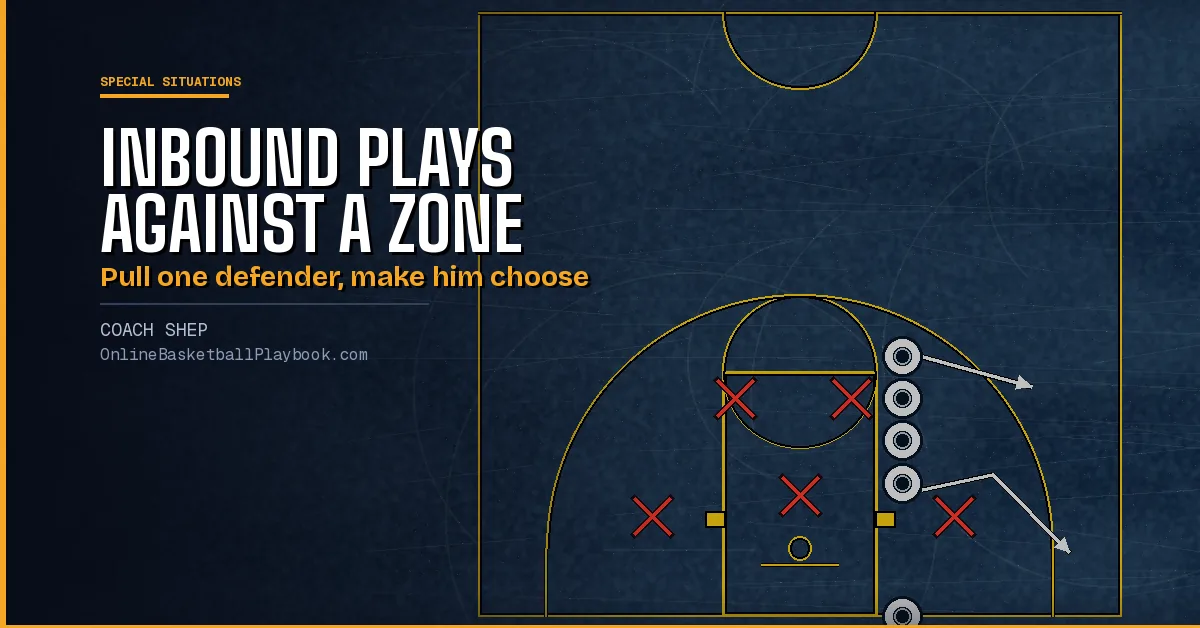
Inbound Plays Against a Zone: Baseline and Sideline Sets
Inbound plays against a zone from the baseline and sideline: the read, the stack near the elbow, short-corner pulls, split cuts, two-part sets and sideline answers.
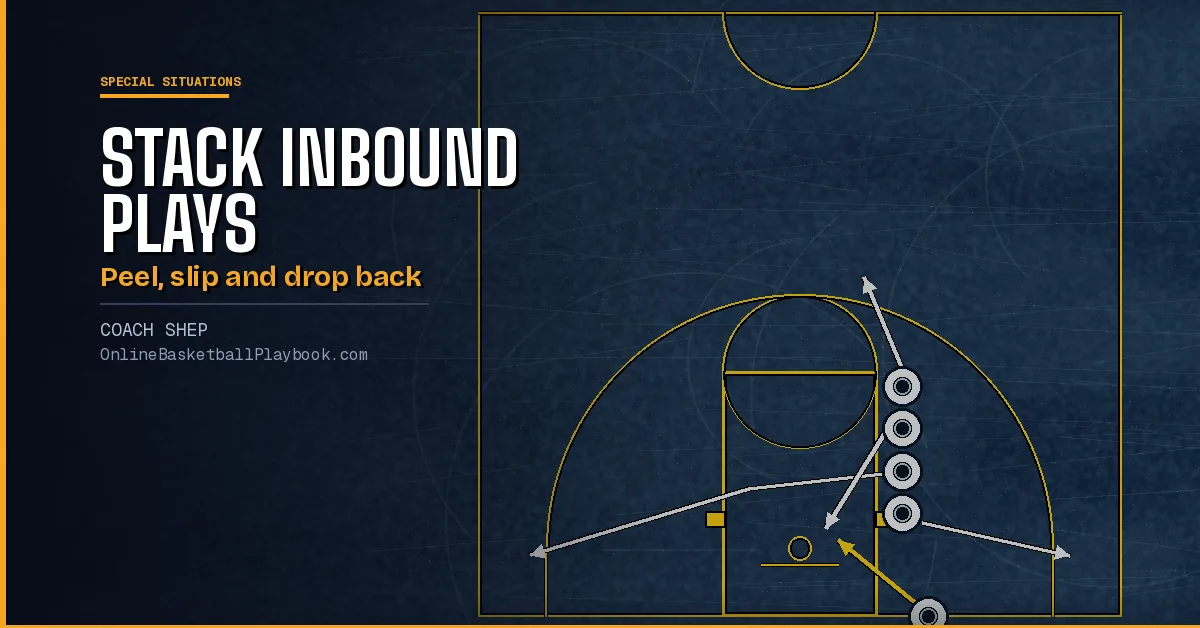
Stack Inbound Plays: Splits, Rubs, Lines and Reads
Stack inbound plays and line sets from the baseline and sideline: splits, stacks away from the ball, rubs, screens inside the stack, line plays and the reads.
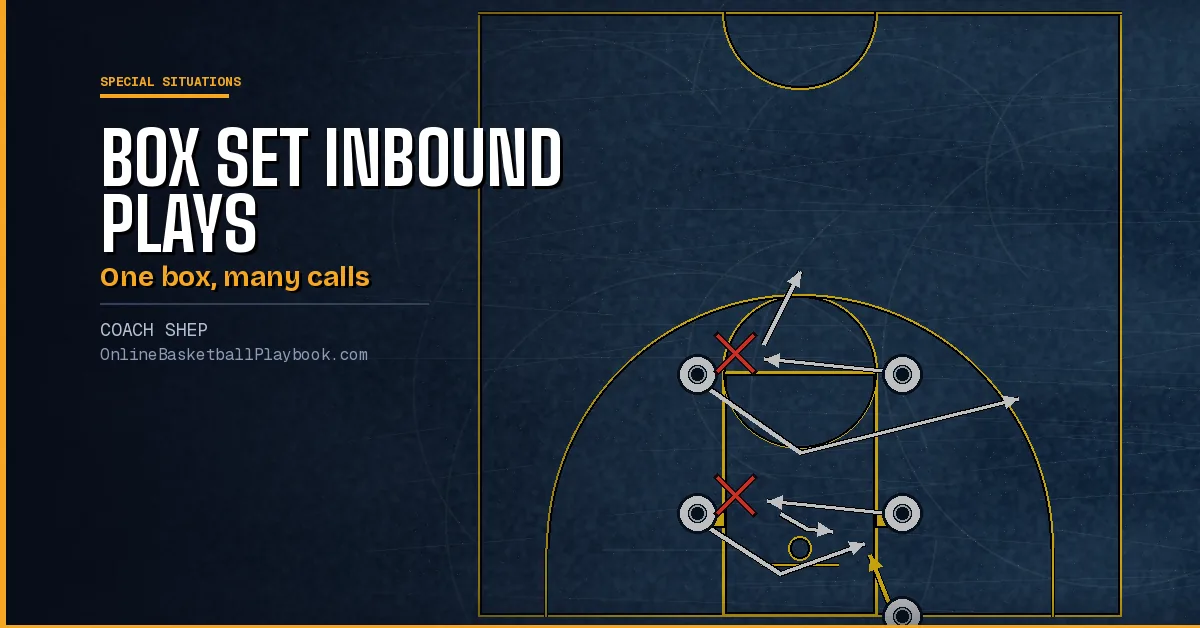
Box Set Inbound Plays: Cross Screens, Back Screens and Reads
Box set inbound plays from the baseline: the box shell and its variations, cross screens, back screens, plays for the inbounder, switch reads and how to teach them.