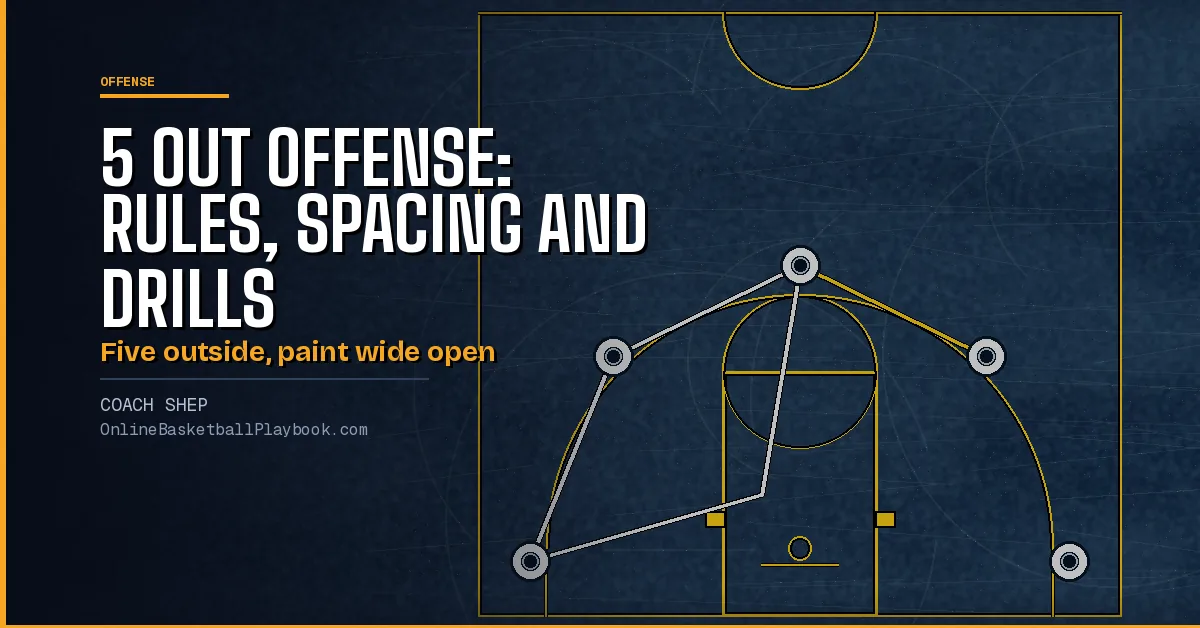
The 5 out offense starts all five players outside the three-point line. Nobody stands in the paint, so the rim protector has to guard a shooter and the lane stays open for cutters and drivers. Players choose cuts and screens from how the defense guards them. Other names for the same idea are 5 out motion offense, 5 out circle motion and open post motion. This guide covers the spots, the rules, the actions, how to teach it to young teams, how to attack a zone and the drills.
The 5 Out Offense at a Glance
| Question | Answer |
|---|---|
| Where does everyone start? | Top, both wings and both corners, all outside the arc |
| Do positions matter? | No. Any player can fill any spot, which makes it a positionless offense |
| How is it run? | Rules and reads, not called plays |
| What does it need? | Five players who can shoot, pass and drive |
| What does it cost? | Inside presence and offensive rebounds |
5 Out Offense Spacing: The Five Spots

The five spots are the top of the key, both wings and both corners. Keep 15 to 18 feet between players. Cones on the spots help for the first two weeks with a young team. Movement should keep those gaps open. When a cutter goes to the basket, the others spread to fill the empty spots.
Spread the five spots and the shot blocker is pulled away from the rim. Quick players then attack bigs off the dribble. That is why the offense fits a team without strong inside players.
The 5 Out Rules
Teach the rules in this order. The first ones are the simplest.
- Spread the five spots.
- Catch ready to attack. Balanced, eyes on the rim, ready to shoot, drive or pass. Even a poor shooter does it. It is the hardest rule and the most important.
- Pass and cut to the basket.
- Always fill the five spaces.
- If you are denied, back cut.
- Pass and screen away.
- Pass and screen the ball.
- If you are dribbled at, dribble hand-off.
- Post-ups must be quick. A long post-up stops the spacing.
Never pass and stand. After a pass you cut, screen or get screened for. Standing is a team mistake. Give every player a shot selection based on his range, because the offense gets the team open and the player decides.
Pass and Cut

Start with four passes and no screens.
- Top to wing. The passer cuts to the basket and out to the opposite corner. The two players behind fill up.
- Wing to corner. The same rule.
- Corner to wing. The passer cuts and replaces himself.
- Wing to top. The passer cuts and fills the same-side corner.
Step away from the defender first and then explode toward the ball on a front cut. Cut hard so help has to come. Watch the ball on every cut for a rebound. Save the V cut for a real backdoor threat. A V cut on every fill turns the offense into robotic movement and collapses the spacing.
Get the next coaching guide in your inbox
One email when a new guide or diagram set goes up. Free.
Back Cuts When Denied

If you are denied one pass away and the passer looks at you, back cut right away. Cut off the defender. Basket-cut a defender who sags and back cut one who overplays. When denied, either back cut and fill from behind or down-screen and fill. Skip the jukes and V cuts to get open. The skip pass and an early curl keep the paint honest.
Screen Away and On-Ball Screens

Add screens after the cutting rhythm is solid. On any pass except corner to wing, the passer can screen away. The screener sets the screen with his backside toward the ball. The receiver reads the defender. He can curl tight hip to hip, cut straight, or back cut. One player goes to the rim and the other pops back to the ball. The screener can slip any time the screener's man jumps above the screen, unless the cutter is curling or going backdoor. Against a switch, back cut after the screen.
For young teams, make the curl the only option and have the screener pop back to his spot. Experienced teams let the cutter choose curl or pop and the screener go the other way.
The on-ball screen comes after any pass, and it is only for players who can dribble. Some coaches make a pass to the corner an automatic ball screen. See What Is a Screen in Basketball and Drills to Teach Off-Ball Screens.
Dribbling in 5 Out
Dribble for three reasons. Attack the rim on a straight line, improve a passing angle, or break a five-second count. On a drive the teammate at the drive pushes up, the corner dives and the trailer pulls back. When the ball is pressured and passes are denied, the player being dribbled at either back cuts or takes a hand-off. Some coaches skip the hand-off with youth teams.
5 Out Circle Motion
Circle motion is a rule set inside the 5 out where everyone rotates in one direction after a pass, so the rule is pass, cut, fill. It is the most structured form and a stepping stone for young teams before free 5 out. Many coaches start with it for that reason.
5 Out Motion Offense for Youth Basketball
Many coaches recommend 5 out as the default for youth and high school teams. Nobody knows who will grow, so a positionless offense keeps every player learning to dribble, pass and shoot. The early bloomer who sits in the post never learns those skills. The other view builds the offense from a 3-out 2-in set first and moves up as players read the game and shooting improves. Compare 3-Out 2-In Motion Offense and 4-Out 1-In Offense. Both views agree that fit matters. Do not run an alignment your roster cannot support.
- Install one layer at a time. Pass and cut alone is a complete youth offense.
- Use cones on the five spots for the first two weeks.
- Add screen away when the rhythm is owned, then on-ball screens, then dribble-at.
- Use a no-dribble game and count a stand after a pass as a turnover.
- Require reversals before a shot.
- Do not switch offenses mid-season and hold the standard on lazy cuts and screens.
5 Out Against a Zone

Five out stretches a zone to its full coverage before any action begins. Be patient. Reverse the ball once or twice before you attack, because the first rotation tests the zone and the next shows the crack. Whenever the ball reaches a wing, the opposite wing flashes to the high post gap. If the low middle defender steps up, the ball-side corner cuts to the hoop and the far corner rotates up. A skip pass is effective because an over-shifted zone leaves a low defender to close out. Keep the player at the top of the key as the safety. For more see How to Attack the 2-3 Zone and Drills to Teach Zone Offense.
The Cost: Rebounding
The biggest cost is the offensive glass. With nobody in the paint, misses are easy to secure. Coaches split. Some name one player to crash on every possession. Others want everyone below the free-throw line to crash. Others send the point guard back as the safety and crash four. Test them in scrimmages. Also expect trouble against length and athleticism, and when you need to kill clock. When shots stop falling, small-ball lineups give up second chances.
5 Out Offense Drills
- 5-on-0 spacing. Walk the five spots with cones, then move at full speed with no dribble.
- Pass and cut lines. Two-on-0, then three-on-0 with pass, cut and fill.
- Add the back cut. The passer looks, the denied player cuts.
- 1-on-1 closeout. The catcher receives, squares up and attacks the closeout. Even poor shooters get their heads up.
- 2-on-2 and 3-on-3 reads. Add defenders one at a time and let cuts read the defense.
- Screen away 3-on-0 then 4-on-4.
- Zone patience. Play the offense against a zone and count two rotations before attacking.
The full drill set is on Drills to Teach the 5 Out Motion Offense and the defensive side on How to Defend 5 Out Motion. Blocker-Mover is the structured alternative, on Blocker-Mover Offense.
Questions Coaches Ask About the 5 Out Offense
What is the 5 out offense?
An offense where all five players start outside the three-point line and use cuts, screens and reads to score. It empties the paint for drives and cuts.
What is 5 out motion offense?
The same offense with continuous movement. After a pass each player cuts, screens or fills a spot.
Is 5 out good for youth basketball?
Many coaches say yes, because every player learns every skill. Start with pass and cut only, then add layers.
What is the weakness of the 5 out offense?
Offensive rebounding. It also needs five players who can make the defense respect them.
What is 5 out circle motion?
A rule set where everyone rotates one direction after a pass. It is a structured stepping stone to free 5 out.
How do you run 5 out against a zone?
Reverse the ball a couple of times, flash the far wing to the high post gap, cut the corners, and skip the ball.
All offense pages sit under the Offense hub and Motion Offense guide. Related pages are Basketball Positions, What Is Spacing in Basketball and Dribble Drive Motion Offense.
Want the printable playbook packs?
OBP Pro members get the premium playbook packs: the zone attack, out of bounds and practice plan PDFs, plus each new pack as it is finished. The membership page lists what is in each one. Or draw your own version free in PlayDraw.
See what OBP Pro includesBack to Motion Offense and every Offense page.
Keep Building
Related breakdowns
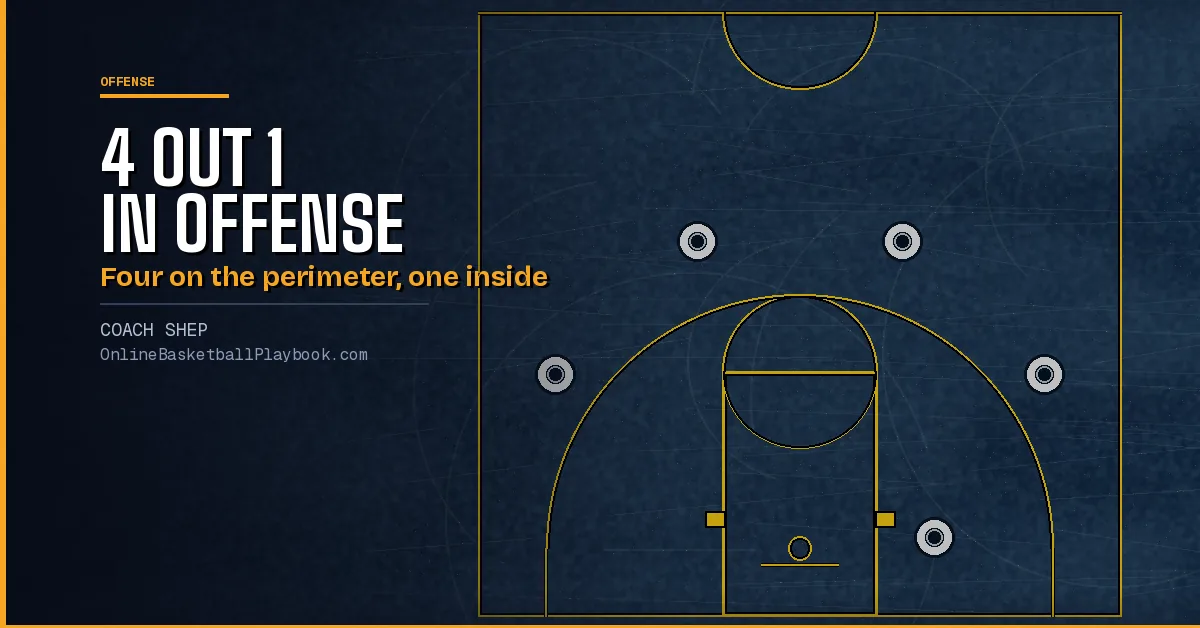
4 Out 1 In Motion Offense: Rules, Spacing and Sets
How to run the 4 out 1 in motion offense: spacing, the six rules, what the post does, pass-cut-fill, screens, quick hitters, zone adjustments and how to install it.
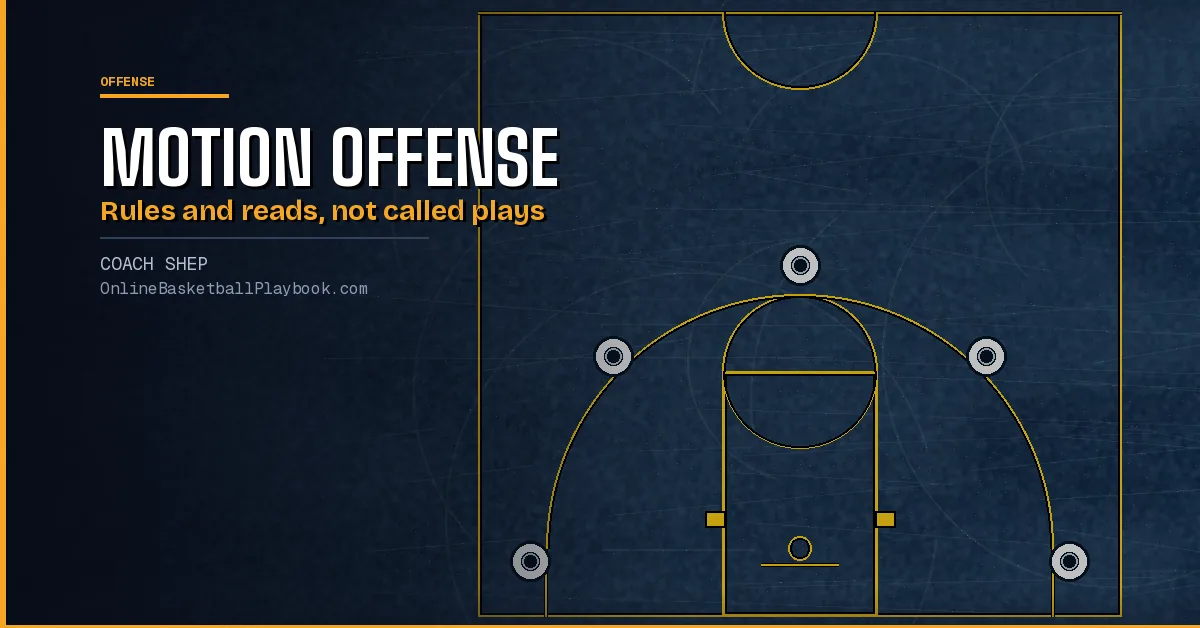
Motion Offense: Spacing, Rules, Actions and How to Install It
Motion offense runs on rules, not called plays. See the spacing, four core actions, 5-out versus 4-out 1-in, the install order, drills and where it struggles.
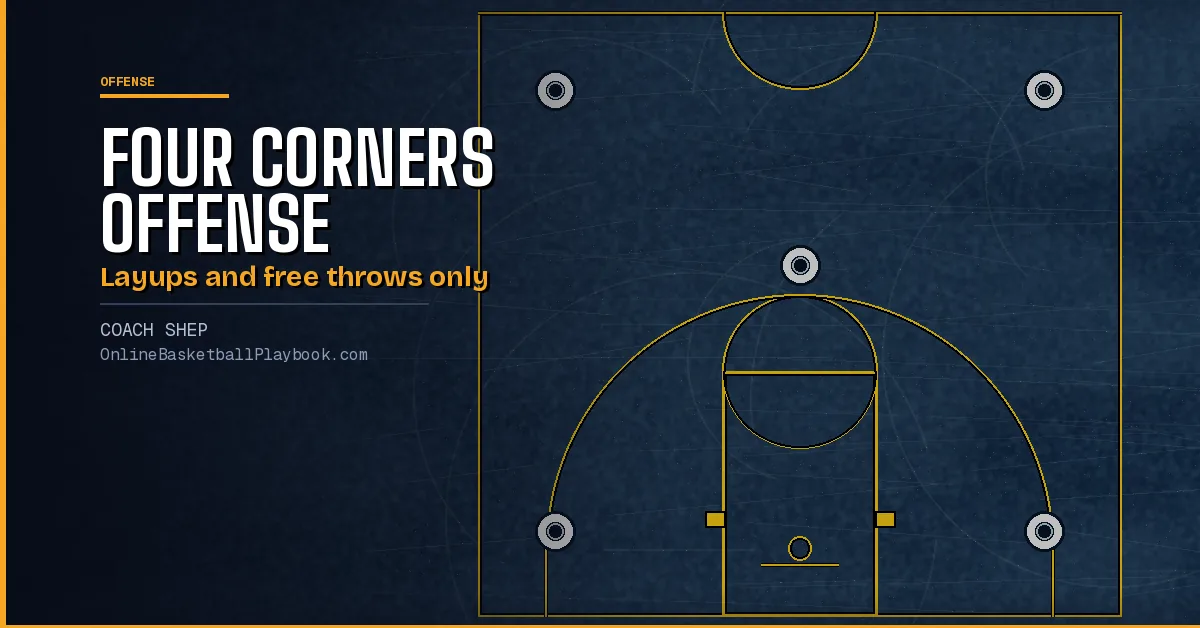
Four Corners Offense Basketball: Roles, Rules and Versions
Four corners offense basketball: the set, the chaser, the corner and post rules, three versions, when to run it, the shots it hunts and shot clock limits by level.