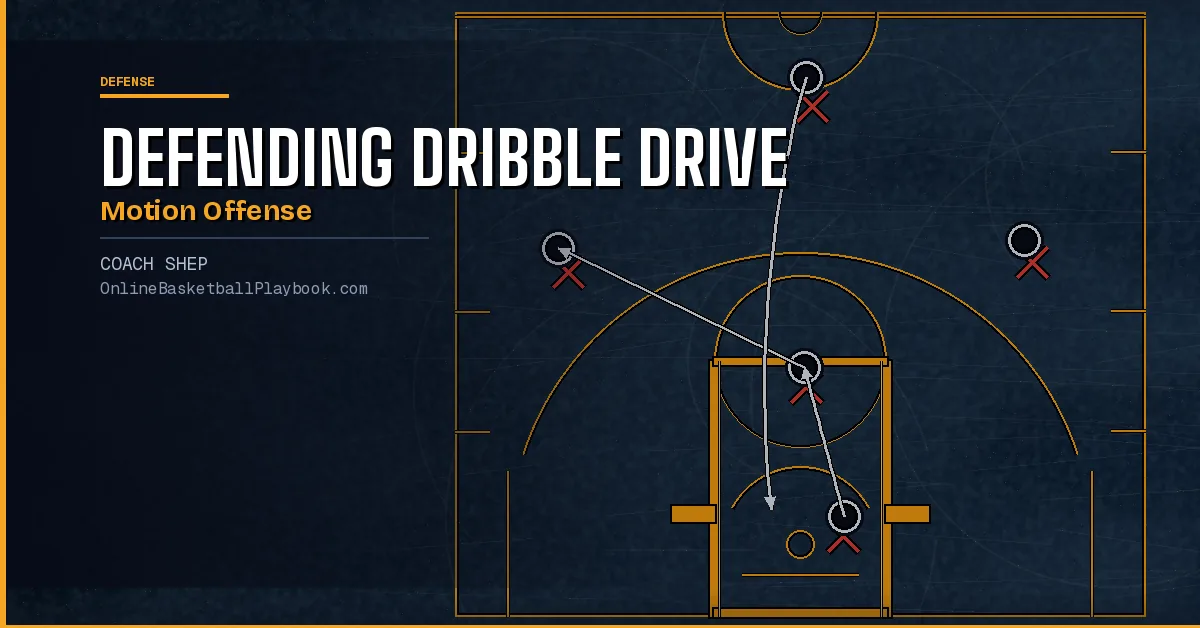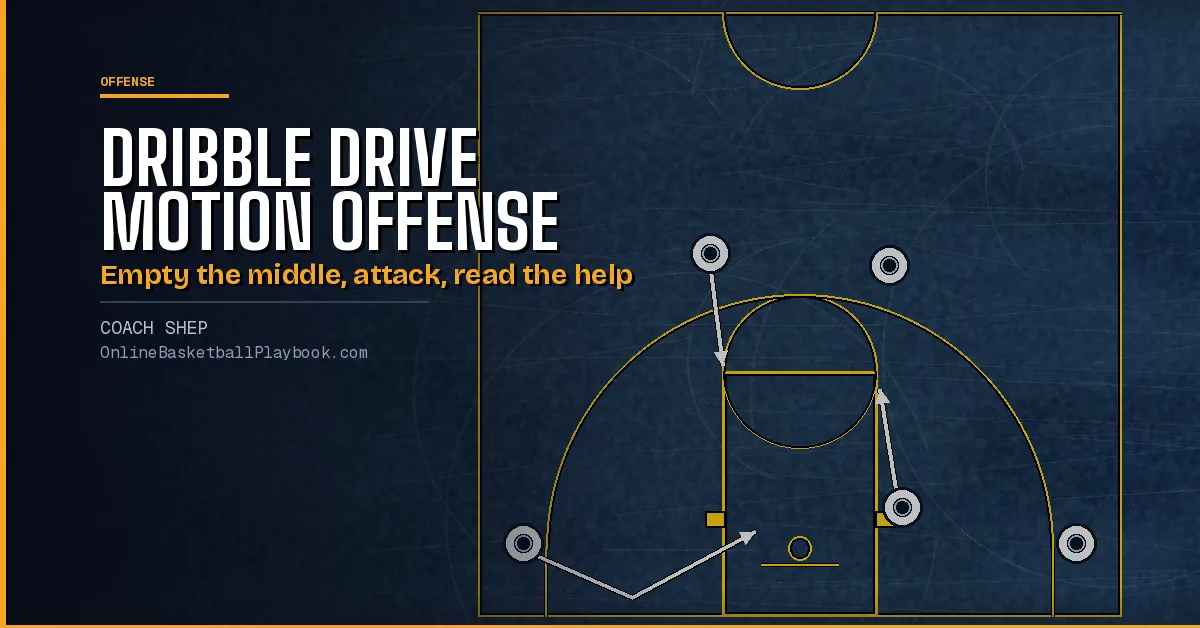
The dribble drive motion offense is a 4-out, 1-in motion offense that attacks the rim off the dribble through an intentionally empty middle. It hunts layups, fouls and kick-out threes and treats the mid-range jumper as a bad shot. Vance Walberg built it and John Calipari brought it to national attention at Memphis. This guide covers who it fits, the spacing, the named zones, the read after a drive, the off-ball rules, the shot diet, where it struggles and how to install it in layers.
The Dribble Drive Motion Offense at a Glance
| Question | Answer |
|---|---|
| Alignment | 4-out 1-in. Four perimeter players, one post |
| Where does the post go? | Opposite the ball, away from the lane |
| What is the goal? | Layups, fouls and kick-out threes |
| Which shot is avoided? | The mid-range jumper |
| How is it run? | Reads, not called plays |
| Best fit | Guards who can beat their man and shoot, with few true posts |
| Cost | Less inside presence and fewer offensive rebounds |
What It Is and Who It Fits
The system clears the middle so a driver has a clear path to the rim. Every possession runs on a read tree, and the off-ball players read their own defenders. The possession mantra is AASAA, which stands for Attack, Attack, Skip, Attack, Attack. Every player catches with an attack intention. If he cannot attack, he skips to the next spot and attacks from there. A skip is a deliberate move to a better angle and not a pass of defeat. How it lines up against a cutting offense is on dribble drive vs Princeton.
Roster fit is a stated precondition. Two versions agree that dribble drive suits guards who can beat their man and shooters who can punish help, and that the 4-out 1-in family gives up inside presence and offensive rebounding. A quick check before you install it is to count how many guards beat their man off the dribble and how many true posts you have. The offense also simplifies decisions, and coaches run it with free substitution so depth becomes a weapon.
Spacing and the Empty Middle
Spacing drives everything else. Keep roughly 15 to 18 feet between perimeter players, so one defender cannot guard two of them and a kick-out is still catchable. A single gap is wing to slot, where one defender can help and recover. Corners create double gaps, where help requires full commitment. The corner defender faces a choice with no good answer. He can help on the drive and concede the three, or he can stay home and concede the rim or the drop-off. That is why both corners stay filled.
The post starts opposite the ball and does not follow it. On a drive he slides toward the far elbow or bails to the backside block, depending on where the driver stops. A spacing law follows from that. A player never drives into a big man who is in the low post, because it closes the lane the offense depends on. The Memphis version insists on a one-guard front, with the other guard trailing or cutting through. The floor picture is the same in every version. Four players stay outside and one is alone inside.

The Zones: Drop, Drag and Rack
A floor vocabulary makes "drive and kick" specific. Two dialects are in use, and a team should pick one and stay with it. Every map and its edges are laid out on dribble drive zones.
- Drop, Drag and Rack. The Rack Zone is the rim, where the only options are score or draw a foul. The Drag Zone is the area near the basket, where the driver drags help toward the rim and opens the far side. The Drop Zone is the free-throw-line elbow area, where the driver stops and drops the ball to a wing, a trailer or the post.
- Breakdown, Drop and Rack It. The Breakdown Zone is where the guard decides which side to attack. The Drop Zone is where a stopped drive looks for a backdoor, a pitch-back or a post flash. Rack It means commit to score.
The Drop Zone has a body-position test. Sources draw its boundaries a little differently, but the real question is whether the driver's shoulders have cleared the defender's shoulders when he gets there. If they have, he pushes through to the rim. If they have not, he picks up the dribble at once, jump-stops and uses a 360-degree pivot to find a kick-out. It turns "attack" into a cue that every ball handler applies the same way on every possession.

The Read After the Drive
Before the drive, read the defender. A tight defender means drive for a layup or a foul. A sagging defender means shoot the three. After the drive, help decides the read. The pass goes to the man whose defender left him to stop the ball. Jump-stop first, because passes thrown off a jump stop are better decisions. The reads for each zone and each teammate are on dribble drive reads.
- Help from the corner. The corner shooter steps in for the three and the driver kicks to him.
- Help from the post defender. Dish to the post.
- No help. Attack the rim.

Coaches publish different orders for the full read. One teaches five levels in a fixed sequence: finish at the rim, draw the foul, dish to the roll man if one exists, kick to the open corner and skip to the weak side. Another teaches four options for the penetrator: the layup, a lob or bounce pass to the opposite post, a reverse pivot and pass back to the cutter filling the vacated spot, or a skip to the relocating weak-side wing. The lists overlap but do not match, so teach one list per team and do not let players carry two.
The kick-out follows the positive pass rule. The off-ball players come behind the ball so the catcher faces the basket and heads downhill, and nobody throws a straight-line pass across the lane. If a pass has to cross the lane on help, it goes high to the post. After he passes, the passer cuts away to open the driving lane.
Off-Ball Rules
- The corner player reads his own defender. If he is denied, he cuts backdoor. If his defender helps, he moves to an open spot for the kick.
- The post clears. On a Drop Zone pickup, the post opposite the ball slides to the opposite elbow. That empties the lane and clears the backdoor cut for the ball-side corner. A dump-down to the post is one of the three outlets off a stopped drive, along with the kick-out and the drop-off.
- The corner stays wide. The ball-side corner player reads his defender and stays in the corner until he has a reason to move. The weak-side wing sprints the sideline for the kick-out.
- The driver replaces. After a stopped drive and a positive pass, the driver loops down to the ball-side corner to refill the spot.
- A baseline drive changes the post. On a baseline drive, the post circles over the top to catch high and keeps the ball high.
- A pass means a cut. When you pass, you must cut.

Get the next coaching guide in your inbox
One email when a new guide or diagram set goes up. Free.
Shot Diet and Pace
The shot diet is a hard rule. Why it is built that way, from the press to the points-per-possession math, is on dribble drive system. The goal is free throws first, then layups, then threes off a kick, with the mid-range jumper ranked as the worst possession. Spot-up threes are acceptable and contested shots and layups over two defenders are not. If two defenders are on you, somebody has a great shot, so find him.
One call tightens the diet in practice and in games. "Black down" means layups only, pass until the team gets one and take no threes. Avoid one-and-done possessions.
Pace is part of the offense. The Memphis version treats the fast break as the offense itself, and simple reads let a team run a deep bench. See How to Run the Fast Break and Early Offense in Basketball for the transition side.
Where It Struggles
There are four failure modes to drill out, and they are worth naming to players in the first week.
- Over-dribbling. A player who dribbles in place instead of relocating destroys spacing. Pass and move. A player who catches and stands kills the offense.
- Kick-out turnovers. The lateral skip at speed is the highest-turnover moment in the system, so drill it.
- Quick-three settling. Taking an early three ends an attack that could have become a layup.
- Lane drift. Young players drift toward the driver and collapse the geometry.
Other weak points come from the roster and the defense. The system suits only guards who can beat their man, so check that first. A pack line or a zone is a known test, because help comes from one pass away. The answers coaches list are straight-line drives before help loads, ball reversals and skip passes, shot-ready threes and a blur screen that builds double gaps.
Where Coaches Split
- The Drag Zone. One teaching treats it as the place to drag the defense to the rim. Another says to avoid it and either stop at the Drop Zone or push through to the rack. They may not mean the same area of the floor, so check the vocabulary before you mix two versions.
- 4-out or 3-out. Four-out spacing is the standard. The system's builder also found 3-out easier for penetration timing in some personnel situations, because wide spacing can put too much lateral distance between the driver and a kick-out.
- Attack on every catch, but do not over-dribble. The rules say to attack on every catch, and the failure modes say to stop over-dribbling. One cue reconciles them. If you cannot attack, skip and move to the open spot.
- Named plays. One practice doctrine runs only three or four set plays in total. Other material documents about fifteen named continuity plays and twelve numbered quick-hitters. The scripted quick-hitters are counters for when the defense has read the free-form attack, and they are useful late in games. The common calls are drawn on dribble drive named plays.
How to Install It
Build it in layers, and make each layer automatic before you add the next.
- Spacing without defenders. Walk the five through their spots. Check the post opposite the ball, gaps of 15 to 18 feet and both corners filled.
- The rim attack. If players pitch the ball out before they attack, run one-on-zero attacks at the rim first and then add the kick.
- The read sequence. Teach one drive hierarchy as a named sequence before any live rep. The order is there to stop players from passing before they try to finish or draw a foul.
- Helper reads. Run three-on-three in which the corner defender helps and the corner shooter steps in for the three, the post defender helps and the driver dishes to the post, or nobody helps and the driver attacks the rim. If the corner shooter's defender denies him, he back-cuts.
- Small-sided decisions. Work one-on-one, two-on-one and two-on-two into three-on-three. A two-on-one power drill has the guard fake past a token defender, attack downhill and read the paint defender. If he steps up, pass to the post. If he stays, finish.
- Live five-on-five. Then add a scripted entry. One entry can be installed once, with its finishes added one at a time across the season.
Track the four failure modes as numbers in practice, such as unneeded dribbles in place and kick-out turnovers. More reps are on dribble drive drills and Teaching Dribble Penetration Reads. The defender's view is in How to Stop Dribble Drive Motion.
Questions Coaches Ask About the Dribble Drive Motion Offense
What is the dribble drive motion offense?
It is a 4-out 1-in motion offense that empties the middle, attacks the rim off the dribble and reads the help for a finish, a foul, a kick or a backdoor cut.
What does AASAA mean in dribble drive?
It stands for Attack, Attack, Skip, Attack, Attack. Every player catches with an attack intention, and a player who cannot attack skips to the next spot and attacks from there.
What does the post do in dribble drive motion?
The post starts opposite the ball and does not follow it. On a drive he slides to the far elbow or circles to the block, which clears the lane and opens a dump-down angle.
Why does dribble drive avoid the mid-range shot?
Free throws, layups and threes off a kick are the best shots. The mid-range pull-up is ranked as the worst possession, and one practice rule counts it as a turnover.
Can a team without a post player run it?
Yes. It fits guard-heavy teams with few true posts. The cost is less inside presence and fewer offensive rebounds, so plan for that.
How is it different from 5-out motion?
5-out starts all five players on the perimeter. Dribble drive keeps one post on the block opposite the ball and moves him out of the driver's way, so the lane stays empty for the drive.
All offense pages sit under the Offense hub. To compare systems, read Motion Offense in Basketball, 4-Out 1-In Offense, 5-Out Motion Offense and Princeton Offense.
Want the printable playbook packs?
OBP Pro members get the premium playbook packs: the zone attack, out of bounds and practice plan PDFs, plus each new pack as it is finished. The membership page lists what is in each one. Or draw your own version free in PlayDraw.
See what OBP Pro includesMore Coaching Guides
- Game Plan Against a Press Defense: Scout, Roles and Rules
- Strategies for Coaching Against Zone Press Defenses
- Basketball Coaching Leadership: 5 Strategies That Hold Up
- How to Run the Fast Break: Lanes, Reads and Drills
Back to Motion Offense and every Offense page.
Keep Building
Related breakdowns
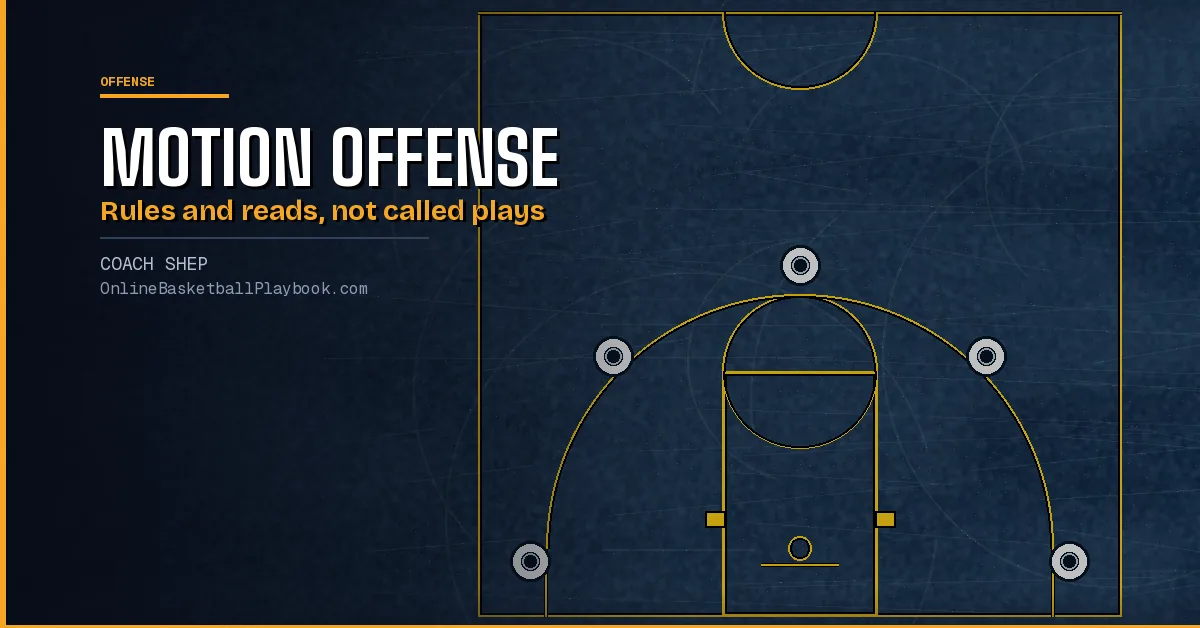
Motion Offense: Spacing, Rules, Actions and How to Install It
Motion offense runs on rules, not called plays. See the spacing, four core actions, 5-out versus 4-out 1-in, the install order, drills and where it struggles.
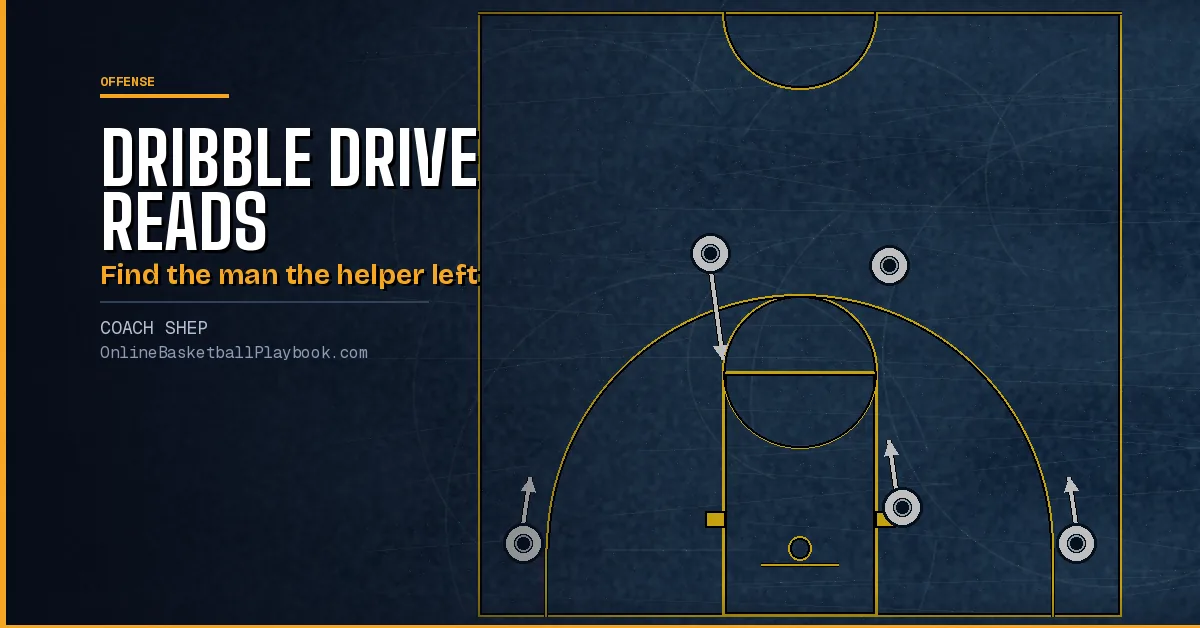
Dribble Drive Reads: Kick Up, Kick Back, Loop and Dump
Dribble drive reads for the driver and the four players around him: the helper tree, kick up, kick back, loop cut, dump, baseline drive jobs and the passing rules.