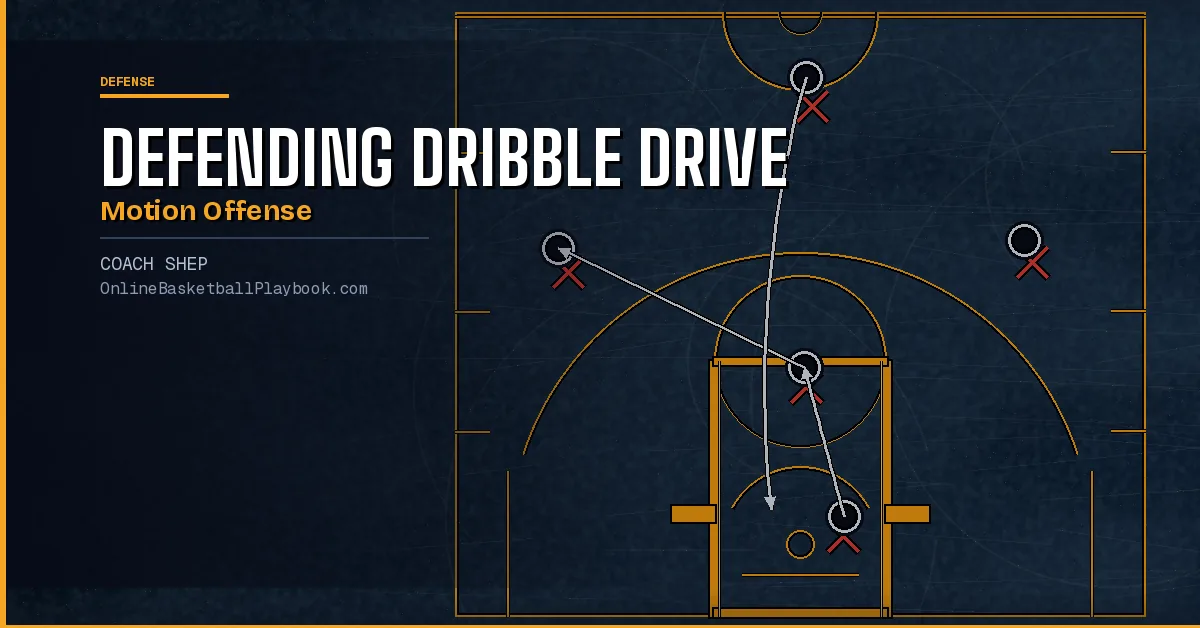
The dribble drive motion offense hunts layups, fouls, and corner threes through a deliberately empty lane. Stopping it requires disciplined gap coverage, sharp closeouts, and a help side that communicates before the drive reaches the paint.
What Makes DDM Hard to Guard
The dribble drive motion offense, originally developed by Vance Walberg and brought to national attention at Memphis, is built on a single structural idea: empty the middle of the floor so that ball-handlers have a clear lane to attack. Unlike traditional offenses that plant a post at the elbow or the block, DDM stations the big on the weakside block and spreads four perimeter players wide. That creates 15 to 18-foot gaps between offensive players, which means one defender cannot shade two threats simultaneously.
The offense operates on a "drive first, shoot second" philosophy. Mid-range jumpers are considered low-value. The system trains players to push to the rim or kick to a corner shooter, never settle. This is what makes it so punishing when defenses fail to account for both. The moment a help defender cheats toward the lane, a shooter is open in the corner. The moment the on-ball defender gives a cushion, the guard attacks the gap and gets to the rack.
Understanding this dual threat is the starting point for any defensive game plan. You are not defending one primary action. You are defending a continuous read system where every drive keys an off-ball response. The offense is simple to teach and hard to scout because the "play" is just the right decision at each read-point. Your defenders need to be equally systematic in their responses. Motion offense in basketball as a broader concept shares this decision-tree logic, but DDM is uniquely aggressive because the default choice is always the drive, not the pass.
Before installing any specific coverage, coaches need to accept one reality: DDM will get some penetration. The goal is not to eliminate all drives. It is to make the offense pay at the point of decision rather than letting a single drive become an easy layup or a wide-open kick-out. Defenses that try to go zero-penetration against DDM get beat badly because they overcommit up the line and leave gaps elsewhere. Build your system around controlled penetration, not zero penetration.
On-Ball Principles: Contain the Drive
The on-ball defender's job is to take away the primary lane. In DDM, the ball-handler is reading a specific "drop zone" on the floor, roughly the free-throw lane area extended toward the elbow. If the driver reaches that band and his shoulders have cleared the defender's shoulders, he pushes through to the rim. If not, he picks up his dribble and makes a kick-out read. Your on-ball defender's goal is simple: never let the driver's shoulders clear yours in that band. The offense's own zone maps and reads are on dribble drive zones and dribble drive reads.
This means stance and positioning are everything. The on-ball defender must be close enough to threaten, no more than an arm's length away, but set to cut off the primary driving lane rather than split-positioned in the middle. Most DDM teams have a dominant drive direction (typically toward the strong hand), so pre-scout and load your defender toward that side. Force the ball-handler into the off-hand and into the help.
Footwork matters more than athleticism here. A defender who is caught flat-footed or who lunges at ball fakes gives up the lane immediately. Teach a two-step close: when the dribble starts, lead-step and mirror the ball, staying connected at the hip level. Do not reach, do not lunge at the ball. Contain first, strip second. Many DDM coaches teach their ball-handlers to take ball-fake-driven reaching defenders directly to the foul line, one reach equals two free throws.
Equally important: communicate the drive early. Before the ball-handler attacks, the on-ball defender should call out "drive left" or "drive right" so the help side can pre-load. A drive that surprises the paint defenders almost always results in a layup or foul. A drive that arrives with the help already set can be channeled into a charge or a forced kick-out under pressure. Man-to-man defense Built on communication is the foundation DDM is designed to crack. Tighten your communication and you close the primary wound.
Help-Side Scheme and the Drop Zone
Once you have the on-ball principles locked in, the bigger challenge is coordinating the help side. DDM is specifically designed to exploit help-side over-rotation. When your paint defender steps up hard to stop a drive, the ball-handler kicks to the corner or drops to the trailer, and a wide-open look results. The offense wins when the help side commits too early or too aggressively.
The most reliable approach is a "drop" or "pack the paint" scheme on the backside. The help defender positioned in the lane does not step up to meet the driver at the elbow. Instead, he holds his position in the paint and forces the driver to pick up his dribble before reaching the rim. This denies the drag zone (the area around the basket) while keeping a body between the ball and a clean kick-out rotation.
Weakside defenders must stay attached to their shooters while staying in vision of the ball. In DDM, corner shooters are stationed specifically because they are at the edge of most defenders' peripheral range, just far enough that help defenders lose track of them. Train your weakside players to use a denial stance angled toward both their man and the ball. When the drive comes, they should retreat one step to close the catch-and-shoot window before the kick-out arrives.
A "stunt and recover" rule helps. When the drive penetrates the paint, the nearest help defender stunts toward the ball, showing a body to discourage the kick-out, then immediately recovers to his shooter. This buys a half-second and forces the passer to look twice before throwing. That half-second is often enough to disrupt the rhythm DDM teams count on. Pair this with vocal communication: the help defender calls "stunt" so teammates know he is momentarily leaving his man and they can shift coverage accordingly.
Reviewing your help defense principles Before installing any DDM-specific adjustments is worth the time. Help defense concepts like vision, rotation responsibility, and communication carry directly into this scheme. DDM exposes teams that have those fundamentals weak more brutally than most offenses do.
Closeout Discipline Against Corner Shooters
The corner three is DDM's release valve. When drives are contested and drops are covered, the ball finds the corner. If that shooter is open for even a moment, the offense gets the exact high-value shot it is designed to manufacture. Closeout discipline is non-negotiable.
The most common mistake: defenders sprint to the corner and arrive off-balance, flying past the shooter or getting pump-faked into the air. DDM coaches teach their shooters to hold the pump fake precisely because defenders tend to sprint-close. The rule for your defenders should be "sprint halfway, chop steps the rest." Get there in a hurry, but arrive under control, hand up, feet on the floor. A contest that sends a shooter to the line from a foul is worse than not closing out at all.
Foot position matters on the closeout. Arrive with inside foot forward, body angled to cut off the baseline. Most DDM shooters are trained to attack a flat-footed closeout back toward the middle, so a well-positioned closeout that takes away the baseline forces the ball back to help, which is exactly where you want it.
This is also a conditioning issue. DDM offenses sub frequently and play fast. One of its stated core principles is using pace and depth to out-condition opponents. By the fourth quarter, if your perimeter defenders are tired, closeouts get lazy, and corner threes start falling. Basketball conditioning drills that emphasize closeout sprints and recovery slides should be part of your weekly prep whenever you are facing a DDM team. Build the leg capacity your defenders need to close out clean for 32 minutes.
Corner defenders should also understand the shot-fake chain: catch → shot fake → one dribble → pull-up. Defenders who bite the shot fake open an uncontested mid-range or a drive to the baseline. Teach your players to mirror the ball after the fake rather than leaving their feet. A hand in the face on a contested corner three is a victory. Take it.
Use the phrase "sprint halfway, chop steps" on every closeout drill. Defenders who hear this trigger phrase during practice will recall it automatically in games when adrenaline and fatigue make disciplined closeouts the first thing that breaks down.
Drilling It: Practice Progressions
Defending DDM is a skill that must be rehearsed systematically, not explained once and assumed understood. The concepts above only stick when players have reps against live DDM actions in practice. Build your defensive reps from 1-on-1 up to 5-on-5, progressively adding the reads that make DDM dangerous.
Stage 1: On-Ball Containment (1-on-1)
Run your on-ball defender against a ball-handler in DDM spacing, wing position, drive lanes open. The ball-handler's only job is to attack the gap. The defender's only job is to keep his shoulders ahead of the driver's in the drop zone band. No help, no rotation. This isolates the primary skill and builds the foot-pattern muscle memory needed before help-side complexity is added. Run this daily for two weeks before you face a DDM opponent.
Stage 2: Drive-and-Kick (3-on-3)
Add a corner shooter and a help defender. Ball-handler drives; helper stunts and recovers; corner defender closes out. Run this action repeatedly from both sides until the communication (drive call, stunt call, recover call) becomes automatic. This is the core sequence of every DDM possession and it must be second nature. The shell drill Format adapts cleanly here. Add DDM spacing to the standard shell and you get exactly the right repetition environment.
Stage 3: Full DDM Look (5-on-5)
Run a full DDM offense against your defense. Rotate through all five positions so your post player also practices defending corner kick-outs (DDM will expose big men who cannot close out). Keep the drill competitive. Offense scores by getting to the rim or getting a corner three uncontested. Defense scores by forcing a pick-up, a missed shot, or a turnover. This creates the game-speed read environment where DDM's complexity actually lives.
Within your basketball practice plan, budget at least 15 minutes of live DDM defense work three times per week during the pre-scout period. Awareness alone does not translate to execution. The footwork and communication patterns need enough reps to be automatic before game night.
In-Game Adjustments
Even well-prepared defenses will need to adjust during a game against a good DDM team. The offense is built on reads, which means it will find whatever you leave open, and you need to recognize what they are finding before the problem compounds across quarters.
Watch for three warning signs. First, repeated layups off the same side drive: your on-ball defender is losing his positioning in the drop zone band and your backside help is late. Respond by shifting your help position half a step toward the drive lane before the drive starts. Second, consecutive corner threes: your stunting help defenders are not recovering fast enough, or your perimeter defender is closing out too aggressively and getting frozen by the pump fake. Slow the closeout and take away the pump-fake drive. Third, the trailer hit: the ball-handler drives, the help collapses, and the kick-out goes to a skip-pass trailer at the top of the key for a clean three. Your weak-side high defender is losing track of the ball. Remind him to stay in vision of the drive before it arrives.
Some teams choose to go under ball-screens when a DDM team adds screen actions. This is a reasonable adjustment if the ball-handler is not a strong pull-up shooter. DDM teams typically want drives, not pull-ups, so going under denies them the drive without surrendering a clean look. Test this adjustment in the third quarter rather than gambling on it in the fourth.
Zone looks, particularly a 2-3 zone: can disrupt DDM's spacing reads mid-game. DDM is trained extensively against man coverage; a zone rotation forces different reads and can temporarily stall the offense. Do not rely on the zone as your primary answer, but a two-possession zone change every other possession can disrupt rhythm and burn clock while DDM players reset mentally.
Transition defense also matters more than most coaches realize. DDM teams push pace deliberately. They want to attack before you are set and before your help-side communication is established. A strong transition defense protocol that gets all five defenders back and matched up before the ball crosses half court is essential. A DDM team that gets four open-court possessions per quarter off your missed shots will score at will regardless of how good your half-court coverage is. Build the habit early: every missed shot triggers a sprint back, no exceptions.
- Force off the dominant hand: pre-load your on-ball defender toward the ball-handler's primary drive direction based on film.
- Drop the help, don't step up: paint defenders hold position in the lane and force a jump-stop rather than rotating up early and opening kick-outs.
- Stunt and recover on every kick-out: help defenders show a body to slow the pass, then immediately return to their corner shooter.
- Sprint halfway, chop steps on closeouts: arrive at the corner under control with inside foot forward and hand high. Never fly past the shooter.
- Call the drive early: on-ball defender announces the drive direction before it starts so the help side can pre-load rather than react.
- Build conditioning to last four quarters: DDM out-conditions teams who tire. Your closeout and help rotations must be just as sharp at minute 32 as minute 5.
- Mix a zone look mid-game: one or two zone possessions per quarter disrupts DDM's man-coverage reads and resets the offense's timing.
Get free play diagrams, drills, and coaching guides delivered weekly.
Draw this play free in the play drawer →
Membership: the full library, playbook packs, and Pro drawing tools →
Keep Building
Related breakdowns
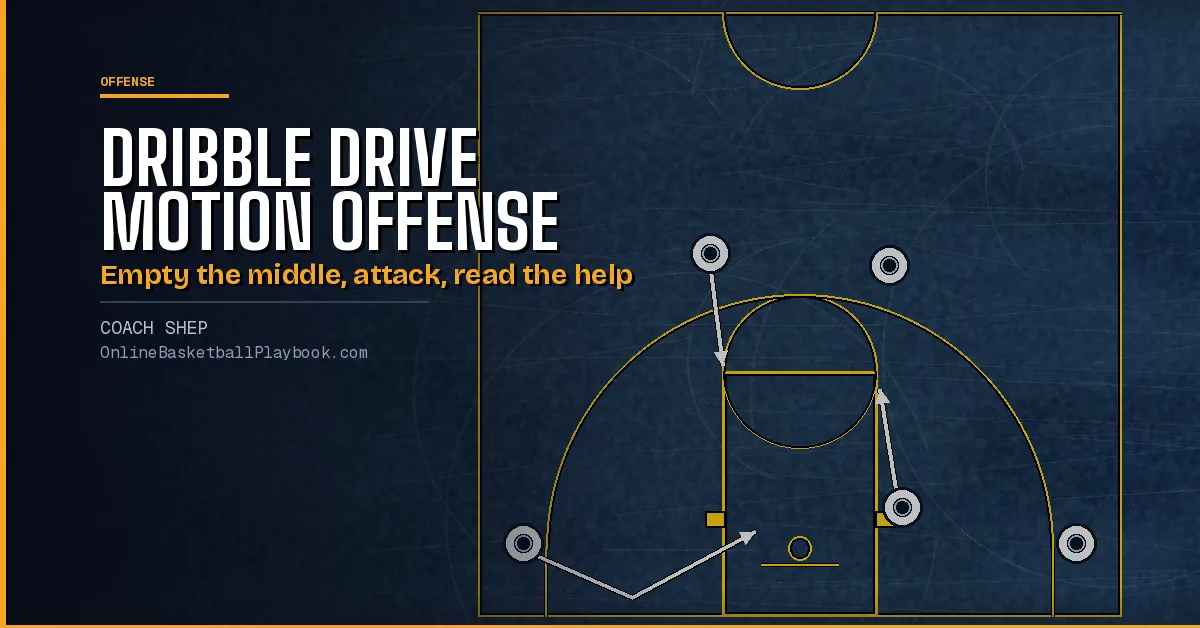
Dribble Drive Motion Offense: Spacing, Reads and Install
The dribble drive motion offense explained: 4-out 1-in spacing, the Drop, Drag and Rack zones, the read off a drive, shot diet, weak spots and the install.
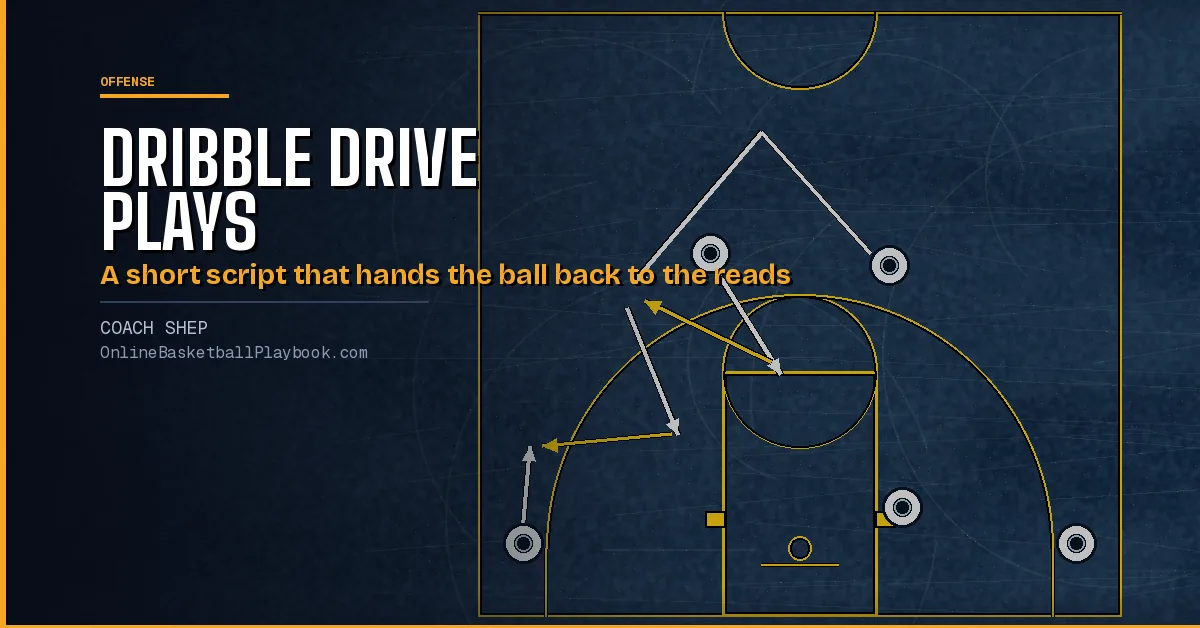
Dribble Drive Named Plays: Drop, Quick, Pop and Corner Sets
Dribble drive named plays, each drawn: Drop, Drag, Quick and Pop calls, a corner ball screen set, one entry with four finishes, the numbering and when to call one.
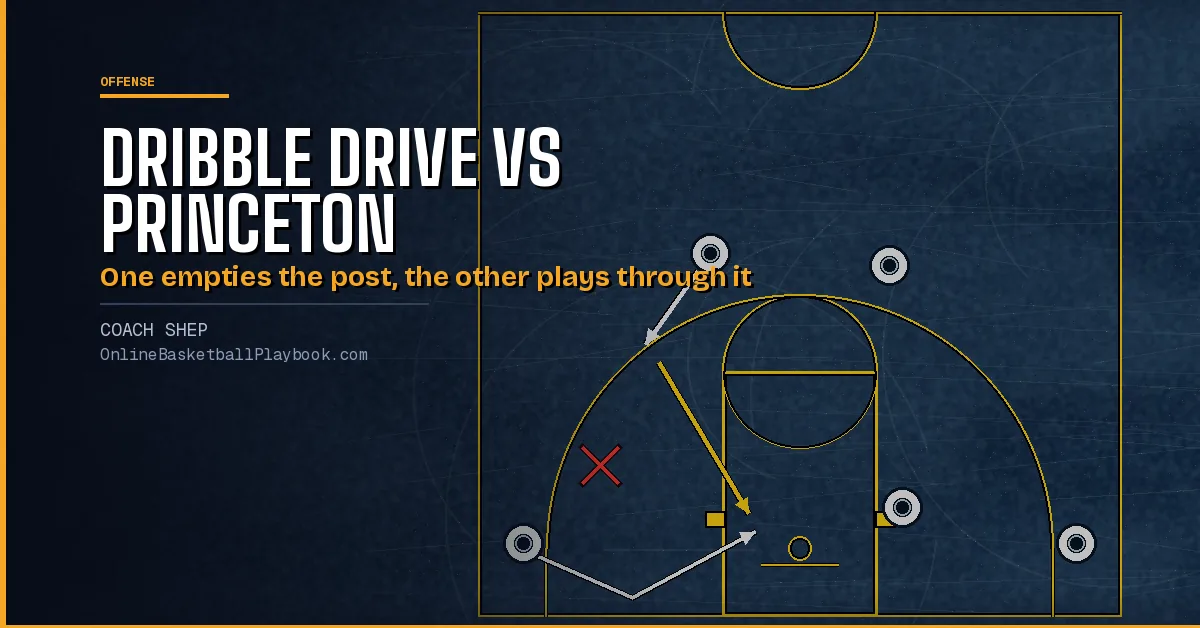
Dribble Drive vs Princeton Offense: Compared by Principle
Dribble drive vs Princeton offense, side by side: the post, spacing, dribble or cut, the backdoor read they share, screens, shots, tempo, personnel and borrowing.