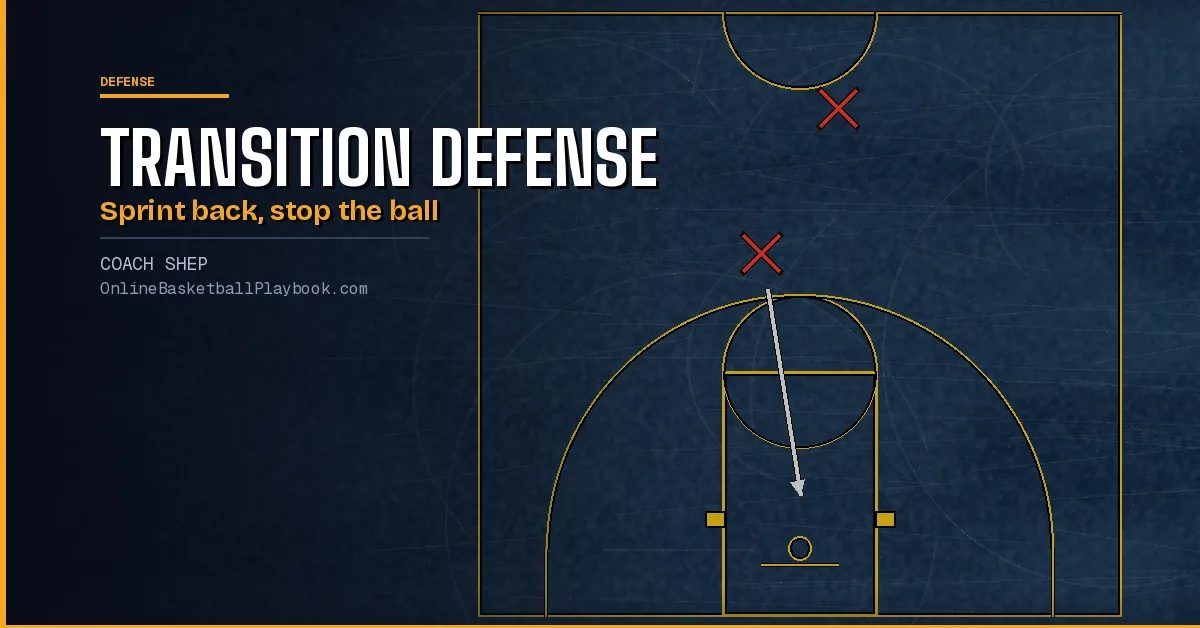
Transition defense is everything a team does between losing the ball and the other team's first shot: who sprints back, who stops the ball, who protects the rim, and how five players match up once the numbers are even. Bob Knight calls this conversion phase the third part of the game and the one most coaches neglect.
It happens on every change of possession, and every press, trap and offensive rebound crash ends in it. Transition defense basketball rests on three jobs: sprint back, stop the ball, match up.
This page covers the decision made before the shot, the sprint, rim first or ball first, the pickup, the matchups, the numbers-down rules, fouling by level, the habits that cost teams and the drills, with the plans side by side. It sits under types of defense in basketball in the defense section.
Transition Defense Basketball: Why It Decides Games
Coaches who rank it put it near the top. Bob Knight says the conversion phase has to be set on day one and practiced every day. All of defense splits into three things: transition, pick and roll, and half court. Jeff Van Gundy's Knicks built their defense from transition and rebounding first. Chris Mack says about a third of possessions are transition.
The case is easy points. Good teams get about 10 to 15 fast-break points and about 10 off offensive rebounds, roughly 25 easy points a game. Cut those to about 5, he said, and scoring 60 or 65 in the half court is very hard against a modern defense.
He also said he watched Gregg Popovich work on transition defense for maybe three minutes every day. Kelvin Sampson calls second-chance, off-turnover and fast-break points the unscripted points. Ettore Messina's non-negotiables include no fast-break layups.
Transition defense starts on offense. A bad shot is often the other team's first fast-break pass. Dick Bennett chooses offensive sets that keep balance, such as 2-3 high sets or 4 out 1 in, and stays away from 1-4 low and the flex. Hubie Brown asks on every shot where the floor balance is and who has back responsibility.
Make getting back a daily habit, not a hope.
Crash or Get Back: Decided Before the Shot
The get-back assignment is a rule written before the shot. Tom Izzo and Dick Bennett sit side by side: Izzo sends the point guard to half court and four to the glass, and Bennett keeps two or three back. The full crash counts, the rules for who goes and the drills are on tagging up, and the table below adds the plans that page does not cover.

| Plan | Back on the shot | To the glass |
|---|---|---|
| Tom Izzo | Point guard to half court | Four |
| Dick Bennett | Point guard to the opposite free-throw line, off guard to half court, the shooter too against athletes | Three, two against athletes |
| Chris Mack | The 1 and 2 never crash | Not stated |
| Ben Howland | The 1 and 2, who swap if the 1 shoots | Three crash hard |
| Three back, two crash | The 1, 2 and 3 as the shot goes up | The 4 and 5 may go |
| Jay Wright | All five run back through the middle | None stated |
| Five-man crash | Nobody | Five, then each one tags a body as the other team rebounds |
Set a ceiling, such as never more than two to the glass. Whatever plan you choose, decide it before the shot. The boxing out that ends every defensive possession is on box out basketball.
Sprint Back and Get Below the Ball
The first steps count most, and the count varies:
- Two steps. The first two steps.
- Three steps. The first three steps.
- Four steps. The first four steps.
Whether to watch the ball on the way back splits coaches.
Sprint first, look later
In the pack line the three non-guards sprint to the paint without looking for the first three steps, then find the ball. It is fine to lose sight of the ball in those first three steps.
Never turn your back
Never run back with your back to the ball, because passers telegraph with their eyes, so sprint looking over the shoulder. The three non-safety players sprint back with vision and match up on shooters.
Get below the level of the ball. Keep every defender ahead of the ball. Players still behind it are not a threat, so nobody chases them. Put the guards even with or below the ball. Gary Williams says when you are behind the ball, sprint toward the lane.
Sprint first and sort out the rest once you are ahead of the ball.
Rim First or Ball First
The first two defenders back split the two jobs, and coaches order them four ways.

| Plan | Rule |
|---|---|
| Rim first | The first man back runs to the rim and takes one step out, and the second stops the ball wherever it is. Bo Ryan's first man back steps in front of the rim, not under it, because you cannot take a charge from under the basket, and his second engages the ball. |
| Wall, shooters, then ball | Build the wall first, find shooters second and build out to the ball last, a plan credited to the Bennetts. |
| Ball first | The pack line order is stop the ball, then protect the basket. Ben Howland's 1 jams the ball in the backcourt while the 2 runs to the paint. |
| Split it | One defender goes to the ball and one to the hole, and they must talk. |
Pick the order before the game and tell the first two back.

Where to Pick Up the Ball
The pickup point runs the length of the floor.
- The point guard meets the outlet handler at the three-quarter court mark.
- Bob Huggins picks up at half court.
- Turn the handler before half court, then settle the pickup just above the arc rather than chase cheap fouls out high.
- X1 contains the ball at half court and push it to a sideline while X2 protects the basket.
Once the ball is picked up, coaches turn it and keep it on one side. Turn the handler at least twice and keep him on one side so the defenders already back can load. Greg McDermott tells the first three defenders back to force the ball to one side so one of them can get to help. Make them throw at least two passes.
Choose one pickup spot and stick to it.
Get the next coaching guide in your inbox
One email when a new guide or diagram set goes up. Free.
Match Up: Guard Their Team, Not Your Man
The shared rule is to guard the open man, not chase your own. Guard their team, not your matchup, and no buddy running. Guard the ball, not a man. Coaches split on when to sort out the matchups.
Match at once
Jay Wright's players run back through the middle, call "Wolf" when they are behind the ball, then point and call who they have. In a Kelvin Sampson drill the five defenders sprint backward calling the jersey number of the man they take.
No matchups this possession
Pack line teams say matchups do not matter for the possession. They play no matchups, declare and stop the ball, and when in doubt keep backing up.
Cross-matches get fixed after the stop:
- Bump the guard out. The first big back bumps the guard who is covering the basket out to the weak side.
- Load and kick out. Jeff Van Gundy loads to the ball side and kicks the smalls out.
- Last back takes the open man. The last defender back takes the man at the top of the key or opposite the ball.
Pack line teams name the shape: sprint, get ahead of the ball, point and talk, build a wall, be on assignment. Their half-court rules are on pack line defense. Guard the open man first and sort the matchups after the stop.
Numbers Down: 2 on 1, 3 on 2 and More
Number the men back so each one knows his job.
- Assign by arrival. The first back goes under the basket, the second to the free-throw line to stop the ball, the third to the closest open man near the ball, the fourth to the basket and the fifth to the free-throw line.
- Assign by jersey. The 1 meets the outlet, the 2 and 3 sprint the sideline lanes, the 4 takes the inside lane and the 5 sprints to the paint.
- Teach the shape by count. Two back play in tandem, three in a triangle, and the late defender makes it a square at 4 on 5.
| Situation | Rule |
|---|---|
| 1 on 0 | Sprint back and contest low with the near hand, then rebound. |
| 1 on 2 | Get as low as the lowest offensive player and give up the outside jumper, never the pass under the basket. |
| 2 on 1 |
|
| 3 on 2 |
|
| 4 on 3, 5 on 4 | A triangle zone against 4 on 3 and a diamond against 5 on 4. Tom Izzo's keys: stop the layup, talk the whole time, box out the miss. |


Outnumbered breaks have to be taught, because players cannot be assumed to know them.
Stay on the Floor: Blocks, Charges and Fouls
Bo Ryan's goal is to be last in the league in blocked shots, because jumping to block brings fouls and costs the defender the dump pass and the rebound.
Teach the chase-down block low with the hand nearest the ball, because a high block risks a foul, and then the defender pulls up before the backboard and goes to the glass. The pack line lists no fouling in the backcourt as a transition rule.
The rulebooks treat a foul that stops a break differently, so check your level:
- NBA. A clear-path-to-the-basket foul is two free throws and the ball. A transition take foul is one free throw and the ball.
- FIBA. A disruptive foul, unnecessary contact made to stop a transition, is two free throws and a throw-in from the frontcourt throw-in line.
- NCAA men and women. No separate transition foul. A foul that is not a legitimate attempt to play the ball (men's book: the ball or player) is a flagrant 1: two free throws and the ball.
- High school. Check your state association rulebook.
Stop the break with position, not a foul.
After a Turnover, a Make or a Broken Press
The first seconds after the ball changes hands:
- After a turnover, retreat and contain. The passer who threw it away should be the first to retreat and contain, not the one who attacks the new handler, because his momentum pulls him into a beaten or reaching position.
- After a make, pressure at once. Convert to pressure the instant the ball goes through, because a team that inbounds faster than the defense sets up gets easy shots.
- Give up no layup and no three. Billy Donovan names no open layup and no open three as his press's two unforgivable outcomes, and calls the press off into man when it is beaten.
A broken press flows straight into get-back:
- Cover the basket on a gut pass. A 2-2-1 press sends everyone to cover the basket on a gut pass while one defender stops the ball.
- Sprint back first. The diamond press makes sprinting back its number one rule once the ball reaches the middle or crosses half court.
- Stop the ball, then fill the key. For young teams, the 2-2-1 has the closest player stop the ball and the other four get to the key before finding a man.
The trap that starts many of these breaks is on trap defense basketball, and the press that picks up later is on three quarter court press. Whatever the press, the next job is the sprint back.
Why Players Do Not Get Back
Jeff Van Gundy lists the reasons: disappointment, celebrating, complaining about a call, and a split second of hesitation. Six habits hurt transition defense: complaining to officials, histrionics after a miss, celebrating a shot, the instinct to go to the glass, gambling, and falling to draw a foul.
The cost of each man missing:
- One back. A dunk.
- Two back. A layup.
- Three back. A contested two.
- Four back. The game is on.
He adds that getting back is not the same as being set, which means in a stance, below the ball and seeing your man.
Make the rule real with a consequence and a number:
- Take the loafer out. Dick Bennett takes a loafer out of the game. Sit players who do not sprint back.
- Set a transition goal. A pack line goal is two transition baskets or fewer a game.
- Cap fast-break attempts. Jeff Van Gundy's Knicks aimed to hold fast-break attempts around 12.
Get back every time, and let the player who does not feel the consequence.
Transition Defense Drills
- Touch the baseline. In Greg McDermott's 5 on 3, the coach passes to the offense and calls a number. The defenders with that number touch the baseline first, the other three sprint back to delay, and the offense has 12 seconds. The same idea runs 4 on 4 or 5 on 5, with the ball defender or named defenders touching the end line.
- Change. The coach yells "Change," the offense drops the ball and attacks the other way, and the new defense sprints back, gets ahead of the ball and builds a wall. Do not pick up the man who just guarded you.
- Progressions. Tom Izzo runs 2 on 1 up to 5 on 5. Phil Martelli starts at the free-throw line and adds a player each trip, from 2 on 1 to 5 on 5.
- Offense to defense. Ettore Messina's 3 on 3 recovery sends the three who were just on offense back to defend the next three.
Rep the sprint back until nobody has to be told.
More setups are on fast break drills, and the other side of the floor is on fast break and transition offense.
Questions Coaches Ask
What is transition defense in basketball?
What a team does between losing the ball and the other team's first shot: sprinting back, protecting the rim, stopping the ball and matching up before the offense gets an easy basket.
Who should get back on defense in basketball?
Coaches set it as a rule before the shot. Common plans send the point guard, the 1 and 2, or the 1, 2 and 3 back, and a few send all five or crash all five.
Should the first defender back guard the rim or the ball?
Coaches split: send the first man back to the rim and the second to the ball, or stop the ball first and protect the basket second.
How do you defend a 3 on 2 fast break?
The two defenders play one behind the other. Either the defender at the top of the key stops the ball while the bottom man takes the first pass and the top defender drops, or who takes the pass depends on where it goes.
How do you defend a 2 on 1?
Coaches differ: contain without reaching and expect the pass, hold the nail until the handler gets close, or fake and drop to force the pass and look for the charge.
How do you practice transition defense?
With drills that start a defender late, such as touching the baseline, change drills that flip possession on a call, and progressions from 2 on 1 up to 5 on 5.
Want the printable playbook packs?
OBP Pro members get the premium playbook packs: the zone attack, out of bounds and practice plan PDFs, plus each new pack as it is finished. The membership page lists what is in each one. Or draw your own version free in PlayDraw.
See what OBP Pro includesMore Core Coaching Guides
- Trap Defense Basketball: When, Where and Who to Trap
- Three Quarter Court Press: Pickup, Traps and Rotations
- How to Defend Inbounds Plays: Baseline and Sideline Options
- Basketball Clock Management: Foul Up 3, Two for One, Last Shot
Back to Types of Defense and every Defense page.
Keep Building
Related breakdowns
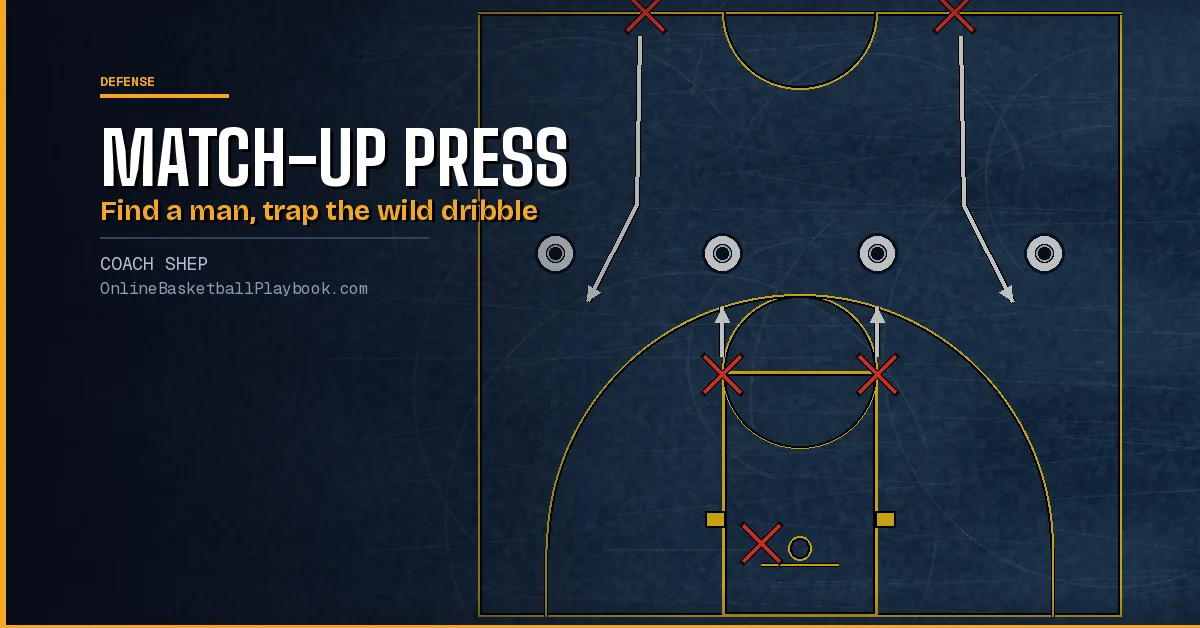
Match-Up Press: Matching Up, Who to Trap, Calls and Drills
The full-court match-up press: matching up from spots, box and diamond, trapping the uncontrolled dribble, the coffin corner, pressing by shot and call menus.
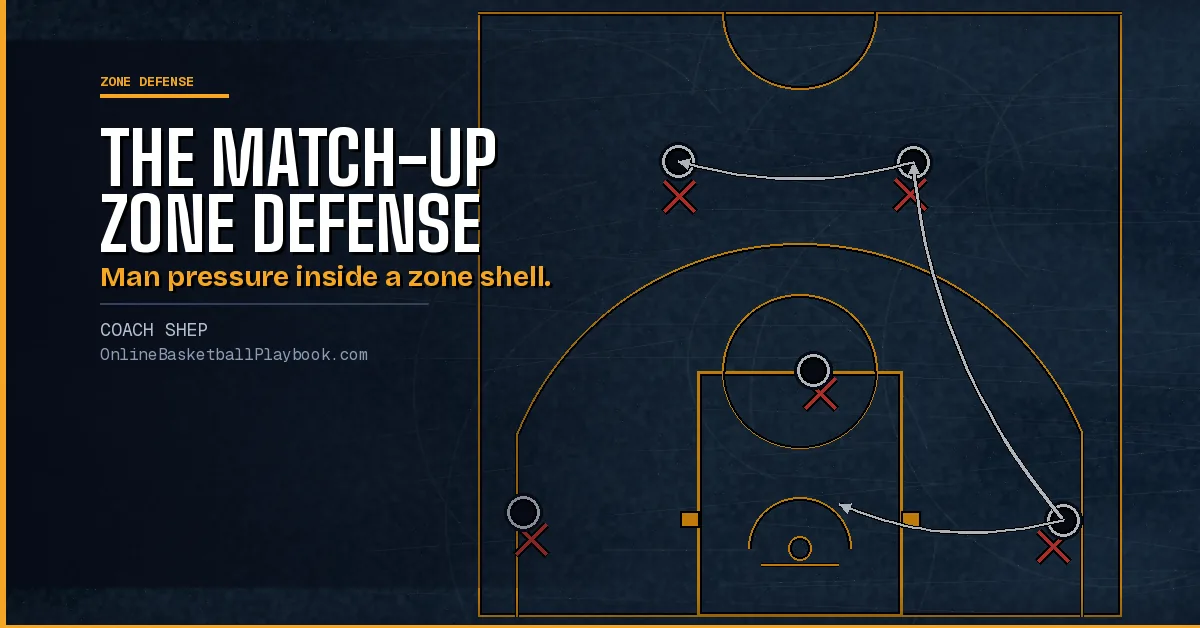
How to Coach the Match-Up Zone Defense (Complete Guide)
The hybrid defense that looks like a zone, plays like man, and confuses every scout who tries to figure it out.
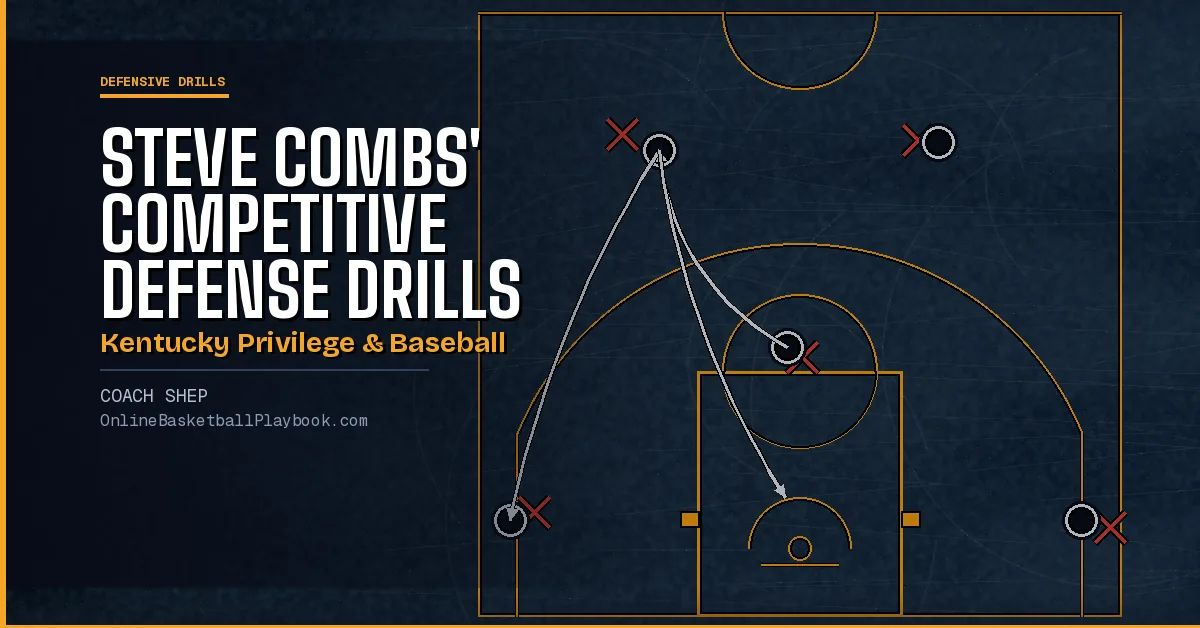
Competitive Defense Drills: Make a Stop the Only Way to Score
Two drills that make a defensive stop the only way to score, so players finally compete for stops in practice.