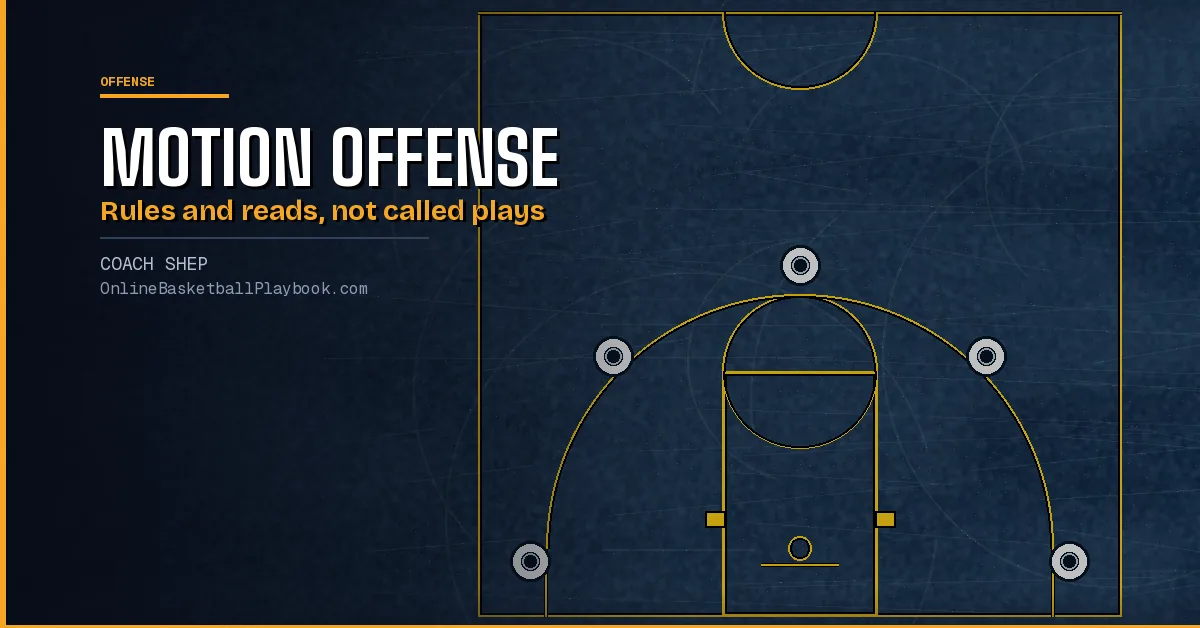
A motion offense is a set of rules, not a list of plays. Players cut, screen and fill spots based on how the defense guards them, so nobody waits for a call. Set plays teach players what to do. Motion teaches players how to play. A program that runs a no-called-plays motion half court behind a full-time push is on transition first program model. This guide covers what motion offense is, the rules it runs on, the alignments, the four core actions, how to install it in layers, where it struggles and the drills that make it stick.
Motion Offense at a Glance
| Question | Answer |
|---|---|
| How is it run? | Rules and reads, not called plays |
| What holds it together? | Spacing, a move after every pass and reads off the defender |
| Which alignments? | 5-out, 4-out 1-in and 3-out 2-in |
| Core actions? | Pass and cut, fill, screen away, dribble-at |
| How long to install? | One layer at a time, each one automatic before the next is added |
| Main limits? | Offensive rebounds, late-clock situations and lineups with a non-shooter |
What Motion Offense Is
Motion offense is not random. Every action has a trigger. A player cuts because the defense gave him the cut. A player screens because a teammate needs to get open. The structure sits in the rules and the reads, and that is why it is hard to scout. There is no fixed shape for the other team to take away.
Coaches choose it for several reasons.
- It teaches players to play. Every player reads the defense on every possession.
- It survives substitutions. Five memorized plays can collapse when one substitute enters. A player who knows the rules can step in and the offense keeps moving.
- It works against any defense. Man, zone, matchup and press all get the same principles of spacing, cutting and reading.
- It is positionless. Any player can fill any spot.
Motion gets the team open. It does not say that a certain play gets a certain player a corner three, so define each player's shot selection by his range.
The Rules Motion Runs On
- Spacing. Spacing is offense. Fill the perimeter spots unless you are cutting or screening. Movement keeps the gaps open. Gap sizes vary by system and level, from about 12 to 15 feet for high school to 15 to 18 for college.
- Move after every pass. After a pass, a player has three choices. Basket cut, set a screen or receive a screen. Standing is a team mistake, not a personal choice.
- Catch ready to attack. A player is most open the instant he catches. Everyone catches balanced with eyes on the rim, ready to shoot, drive or pass, including players who are not shooters. Then he reads.
- Read the defender, not the play. Basket cut a defender who sags and back cut one who overplays. Take what the defense gives.
- Move on the pass. Start the cut when the ball is in the air and cut credibly, so the defender has to respect it.
- Dribble for a reason. Attack the rim on a straight line, improve a passing angle or break a five-second count. Two dribbles in the same spot help nobody.
- Shoot if the defender sags. Drive only when the defender commits.
Rep each rule until players follow it without thinking.
Ball movement matters as much as player movement. Five players standing still but passing quickly can beat five players moving while one holds the ball, because a quick pass finds a late defender faster than complex movement does. The two ideas work together.
5-Out, 4-Out 1-In and 3-Out 2-In

5-out. All five players start outside the arc. The paint is empty, the shot blocker is pulled away from the rim and quick players can attack bigs off the dribble. That suits a team without strong inside players. It works when all five players can make the defense respect their catch. One non-shooter lets a defender sag into the lane. The full guide is on 5 Out Offense.

4-out 1-in. Four players play outside and one post player stays inside. The post player can stay low if he scores with his back to the basket, act as a screener if he does not score, or roam from low to high. A post who does not understand spacing clogs the lanes. One simple continuity has three rules.
- Top-to-top pass. The post back screens and everyone rotates toward the ball.
- Top-to-wing pass. The passer cuts through.
- The 4 steps up. The post back screens and the two switch positions.
See 4-Out 1-In Offense.
3-out 2-in. Two post players stay inside and three players play outside. The posts step out when their defenders sag and duck in when their defenders step up to stop the ball. It suits teams with two genuinely high-IQ posts. See 3-Out 2-In Motion Offense.
The alignments also form a progression. Move a team from 3-out to 4-out to 5-out as its perimeter skills improve. Whatever you pick, run an alignment your roster can support.
The Four Building-Block Actions

1. Pass and cut. The passer cuts to the basket and looks for the return pass. If it is not there he cuts through to the far corner. Hard cuts pull help toward the rim, which frees teammates. Teach it first.
2. Fill the open spot. When a player cuts, someone fills the spot he left. Cut to the basket first, then spread to the weak side. This keeps every perimeter spot occupied. A denied player either back cuts and fills from behind or down-screens and fills.

The backdoor is always live. Any overplay anywhere on the floor is a trigger. Patience matters here. Wait for the defender to turn his head or overplay, then cut.
3. Screen away. After a pass the passer can screen for a player on the far side. The receiver reads the defender. He can curl tight, cut straight or back cut. The screener slips any time his defender jumps above the screen, unless the cutter is curling or going backdoor. Treat the screener as the second cutter. Add screens after the pass-and-cut rhythm is solid.

4. Dribble-at and hand-off. When a ball handler dribbles at a teammate, the teammate takes the hand-off and attacks. If his defender jumps the hand-off, he back cuts.

More on screening is on Basketball Screens and Drills to Teach Off-Ball Screens. Teach pass and cut first and add one action at a time.
Get the next coaching guide in your inbox
One email when a new guide or diagram set goes up. Free.
How to Install Motion Offense
Motion taught all at once overwhelms players. Install one layer at a time and do not add the next until the last one is automatic. A team running one layer well beats a team running four badly.
- Spread the spots.
- Catch ready to attack.
- Pass and cut to the basket.
- Always fill the empty spots.
- If denied, back cut.
- Screen away.
- Screen the ball.
- If dribbled at, hand off.
- Keep post-ups quick so the spacing holds.
Go 5-on-0 before 5-on-5. Run each action with no defender until it looks right. Then give one prescribed defensive action, such as denied, caught on the screen or sagging, and only then go live. Choose one option and get the team to execute it before giving players a choice.
Off-ball movement has to be drilled. Left alone, even good passing teams stand and watch. Constraints help. Play no-dribble games, count a stand after a pass as a turnover, or require two passes before a shot. With youth teams put cones on the spots for the first two weeks. Do not switch offenses mid-season and hold the standard on lazy cuts, slow screens, standing and holding the ball.
Motion Against a Zone
The same principles apply, with more patience. Coaches split on how many reversals break a zone.
- Reverse once or twice. Reverse the ball once or twice before attacking.
- Wait for the third or fourth. The third or fourth reversal, not the first, is when a zone breaks.
Whenever the ball reaches a wing, the opposite wing flashes to the gap in the high post. If the middle low defender steps up to cover the flash, the ball-side corner cuts to the hoop and the far corner rotates up. Reversals and skip passes work because they move the ball faster than the zone can shift. See How to Attack the 2-3 Zone and How to Attack a Zone Defense. Be patient and let the ball beat the zone.
Where Motion Struggles
- Offensive rebounding. With nobody in the paint, misses are easy for the defense to secure. Designate a crasher on each possession and test the plan in scrimmage.
- A non-shooter in the lineup. The defense sags off him and every drive meets an extra helper.
- Late clock. When you need one specific look, use a called set. Keep motion as the base for most possessions and save a few quick-hitters for special situations. See Drills to Teach Quick Hitters.
- Unclear roles. Without defined shot roles, choices can freeze players.
- Install time. Each layer has to be automatic before the next one goes in, so a full install is slow.
- Mixing with many set plays. A layered read-based offense needs full commitment and does not mix with a long list of set plays.
Know the limit before the season and plan for it.
Motion Offense Drills
- 5-on-0 spacing. Walk the spots, then move at game speed with no dribble.
- Pass and cut lines. Pass, basket cut and fill until the rhythm is automatic.
- Back cut card. Denied one pass away and the passer looks. The player back cuts.
- 1-on-1 closeout. The catcher receives ready to attack and attacks the closeout.
- Screen reads. No defender first, then one prescribed defensive action, then live.
- No-dribble 5-on-5. Forces movement without the ball.
- Reversal rule. Require a ball reversal before a shot.
Full drill sets are on Drills to Teach Motion Offense and Drills to Teach the 5 Out Motion Offense. The defensive side is on How to Defend 5 Out Motion. Pick the drill that fixes the layer you are installing.
Where Coaches Split on Motion Offense
Coaches split on a few forks. Pick the side that fits your team.
Which alignment to start with.
- 5-out by default. It is the default for most youth and high school teams because it is positionless.
- Fit it to the roster. Shooters and few posts point to 4-out or 5-out, and balanced size points to 3-out 2-in.
Both agree that fit matters.
Pure rules or named actions.
- Pure rules. Free motion runs on rules alone.
- Named actions. Name recurring actions or add a set family or a call that lets the point guard change to a set. Names make reads coachable and communication fast. Princeton's named shapes are set beside motion's rules on Princeton offense vs motion offense.
What moves the defense.
- Move the player. The toughest player to guard is one who is moving.
- Move the ball. Ball movement beats player movement.
Many teach both.
Structured alternatives.
- Blocker-Mover. Blocker-Mover gives screeners and cutters defined jobs.
- Dribble drive motion. Dribble drive motion builds on penetration.
Pick a side for each fork and stay with it all season.
Coach Cheatsheet
- After every pass a player cuts, screens or receives a screen.
- Catch ready to attack, even a non-shooter.
- Cut to the basket first, then fill.
- Denied and the passer looks means back cut.
- Install one layer at a time, 5-on-0 first.
- Save a few quick-hitters for the end of the clock.
Questions Coaches Ask About Motion Offense
What is a motion offense in basketball?
A motion offense is a rules-based system in which players cut, screen and fill spots by reading the defense instead of running called plays.
What is the best motion offense for a youth team?
Coaches disagree: start with 3-out 2-in and move up, or make 5-out the default. Match the alignment to the roster and install one layer at a time.
How do you teach a motion offense?
Teach the spots, then pass and cut, then fill, back cut, screen away, on-ball screens and dribble-at. Go 5-on-0 first and add defense in stages.
Does motion offense work against a zone?
Yes. Reverse the ball with patience, flash to the high post gap and use skip passes to move the ball faster than the zone can shift.
What are the weaknesses of a motion offense?
Offensive rebounding, late-clock situations, lineups with a non-shooter and the time it takes to install.
All offense pages sit under the Offense hub. Related guides include 5 Out Offense, 4-Out 1-In Offense and 3-Out 2-In Motion Offense, and against man defense see How to Beat Man-to-Man Defense.
Want the printable playbook packs?
OBP Pro members get the premium playbook packs: the zone attack, out of bounds and practice plan PDFs, plus each new pack as it is finished. The membership page lists what is in each one. Or draw your own version free in PlayDraw.
See what OBP Pro includesMore Coaching Guides
- Basketball Player Development: Workouts and Skill Progressions
- Man-to-Man Defense: Stance, Positioning, Help and Drills
- Full Court Press Defense: Types, Rules and How to Install It
- Basketball Shot Fake (Pump Fake): How to Do It and Teach It
Back to every Offense page.
Keep Building
Related breakdowns
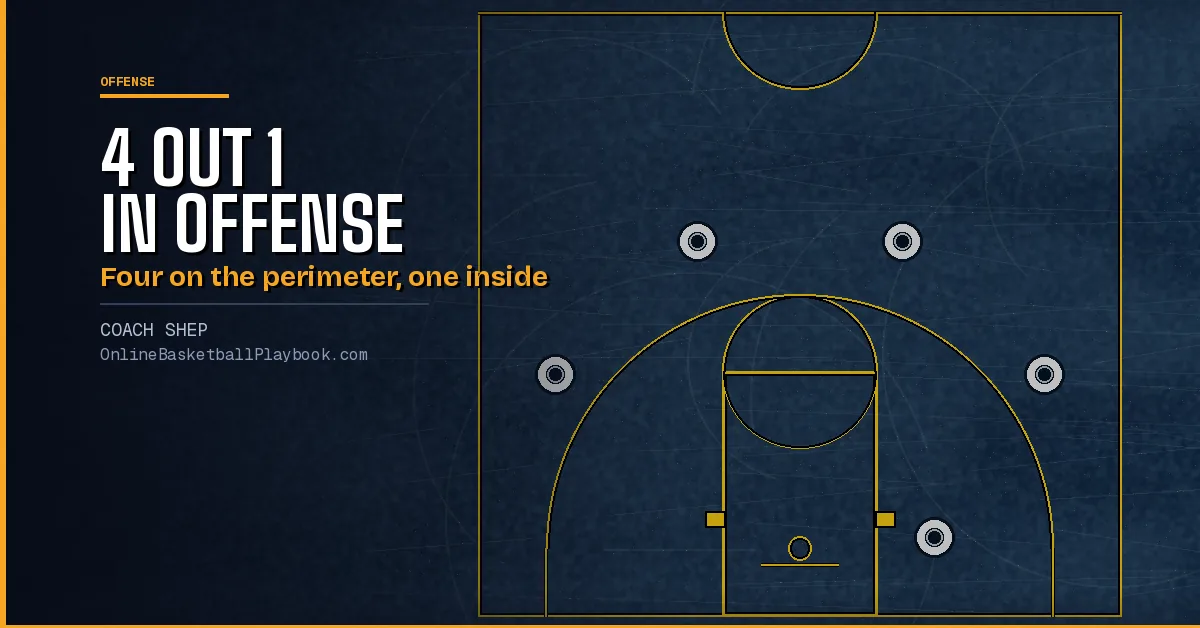
4 Out 1 In Motion Offense: Rules, Spacing and Sets
How to run the 4 out 1 in motion offense: spacing, the six rules, what the post does, pass-cut-fill, screens, quick hitters, zone adjustments and how to install it.
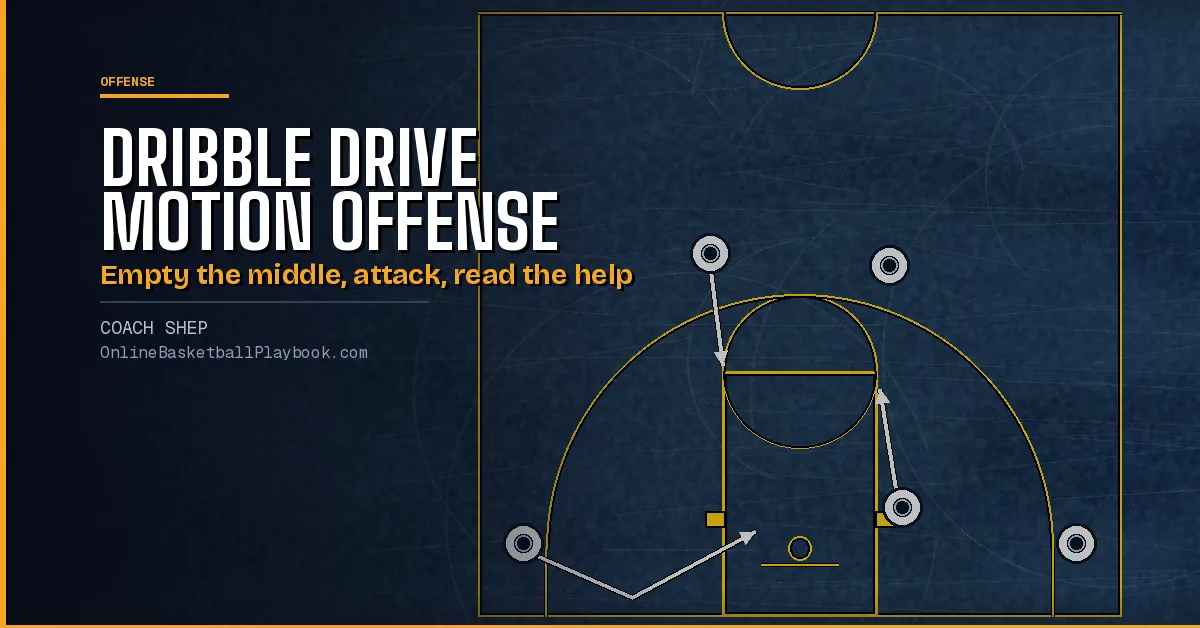
Dribble Drive Motion Offense: Spacing, Reads and Install
The dribble drive motion offense explained: 4-out 1-in spacing, the Drop, Drag and Rack zones, the read off a drive, shot diet, weak spots and the install.
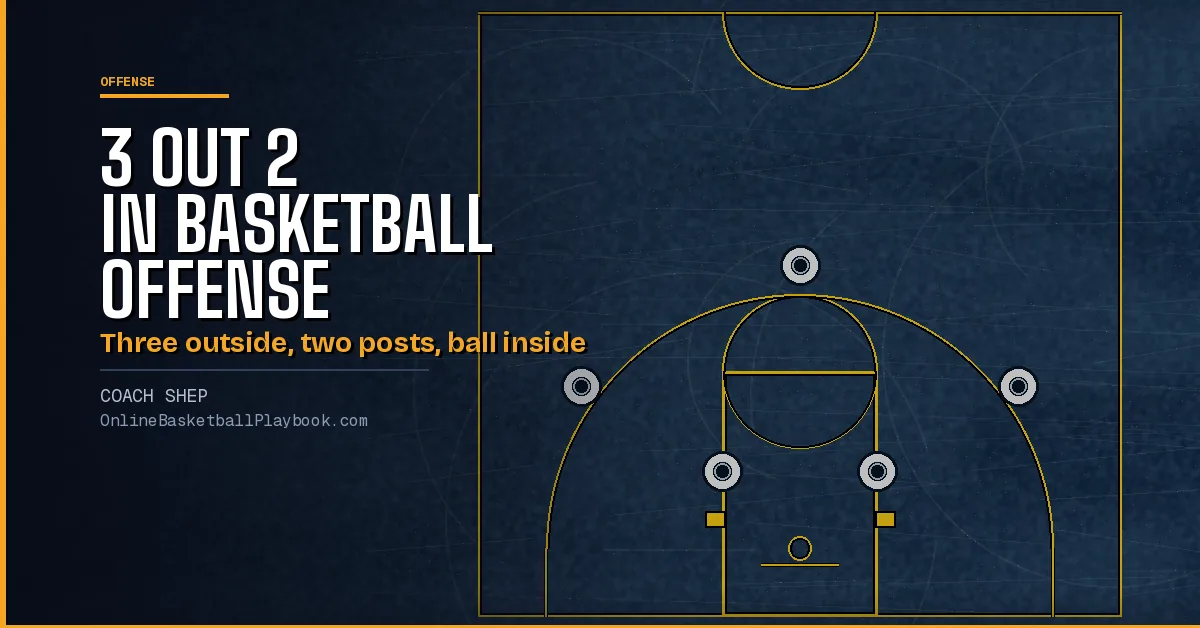
3 Out 2 In Basketball Offense: Spacing, Actions and Reads
The 3 out 2 in basketball offense explained: alignment, actions off every pass, the high-low counter, drive rules for the posts, add-on plays and who fits it.