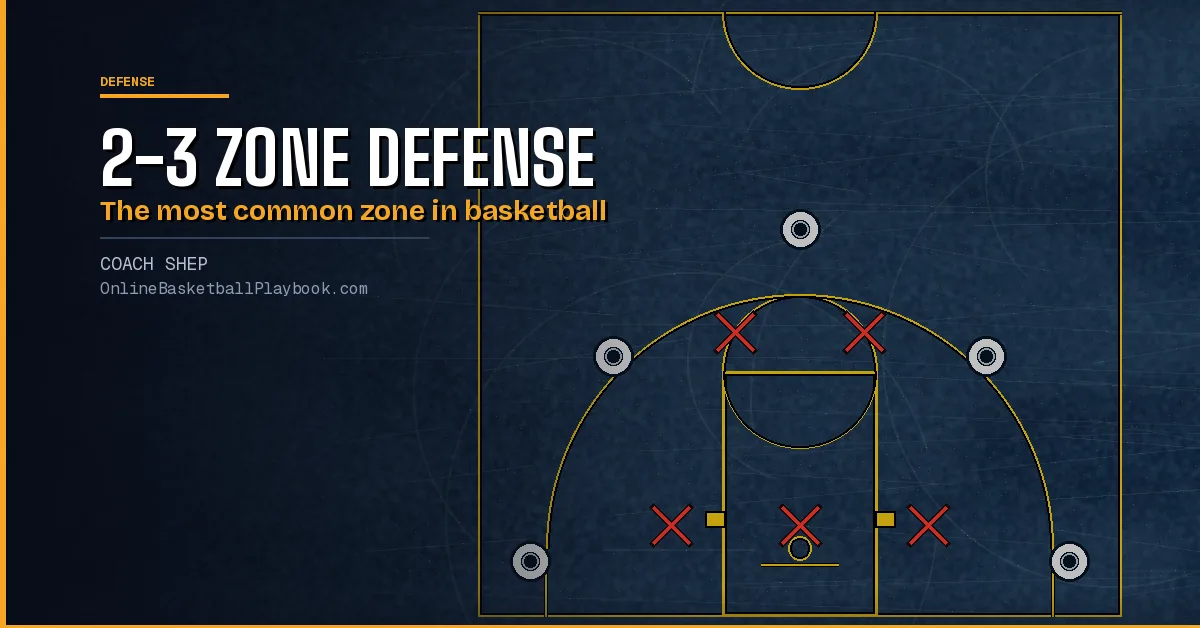
The 2-3 zone defense is the most common zone in basketball. Two guards guard the top of the zone and three players guard the back line, so the paint, the rim and the low post are covered before the ball moves. The price is paid at the corners, the high post and the ball reversal. This guide shows the alignment, how the zone shifts on every pass, where offenses attack it, how to trap out of it, and the drills that make it work.
The 2-3 Zone Defense at a Glance
| Piece | Where he starts | Main job |
|---|---|---|
| Two guards (X1, X2) | A step inside the arc, close together | Guard the ball, deny the pass to the high post, jump-switch on a reversal |
| Two wings (X3, X4) | A step outside the lane line, level with the center at the blocks | Close out on the corner, take away the baseline, drop to the paint on the weak side |
| Center (X5) | Middle of the paint | Guard the low post, contest the rim, rebound the far side, talk |
2-3 Zone Defense Diagram: Starting Positions

The two guards start about one step inside the three-point arc. They stand close enough together that no pass can go between them to the elbow. If a gap opens there, the offense hits the high post and the zone splits in one pass.
The back three line up flat across the baseline side of the lane. The two wings start a step outside the lane line at the blocks, level with the center, and the center starts in the middle of the lane in front of the rim. From there a wing closes out to the corner with the baseline behind him, and the center owns the low post. Some coaches start the wings higher, out at the free-throw line extended, to reach the corner sooner. That is the tandem look covered below, and it pays for the early closeout with one big alone at the rim.
How to Play 2-3 Zone Defense: Shifting to the Ball
All five defenders move while the ball is in the air. Be in the new spot before the catch. Every other rule in this zone sits on top of that one.

Ball at the top of the key. One guard has the ball and the other protects the middle. The guard on the ball contains the dribble and forces one direction. The guard away from the ball stays above the free-throw line to cut off a reversal.
Ball on the wing. The ball-side guard takes the ball. The other guard slides toward the elbow to deny the high post. The ball-side wing sets between the block and the corner. The weak-side wing pulls a foot into the lane, ready for a lob or a backdoor cut, and keeps an eye on both the ball and any cutter.

Ball in the corner. The ball-side wing closes out with his butt pointed at the corner and his shoulder on the baseline. That angle contests the catch and takes away the baseline drive in one move. The center steps up to the short corner side. The weak-side wing drops to the paint. Both guards shift one step toward the ball. This chain is often called the bump rotation.
The ball-side wing does not give up the baseline. A baseline drive puts the center in an impossible spot and opens a dump-off to the elbow.
Skip Passes and the Bump

Two guards cannot cover three perimeter spots at once. The bump solves it. On a skip pass to the far wing, the low wing on that side steps out with his outside foot and outside hand high, back to the corner. That stunt covers the wing shot and the follow pass to the corner. The guard arrives, takes over, and the wing drops back to his spot.
Coaches differ on who owns the skip. Some send the backside low defender to cover a skip from the corner to the far wing. Others send whichever defender is closest to the ball. Pick one owner for each skip before the game and put it on the whiteboard.
On a wing pass the low wing retreats once the guard takes over. Once the ball reaches the corner he stays attached to it and does not retreat.
Get the next coaching guide in your inbox
One email when a new guide or diagram set goes up. Free.
The High Post

A catch at the elbow is the emergency in a 2-3. The player there can shoot, hit a cutter or kick to a corner. Most coaches treat it the same way. The center jumps the catch, both back wings pinch toward the middle, both guards close from above, and everyone is ready to sprint out to shooters.
Coaches split on how hard to fight for it. Some want the two guards to deny the pass with active hands and pressure on the ball. Others cushion the high post on purpose. They let the center guard the catch one on one while the other four run to the corner boxes, and they accept a tough ten-footer in return for no open threes. The zone does not collapse on the center in that version, because the kick-out is what hurts. Choose one cue per team and stay with it all season.
Whichever you choose, the guard who closes should make the catcher face the basket late and with a hand up. The middle defender can also stunt at the catch and wait for a wing to drop before closing all the way.
Weak Spots in the 2-3 Zone
- The high post. Covered above. The gap between the guards is the entry.
- The short corner. The area beside the block is beyond the center's reach. The center steps out to contest while the weak-side wing rotates under the rim for the dive. A second answer is a trap on the short corner entry, covered below.
- Ball reversal. The zone is most vulnerable in the half second after a reversal, when rotations have started and are still unfinished. Passive top guards make it worse. The guards should deny wing catches, not just contest them.
- The corners. Any team with two corner shooters can skip the ball between them. A weak-side wing who sits too far inside cannot recover.
- Dribble penetration between the guards. The guards narrow the gap and force the handler one way. Every defender pressures the ball in his own area.
To see these weak spots from the other side, read How to Beat a 2-3 Zone and How to Attack the 2-3 Zone.
The Tandem 2-3
The flat 2-3 has a reputation for being passive. The tandem version is aggressive. It keeps the two-guard front but starts both wing defenders high, out at the wings, so the base reads as a 2-2-1 (at times a 4-1), with one defender alone at the rim. It gives up tough 10 to 12 foot pull-ups to take away three-point attempts and uncontested shots at the rim. The full version is on the tandem 2-3 zone page.
Five rules run it:
- All five move on the flight of the ball.
- Hands stay above the waist.
- Nobody gets screened.
- Read the next play before it happens.
- No shooter catches and shoots from his spot.
The center is the limiting piece. He has to defend one on one, contest the short corner without help, rebound the far side and talk.
Another five-rule version is more direct. Push the ball to one side. The ball-side wing takes the first pass into the paint. On a corner pass the middle closes out, the low wing rotates to the middle, the top guard rotates to the wing and the weak-side wing drops to the middle.
The 2-3 Trapping Zone

A 2-3 can trap from its base shape. Most coaches keep the menu short and match each trap to a spot:
- Point trap. Both top guards trap the ball as it crosses half court while the two wings deny the wing pass. Call it a surprise two or three times a game.
- Wing trap. The top guard and the low wing close together for one trap and out. Use it rarely.
- Corner trap. It works well against a team that keeps passing to the corner. Run it as often as your team can handle it.
- Short corner and low post. The center and the ball-side wing double every time. The weak-side guard becomes the interceptor.
A common frame is two players on the ball, two anticipating the pass and one guarding the basket. The second defender to the trap locks his legs so the dribbler cannot split it. Steals come from the interceptors. Trappers force a high, slow pass and must not foul. After the pass they sprint out of the double.
Before you install any trap, decide three things. How often will you trap and where? How hard will you pressure the ball? How many players will crash the boards? The answers set your tempo. A trap into a short corner needs a plan for the pass back out. Offenses have a counter that passes out to a guard and then penetrates or reverses.
Rebounding, Ball Screens and Out of Bounds
Nobody owns a box-out man in a zone, so an area rule decides. Each player boxes out whoever is in his area and everyone pursues the ball. The zone gives up more second shots than man-to-man, so drill this like the rotations. Coaches split on how many to send. A big team can send three and leak the guards. A small team can crash with five.
Ball screens do reach a zone. Against a poor shooter the guard goes under and his partner stunts to buy time. Against a good shooter the guard goes over. The guards can jump-switch and funnel the drive to the center. Never let the offense reject the screen.
Baseline out-of-bounds plays are where zones get torched. One common alignment puts two players on the paint, one on the ball-side corner, one above the free-throw line and one on the weak-side block-to-corner area. Once the ball reaches a wing or slot, the top defender sprints to the uncovered wing while the low defender stunts to buy time. Most breakdowns come from a slow sprint and an over-committed stunt.
2-3 Zone Defense Drills
- Stance. Hold a proper stance for a full minute, hands out, weight on the balls of the feet. Run it every day as a warm-up.
- Slides. Slide on the coach's call of right or left. Feet chatter between slides and hands stay up.
- Ball pressure and contain. Pressure at arm's length with no reaching. Then let the offense dribble and contain with the feet.
- On-off closeouts. The wing closes out on the wing pass, retreats when the guard arrives and stays on the ball in the corner. The progression is on zone defense drills.
- Zone slides with a pass fake. The passers move slowly and fake first while the coach checks every slide. Speed up only when the slides are right.
- Half-second drill. The offense reverses before the rotation finishes. Defenders talk and close.
- 4-on-3 and 5-on-3. Your bottom three defend. Every rep shows who takes the short corner, who takes the dive, and what a low defender who cheats toward the corner costs.
- 5-on-6. Play the zone against six offensive players so nobody rests on a rotation.
- Baseline out of bounds. Run two or three sets against your zone and have the low defender call the read before the pass.
The full zone drill collection is on zone defense drills. For more defensive work, see Basketball Defense Drills and Drills to Teach Help and Rotation. Closeout technique is on Basketball Closeout Technique.
When to Run the 2-3 and When to Switch
- Use it against a team with a dominant big and average shooters.
- Use it against a team that lives in transition and wants to run.
- Use it to keep a player in foul trouble on the floor.
- Switch to man if the offense keeps hitting the high post or short corner and your center loses the one-on-one. Switch before the third easy possession.
- Switch to man against a team with several corner shooters who can all catch a skip and fire.
- Some coaches say zone should wait until players know man-to-man. Others teach one zone early as a change-up. Decide by the age and skill of your group.
- A 2-3 that follows a press can look harder to attack even with the same shape.
- Compare it with the sister zone on 2-3 Zone vs 3-2 Zone.
Questions Coaches Ask About the 2-3 Zone Defense
What is a 2-3 zone defense?
A zone with two defenders at the top of the zone and three across the back. It protects the paint and the low post and gives up the corners, the high post and quick ball reversals.
How do you play a 2-3 zone defense?
Move on the flight of the ball, keep the two guards close together, start the wings at the blocks, close out on the corner with the baseline shut, and let the center talk and guard the low post.
What is the weakness of a 2-3 zone?
The high post, the short corner, the half second after a reversal, and corner skip passes. Offenses hit those spots first.
Can a 2-3 zone trap?
Yes. Common traps are a point trap as a surprise, a wing trap rarely, and a corner or short corner trap more often. Interceptors get the steals and trappers must not foul.
What is the difference between a 2-3 and a 3-2 zone?
The 2-3 has three players near the rim and the 3-2 has three across the top of the zone. See 3-2 Zone Defense for the full picture.
What is a tandem 2-3?
A pressure 2-3 that starts both wing defenders high to take away threes, so it looks like a 2-2-1, and leaves one defender at the rim. See the tandem 2-3 zone page.
Other zones and junk looks are ranked on Best Zone Defense for Your Team, and every defense sits under the Defense hub and Types of Defense in Basketball. Related pages are 1-3-1 Zone Defense, 2-1-2 Zone Defense, 1-2-2 Zone Defense and Man-to-Man vs Zone Defense.
Want the printable playbook packs?
OBP Pro members get the premium playbook packs: the zone attack, out of bounds and practice plan PDFs, plus each new pack as it is finished. The membership page lists what is in each one. Or draw your own version free in PlayDraw.
See what OBP Pro includesMore Zone and Junk Defenses
- 3-2 Zone Defense: Rotations, Weak Spots and Drills
- 1-3-1 Zone Defense: Traps, Rotations and Drills
- Box and 1 Defense: How It Works and How to Beat It
Back to Types of Defense and every Defense page.
Keep Building
Related breakdowns
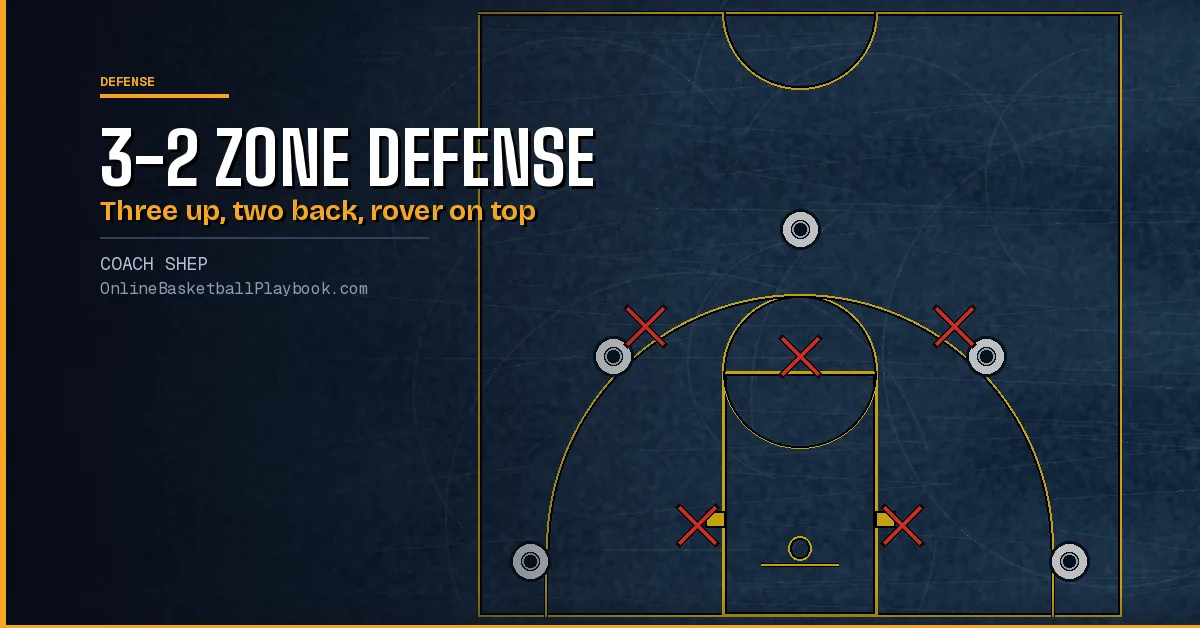
3-2 Zone Defense: Rotations, Weak Spots and Drills
How to run the 3-2 zone defense: the alignment, the rover, every rotation, the weak spots, the 3-2 matchup zone and the drills, plus when to pick it over a 2-3.
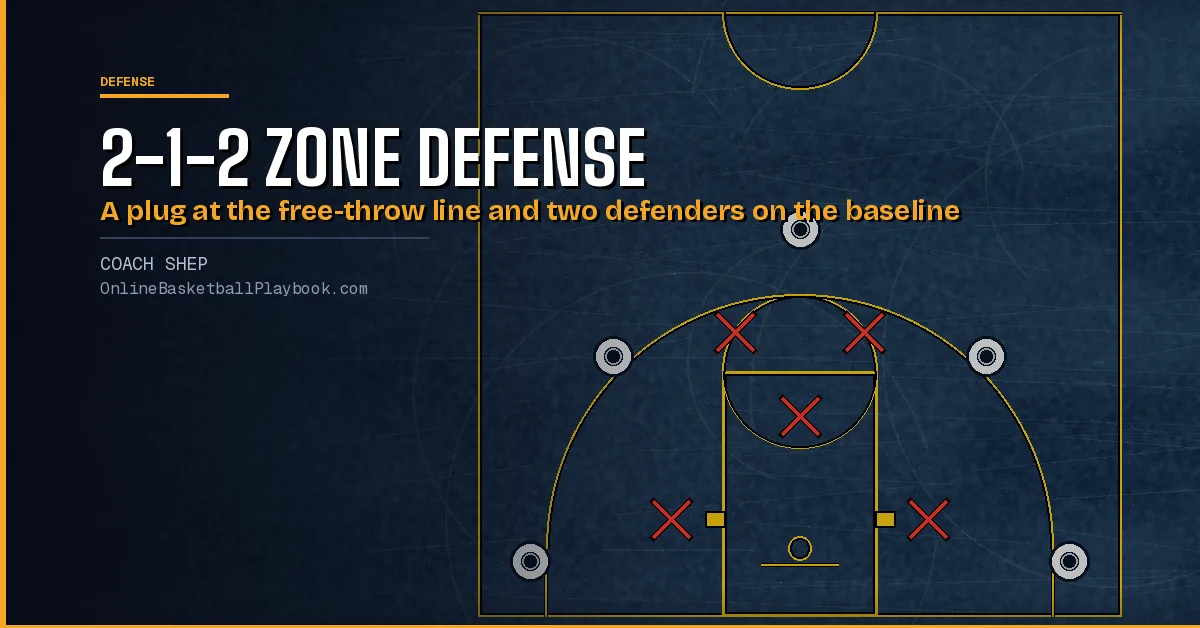
2-1-2 Zone Defense: Rotations, Weak Spots and Personnel
2-1-2 zone defense guide with the alignment, rotations by ball location, how it differs from the 2-3, who plays the middle and its weak spots.
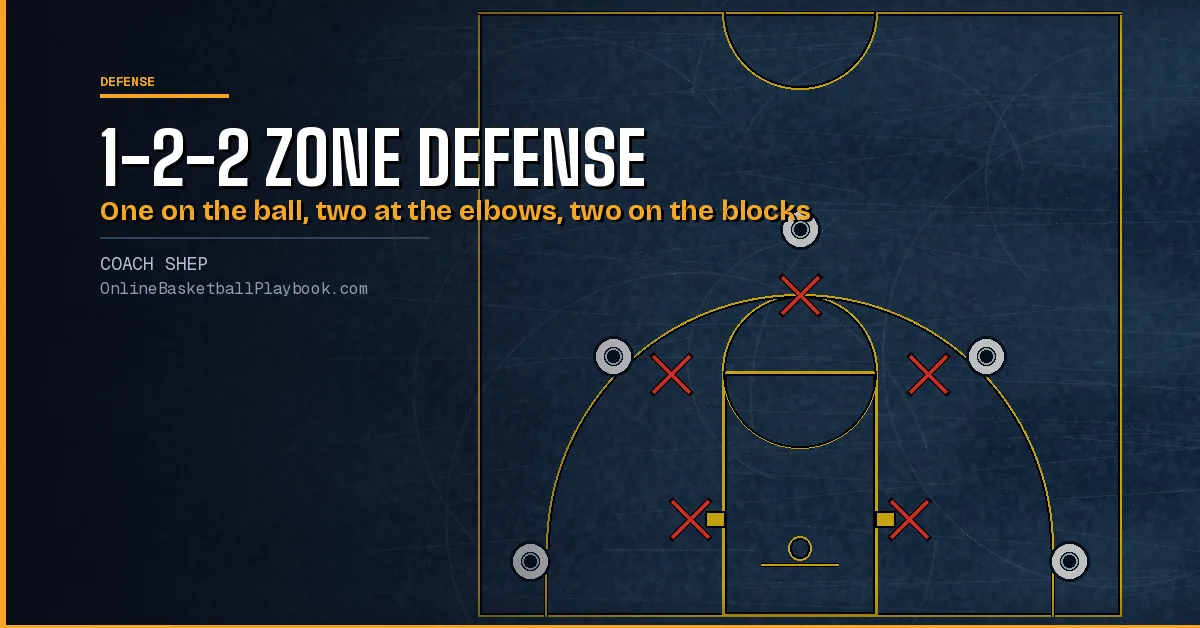
1-2-2 Zone Defense: Rotations, Weak Spots and Drills
How to run the 1-2-2 zone defense: the five roles, rotations for every ball spot, the corner trap, the high post problem, the variations coaches run and the drills.