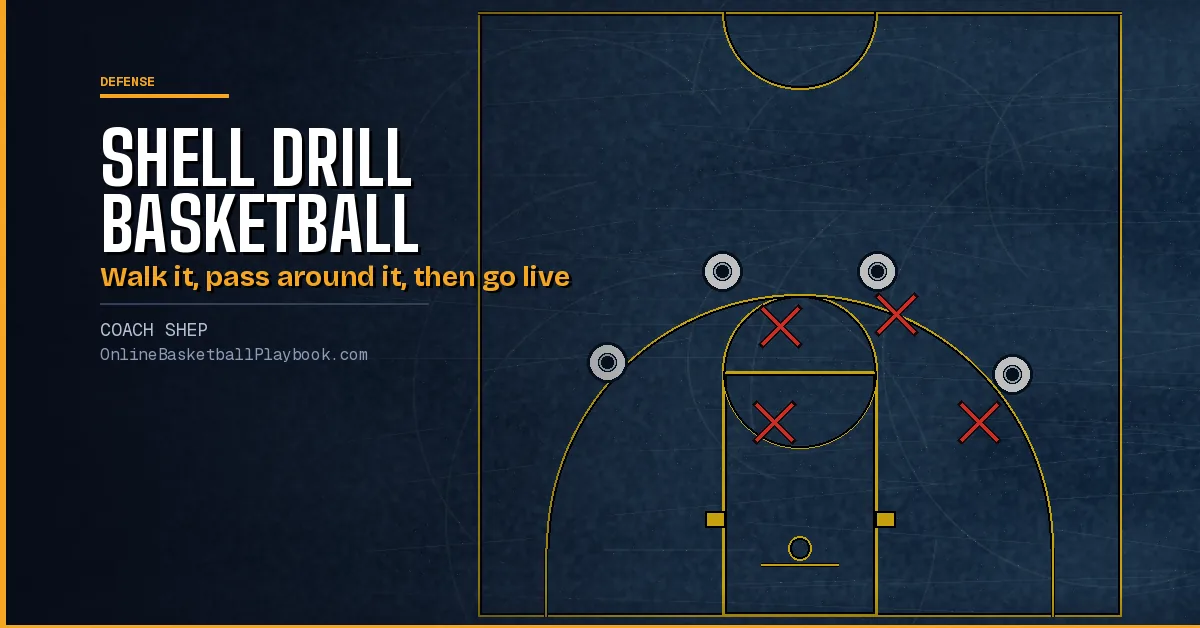
The shell drill in basketball is a step-by-step team drill for teaching defensive positioning. One-on-one drills teach on-ball defense, and the shell teaches players to defend away from the ball. It is usually run 4-on-4 around the arc, and for young players it may be the first time they hear terms like help side, one pass away, rotation and closeout. This guide shows the setups, the stages, the rules coaches put on the offense and the scored live versions. Coaches differ on alignment, on how deep to help and on whether to deny one pass away, so each version below is named for how it lines up.
Shell Drill Basketball at a Glance
| Question | Slots and wings | Wings and corners |
|---|---|---|
| Where the offense starts | Two slots and two wings. The slots-and-wings version uses this | Two wings and two corners, or five players that add a point guard to the wings and corners. The wings-and-corners version uses this |
| What the offense does at first | Pass around the perimeter, holding the ball about 3 seconds | Stationary passing with no cuts or dribbling, triple-threat catches and skip passes |
| How it goes live | Two rotations around the perimeter, then a competitive 4-on-4 | Live half court with cuts and screens, then scored games to five baskets or three stops |
How to Set Up the Shell Drill
The slots-and-wings version sets four offensive players on the perimeter, two at the slots and two on the wings, and matches a defender to each. Its first step is a walk-through of the ball at each position so every defender knows where to stand. The wings-and-corners version starts with two wings and two corners instead. The two pictures below show the same ball position in each setup.

With the ball on a wing, the slots-and-wings version has one defender guarding the ball, one in denial and two sagging into help on the split line, the line that splits the floor in half.

With the ball in a slot, one defender guards the ball, the two players one pass away are both denied and the last defender helps from the split line.

The Three Roles
The wings-and-corners version names the three roles by the distance of a defender's man from the ball. Each role rotates into the next as the ball moves, so the drill teaches them as one chain.
- On the ball. Pressure the ball and force it toward the sideline or baseline. If the player has given up his dribble, move up tight and harass him.
- Deny, one pass away. The wings-and-corners version does not want complete dead-ball denial. It wants the defender slightly up the passing line and a step or two off his man toward the ball, so he can steal the pass and still help if the ball handler drives. Once the dribble ends, the defenders one pass away go to full denial on the line.
- Help, two passes away. The defender sprints in and out of help-side as the ball moves, and the wings-and-corners version warns that players get lazy on these rotations.
Coaches split on how deep the helper plays and whether to deny at all.
| Question | Idea | Example |
|---|---|---|
| Help depth | Ball above the free-throw line, one foot in the lane. Ball below it, straddle the help-side line | Wings-and-corners version |
| Help depth | One-third of the way into the passing lane at two passes away, halfway at three | Wings-and-corners version's team defense drills |
| Help depth | One foot in the lane at two passes away and bucket to bucket at three | Bucket-to-bucket version |
| Help depth | One step toward the ball for each pass that moves away from your man, never so far you cannot beat the pass back | Step-per-pass version |
| One pass away | Deny, a little up the line | Wings-and-corners and slots-and-wings versions |
| One pass away | Play ball, you, man "up the line" to stop the pass and face cut and to win the back screen | Ettore Messina |
| One pass away | Do not deny perimeter passes that do not penetrate | Kevin O'Neill and Flip Saunders. One pack line version also does not deny |
Shell Drill Stages Side by Side
| Plan | Order of stages |
|---|---|
| Slots-and-wings version | Walk through each ball position. Pass around the arc holding about 3 seconds. Go live for two rotations. Then play a competitive 4-on-4 |
| Wings-and-corners version | Passing only. On-ball, deny and help-side. Full denial once the dribble ends. Help and recover. Defending the cutter. Then live |
| Jump-to-the-ball version | Jump to the ball. Give-and-go, where you jump the cutter or get face-cut. Flash, where you stay in help on the flash-out. Live to the paint |
| Screen-series version | Jump to the ball, deny the cut and deny the flash, then ball, down, back, flare and cross screens, then two live finishing games |
| Interchange version | Positioning, interchange, baseline drive, live, down screens, back screens |
| Mike Fratello | Stage the closeout. First rep just close, second rep allow two dribbles, third rep play live |
| Ettore Messina | 3-on-3 shell with movement, then 4-on-4 shrink-and-spread. The defense shrinks to cover a post entry, then spreads when the ball comes back out |
A longer curriculum runs six team shell drills: shifting, three stages of dribble penetration, closeouts, basket cuts, down screens and a live Cutthroat. It ties them to a ten-session plan.
Help and Recover
In the wings-and-corners version's help-and-recover stage, a ball handler dribble-penetrates, the defender on the adjacent player gives help and the ball handler has to pass back out. That defender then rotates quickly to the ball, the defenders one pass away go back to deny and the weak-side defender moves into help-side. The wings-and-corners version says to teach players that helping on the dribble is not trapping. Stop the ball and recover quickly.

Defending the Cutter
When the ball is passed, defenders jump to the ball, which means they are already stepping toward it as it leaves the passer's hands. In the wings-and-corners version's cutter stage the passer's defender is ready to beat the cutter to the spot and keep his body between the cutter and the ball. If the passer cuts to the opposite corner or wing, the defender stays in the lane in help-side.

Get the next coaching guide in your inbox
One email when a new guide or diagram set goes up. Free.
Rules on the Offense
Control the drill by putting rules on the offense so the defense isolates one situation.
- No face cuts. The all-season version runs shell all season with rules such as no face cuts, so defenders must bump the cutter, and back screens with no dribble.
- Screen rules. Skip Prosser's Wake Forest shell sets the answer in advance: go over on down screens and switch on cross screens.
- Pass and cut. In Ben Jacobson's 4-on-4 shell a wing pass sends the ball-side cutter through to fill the opposite side.
- A clock and a target. Ben Jacobson's 3-man shell starts above the three-point line and gives the defense 15 seconds to keep the ball from entering the paint.
- Lane limits. The pressure-man version allows shots only in the lane in its 3-on-3 shell.
Coaching Cues and What to Watch
- See ball and man. Defenders must see both at all times. For younger players, have them point at the ball and at their man and use the calls "ball," "deny" and "help."
- Move on the pass. Messina has defenders reach their final position before the ball arrives. The magnet cue says the ball is a magnet, so move with the ball as it travels, not after it lands.
- Two benchmarks. Messina stands on the baseline under the basket and watches only two things: whether at least one defender is in the paint at all times, and whether the ball and the defender arrive together. He freezes play with a whistle to fix positions.
- Hands up. In one NBA camp setting, everyone in the gym held both arms up for the full 24-second shot clock during 5-on-5 shell.
- Stop the dribble. The pressure-man version asks the defense to stop any dribble penetration within three dribbles.
- Check in. The check-in version has the defense confirm stance and position before the ball goes live, or pay ten push-ups.
Live Shell Drills
| Game | How it scores |
|---|---|
| Live shell (wings-and-corners version) | 4-on-4 or 5-on-5 until one team scores five baskets. Teams switch on every defensive stop, and the losing side pays with push-ups or running |
| 4-on-4-on-4 live shell (wings-and-corners version) | Three teams. The offense stays on until it is stopped, and the first team to five baskets wins |
| Three stops (wings-and-corners version) | Three teams, and a team can only win on defense. A score sends the defense off, and three consecutive stops ends the drill |
| 2-in-1 (Bruce Weber) | The team must get a stop, score and get another stop in three consecutive possessions |
| 24-Second Drill (Weber) | 5-on-5 half court. The defense must hold the offense scoreless for a full 24 seconds, and an offensive rebound resets the clock |
| Lane-entry shell (Weber) | The defense loses the possession if the offense gets two feet in the lane in a position to make a play. 20-second limit, three stops in a row to win |
| Defense-only scoring | A stop or forced turnover is plus one. An offensive score, offensive rebound or defensive foul is minus one. Play to 3 or 5 |
| 3 on 4 (Tubby Smith) | The defense needs stops on two of three possessions |
The wings-and-corners version deliberately lets the offense take a quick basket in the live shell even if the incoming defense is not set, to teach players to be ready and transition fast. A timed version of the whole block is 10 minutes of 4-on-4 in one-minute segments, with ball screens getting three minutes and one coverage chosen from a list that includes soft hedge, hard hedge and ice. For the coverages, see Drills to Teach Ball Screen Defense.
Shell Variations
- Mike Young. Start nearly every day with a sprint to the ball. Run the traditional 4-man shell with two players in the slots and two on the wings, then a drive-and-shrink drill, where a wing drives, the help comes from outside the lane, the defense shrinks and coaches stand unguarded in the corners. He then graduates to a diamond out of the shell to rep the ball screens and actions his league runs.
- Ropes. The pressure-man version puts jump ropes around players' backs in the 4-on-4 shell so they have to move their feet.
- Calls. The shell uses "ball" for the ball player, "gap" for one pass away, one step off and one step up the lane, and "split" for two or more passes away. A shot call sends everyone to block out.
- Backcourt start. Billy Gillispie runs a 4-on-4 shell that starts in the backcourt and adds a post for 5-on-4.
- Extra players. The 6-on-4 version adds two unguarded attackers in the corners to a 4-on-4 shell, so stopping 5-on-5 feels easy by comparison.
Pair the shell with the stance and rotation work in Defensive Stance in Basketball, Basketball Closeout Technique and Help Defense Principles in Basketball. Related drills are in Drills to Teach Help and Rotation Defense, Drills to Teach Defending Cutters and Man-to-Man Defense Practice Drills. For the whole defensive menu and a drill progression, see Defensive Basketball Drills.
Questions Coaches Ask About the Shell Drill
What is the shell drill in basketball?
A step-by-step team drill for teaching defensive positioning away from the ball. It is traditionally run 4-on-4, with the defense matching up with four offensive players around the arc.
How many players run a shell drill?
The traditional shell is 4-on-4. Coaches also run 3-on-3, 5-on-5 and three-team versions such as 4-on-4-on-4.
What does the shell drill teach?
The on-ball, deny and help roles, rotations, closeouts, jumping to the ball and defending the cutter. It also gives a coach a place to install the words the team uses on defense.
How do you run a shell drill?
The slots-and-wings version walks through each ball position, passes around the arc holding about 3 seconds, goes live for two rotations and then plays a competitive 4-on-4.
Should defenders steal in the shell drill?
In the wings-and-corners version's early stages no. The drill is about positioning. Live scored versions then reward stops.
The shell drill is one tool in man-to-man defense, and the Defense hub lists the rest.
Want the printable playbook packs?
OBP Pro members get the premium playbook packs: the zone attack, out of bounds and practice plan PDFs, plus each new pack as it is finished. The membership page lists what is in each one. Or draw your own version free in PlayDraw.
See what OBP Pro includesMore Guides From This Batch
- Press Break Basketball: Alignments, Reads and Drills
- Basketball Conditioning Drills for Teams: Runs, Games and Tests
- Basketball Tryouts: Sessions, Drills, Scoring and Cuts
- Defensive Basketball Drills: Slides, Closeouts, Shell and Games
Back to Man-to-Man Defense and every Defense page.
Keep Building
Related breakdowns
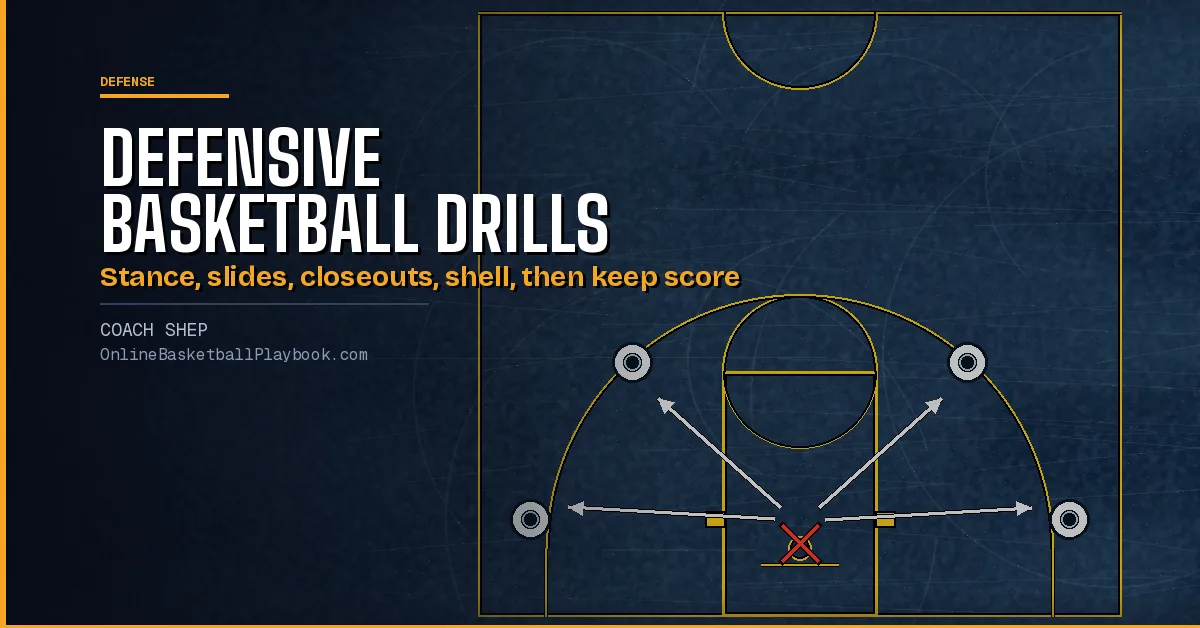
Defensive Basketball Drills: Slides, Closeouts, Shell and Games
Defensive basketball drills in teaching order, from stance and defensive slide drills to closeouts, pass denial, shell and scored games, with the versions coaches split on.
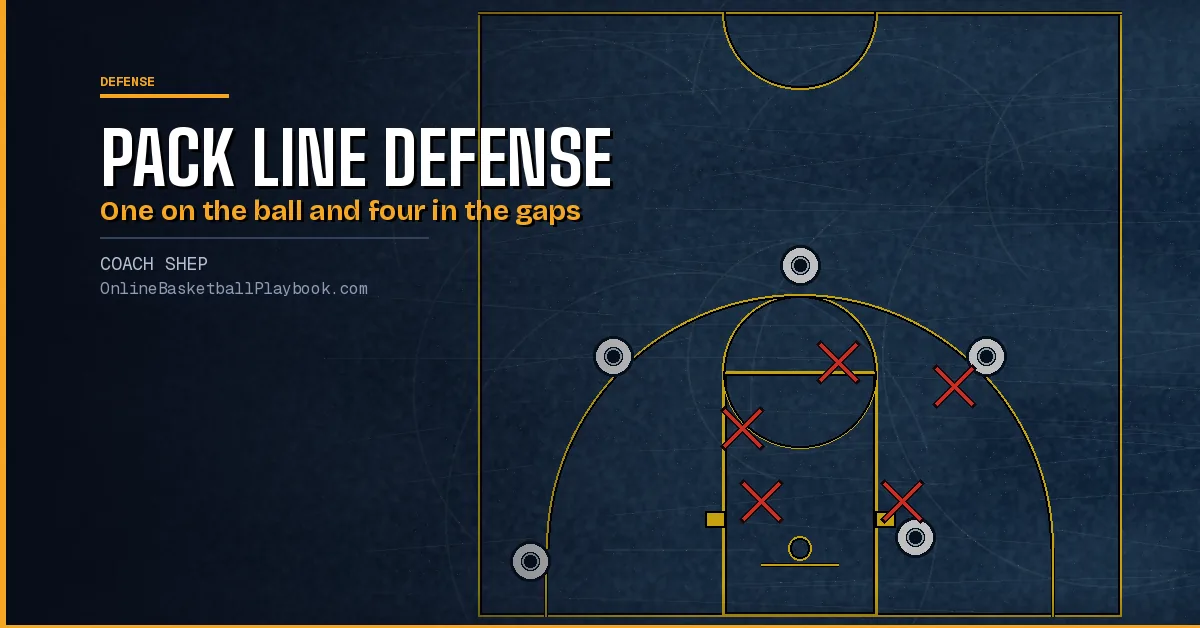
Pack Line Defense: Rules, Post Coverage and How to Install It
Pack line defense as coaches run it: where the line sits, on-ball and gap rules, post doubles, screens, dead balls, the costs and an install order.
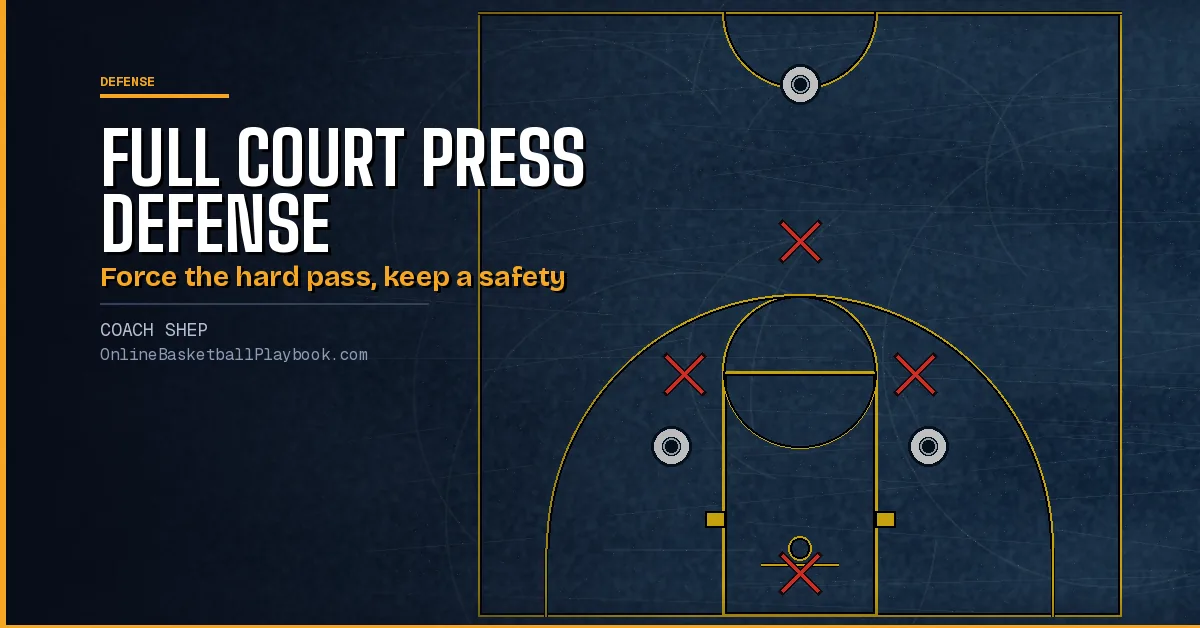
Full Court Press Defense: Types, Rules and How to Install It
Full court press defense pressures the ball for 94 feet. See the press families, shared rules, trap mechanics, the cost, the install order and drills.