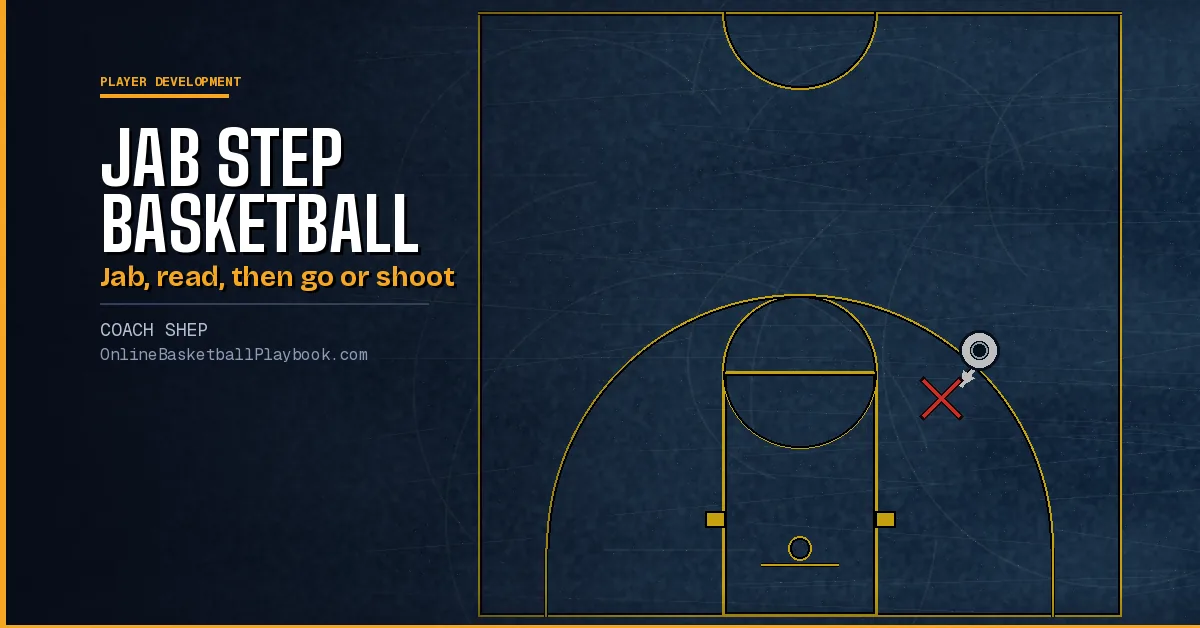
A jab step in basketball is a short, quick step at the defender with the free foot, taken from triple threat with the pivot foot planted. It looks like the start of a drive, so the defender has to react, and his reaction tells the offensive player whether to drive, cross over or shoot.
This jab step basketball guide covers the footwork, how to read the defender, the three answers off the jab, the jab series coaches teach, the travel rules by level, how defenders guard it, and drills.
How to Do a Jab Step
Coaches describe the same step in slightly different words.
| Approach | The step | Coaching points |
|---|---|---|
| One-count hold | Jab and hold it for a one-count while reading the defender | If he does not drop back, attack his forward foot without bringing the jab foot back. If he drops, pull the jab back and shoot |
| Jab at the foot | Square up, read, then jab forward at the defender's foot, not sideways | Keep the ball at the core, do not bring the jab foot back before the drive, push the dribble out in front, and treat it as a read, not a count |
| Six-inch jab | Every move starts from the same short jab of about six inches | Pivot on the weak leg so the strong foot jabs, and use one jab for every move so the defender cannot read where you are going |
| Sell the drive | A quick, aggressive jab that looks like a real drive | Stay balanced, sell it with the hips, dropped shoulders, the ball, the head and the eyes, keep the ball close and gripped, and jab more than once if the first fake does not work |

Triple Threat Under Pressure
Triple threat means the catch leaves three options: dribble, pass or shoot. Against tight pressure the ball often cannot sit out in front of the body.
- Hold it on the hip. Many right-handed players hold it on the left hip instead, away from the defender's hands, then sweep it low, below the knees, to drive right.
- Sweep for momentum. The sweep builds momentum into the first step.
- Pivot first. Front and reverse pivots on the pivot foot move the player into a better spot before the jab.
- Mix the fakes. The jab is one of several fakes from the same stance, along with the shot fake and the pass fake.
Shot fake footwork is on the basketball shot fake, the stance on the triple threat position and pivots on basketball pivot footwork.
Two points follow. If the defender has pressured the player off balance or facing away from the basket, pivot back into a strong position before jabbing. And all three triple-threat options, shoot, drive and pass, must be real, so the dribble and the shot are part of jab step practice too. Pivot rules and pivot drills are on pivot foot in basketball. Whichever way you teach it, keep the pivot foot down and the jab short.
Reading the Defender
The jab is a question, and coaches teach different ways to read the answer.
- Read the feet first. Look at the defender's feet before choosing a move. A foot up gets attacked, a defender playing back gets a shot, and a defender standing even gets a jab at a 45-degree angle. Sweep the ball below the knees and never decide the move in advance.
- Read the stance. Check whether the stance is parallel or staggered. Against parallel feet, jab to stagger them. Then attack the front foot, taking the second step past the heel of that foot, close enough to brush shoulders, and get behind the defender so only post help is left.
- Read the lead foot. Attack the defender's lead foot because that does the most damage to his balance.
- Read the arm. Read the defender's higher arm, not his feet, as the jab-step read.
Whichever read a team uses, the rule from the one-count hold keeps the three answers together: defender stays, attack his forward foot, defender drops, shoot. Read first, then choose.

Jab Step Basketball Moves: Go, Cross and Shoot
Jab and Go
The defender does not drop and his outside foot is forward. The player extends his outside leg straight around the defender without bringing the jab foot back, pushes off the back foot and drives in a straight line at the defender's outside shoulder. The same move is a jab at the foot and a drive past the defender in the same direction as the jab, with the dribble pushed out in front.

Jab Crossover
The defender's inside foot is forward. The player swings the ball low and across, crosses the jab foot over without first returning it, and drives hard off the defender's inside shoulder in a straight line. This clip is a borderline travel, so remember that the dribble has to start, ball out of the hand, while the pivot foot is still down. More crossover footwork is on the crossover in basketball.

Jab and Shoot
The defender drops back to stop the drive. The player pulls the jab foot back to balance and shoots. Bring the foot back for the jumper, or use a separate hitch and shoot.

Jab and Go Opposite
Jab and go opposite is a second-layer counter.
- Jab strong, then cross. The player jabs at the defender's foot to the strong side, then, without bringing the jab foot back, steps across the defender and attacks the other way, putting the ball down as he steps.
- Teach it last. It starts out looking exactly like its sweep move, so it only works once the defender already respects the sweep and the straight jab and go. Teach it after them.

Get the next coaching guide in your inbox
One email when a new guide or diagram set goes up. Free.
The Jab Series
Coaches package these answers as a series and rep them from both sides of the floor.
| Series | Moves in the series |
|---|---|
| Long-stride series | Jab and go (a short jab, then a long stride past the defender), jab and rip to change direction, jab and bring the foot back for a jumper |
| Hitch series | Jab and go, jab and step by, jab and shoot, hitch and shoot, hitch and go, three shots each |
| Step-back series | Jab and go, jab and cross, jab and shoot, jab with a shot fake and go, jab and step back |
| Shot-fake drive series | Jab and direct drive, jab with a shot fake and drive, jab and drive and step back, jab with a shot fake and crossover |
| Six-inch jab series | Four moves from the same six-inch jab: step to one side, step to the other side, jab and balance for the jumper, and jab, fake the jumper and drive |
| Three-move series | Direct drive, crossover, and jab and shot only |
- Add the rocker step. The long-stride series adds the rocker step, where the player raises the ball on the jab to stand the defender up and then goes, with the knees bent and the feet still.
- Catch on balance. The most important thing is to catch on balance, turn and jab so the defender backs off, and players must be comfortable on either foot.
- Name the jab types. Four jab types: front, side, middle and cross.
The shot fake that pairs with these moves is on the shot fake in basketball. Rep each move from both sides until it is automatic.
The Travel Rules
A jab is legal because the pivot foot stays down. The trouble comes when the dribble starts late.
- NCAA men (Rule 9 Sec. 5 Art. 5). Once the pivot foot is set it may be lifted, but not returned before a pass or shot, and on a dribble the ball must leave the hand first. The 2026-27 points of emphasis say pre-dribble and split-step travels are not being called consistently.
- NCAA women (Rule 9 Sec. 5). The same pivot rules as the men's book.
- NBA (Rule 10 Sec. XIII(c) and (d)). The ball must be out of the hand before the pivot foot is lifted to start a dribble, and a raised pivot foot means pass or shoot before it returns.
- FIBA (2026 Art. 25.2.1). For a player who catches standing, the ball has to be out of the hand on the dribble before the pivot foot comes up.
- NFHS. The current high school wording was not available to read. Check your state association rulebook.
Every level's traveling rule is on traveling in basketball. Keep the pivot foot down until the ball is out of the hand.
Common Mistakes
- Faking without a threat. A player who cannot shoot or drive gets his jab ignored.
- Bringing the jab foot back before the drive. The one-count hold and the jab at the foot both drive without returning it.
- Lifting the pivot foot before the dribble. Watch for it on both the jab drive and the jab crossover, and every level calls it a travel.
- A jab that tells the defender the move. The six-inch jab series cites a defender who could predict moves from where the jab went, and it dropped that kind of foot fake.
- Teaching both feet as the jab foot. The six-inch jab series says only 3 players in 18 years could handle both, that players walk on the crossover and that most shooters are uncomfortable shooting off the weak-side jab. The long-stride series makes players comfortable on either foot. See the table below.
Correct one mistake at a time.
Guarding the Jab
Defensive coaches teach answers to the same fake.
- Back up, not sideways. Going side to side on a jab makes the gaps bigger, so back up instead.
- "Back," then "Attack." Answer a jab with a quick two-footed hop of about 12 inches back against the drive, then close out again with both hands up when the ball handler resets. Most offensive players over-stride on the jab.
- Absorb it with the back foot. An NBA closeout series absorbs the jab with the back foot.
Reacting to the jab is one of three closeout jobs an NBA series lists, with the closeout itself and cutting off the first drive. More is on closeout technique. Choose one answer and drill it.
Jab Step Drills
- Elbow drill. The player flips the ball out to the elbow, catches it with a jump stop, pivots on the inside foot to face the basket and goes into the jab series. It teaches players how to stop with the ball.
- Box drill. A one-dribble drill. The defender slides across the lane while the offense rolls the ball out, then the defender comes out to play live, and the offense must use the jab series and play low and wide.
- Jab and go from the arc. Start in triple threat on the three-point line, jab at a coach or an imaginary defender, sweep the ball past and finish with a pull-up or a layup, then rebound and repeat.
- Run it inside a workout. Run ball handling, form shooting, footwork and game spots, then the jab series and a five-spot shooting drill. A one-on-one game across the lane against live defense follows the rule "take what the defense gives you."

If players take a shot in a drill, most will focus only on the shot, so change drills often so players do not get bored. More live-ball footwork is on basketball footwork drills, the full move menu is on the basketball dribble moves guide, and live work is on 1 on 1 basketball. Rep the jab until the read is automatic.
Where Coaches Differ
| Question | Approach |
|---|---|
| Hold the jab? | Hold a one-count and read |
| A read, not a count | |
| Which foot jabs? | One permanent pivot foot, with the strong foot jabbing |
| Comfortable jabbing off either foot | |
| What to read? | The feet (foot up, back or even) |
| The stance, parallel or staggered | |
| The defender's higher arm | |
| How many moves? | Three moves only |
| A series of four or five with counters |
Pick one answer to each question and teach it the same way.
Want the printable playbook packs?
OBP Pro members get the premium playbook packs: the zone attack, out of bounds and practice plan PDFs, plus each new pack as it is finished. The membership page lists what is in each one. Or draw your own version free in PlayDraw.
See what OBP Pro includesQuestions Coaches Ask
What is a jab step in basketball?
A short, quick step at the defender with the free foot, from triple threat, that fakes a drive so the defender reacts.
How do you do a jab step?
Catch in triple threat, keep the pivot foot down, jab at the defender's front foot and read him. If he stays, drive past his forward foot without bringing the jab foot back. If he drops, pull it back and shoot.
Is a jab step a travel?
No, as long as the pivot foot stays down. It becomes a travel if the pivot foot lifts before the ball leaves the hand on the dribble.
What is the jab series in basketball?
A set of moves that all start with a jab, usually jab and go, jab and cross, and jab and shoot, with counters such as a shot fake or a step-back.
What is the difference between a jab step and a rocker step?
The rocker step adds the ball: the player raises it on the jab to stand the defender up, then goes.
How do you defend a jab step?
Back up rather than slide sideways, or hop back about 12 inches and close out again when the ball handler resets.
More Guides From This Batch
- Basketball Speed and Agility Drills: Sprints, Starts and Stops
- Fast Break Basketball Drills for Youth and Varsity Teams
- Pick and Roll Basketball Drills: From 2 on 0 to Live Reads
- Flagrant Foul in Basketball: Rule, Penalties and Calls by Level
Back to Basketball Player Development and every Player Development page.
Keep Building
Related breakdowns
Hook Shot Basketball: How to Do It and How to Teach It
Hook shot basketball for post players and coaches: the classic hook, sky hook and jump hook, the footwork steps, when to use it, the pivot foot rules and drills.
Basketball Shot Fake (Pump Fake): How to Do It and Teach It
The basketball shot fake, also called the pump fake, works when it looks like the real shot. The mechanics, the pivot foot footwork, the read and the drills.
Basketball Shooting Form: Step-by-Step Mechanics
Basketball shooting form step by step, from the ready stance and grip to release and follow-through, with drill progressions and where coaches disagree.