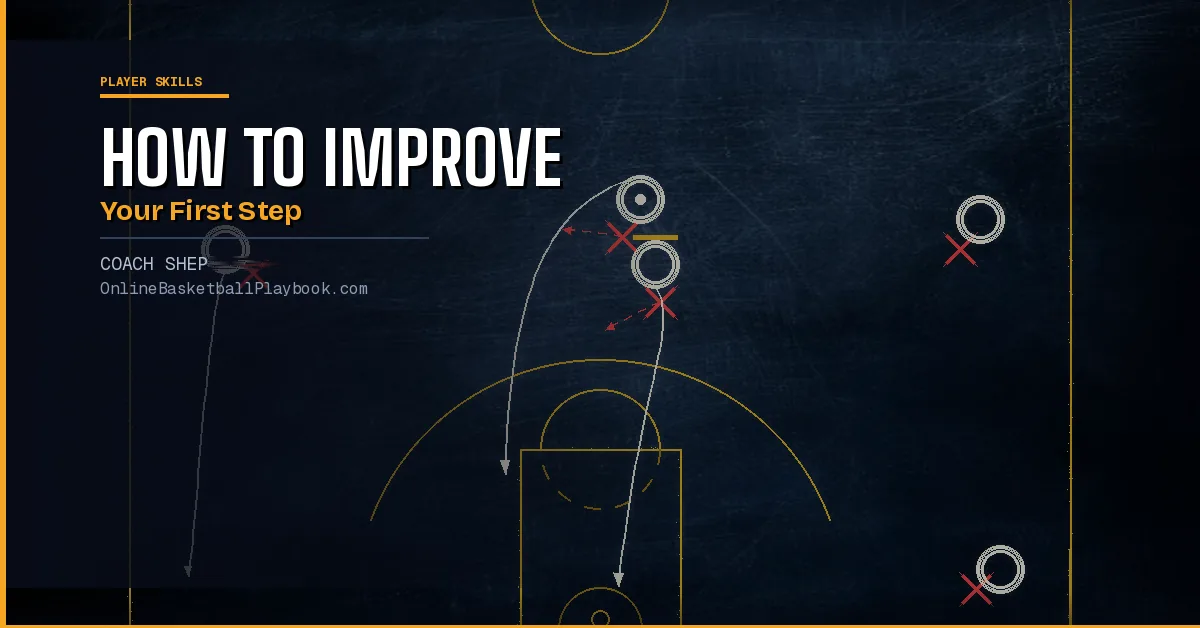
Your first step is the difference between creating a clean look and getting stuck at the three-point line. This guide breaks down the stance, weight transfer, and drills that make your first step faster and more decisive.
Why Your First Step Determines Everything
Every guard who gets to the rim consistently has one thing in common. A first step that puts defenders on their heels. It is not always about raw speed. The best first steps in basketball come from preparation: the right stance, the right read, and the right footwork pattern executed before the defense can react.
At the guard level, separation is created in fractions of a second. A defender who is flat-footed or leaning the wrong way has already lost before the offensive player takes a dribble. That advantage starts with body position and ends with a purposeful, low, explosive push off the back foot. The dribble itself is almost secondary. What matters is that the defender cannot recover by the time the ball hits the floor.
This is why basketball footwork drills belong in every individual workout, not just as a warmup but as a central training block. Footwork is trainable. A slow first step today is not a permanent condition. It is a technique problem with a technique solution.
There is also a mental component. Players who hesitate at the point of attack telegraph their uncertainty to defenders. A decisive first step signals confidence. Even when the move does not work perfectly, decisiveness keeps the defense guessing. Coaches who build basketball player development programs around decision-making recognize that the hesitation before the move is often more costly than the move itself.
Understanding why the first step matters is the starting point. The rest of this guide is about what you can actually do to make yours sharper.
Stance and Balance: The Foundation
Every explosive first step starts from a balanced athletic stance. If your weight is back on your heels, your first step will be slow regardless of your effort level. If your feet are too wide or too narrow, your ability to push in any direction is compromised. Stance is not just a starting position. It is the engine that powers everything that follows.
The correct stance keeps the weight on the balls of the feet, with knees bent and hips sitting slightly back. The feet should be roughly shoulder-width apart, staggered slightly so one foot is slightly ahead of the other. This stagger matters because it pre-loads your ability to attack in a preferred direction while still leaving you mobile enough to counter in the opposite direction.
Eyes must be up. A player who is looking down at the ball or at their own feet cannot read the defense and will always be a half-step behind. The scan must happen before the dribble: size up the defender's foot positioning, look for a flat-footed moment, check where the help is coming from. All of that reading happens from the stance before any movement begins.
Recovery balance matters as much as setup balance. Players often practice the explosive first step but neglect returning to a stable position after the move. When a drive is cut off or a pull-up jumper is needed, the player who lands in balance has options. The player who arrives out of control has none. Train the return as deliberately as you train the launch.
Weight Transfer and the Power Position
The first step is powered by the foot you push off, not the foot you step with. This is the most common misunderstanding among players trying to improve their quickness off the dribble. The step itself is just a result. The explosion comes from the push.
To maximize that push, the weight needs to transfer onto the back foot just before the first step launches. This is called getting into the power position. It is a subtle, quick shift that loads the leg like a spring. Players who skip this step end up lunging forward with their upper body rather than driving through with their legs, which produces a slow, inefficient first step that defenders can easily stay in front of.
The jab step is one of the most effective tools for triggering the weight transfer and testing the defense simultaneously. A sharp, short jab toward one side forces the defender to commit. If they over-rotate, the crossover into the vacated space is wide open. If they freeze, the direct drive is there. Either way, the jab has created the moment the offensive player needs to generate a real first step with separation.
The hesitation move accomplishes a similar goal through timing rather than spatial threat. A brief stutter or change in tempo (bringing the knee up, pausing the dribble rhythm) can freeze a defender just long enough to create a window. These reads and counters are the difference between a first step that gets you to the paint and one that runs into a waiting defender.
Drills to Train Your First Step
Improvement in the first step comes from deliberate repetition of specific movement patterns, not just playing more pickup basketball. The following drills isolate the mechanics most responsible for a quick, decisive first step and train them under controlled conditions before adding defensive pressure.
Jab and Go
Start in a triple-threat stance at the wing. Execute a sharp jab step in one direction, pause for one count to simulate reading the defender, then attack directly, either down the line or through the crossover. The drill builds the pause-and-read habit that separates reactive players from predictable ones. Do five reps in each direction before switching sides.
Stance and Slide Warmup
Begin every footwork session with a simple lateral slide pattern that reinforces the athletic position. Slide five steps left, plant, and explode right. The plant step is the teaching point: weight transfers to the outside foot, the body lowers, and the explosion comes from that loaded position. This is the same mechanical pattern used on the first step off the dribble.
Cone Attack Series
Set a cone at the top of the key. Approach the cone with a dribble, execute a jab or hesitation move at the cone, then attack a second cone placed at the elbow. This trains players to use a move at a specific point of attack, the wing, the three-point line, the nail, rather than waiting until they are already in contact with a defender.
One-Dribble Pull-Up
From the wing, take one dribble hard to the elbow and pull up for a mid-range jump shot. The focus is not the make. It is the landing position. The player should arrive balanced, with the same distance between the feet on every landing. This ties directly to the basketball shooting form principle that great pull-up shooters land in the same spot every time.
Partner Reaction Drill
With a passive partner acting as a defender, the offensive player holds the ball in triple threat. The partner points left or right randomly. The offensive player attacks in the indicated direction immediately. This trains reaction speed in a competitive context without full defense. Gradually reduce the delay between the signal and the required response.
Reading the Defense Before You Move
The best first steps in basketball do not just happen. They happen in response to something the defense shows. A guard who attacks without reading is fast but predictable. A guard who reads and then attacks is nearly impossible to stop because the move is triggered by a real defensive mistake.
There are two primary reads on the initial drive: the defender's foot position and their weight distribution. A defender whose feet are even and flat is vulnerable on either side. A defender who is cheating to stop the drive in one direction has given up the opposite side. Reading this in real time is a skill that must be trained. It does not happen automatically.
Practicing with a passive defender who occasionally shifts their weight or opens their hips is the fastest way to build this habit. The player learns to see the opening before they create the move, which makes the move more effective because it starts with an advantage already in place. Over time, reading becomes automatic, and the first step becomes reactive rather than pre-planned.
Help defense positioning also matters. A player who drives without awareness of where the help is coming from will often create a first step but lose the advantage by the time they reach the paint. Understanding your team's help defense principles from an offensive perspective, knowing where the helper will come from, lets you attack the right gaps and finish before help arrives.
These reads connect directly to broader basketball IQ. Players who invest time developing their reading ability become more effective at every level of the game, not just on drives. Scouts and coaches notice the difference between a player who has one move and a player who has a move system built on what the defense gives them.
Common Mistakes That Slow Your First Step
Most players who struggle with their first step are not slow. They are making one or more correctable technical errors that rob them of their natural quickness. Identifying and fixing these mistakes can produce noticeable improvement within a single training session.
The most common error is telegraphing the direction of the drive before making a move. This happens when a player's eyes, shoulders, or the dribble itself gives away the intended direction. Defenders who can read the drive early do not need to be fast. They simply do not have to react to a fake because they never believed the fake was real. Work on keeping your eyes level, your shoulders square, and your dribble pattern neutral until you are committed to a direction.
The second common error is standing too upright. Players who do not bend their knees cannot generate drive force from the legs. The first step becomes a stumble forward rather than an explosive push, and the result is a slow, flat drive that gives the defense time to recover. Drop the hips, bend the knees, and get into a genuine athletic position before attacking.
Recording your footwork during solo workouts is one of the fastest ways to identify stance and weight-transfer errors. Most players are shocked by the difference between what they feel and what the video actually shows. Watch the first two frames of each drive to audit your launch position.
The third mistake is taking a false step, stepping backward or sideways with the pivot foot before attacking. A false step tells the defense exactly where you are going and gives them a free half-second to close the gap. Practice launching from a completely still position. The first movement should be the attack, not a preliminary step.
Finally, many players try to develop a fast first step in isolation from their overall workout, spending a few minutes on footwork before moving on. Real improvement requires dedicated repetition as part of a structured practice plan. Building it into your basketball practice plan as a standing component, not an afterthought, is what produces lasting change in game situations.
- Start every drive rep from a true athletic stance: weight on the balls of your feet, knees bent, hips back, eyes up
- Load the back foot before you attack. The push comes from that leg, not the step foot
- Read the defender's foot and weight position before you choose a direction. Attack what they give you
- Eliminate the false step. Your first movement should be the attack, never a preliminary shuffle backward or sideways
- Train recovery balance as deliberately as you train the launch. Arrive in control on every pull-up and finish
- Use the jab step to trigger a real defensive commitment before you attack. Don't drive into a set defender
- Film your footwork at least once per week and audit the launch position on each drive rep
Get free play diagrams, drills, and coaching guides delivered weekly.
Draw this play free in the play drawer →
Membership: the full library, playbook packs, and Pro drawing tools →
Keep Building
Related breakdowns
Basketball Shooting Form: Step-by-Step Mechanics
Basketball shooting form step by step, from the ready stance and grip to release and follow-through, with drill progressions and where coaches disagree.
Jump Shot Basketball: Footwork, Release and the Step-Back Jumper
The jump shot in basketball from the feet up: catch footwork, the lift and release, shooting off the catch or the dribble, the step-back jumper and fixing a miss.
How to Fix Common Shooting Errors: Read the Miss First
How to fix common shooting errors: read what the ball does on the rim, find the cause, apply one correction, and coach the shooter through the dip.