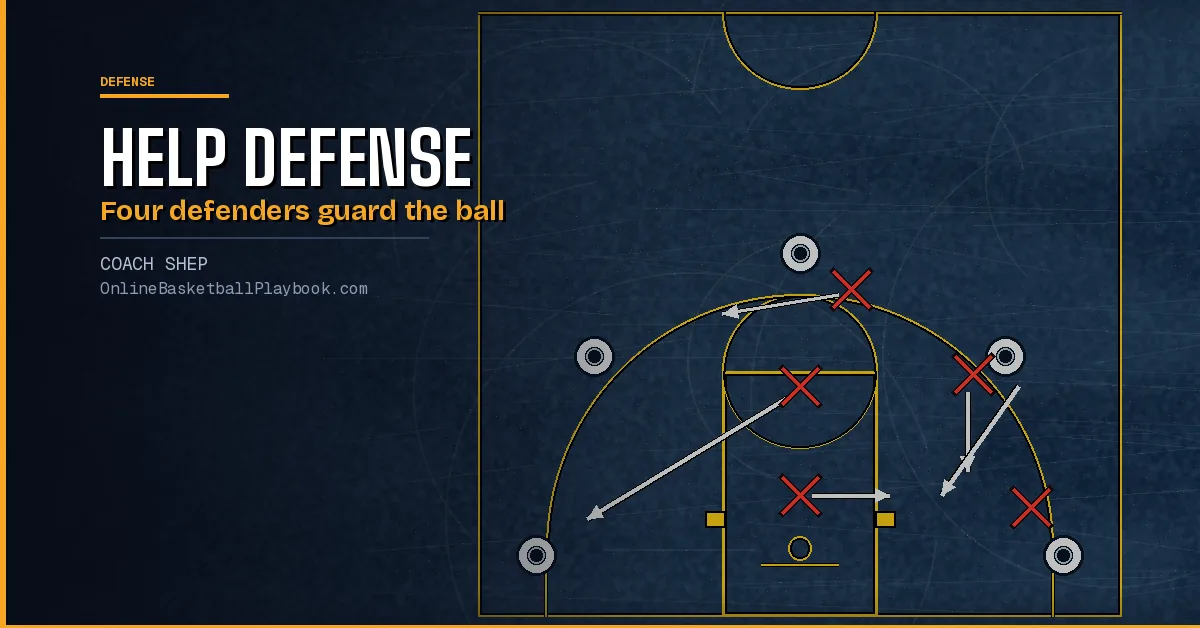
Help defense is the off-ball half of man-to-man: where the four defenders not guarding the ball stand, when one of them leaves his man to stop a drive, a post catch or a cutter, and how the others cover the man he left. Help defense basketball splits into two families. Deny-and-pressure systems guard one pass away tight and rotate hard. Pack-and-gap systems sit in the gaps and recover.
This page covers both, with the help side position, stunting against committing, the rotation when the ball beats its man, the 911 sink, help under ball screens, the talk, and the drills, with each approach laid out. It sits under types of defense in basketball in the defense section.
Help Defense Basketball: Three Jobs by Distance
Man-to-man uses three jobs.
- Pressure the ball.
- Guard one pass away.
- Help two or more passes away.
The farther your man is from the ball, the farther off him you play. Bob Huggins teaches it in his 4 on 4 plus 1 drill as one away on the line and two away on the help line. The youth check: take one step toward the ball for each pass that moves away from your man, but never so far you cannot beat the pass back.
The four defenders off the ball are the most critical part of team defense, with three concerns: the cutter or flash, screens, and the drive once the ball defender is beaten. The off-ball alignment itself, the ball-you-man triangle and how it moves, is on ball you man defense. Play farther off as your man gets farther from the ball.
Where Help Side Defenders Stand
The two-passes-away spot is where coaches differ most. Start with one rule. Frank Martin wants every weak-side defender on the rim-to-rim line every possession.

Other systems place the spot differently, so write the position next to the name. Each is one rule, not a ladder.
- Free-throw line split. Ball above the free-throw line: one foot in the lane. Ball below it: a foot on the help-side line.
- Lane line straddle. Ball above the line extended: both feet outside the lane. At or below it: one foot in the paint straddling the lane line.
- Split line. Ball below the free-throw line: two helpers on the split line, the low I near the rim and the high I near the foul line.
- Taped help line. Tape a help line down the middle that two-away defenders must touch.
- The rope. Two away: fingertips on the ball-to-man line at the midline. One away: halfway, two steps off it.
- The ball line. Messina: ball lower than the free-throw line, drop to a line through the ball parallel to the baseline.
- Help at the rim. Lock left: help at the rim, not the paint line, and weak-side shooters on the far side stay open.
The stance matters too. Every help defender's backside points toward the baseline unless he is fronting a cutter, so he sees the whole floor. Not seeing ball and man is blamed for most high school breakdowns. Put the ball-side foot forward with the arms pointing at man and ball. The pack line keeps its triangle flat, because a deep triangle lets the handler drive deep and the helper cannot get back out to the kick.
Where Help Comes From
Set where help comes from as a rule.
- From the weak side and the middle. Denial defense has help always come from the weak side, and never help off the ball-side corner because help comes from the middle.
- Guards help guards, bigs stay home. Frank Martin keeps his bigs on the strong-side block.
- Across, not up. Help across from your own man on the same level, never up the floor, because helping up gives up the lob.
- From the force side. Forcing baseline keeps the ball on one side so everyone knows where help comes from, while forcing middle starts every defender in help. That choice is on lock left defense.
Help also has a time. Stop penetration by the first bounce. Helping behind the ball was blamed for the only loss in one 39 and 1 season. The help skill that pays off most visibly is the charge: set before the driver arrives, both feet outside the restricted arc. Know where help comes from before the drive starts.
Stunt, Help or Just Recover
A helper does not always leave his man. A stunt is a fake: the defender steps at the ball to slow the driver, then gets back.

Stunt, help only when beaten
The pack line gap defender stunts at the ball but only helps if a teammate is beaten. Helpers stunt at a driver to buy recovery time. Denial defense bans help from one pass away entirely: those defenders deny and may only stunt.
Just recover
Dick Bennett's man-to-man rules say do not help and recover, just recover, and his closeout drill allows no help, only recovery.
Over-helping is as costly as under-helping. The things that make you lose include over-helping by posts and help-and-stand. The youth rule allows help only on separation and makes the helper or the beaten man recover. Help early, then get back.
Rotations When the Ball Beats Its Man
Once the ball defender is beaten, someone stops the ball and someone covers the man he left. Each is one answer.

- One rotator. One defender stops the ball, the other helpers retreat to the lane and close passing lanes, and the beaten man sprints to the lane and finds a different colored shirt.
- The split-line rotation. Wing baseline drive: the low I helps and traps just outside the paint, the high I drops to the corner shooter, the denier at the top of the key splits the two far players.
- Post trap. Baseline drive: the ball-side post traps with the on-ball defender, the weak-side post covers the post, the weak-side wing protects the paint.
- Larry Brown's one rotation. Two interceptors and a goaltender, and bigs never rotate to bigs.
- Just recover. Dick Bennett: no help and recover, just recover to your own man.
- Help at the rim. Lock left walls up at the rim first, then wedges down.
Chain the help: a third defender must rotate down for the helper the moment he steps in, and a late third rotation is a guaranteed basket. This is help the helper.

Or stop the chain: once you have rotated there is no further rotation. In a scramble, the beaten man calls "help" and sprint into the key for the open man while the helper calls "fill," and the closest man takes the ball. The full rotation teaching is on how to coach defensive rotations.
Get the next coaching guide in your inbox
One email when a new guide or diagram set goes up. Free.
Pack Line vs No-Middle Help
Two help systems look alike on paper because both keep the ball out of the middle. They differ on where the helpers stand and on who stops a baseline drive.
Pack line: your position is your help
In Dick Bennett's pack line the four defenders off the ball stay inside an imaginary line, about 16 or 17 feet from the rim depending on the program, and nobody leaves it unless he is guarding the ball. It can look like a zone, yet it is man-to-man. In the pack there is no help mode, because the players are already in help. So the defender does not help and recover. He stops the ball, then closes out.
- The ball on the wing. Take away the baseline drive. Force the drive middle into the gap help at the elbows, or deny the baseline without forcing a direction.
- The post. The base technique is three-quarter on the high side. A full front is used with the ball in the corner or at the top of the key.
- Closeouts. The pack does not deny ball reversals, so closeouts happen constantly and pack teams drill them every day.
Stay in the gap and close out.
No-middle: stay or go
A midline down the middle of the floor splits the ball side from the help side. On the wing, the ball defender puts his nose on the dribbler's high shoulder and steers him baseline toward the short corner. The low man on the help side, two passes away and under the rim, sees the whole floor and makes the call.
"Stay" if the driver was cut off, and everyone stays matched up. "Go" if he has to stop the baseline drive.
On "go," coaches split.
Switch
The low man takes the ball for good, and the beaten wing defender rotates to take the second pass on the help side.
No switch
The low man stops the ball, then rotates back out to his own man, so he makes two rotations.
Either way, someone has to drop to help the helper, and the defense needs rotation and closeout work every day. The off-ball spots under both systems are on ball you man defense.
The 911 Call
The 911 rule: dribble penetration into the lane means everyone sprints there, the offense has to pass back out, then the defense recovers and matches up. Jay Wright's convert is the same idea when any defense is beaten: everyone to the paint, load to the ball, match up. The same collapse is also called sink and clutter.

The kick-out after the sink is where the closeout takes over, covered on closeout basketball. Everyone sprints to the paint, then everyone recovers.
Help Under Ball Screens
Ball screens bring their own help layer. Run Last and X-Out under any ball-screen coverage.
- Last. He owns the deep roll. There is a new Last on every pass. His tagger plays what he calls 6100: 60 percent in help, 100 percent responsible for his shooter, and he leaves the moment the roller's own man recovers.
- X-Out. He sits on the hardest passing lane and takes the first pass out.
- The low man. Steve Clifford's low man owns the roll in every coverage and helps only as much as he needs to.
The coverages themselves are on pick and roll defense.
Post doubles are help rotations too.
- Big to big. The pack line doubles big to big.
- The low man from the weak side.
- The opposite help-side wing. He already has a foot in the lane.
- Rank the places. Four places the double can come from, starting with the defender at the top of the key against a three-point team.
Know your job on the ball screen before the screen comes.
Move on the Pass and Talk
Help positions change with every pass. Everyone moves as one on the pass and sprint to the ball. Reroute on every move: the instant the ball or your man moves, reroute to your new spot on the rope or at the 50. Hubie Brown's rule is that nobody rotates until the ball is in the air.
Talk is a skill with a vocabulary. The inverted call: yell your teammate's job, not your own, so the Last yells "X-out" at his partner and the X-out yells "Last" back. Track communication in practice, because silent defenders are out of position. The denial calls: "ball," "help," "screen" and "switch." Talk early and talk loud.
Drills and Install Order
Install in order: individual skill, then rotation, then live. Teach the on-ball hands one on one, then jump to the ball and help in 2 on 2 and 3 on 3, then 5 on 5. Drills:
- Shell drill. Every man system teaches help in a shell. Messina watches from under the basket for a defender always in the paint and freezes play to correct.
- Mike Krzyzewski's six point drill. One defender goes through deny, help, front, help, deny the flash and close out on a skip.
- Bob Huggins' 2 on 2 sprint to help and his 4 on 4 plus 1, which trains the 4 on 3 that his traps leave.
- Bob Knight's 6 on 4. A 4 on 4 shell with extra offensive players in the corners, so the defense practices outnumbered.
Full drill setups are on drills to teach help and rotation, the shell on shell drill basketball, and the whole man-to-man build on building up man-to-man defense. How the pack line helps is on pack line defense.
Questions Coaches Ask
What is help defense in basketball?
The work of the four defenders not guarding the ball: standing where they can stop a drive, a post catch or a cutter, leaving their man to do it, and covering for each other when one of them does.
What is help side defense?
The positions of the defenders on the side of the floor away from the ball. Most put them on or near the middle of the floor, with a foot in the lane or on a help line.
What is the difference between help and recover and just recover?
Help and recover sends a defender to stop the ball and then back to his man, with teammates rotating if needed. Just recover, Dick Bennett's rule, sends the defender back to his own man with no help-and-recover step.
What does 911 mean in basketball defense?
A call for dribble penetration into the lane. Every defender sprints into the paint so the ball has to be passed back out, then the defense matches up.
What is the difference between pack line and no-middle help?
Pack line defenders stay inside the line and are already in help, so they stop the ball and then close out. No-middle sends the ball baseline, and the low man on the help side calls "stay" or "go" to stop the drive, with coaches split on whether that is a switch.
Who should help on a baseline drive?
Coaches differ. A denial defense can trap with the low help defender just outside the paint or with the ball-side post. Pack line teams take the baseline away so the drive goes middle into the help.
Want the printable playbook packs?
OBP Pro members get the premium playbook packs: the zone attack, out of bounds and practice plan PDFs, plus each new pack as it is finished. The membership page lists what is in each one. Or draw your own version free in PlayDraw.
See what OBP Pro includesMore Core Coaching Guides
- Advantage Basketball: Reading the Help and Keeping It Alive
- Backdoor Cut Basketball: How to Read the Denial
- Ball You Man Defense: Off-Ball Positions by Passes Away
- Closeout Basketball: Technique, Angles, Shooter Reads and Drills
Back to Types of Defense and every Defense page.
Keep Building
Related breakdowns
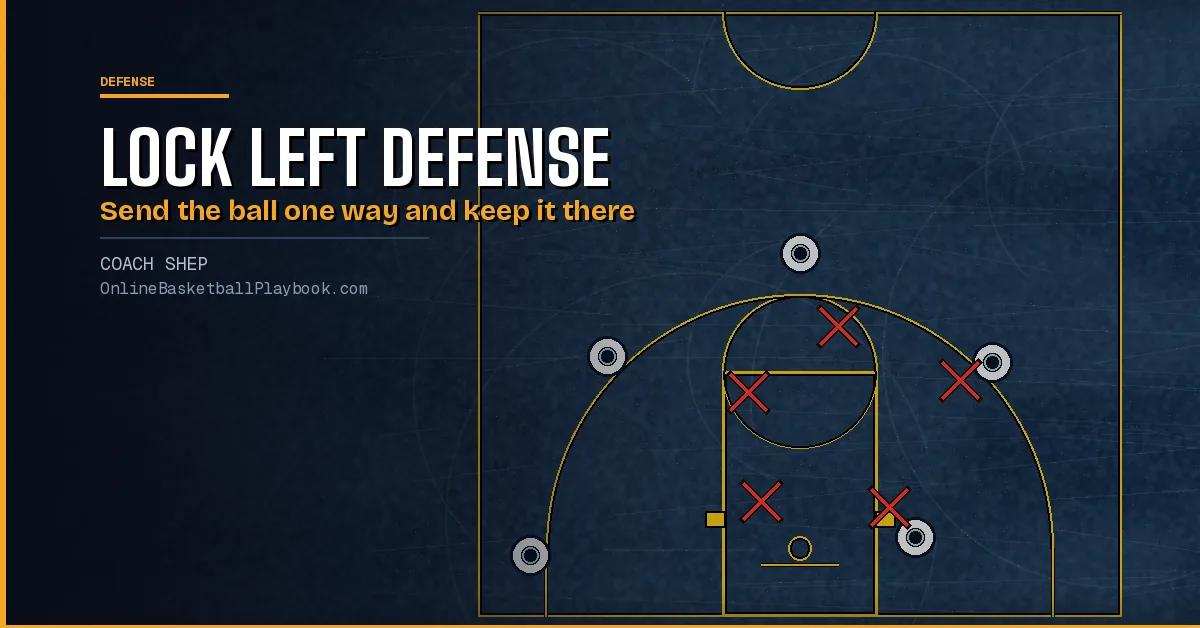
Lock Left Defense: Force Direction, Rules and Help Rotations
Lock left defense explained: force the ball to the offense's left all game, the stance and layers, how help changes, and the other ways to force the ball.
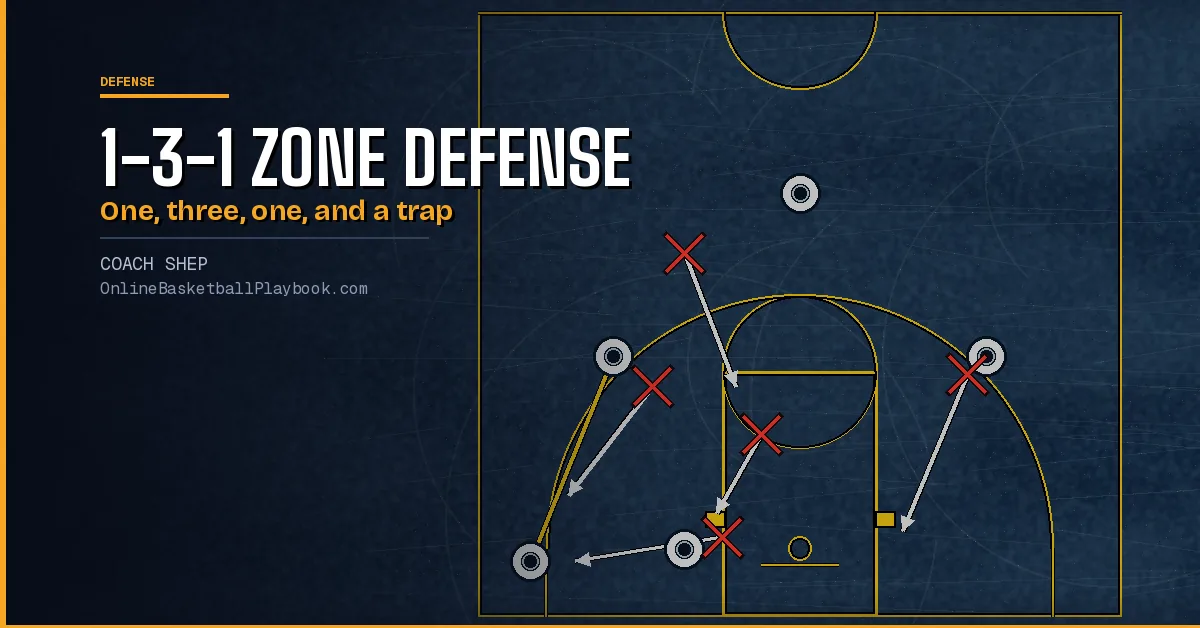
1-3-1 Zone Defense: Traps, Rotations and Drills
How to run the 1-3-1 zone defense: the five roles, the corner and wing traps, the skip pass that beats it, loose and tight depth, and the drills to install it.
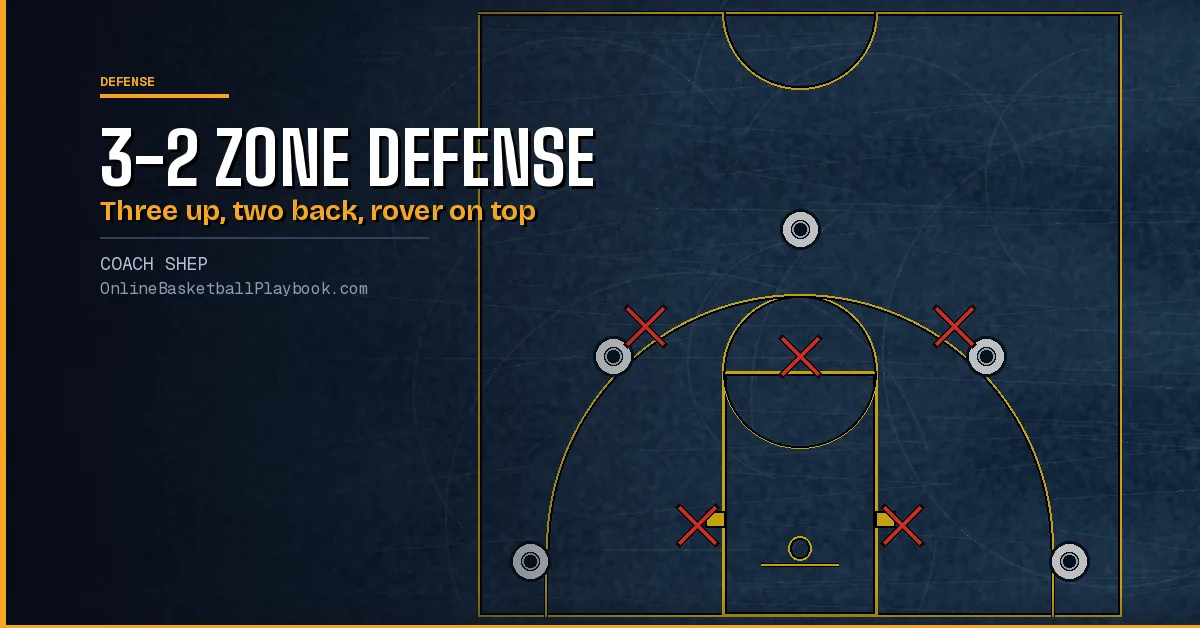
3-2 Zone Defense: Rotations, Weak Spots and Drills
How to run the 3-2 zone defense: the alignment, the rover, every rotation, the weak spots, the 3-2 matchup zone and the drills, plus when to pick it over a 2-3.