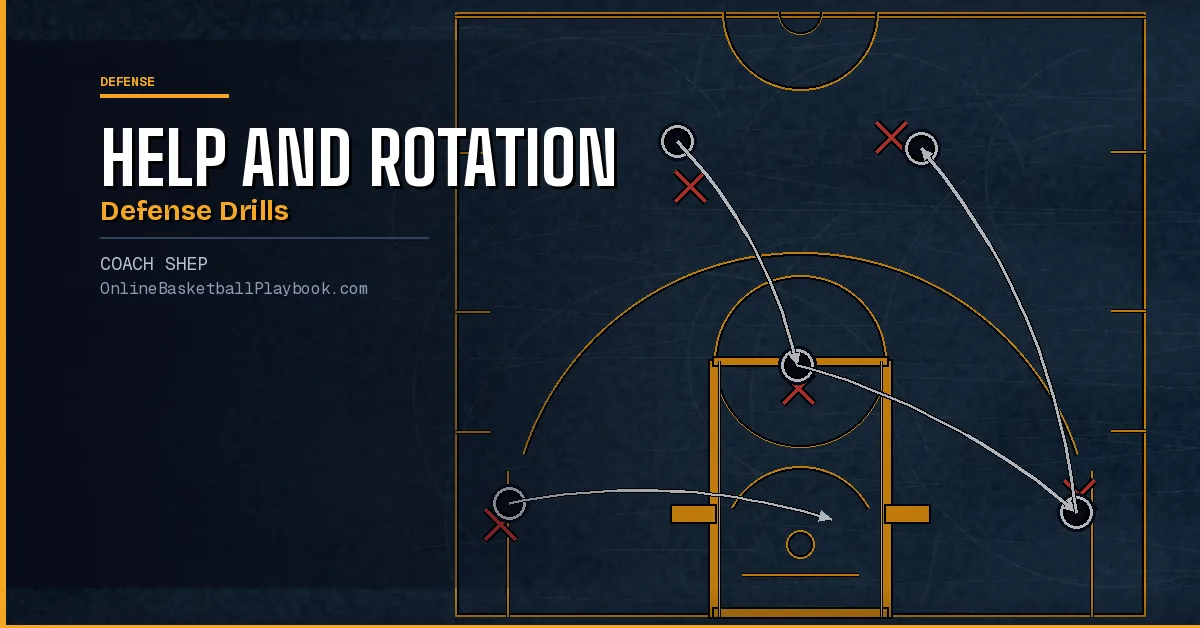
Help and rotation defense turns five individual defenders into one connected wall. These drills teach players to read the ball, sink into gaps, communicate, and rotate in time, building the habits that stop penetration before it starts.
Why Drilling Help Defense Changes Everything
Most teams practice their man-to-man defense by guarding their assignment and hoping everyone else does the same. The problem is that individual defense alone almost never stops a good offense. Penetration creates advantages. Ball reversal creates open looks. Without help and rotation built into muscle memory, each player is an island, and good offenses exploit those gaps every possession.
Help defense is a system, not an instinct. Players have to learn where to stand when the ball is two passes away. They have to learn when to leave their man to stop a drive. They have to learn how to communicate so the rotation chain doesn't break. None of this happens by accident. It has to be drilled, over and over, until it becomes automatic.
Understanding help defense principles is the first step, but principles only stick when players rehearse them in structured repetition. The drills in this guide build that repetition in a logical sequence, starting with positioning, moving to rotation reads, and finishing with competitive five-on-five situations where the skills get tested under pressure.
Teams that consistently stop penetration and recover without giving up open threes have done one thing: they have built habits through drilling. The goal of every drill below is to create an automatic response. When the ball moves, players move. When a driver beats a teammate, the next defender is already stepping up. When the rotation happens, players trust each other enough to let their assignment go, because they know the system will cover it.
Gap Positioning Fundamentals
Before you can teach rotation, you have to teach positioning. Help defense starts with where players stand before anyone drives. Help-side defenders, those two or more passes away from the ball, need to be in the gap, with a foot near the paint or on the midline of the lane, able to see both their man and the ball simultaneously. That stance is what gives the defense an early warning system. The defender is already in position to stop a drive before it happens, not scrambling to recover after it starts.
Drill 1: Four Corners Stance Walk-Through. Set up four offensive players at each corner of the half court. Put one defender at each position. The coach holds the ball at the top of the key. Walk through ball movement without any dribbling. Just pass to pass. Every time the ball moves, defenders adjust their position. The goal is not speed yet. The goal is correct angles. Defenders two passes from the ball should be in the lane with their back toward the baseline, seeing their man and the ball in their peripheral vision. Defenders one pass from the ball should be in a pistol stance. Arm pointing to their man, arm pointing to the ball, foot up the line to deny.
After three or four walkthroughs, speed it up. Increase the pace of passing and watch where defenders cheat. Common mistakes include playing too close to the ball-side (so the help-side becomes empty) and playing too deep in the lane (so the corner player gets a free catch and shoot). Fix these in real time by stopping play and resetting players to the correct position. Players need to see the right position, feel it, and have it corrected before habits form.
Drill 2: Two-on-Two Gap Drill. Two offensive players at the wing and corner, two defenders. The ball starts at the wing. The defender on the ball pressures the wing. The off-ball defender has to find the gap, not playing tight on the corner, but one step inside the lane so they can help on a drive AND recover to the corner on a pass. Pass to corner, the help-side defender closes out. The drill teaches the constant decision: how far can I gap without giving up the corner catch and shoot? That judgment is the heart of help defense, and it takes repetition to calibrate.
The Shell Drill and Its Progressions
The shell drill is the foundational teaching tool for help and rotation defense at every level. If you only have time for one defensive drill series in practice, this is it. The shell drill creates a controlled environment where you can teach positioning, communication, and rotation simultaneously without the chaos of a full scrimmage obscuring what went wrong.
Basic Shell Setup: four offensive players, two on the wings, two in the corners. Four defenders in proper gap positions. The coach or a fifth offensive player holds the ball at the top of the key. Offensive players move the ball around the perimeter on your call. Defenders adjust continuously. No drives allowed in the basic version. This is pure positioning and communication work.
Progress to Shell with Live Drive: Now offensive players can drive, but only when the coach calls "live." The driver attacks the lane. The help-side defender must step up and stop the ball. The remaining defenders rotate. The key teaching point here is timing. The help defender cannot wait until the ball is in the paint to step up. They have to read the hip of the driver and commit early. If they wait too long, they either foul or give up the layup.
Shell with Skip Pass: Add skip passes to the mix. When the ball is skipped from one wing to the opposite corner, two defenders have to react simultaneously. The corner defender closes out, the wing defender who was in gap position has to rotate quickly. Skip passes expose lazy defensive movement more than anything else. Defenders who are not in the right position before the skip will be beaten by the time they arrive at the ball.
Shell with Kick-Out: This teaches the help-the-helper concept. A driver attacks, the first help defender steps up. The driver passes back out to their man (now open). A second defender rotates to that man. The first help defender recovers to their original assignment. Running this sequence until the rotations are clean, no breakdowns, no open corner threes, is the marker that your team has internalized the concept.
Rotation and Help-the-Helper Drills
Once shell positioning is established, the next layer is teaching the full rotation chain. What happens when the first helper leaves their man to stop the ball. This is where most defenses collapse. The first defender helps, but the second and third defenders don't rotate, so the ball gets kicked back out to an open shooter. The solution is drilling the chain until every player knows their role the moment a drive happens.
Drill: Three-on-Three Rotation Chain. Start three offensive players in a line on the perimeter (top of the key, wing, corner) with three defenders. Ball is at the top of the key. Top defender applies pressure. Wing defender is in help-side gap. Corner defender is in deep gap. The offensive player at the top of the key drives. Wing defender must help stop the ball. Corner defensive player rotates up to cover the wing player who was left open. Wing offensive player is now covered. Corner offensive player is now open if the third defender doesn't rotate. Walk through this slowly, name each rotation out loud, and then speed it up.
The verbal cues matter as much as the physical movement. Defenders should be calling out what they see, "Ball!" when the drive happens, "I've got ball!" from the helper, "Rotate!" from the next defender in the chain. This language keeps the rotation from falling apart when it speeds up in live play. Teaching players to yell their teammate's job, not their own, is a concept from Iisalo and NKU that accelerates defensive communication significantly.
Drill: 911 Drill. The "911" call is a verbal trigger that means everyone sinks to the lane immediately. It is used when there is immediate and severe dribble penetration that the primary defender cannot stop. Set up five-on-five, tell the defense that on your signal (a whistle or "911!"), all five defenders sprint to the lane regardless of where they are. Then bring offense back out and teach them to capitalize on the kick-out if the defense over-commits. This teaches players the tool while also teaching them not to abuse it. The transition defense situation is where 911 gets called most often. Knowing when to use it is just as important as knowing how.
Building Communication on Defense
Help and rotation defense fails without communication. A defender who steps up to help but doesn't call it out creates confusion. Their teammates don't know whether to rotate or hold. A rotation that happens in silence often results in two defenders going to the ball and a shooter standing wide open in the corner. Communication is not optional. It has to be trained as deliberately as footwork.
Drill: Blindfold Rotation. This is a team exercise, not a physical drill. Have four defenders close their eyes while you move the offensive players to different spots. On your signal, defenders open their eyes and have exactly two seconds to call out their assignments. This forces players to survey the entire defense immediately upon returning to the possession, rather than only tracking their own man.
Drill: Call-First Shell. Run a standard shell drill but add a rule: no defender can move until they say their call out loud. "Ball!" before closing out. "Help!" before stepping into the gap. "Rotate!" before switching assignments. At first this feels slow and awkward. That's fine. The goal is to wire the verbal habit into the physical one so that in a game, the call and the movement happen at the same time without thinking.
Coaches who build strong defensive teams consistently name communication as the separator. A team with good athletes and poor communication gets beat by a team with average athletes and clear, loud defensive talk. The call creates the action. Drill it that way and players will carry it into games. You can also find useful drill progressions in resources about effective basketball practice structure that show how to sequence these communication exercises in a full practice plan.
Competitive Drills That Tie It Together
Isolated drills build the skills. Competitive drills test whether players have actually internalized them. The jump from drilling in a controlled setting to maintaining defensive structure in a live game is significant, and competitive drills bridge that gap. They add decision-making pressure, fatigue, and the emotional stakes that simulate what happens in games.
Drill: Four-on-Four Scramble. Start with the defense in a poor rotational position. Two defenders under the basket, two on the perimeter, offense positioned to attack immediately. On "go," the offense attacks and the defense has to communicate, scramble, and recover into proper structure without giving up a layup or an open three. Score it: defense gets a point for a stop, offense gets a point for a score. First to five wins. This is chaotic by design. It teaches players to find their spots quickly under pressure.
Drill: Five-on-Five Live with Rotation Accountability. Run a standard five-on-five drill, but stop play every time a rotation breaks down and ask the player who was out of position to explain what they should have done. This is not punitive. It's diagnostic. Players need to understand the why behind the rotation, not just be told to do it differently. When they can articulate the correct action, they're more likely to execute it without being reminded.
Drill: Drive and Kick Series. Five offensive players, five defenders. The rule is the offense must drive and kick. No settling for perimeter shots. The defense must stop every drive and recover to every kick-out. Run this for two minutes, count how many clean defensive rotations the team completes (no open shots off kick-outs). This is one of the best conditioning tools in basketball because it combines cardiovascular work with defensive technique. Exactly what a good basketball practice plan needs to include when time is limited.
Keeping score matters in competitive drills. When there are stakes, players pay attention. They communicate because they want to win the drill. They rotate because they don't want to be the one who let a wide-open shot happen. The competitive format creates urgency that isolated skill work cannot replicate.
Tracking progress is also important. Keep a simple tally of how many help-side breakdowns happen in each scrimmage over the course of a week. If that number is declining, the drills are working. If it is flat or rising, you need to identify which part of the rotation is consistently breaking down. Is it the first help, the second rotation, or the recovery? Knowing which link in the chain is weak tells you which drill to run more.
Players should be moving on the pass, in the direction of the pass, every time without exception. If a defender is still in their old position when the ball arrives at the new location, the help structure has already broken down before a single drive has been attempted. Train this as a non-negotiable habit from the first day you install your defensive system.
- Start every defensive practice with the shell drill. No live offense until positioning is correct at every spot.
- Install verbal calls before physical movement: "Ball!", "Help!", "Rotate!" must become automatic triggers.
- Drill the kick-out recovery separately. The moment after the help is where most rotations fall apart.
- Use the Four-on-Four Scramble drill weekly to stress-test rotation habits under pressure and fatigue.
- Stop scrimmages at every rotation breakdown and ask the player to explain the correct action out loud.
- Track breakdowns over time. Declining breakdown numbers are proof the drills are transferring to live play.
Get free play diagrams, drills, and coaching guides delivered weekly.
Draw this play free in the play drawer →
Membership: the full library, playbook packs, and Pro drawing tools →
Keep Building
Related breakdowns
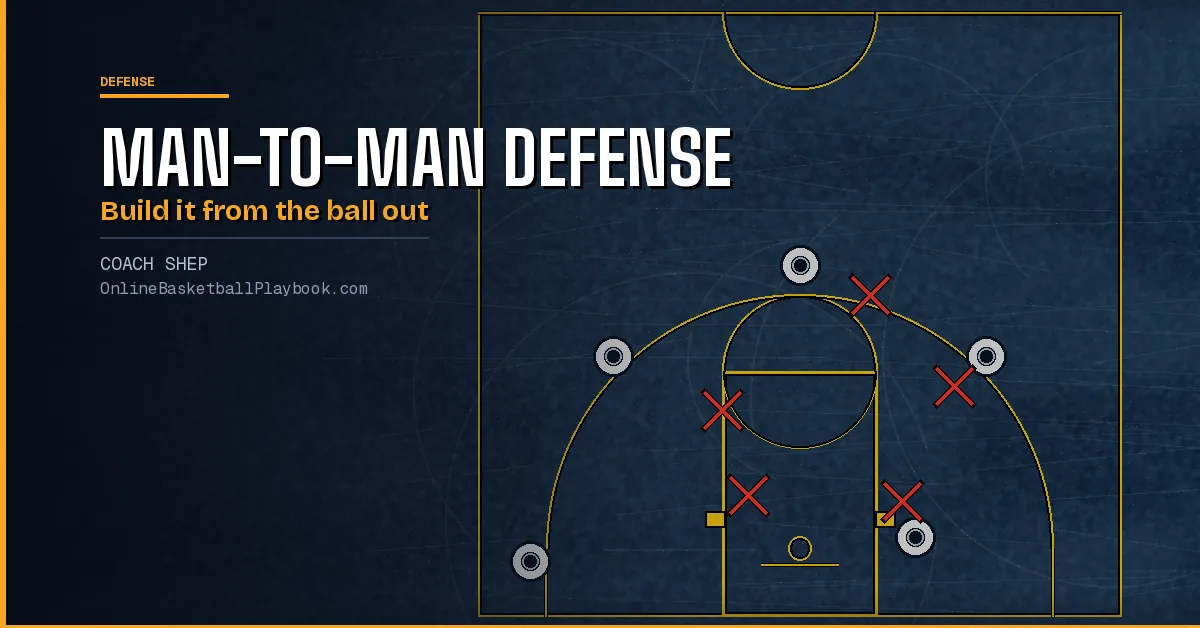
Man-to-Man Defense: Stance, Positioning, Help and Drills
Man-to-man defense starts with the ball-you-man line. Build it in order from the on-ball stance to one pass away, help and rotation, screens and the shell drill.
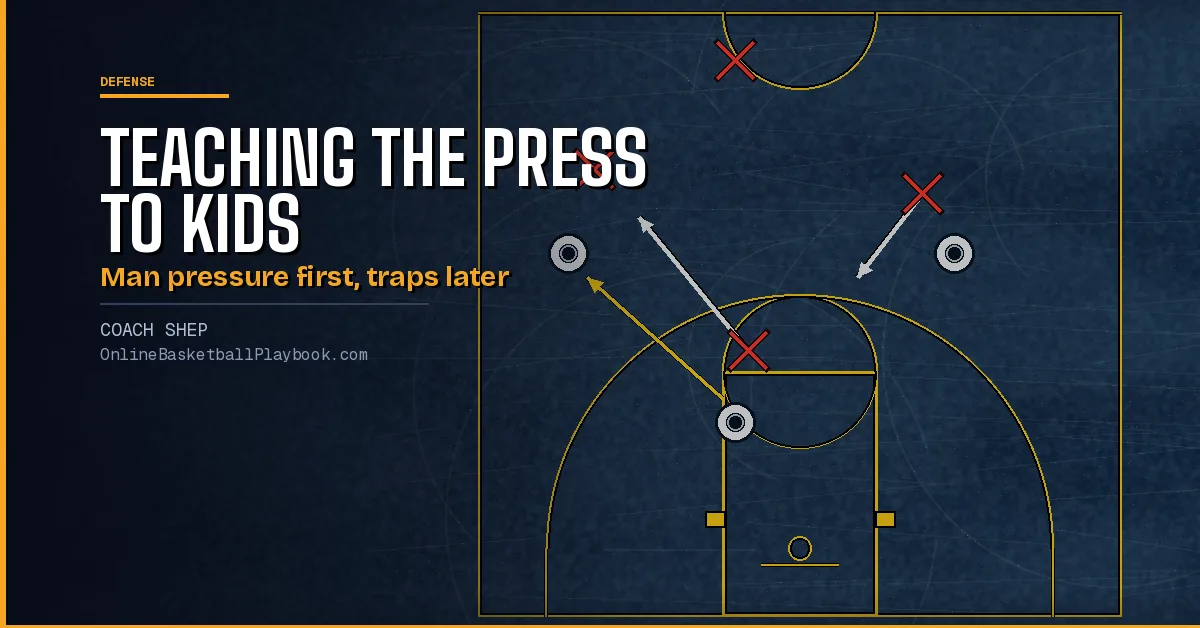
How to Teach a Press to Youth Teams: What to Teach First
How to teach a press to youth teams: check your league's rules, start with man pressure, build it through small games, then add a simple trap or zone press later.
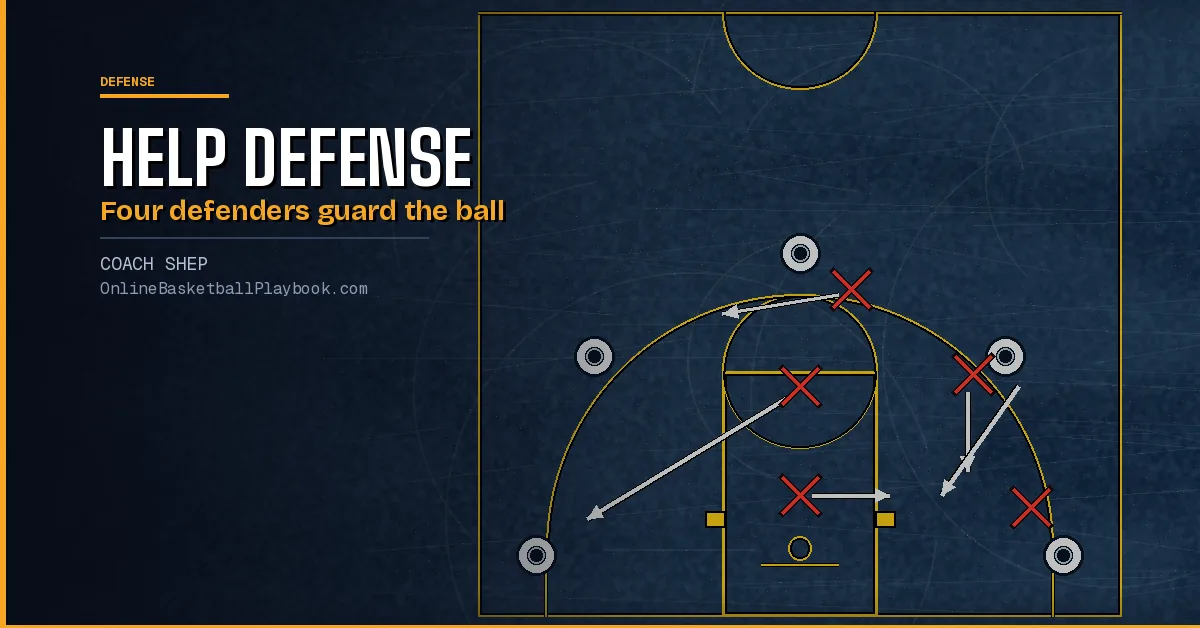
Help Defense Basketball: Help Side, Stunts, Rotations and 911
Help defense basketball explained: where help side defenders stand, stunt or commit, who rotates on a drive, the 911 call, and how coaches teach each.