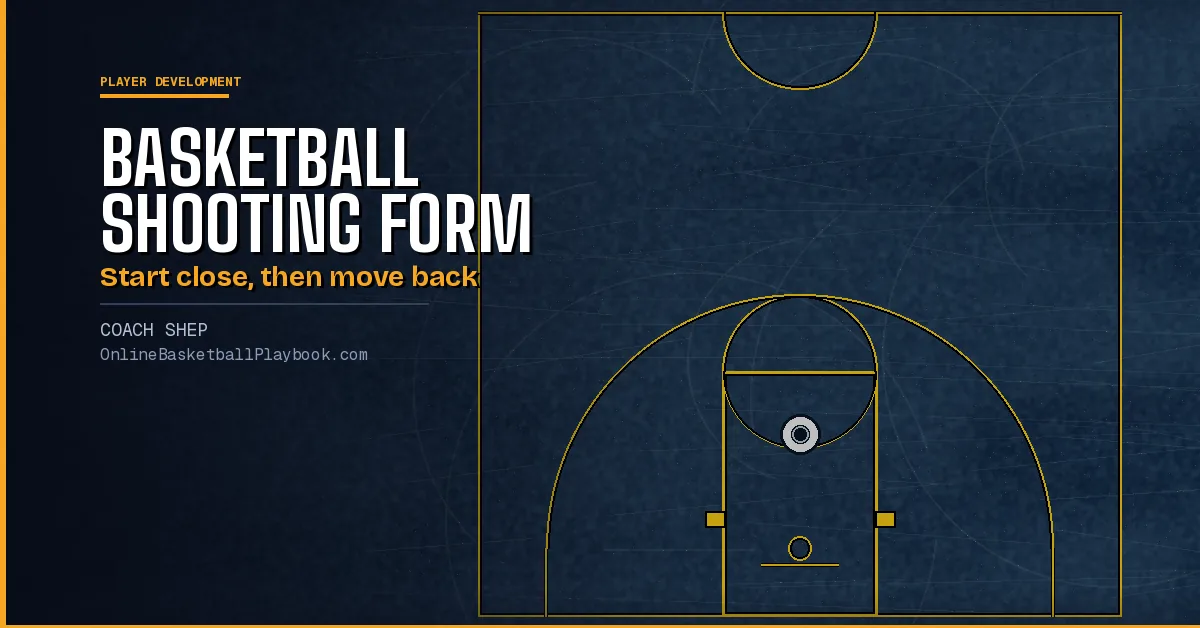
Basketball shooting form is a chain of small steps. A shooter gets ready before the catch, sets a balanced base, puts the hands and elbow in line, uses the legs for power and finishes with a held follow-through. This guide covers proper basketball shooting form step by step, how to shoot a basketball with a progression that starts close to the rim, and the points where coaches teach it differently. The diagrams show drill spots and progressions on the court.
The Shot at a Glance
| Part | What the shooter does |
|---|---|
| Prepare | Get down ready with the hands up before the catch |
| Base | Feet about shoulder-width apart, shooting-side foot slightly forward, knees bent |
| Hands | Shooting hand under and behind the ball, balance hand on the side |
| Elbow | Under the ball and pointing at the basket |
| Eyes | One target, held through the shot |
| Power | The legs, with a down-and-up rhythm |
| Release | Full arm extension and a wrist snap off the fingertips |
| Finish | Hold the follow-through until the ball lands |
Basketball Shooting Form Step by Step
1. Prepare before the catch. Fast shooters get ready early. Drop the hips, show the hands as a target and use the same catch footwork every time, either a hop or a 1-2 step. Load the ball in the shot pocket with the wrist cocked as it arrives.

2. Set the base. Feet are about shoulder-width apart with the shooting-side foot slightly forward. The feet turn slightly toward the shooting hand, roughly 11 o'clock for a right-hander. Bend the knees and keep the weight on the balls of the feet and not the heels. The head stays over the waist and the feet.
3. Place the hands. The shooting hand sits under and behind the ball and faces the basket. The balance hand rests on the side and only stabilizes. Spread the fingers and let the ball rest on the finger pads with the palm off the ball. With the thumb of the shooting hand at about 45 degrees, the elbow falls naturally under the ball.
4. Line up the elbow. The elbow sits under the ball and points at the basket. The shooting eye, the hand, the elbow and the rim line up on one plane. A flared elbow puts the hand off the ball and produces side spin.
5. Use the legs. Power comes from a down-and-up motion of the legs. Short shots draw more from the arm and wrist. Longer shots need more from the legs. Jump straight up without drifting sideways or backward.
6. Pick a target. Look at one spot on the rim and hold it. Do not watch the flight of the ball.
7. Release. The shoulder is the hinge. The arm extends fully, and a shooter who stops short becomes a short-armer. The wrist snaps, and the ball rolls off the fingertips with backspin. A shot with arc sees a bigger opening than a line drive.
8. Follow through. Finish with the fingers pointing at the hoop, the wrist bent forward in a gooseneck and the palm facing down. Hold it until the ball reaches the rim. Land balanced on both feet without kicking a leg out.
BEEF for Beginners
BEEF gives beginners four checkpoints. Balance is the base. Eyes are one target that stays the same. Elbow is under the ball and in line with the rim. Follow-through is the snap and the held finish. It is a beginner tool, so move players past it once the basics are set. The balance hand stays quiet and never pushes the ball at release.
How to Shoot a Basketball: The Progression
Start close. Form shooting from a few feet in front of the rim takes strength out of the picture and lets the player focus on the motion. Stand in front of the rim, put one hand behind your back and shoot with the other. Follow BEEF on every shot.

Work five spots near the rim, one on each side, one in front and two on the 45-degree angles where the glass helps. Then move out only while the motion stays the same. If the shot breaks down at distance, step back in and rebuild the release and backspin.

- Distance ladder. Start about 9 feet out. After five good makes at one distance, move to 12 feet, then 15 feet. The goal is 10 good shots in a row.
- Perfects. Count swishes from 3 feet out and work back to the free-throw line.
- Spin Outs. Toss the ball to yourself, then catch and shoot with a hop or a 1-2 step.
- Chair drill. Shoot from a seat to build force from the back and shoulders and through full arm extension.

Off the dribble. Take two or three hard dribbles into a balanced pull-up. Isolate the 1-2 step or the hop before the third rep becomes a live jump shot. Do not start a jump shot until a player is strong enough. Too early, and the shot turns into a two-handed push. Younger or weaker players use a lower set point and raise it as they grow. Teach one or two mechanics at a time. For drills that put a score on each rep see Basketball Shooting Drills.
Get the next coaching guide in your inbox
One email when a new guide or diagram set goes up. Free.
Where Coaches Split on Shooting Form
- The guide hand. Some coaches say it only stabilizes the ball before the shot. Others say it comes off just before release. Another sets it slightly under the ball and turns the palm up in the finish.
- The set point. One method sets the ball to the shooting side of the face at forehead height or higher. Another sets it in front of and above the shooting-side shoulder between the ear and the shoulder. Both want the same spot on every catch.
- The stance. Most teach a square stance. One shooting teacher argues great shooters share an open stance, a relaxed wrist and a release on the way up.
- The aim point. Some aim at the middle of the rim for margin of error. Others aim at the back of the rim, the front of the rim, just over the front or a spot on the net. Let each player pick a target he can repeat.
- Textbook cues. A small dip on the catch is fine, the ball may touch the palm and deep squats are not needed for power. The opposite cue tells players to keep the palm off the ball.
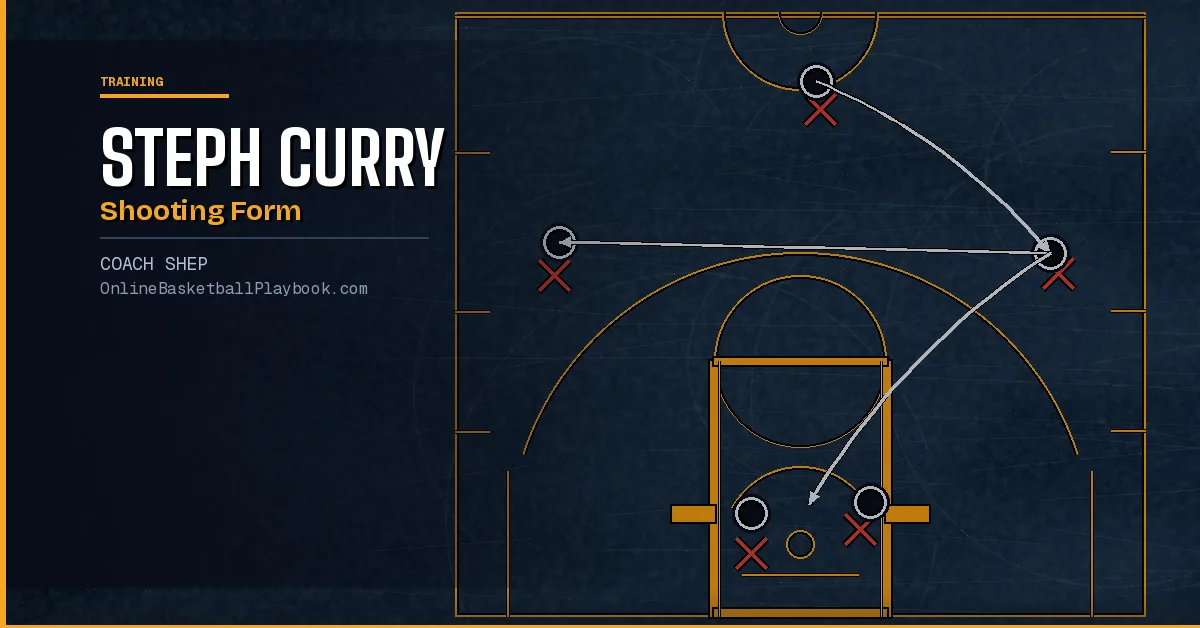
- Copying a pro. Body dimensions differ, so copying a player's exact motion rarely works. See Steph Curry Shooting Form for one breakdown.
Fixing a Flaw
Fix mechanics before adding volume. Reps with a flaw only make it permanent. Find out whether the problem is shot selection or mechanics before changing anything. Reading the miss to find the cause is on how to fix common shooting errors. An off hand that interferes is a common cause of misses to the left or right. A corrected motion feels awkward at first and results dip before they recover, so stay patient. For a cold spell see Basketball Shooting Slump Solutions. For range see Three-Point Shooting Drills. For free throws see Free Throw Shooting.
Coach Cheatsheet
- Have players get down ready before the pass arrives.
- Teach one or two mechanics at a time.
- Start every session with form shots close to the rim.
- Move back only while the motion holds.
- Hold every follow-through until the ball lands.
- Let each player pick a repeatable rim target.
- Correct the flaw before adding volume.
Questions Coaches Ask About Shooting Form
What is proper basketball shooting form?
A balanced base, the shooting hand under the ball, the elbow under and in line with the rim, power from the legs, a full extension and a held follow-through.
How do you shoot a basketball?
Get down ready before the catch, bend the knees, lift the ball on the way up and snap the wrist off the fingertips. Hold the follow-through until the ball lands.
What does BEEF stand for in basketball?
Balance, eyes, elbow and follow-through. It is a checklist for beginners.
Where should you aim when you shoot?
Coaches split. Middle, back and front of the rim all have supporters. Pick one target and keep it.
How do you fix a shooting form problem?
Work close to the rim, change one or two mechanics at a time and be patient. Results usually dip before they improve.
All skill pages sit under the Player Development hub. This page is the hub for the shooting pages. Go deeper with Jump Shot Basketball, Basketball Shooting Drills, Competitive Shooting Drills, Post-Practice Shooting Drills, How to Shoot a Floater, Catch and Shoot, Triple Threat Position and Best Basketball Drills for Kids.
Want the printable playbook packs?
OBP Pro members get the premium playbook packs: the zone attack, out of bounds and practice plan PDFs, plus each new pack as it is finished. The membership page lists what is in each one. Or draw your own version free in PlayDraw.
See what OBP Pro includesMore Skill Development Guides
Back to every Player Development page.
Keep Building
Related breakdowns
Free Throw Shooting: Routine, Form and Drills
Free throw shooting starts with a routine the player never changes. Form cues, the mental side and drills that copy the fatigue and pressure of a game.
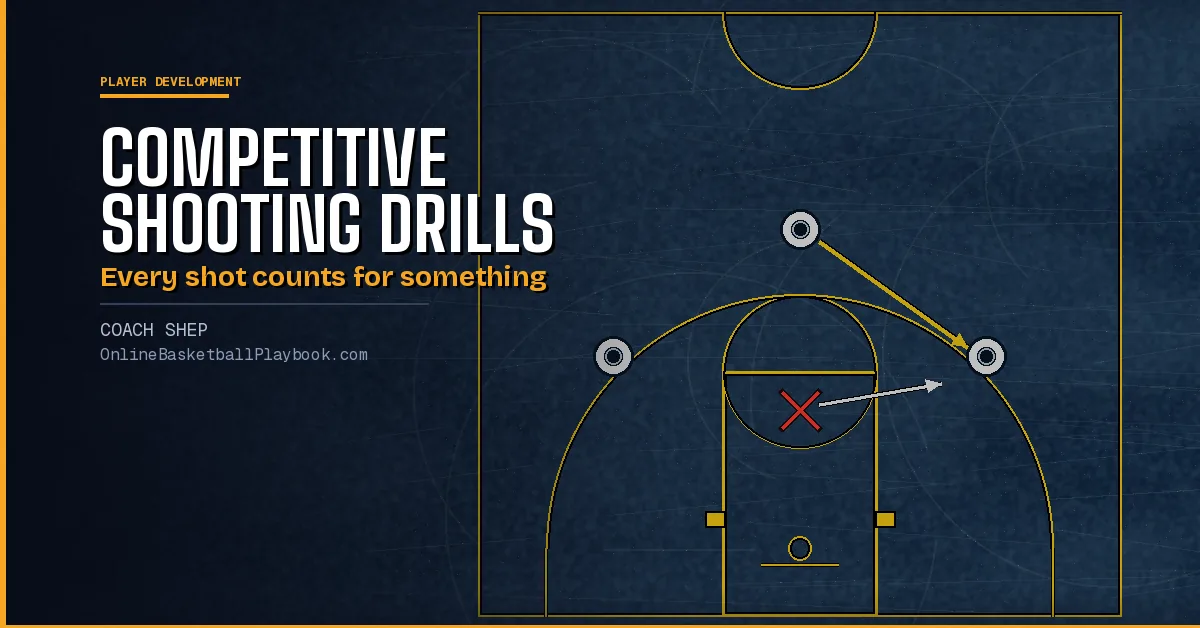
Competitive Shooting Drills: Scored Games and Records
Competitive shooting drills with a score on every shot: streak games, timed targets, Beat the Pro, plus and minus, 2-on-1 shooting and record boards.