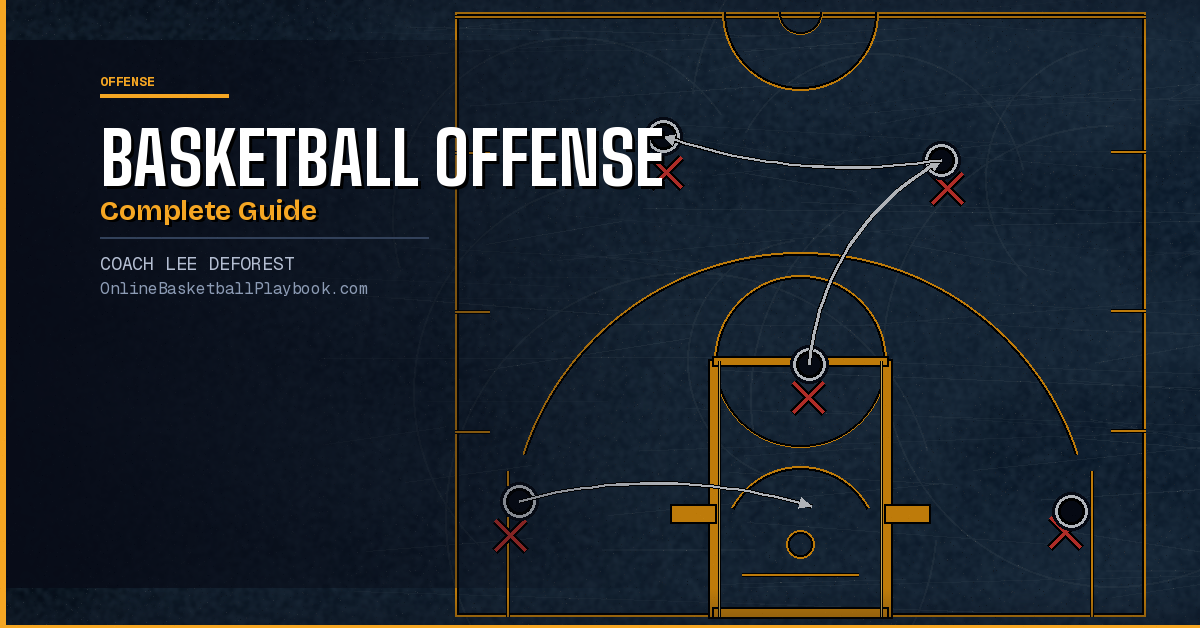

Building a great offense starts with principles, not plays. This guide covers spacing, motion concepts, fast break execution, half-court structure, and the teaching progressions that turn confused players into decisive ones.
Offensive Foundations Every Coach Must Know
Before you draw up a single play or install a system, you need to answer one question: what do you want your players to do when they catch the ball? That single question drives every offensive decision you make. Do you want them to shoot, drive, pass to the next action, or set a screen? If your players don't have a clear answer, your offense will stall regardless of how sophisticated the scheme looks on a whiteboard.
The best offensive teams in basketball — at every level — share a few common traits. Their players are in constant motion, their spacing is deliberate, and their decision-making is fast. None of those things happen by accident. They are the result of coaches who teach principles before plays, and who build habits through repetition long before they layer in complexity.
Every strong offense begins with these non-negotiable foundations: court balance, decision speed, and purposeful movement. Court balance means your players are spread in a way that forces the defense to guard the whole floor. Decision speed means your players have clear reads and aren't guessing. Purposeful movement means that nobody stands — every off-ball player is either cutting, screening, or relocating to keep the defense honest.
Too many coaches — especially at the youth level — build their offense around plays that only work when the defense cooperates. The smarter approach is to build an offense around reads: teach players what the defense is giving them, and let the right action emerge. This is harder to install but far more durable. A play breaks down the moment a defender does something unexpected. A read-based offense just finds the next open action.
One more foundation worth stating early: your offense must serve your personnel. A dribble-drive system built around athletic guards falls apart if your best player is a high-post forward. A four-out, one-in set fails if your center can't shoot. Evaluate your roster clearly before choosing your system, and build your offense around what your players can actually execute under pressure.
Spacing and Floor Balance
Spacing is the single most undercoached element in youth and high school basketball. You can have the most talented roster in your conference and lose every close game because your players crowd each other out of driving lanes and force the defense to guard only half the court.
The general rule is 15 to 18 feet between offensive players along the perimeter. That distance is not arbitrary — it is the minimum needed to prevent one defender from guarding two players at once. When players collapse inside that range, a single help defender can cover the ball-handler and a teammate simultaneously. You've effectively turned a five-on-five game into a five-on-four disadvantage.
Floor balance also means vertical spacing, not just horizontal. If all five of your players are parked on the three-point line, your driving lanes clog the moment a ball-handler attacks. You need at least one player behind the level of the ball — in the mid-post, short corner, or on the weak-side block — to provide a bail-out pass and keep the defense honest on the back side.
Teaching spacing starts in practice. Use visual markers — cones, spots, tape on the floor — to show players where they should be standing. Then run your offense without defense first. If a player drifts inside or collapses on a drive, stop the drill and reset. Good spacing is a habit, and habits require repetition before they hold under pressure. Pair this with dedicated basketball practice planning that includes spacing drills in every session so the habit builds week over week.
One common mistake is treating spacing as a static concept — "stand in the corner." Real spacing is dynamic. As the ball moves, players must relocate. If the ball swings from the right wing to the left wing, the corner player on the right side doesn't stay frozen — she slides to the right slot or the right elbow to maintain the proper floor geometry. This is spacing as active work, not passive positioning.
Motion Offense Principles
Motion offense is the most widely used offensive framework at the college and professional levels, and for good reason. It gives players structure without scripting, rewards good decision-making, and adapts to whatever the defense does. The core idea is simple: every pass is followed by a meaningful action — a cut, a screen, or a relocation. Standing still after a pass is a mistake.
"Motion teaches kids how to play, not just how to run plays."
— Basketball Vault
There are several popular motion variants. The 5-out motion offense places all five players on the perimeter and emphasizes dribble penetration with kick-out reads. The four-out, one-in system keeps a post player in the lane while four perimeter players operate around them. The dribble-drive motion system, popularized by Vance Walberg, is built almost entirely on one-on-one attacks off the catch with pressure-release passes to shooters in the corners and slots.
What all of these systems share is a reliance on reads rather than scripted actions. The ball-handler doesn't run Play A or Play B — they read the defense and choose the best available action. Does the on-ball defender over-play the pass? The passer back-cuts. Does the screener's defender sag? The screener pops to the three-point line. Does the help side collapse? The ball-handler kicks to the vacated corner. This is motion offense working as designed.
Installing motion offense requires patience. You can't drop five players into a read-based system on day one and expect clean execution. Start with two-man actions — pass-and-cut, dribble-handoff, pick-and-roll — and build from there. Once players internalize the basic reads, add a third player. Then a fourth. By the time you're running five-on-five motion, every player has a foundation of smaller decisions they've already mastered.
Fast Break and Transition Offense
The fastest points in basketball come before the defense can get set. Every coach preaches transition offense, but few teams actually run it well. Most teams jog up the floor and set up their half-court offense because nobody established the habit of sprinting in transition during practice. Fast break points don't happen by accident — they are the result of deliberate preparation and specific assignments every time the ball changes hands.
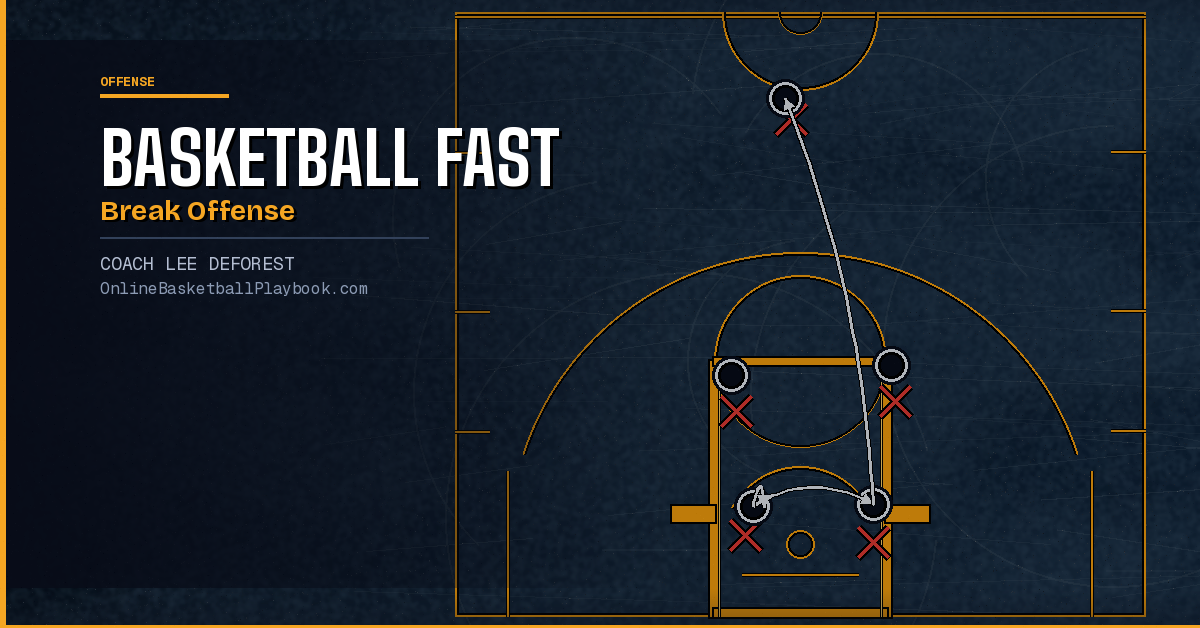
Great transition offense starts with rebounding and outlet passes. When your team secures a defensive rebound, the rebounder should immediately look to push the ball. The point guard sprints to receive the outlet, the wings fill the lanes wide (not in the middle), and the trailer — typically a forward or center — fills behind the play for the secondary break. Each player has a lane and a purpose.
The decision to push versus pull up comes from reading the defense. If the defense is outnumbered — three attackers against two defenders — push all the way to the rim. If the defense is equal in numbers, pull up to three-point range and run your early offense. Early offense is the transition between the fast break and the half-court set — a series of quick actions (a dribble-hand off, a flare screen, a post-up) that attack the defense before it can get fully organized.
Defensive transition is the flip side of this conversation. Your best transition offenses will also be your best transition defense teams, because coaches who value the break understand both sides of the transition equation. If you want to push in transition, you must also assign players to get back on made baskets and take away the opponent's fast break. Teaching transition defense is inseparable from teaching the fast break — they are two sides of the same decision.
In practice, run transition drills at the start of every session. Competitive three-on-two drills, outlet passing with full-court runs, and shell-to-break scenarios all build the habits that produce easy baskets in games. The teams that score the most fast-break points are the teams that have practiced the break more than anyone else — not the teams with the most talented athletes.
Half-Court Attack: Sets, Actions, and Reads
Even the best transition teams need a half-court offense. Defenses get organized, shot clocks wind down, and late-game situations demand specific actions. A complete offensive program develops both the push game and the half-court game, and teaches players how to recognize when each is appropriate.
Half-court offense is usually organized around a primary structure — a formation that sets the starting point — and a series of actions that flow out of it. Common starting formations include the 5-out, the 4-out-1-in, the horns set (two bigs at the elbows with three perimeter players), and the high-low (one big at the elbow, one on the block). From each formation, you can run ball screens, off-ball screens, post entries, and dribble penetration actions.
Ball screens are the most common action in modern basketball at every level. The pick-and-roll creates a two-man problem for the defense — the ball-handler and the screener must both be accounted for, and any coverage decision creates a counter. If the defense hedges hard on the roller, the ball-handler pulls up. If the defense drops, the ball-handler attacks the space. If the defense switches, the ball-handler looks for a mismatch. Teaching the pick-and-roll well means teaching every coverage and every corresponding read.
Post play remains one of the most underutilized weapons in youth basketball. A skilled post player who can catch, face up, or drop-step creates immediate advantages that perimeter actions can't replicate. Even teams without a dominant center benefit from establishing post entries and forcing the defense to commit help, which opens corner threes and mid-range shots on the weak side. Build your post play vocabulary into your half-court system even if your personnel aren't traditional bigs — modern post play happens at the elbow, the short corner, and the high post as much as on the block.
Late-game half-court offense is its own category. When the shot clock is low, when you need a specific basket, or when the opponent knows exactly what you're going to do, your called sets must be clean and well-rehearsed. Keep your situational offense simple — two or three sets you've drilled hundreds of times are more reliable than ten sets your players have seen twice.
Your half-court offense should have a primary action, a secondary counter, and at least one reset option that gets you back into your base spacing when the primary and secondary both get taken away. Without a reset, your offense goes stagnant and you end up with a forced shot at the buzzer.
Teaching Progressions and Practice Structure
The gap between a good offensive system on a whiteboard and a functional offense on the floor comes down to teaching progressions. How you introduce the offense matters as much as what the offense is. Start too complex and players get confused and play slow. Start too simple and players develop bad habits you'll spend months breaking.
The standard progression for any offensive system follows this arc: individual skills first, two-man actions second, three-man actions third, five-on-zero walkthroughs fourth, and live five-on-five last. At each stage, players should be able to execute the material comfortably before the next layer is added. Speed through the progression and you'll spend all season correcting the same mistakes.
Individual skill development is the foundation of every offensive system. A motion offense that requires shooting off the catch only works if your players can actually shoot off the catch. A dribble-drive system only works if your ball-handlers can attack the rim under defensive pressure. Investing in basketball player development at the individual level pays dividends when you run your team offense, because every action in the system requires a specific skill executed under pressure.
Two-man actions — pass-and-cut, dribble-handoff, pick-and-roll, pick-and-pop — are the building blocks of every offense. Drill them in isolation before connecting them to the full system. Players should be able to execute each action at game speed against live defense before you ask them to chain multiple actions together in your five-man offense.
Five-on-zero walkthroughs are underused at every level. Before you put a defense on the floor, run your offense five-on-zero at three-quarter speed, stopping to correct spacing, timing, and decision points. This builds the movement patterns without the distraction of a defender. Once players can run the system cleanly without defense, they can handle the pressure of a live defender and still make good decisions.
Your practice structure should reflect your offensive priorities. If spacing is the biggest problem, devote the first 10 minutes of every session to a spacing drill. If transition is lagging, open with a competitive break drill before anything else. The things you put first in practice signal to your players what matters most. Structure your time accordingly and your offense will reflect it over the course of the season.
- Spacing first: No play works without 15–18 ft gaps — drill spacing every session before any live offense.
- Pass-and-move: Every pass must be followed by a cut, screen, or relocation; standing still kills the action.
- Teach reads, not routes: Players who understand why an action works will execute it under pressure; players who only memorized the play will freeze when the defense adjusts.
- Build the break into every practice: Fast-break points come from habit — if you don't run transition drills daily, you won't get transition baskets in games.
- Install by progression: Individual → two-man → three-man → five-on-zero → live; never skip a stage, and don't move on until the current stage is clean.
- Keep your late-game sets simple: Two or three well-rehearsed situational plays beat ten sets your players have seen twice — simplicity holds under pressure.
Get free play diagrams, drills, and coaching guides delivered weekly.
Keep Building
Related breakdowns
Basketball Shooting Off Screens: Complete Guide
Basketball Shooting Off Screens: Complete Guide
Basketball Shooting Fundamentals: Complete Coach Guide
Basketball Shooting Fundamentals: Complete Coach Guide