
Post play is the most teachable skill in basketball. A player who can seal, catch, and execute one or two moves with counters gives your offense a consistent, foul-drawing weapon that perimeter defense cannot solve on its own.
How to Seal and Catch on the Block
Everything in post play starts before the ball arrives. If your player cannot establish and hold a seal, the entry pass never comes — and no move menu matters. Teach this before anything else.
The fundamentals of sealing come down to three linked actions: position, contact, and a target hand. The post player must establish a wide base on the block, pin the defender on their back with a forearm or hip, and then raise a clearly visible target hand on the high side to give the passer an aiming point. All three must happen simultaneously. Players who raise the target hand without first establishing physical contact lose the seal the moment the defender steps through.
Footwork into the seal is just as important as the seal itself. Teach your post players to use a reverse pivot to seal the low side, or a forward step to seal the high side, depending on where the defender is cheating. The defender will try to front the post or play three-quarter — your post player's job is to feel that pressure and pin them in place, not fight for a new spot.
The catch itself is the first scoring action. Too many coaches rush past this. The post player should land in a wide, balanced stance with both feet on the floor, the ball protected in two hands, and their head already turning to read the defense. Catching off-balance or with one hand creates turnovers before any move begins. Spend real practice time on the catch — have perimeter players make passes from different angles while the post player works the seal, catches cleanly, and chins the ball into a protected position.
"Post play is pivots and angles before it's strength — teach the footwork at game speed, both blocks."
— Basketball Vault, Post Play Development
Reading the Defender Before You Move
The single most common post-play mistake — at every level — is running a predetermined move without reading the defense. When a player has decided on the drop step before the ball is in their hands, a smart defender takes it away every time. The answer is to feel where the defender is and pick the move that punishes that position.
There are three defensive positions your post player will encounter after the catch, and each has a correct response. When the defender is behind (sealed), the post player has a direct path to the basket — a drop step baseline or middle is available. When the defender is playing the high side, the baseline is open and a baseline drop step or a quick spin toward the middle beats them. When the defender is playing the low side or fronting, the pass goes over the top to a lob or the post player seals to the middle and calls for a high-low entry.
Teaching this read takes repetition with live defenders — not air-moves. Have your post player close their eyes as the pass comes and feel the defender's body with their back and hips. Then ask them: high side, low side, or behind? They should be able to answer before they see the basket. That tactile read is faster than a visual read at game speed. Once they can name the position, they choose the move. The sequence is always feel → identify → execute, not memorize → repeat.
The Core Post-Move Menu with Counters
A complete post scorer needs four moves and a counter for each. More than that is noise — your players will default to one move under pressure anyway. Build depth in a short menu rather than surface knowledge of a long one.
Drop Step
The drop step is the foundational post move. After the catch, the post player drops their foot along the baseline (or toward the middle), seals the defender behind their hip, and powers up for a two-foot finish. The finish is a strong, two-foot power layup — chin the ball, go up through contact, and finish with your body as a shield.
Counter: When the defender anticipates and steps in front of the drop, the post player pivots back through with a middle drop step or a quick spin baseline.
Jump Hook
The jump hook is the most unguardable post move because it can be released over either shoulder and keeps the ball away from the defender throughout the motion. The player catches, pivots toward the middle or baseline, and releases a hook shot off the backboard or swished from the near side. Developing the jump hook with both hands is a non-negotiable for any serious post player — a one-handed hooker is defended with overplay to the weak hand.
Counter: When the defender jumps to contest the hook, a shot fake into a power dribble and a step-through finishes at the rim.
Up-and-Under
The up-and-under is a shot fake into a step-through — it works because it sequences two things the defender cannot respond to simultaneously. The post player catches, turns into a turnaround shooting motion, sells the shot with eyes up and ball raised, then steps through the defender's momentum as they leave their feet. The finish is a soft layup or short bank shot from the other side.
Counter: A defender who refuses to bite on the fake can be beaten by going straight up off the shot fake and taking the turnaround off the glass.
Turnaround / Fade
The turnaround jumper is the most versatile post move in modern basketball because it creates separation without requiring a clear path to the basket. The post player catches, squares up with a pivot, and rises into a mid-range jumper — typically off the glass from the short corner or from the mid-post. The fade variation adds a step away from the defender on the jump, making it harder to contest but requiring more shooting touch.
Counter: When the defender plays off to discourage the turnaround, the post player pump-fakes and attacks the baseline or middle off a live dribble.
Do not teach moves and counters in separate weeks. Pair every primary move with its counter from the first day of instruction. Players who learn moves in isolation never develop the habit of reading the defense response — they just repeat the primary move until it stops working.
Post Footwork: Pivots and Angles First
Coaches spend too much time on the aesthetics of post moves and not enough time on the pivots that make them work. A drop step with sloppy footwork is a travel. A jump hook off the wrong pivot is a missed shot from a poor angle. Post play is a footwork discipline before it is a strength discipline — and this matters especially for young players who cannot yet overpower defenders.
There are two pivot types that govern all post moves: the forward pivot and the reverse pivot. The forward pivot opens the post player toward the basket on a baseline drive. The reverse pivot (drop step) seals the defender and creates a direct path to the rim. Players must be comfortable with both pivots off either foot — four combinations total — or they are predictable.
The two-foot jump stop is the foundation. When a post player catches in stride and lands on one foot, they have eliminated one pivot option before the move begins. Teach the jump stop on every catch so both pivot directions remain available. This also prevents traveling violations that come from accidental foot movement during the read.
Angles matter as much as the pivots themselves. The angle of the drop step determines whether the post player finishes in front of the backboard or at a tough angle on the side of the rim. On the drop step, the foot should land at roughly 45 degrees toward the rim — not straight across the lane. This angle naturally squares the body toward the basket on the power jump. Correct it by putting tape on the floor during drills and coaching foot placement before the jump.
Practice all footwork at game speed, not slow motion. Slow footwork builds slow habits. Run all post footwork drills at the tempo players will use in games — even if the execution is messier early. The timing of the pivot, the seal, and the jump must feel automatic under pressure. Slow-motion drilling rarely transfers to live game situations.
Developing the Modern Big: Beyond Back-to-Basket
The era of the pure back-to-basket big is over at the college level and above. Every player who spends time on the block also needs a face-up game, or the defense will simply front them and eliminate the post entry. Developing bigs to face up is not optional — it unlocks everything else in your offense.
The face-up game for a post player starts with the same two-foot jump stop on the catch, but instead of turning their back to the basket, the player pivots to face the defender. From there, the same perimeter read-and-react framework applies: read the defender's positioning and gap, and choose between a jab step into a drive, a shot fake into a pull-up, or a straight-line drive to the rim. The vocabulary is identical to a perimeter player's — the execution happens from 12 to 15 feet instead of 20.
The pick-and-pop and short-roll actions tie directly into face-up post skill. A big who can face up after popping to the mid-post is a genuine threat to score, not just a decoy. A big who catches in the short roll and faces up forces the defense to commit — and the drive-or-pull-up read punishes either response. These actions are now standard at the high school varsity level and above, and big-man development must include them.
Quarter-facing on the catch is the technique bridge between back-to-basket and face-up play. When a post player catches in the mid-post, instead of immediately turning their back or fully facing up, they land in a quarter-face — angled 45 degrees toward the defender, with the baseline visible in their peripheral vision. This position opens the turnaround, the drop step, and the face-up drive from a single catch, forcing the defender to commit before the post player has moved. NBA bigs have used this for decades; it belongs in your development program starting at the high school level.
Practice Structure and Post Play Drills
Post skill develops fastest with a combination of individual footwork drills, partner reads, and live 1-on-1 post work. Each phase builds on the previous — you cannot skip to live work before the footwork is automatic.
Start every post practice block with 5 minutes of no-defense footwork: drop steps, jump hooks, and up-and-unders off the two-foot catch, both sides of the floor. No ball for the first few reps — just the footwork pattern. Add the ball once the pattern is consistent. This builds the motor pattern before cognitive load (the defender) is introduced.
The second phase is partner reads. One player at the elbow passes to the post player, while a third player stands as a static defender in one of the three positions (behind, high side, low side). The post player reads the position, names it out loud, and executes the correct move. Static defender first — no resistance — so the read is isolated from the execution. Gradually add resistance as the read becomes automatic.
The third phase is live 1-on-1 from the block. The post player must seal, receive the entry pass, and score in three dribbles or fewer. Limit the dribbles to force decision-making — post players who dribble excessively have not read the defense, they are stalling. Three dribbles maximum keeps the timing tight and forces the read on the catch, not after four bounces.
- Teach the seal and catch before any move — the entry is the first scoring action
- Every move must be paired with its counter from day one of instruction
- Footwork drills at game speed only — slow reps build slow habits
- All post players need a face-up game; don't develop back-to-basket only
- Quarter-facing in the mid-post keeps three options open off a single catch
- Limit dribbles in 1-on-1 drills (three max) to force reads on the catch
- Develop the jump hook with both hands — a one-handed hooker is solved with overplay
Get more coaching content like this — plays, drills, and teaching progressions — delivered to your inbox.
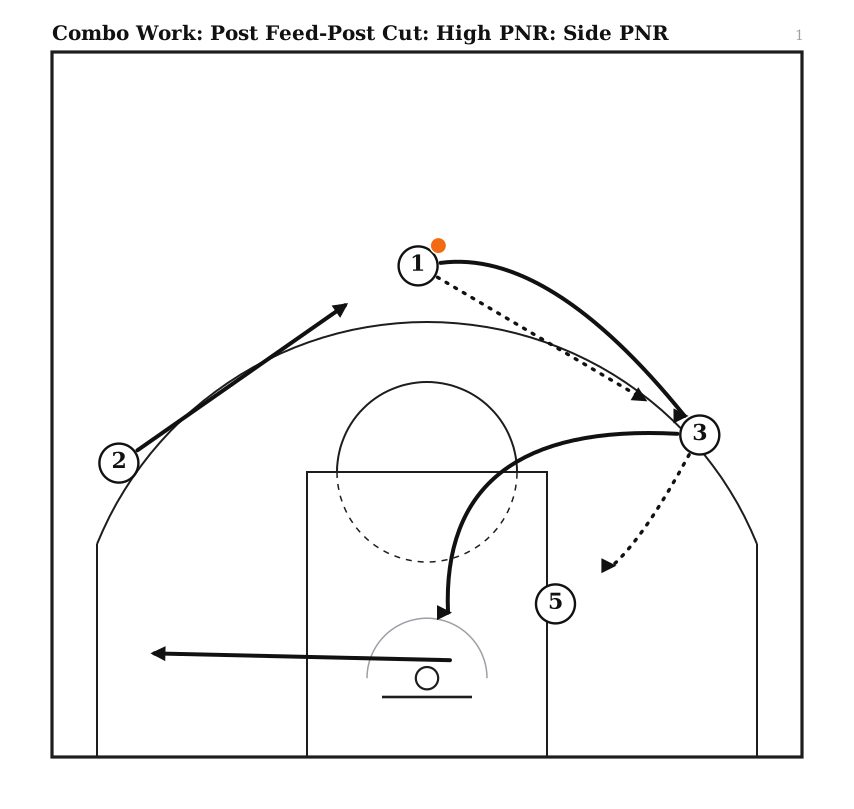
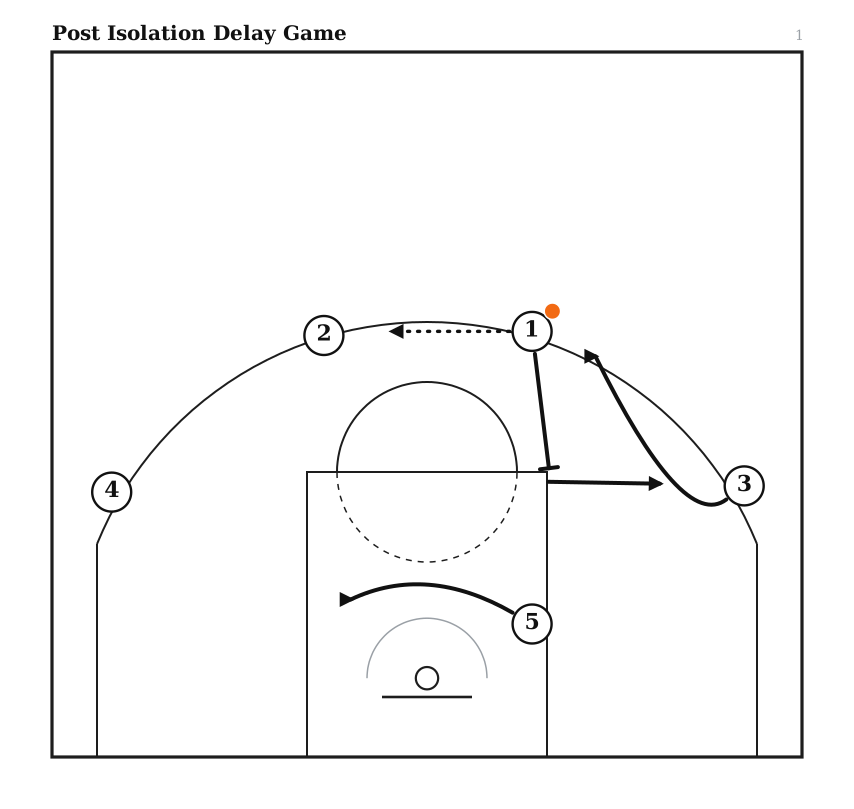
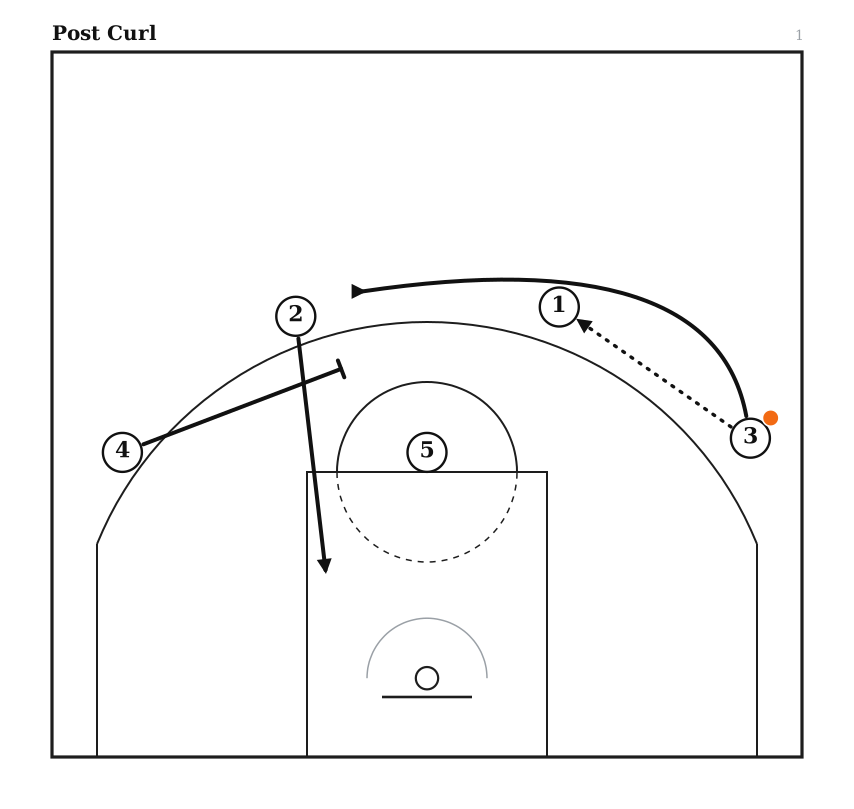
Join the NewsletterSee it drawn up
Related diagrams
Keep Building
Related breakdowns
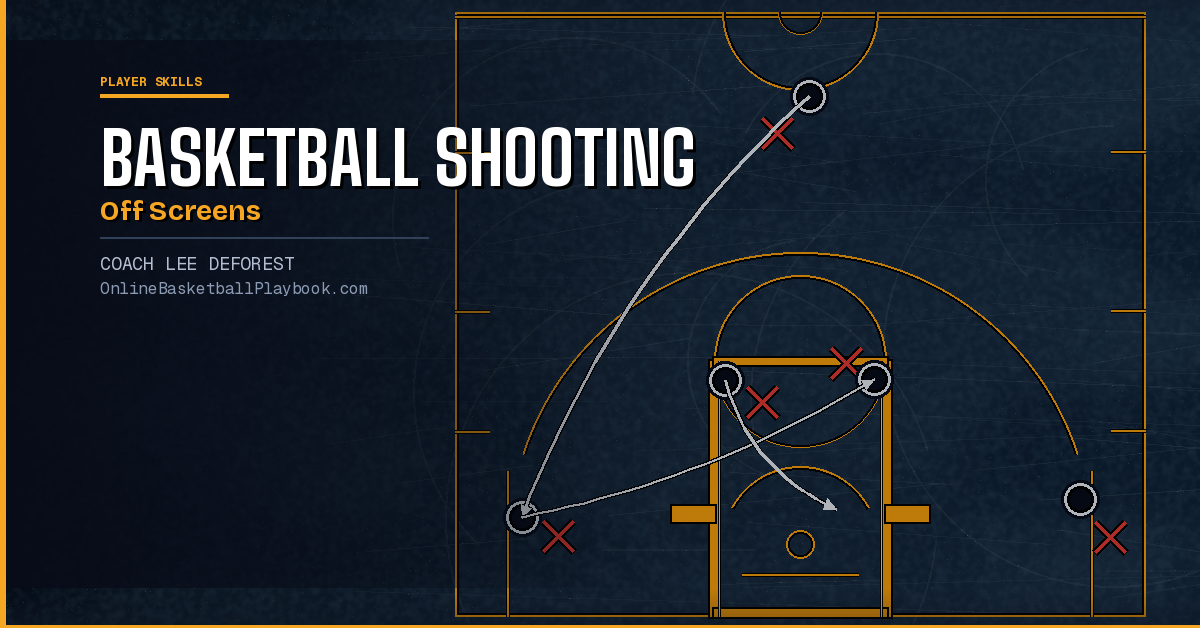
Basketball Shooting Off Screens: Complete Guide
Basketball Shooting Off Screens: Complete Guide