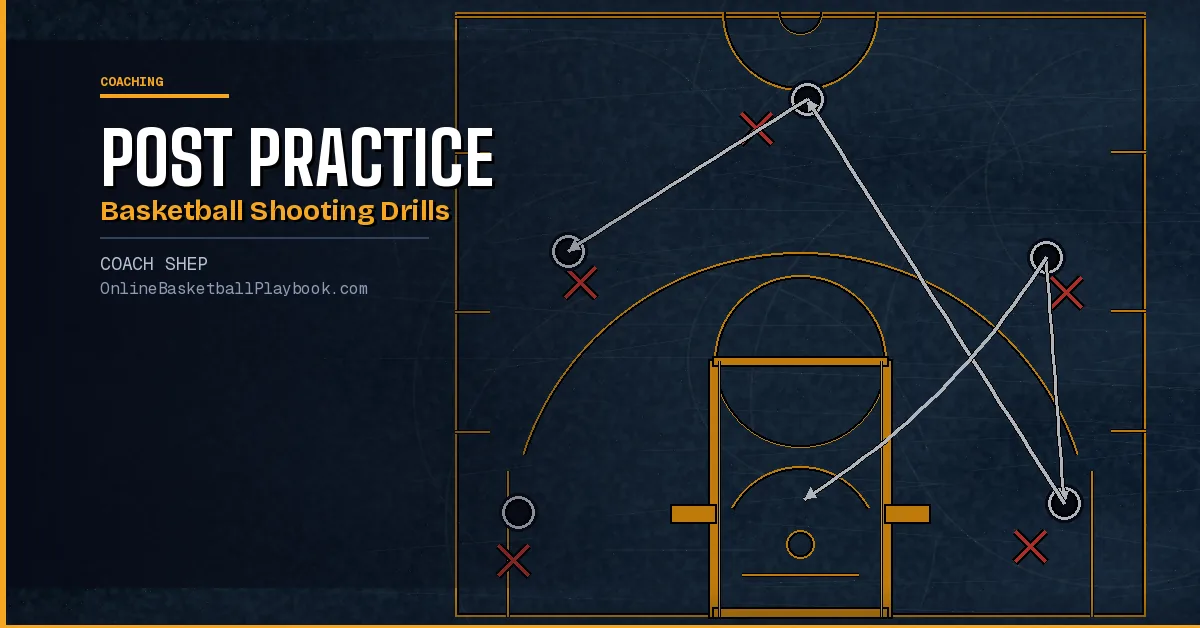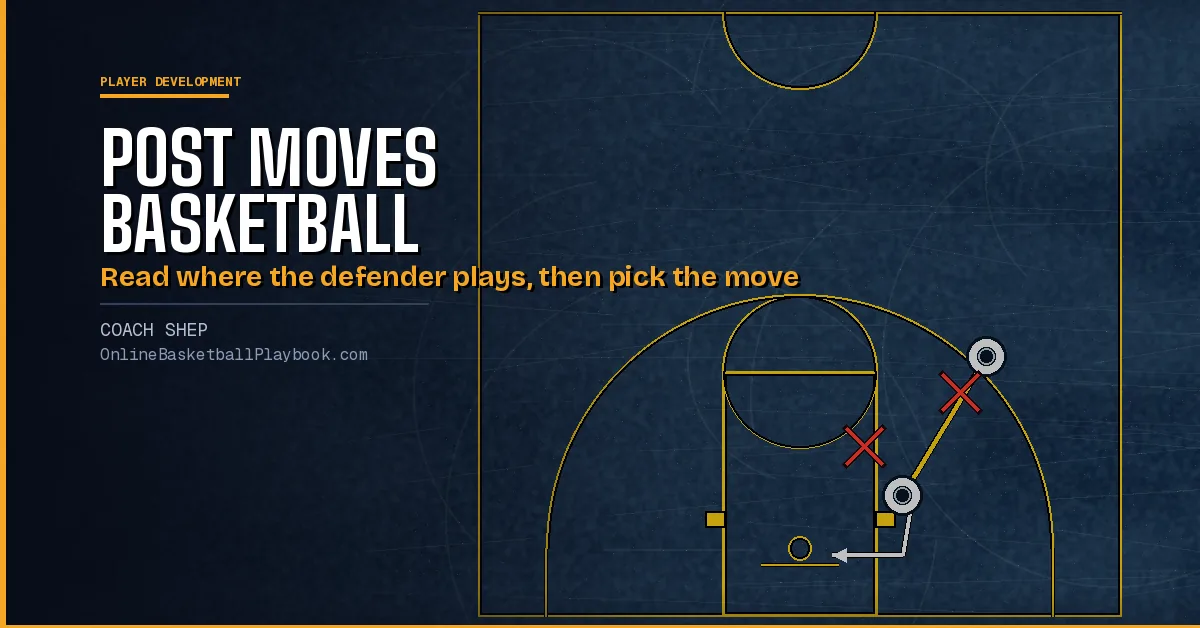
Post moves basketball coaches teach are a short list: the drop step, the jump hook, the up-and-under, the face-up and the power shot. The moves are the last step. Before them come getting open, sealing the defender, catching the ball cleanly and reading where the defender is playing. Don Meyer puts the post's jobs in that order: get open, seal, receive, then score simply. The same chain is also taught as seal, secure, survey, score. Where coaches teach a skill differently, each option is listed.
Position, Seal and Catch Come First
The post wins the catch before he makes a move. He posts where there is room, lines up ball, post and basket, seals with his body and catches with two hands.
Where to post. Most of these options move the post up the floor from the block.
- Post above the block. Gonzaga's first position rule.
- Post one lane space above it. Hubie Brown's spot, for room.
- Post across the lane, not up it. Bigs tend to post too deep, so they post across the lane and catch higher.
- Low foot above the block. Keeps the baseline cut and the bounce pass open.
- Mid post. Rick Majerus keeps his center there.
The line. Tex Winter's line of deployment puts ball, post and basket on one line. Ettore Messina uses the same alignment so a catch can turn into a score in one move. A post on the line can only be guarded four ways: in front, behind, on the high side or on the baseline side.
The seal.
- Seal with the feet. Don Meyer's first contact is from the waist down.
- Near foot in front. Get the foot nearest the defender in front so the passer sees the post's numbers.
- Top foot over his top foot. A front-foot drill puts the post's top foot above the defender's top foot.
- Seal by where he plays. Four seals named for the defender's spot: in, out, lob and spin.
- Post him higher or lower. Kevin O'Neill's cues follow the defender. If he plays you high, post him higher, if low, lower, and if he fronts, post further up the floor.
The catch.
- Target hand, two-hand catch. Gonzaga asks for both every time.
- The 3 C's. Catch in twos (two eyes, two hands, two feet on a short jump stop), chin the ball, check the defense by turning the head.
- Two-foot hop. A small hop on every inside catch so either foot can become the pivot.
- Numbers to the ball. The single point for the post: get the jersey numbers to the ball.
Bad passes. Meyer's view is that a poor receiver cannot be hidden.
- Tennis-ball drill. Meyer starts with one tennis ball, then two with flick passes, then basketballs with mixed bounce and flick passes.
- Bad Pass drill. Kevin O'Neill's drill keeps a balanced stance on a bad entry.
- Bad passes before moves. Catching and finishing bad guard-to-post passes ranks above isolated move sequences.
Win the spot and the catch first, then think about a move.
Read the Defender, Then Pick the Move
Read where the defender plays after the catch, then take what he gives.

Rick Pitino frames all five of his post moves as reading what the defense gives, with the same footwork for any size player. A five-read module for every offense is credited to Tex Winter, and Kevin O'Neill teaches a parallel set of reads.
| Where the defender plays | Read and finish |
|---|---|
| High side | Power layup, post him higher, or drop step away from the pressure with one dribble into the area in front of the rim. Kevin O'Neill teaches this read. |
| Baseline side | Baby hook off a quick, long lead step, or turn to the middle |
| Behind | Turn and face, spin baseline, or score at once |
| In front | Post further up the floor, seal and lob, or have the weak-side post flash high. Kevin O'Neill and Hubie Brown teach this read. |
| Double team | Attack before it arrives, retreat, skip and post again, release to the elbow or short corner, or kick out to a shooter for three. Ettore Messina teaches this read. |
| No pressure | Slow down and take the middle jump hook |

Catch distance is a second read. Close to the block the post uses the spin or the jump hook, and a step off the block he faces up. The move can also change with what has already scored.
Let the defender pick the move. The post only has to see him.
The Core Post Moves Basketball Players Learn
Every list here is built from the same few moves. They differ in what comes first.
- Middle shot, power move, jump hook. A post shot to the middle, the power move (drop step) and the jump hook, plus facing moves.
- Gonzaga's one-on-zero menu. Drop step, up-and-under, jump hook, Sikma pivot and turn shot.
- Hubie Brown's post shots. Jump hook, power move, up-and-under and Sikma.
- Youth order. Learn the drop step, jump hook and up-and-under before any variations.
Drop step. The power move to the baseline.
- Step by step. A low, wide catch, a big step to the baseline off the top-foot pivot, one power dribble to square up, a two-foot jump and a finish off the backboard, selling the middle first.
- Show and go opposite. Against a high defender the top foot pivots and the baseline foot drops. Against a low defender the baseline foot pivots and the top foot drops into the lane.
- Head-and-ball fake. Fake to the middle with the head and ball, drop the baseline foot, take a power dribble and score high off the glass.
- Secure, then drop. Secure the catch first, then drop step, with the foot driven toward the rim.

Hook and jump hook. The jump hook to the lane is the usual counter when the baseline drop step is taken away.
- Lock, legs, lift. A hook with a range of 10 to 12 feet, with both hands.
- Big step, two-foot jump. A low catch, a big step off one pivot foot, shoulders parallel to the sideline, a two-foot jump and a high release.
- Baby hook. A quick, long lead step with a flip of the wrist.
- Keep the shoulders closed. Rick Pitino tells the shooter not to open the shoulders.
- Shoulders perpendicular to the backboard.

Face-up and the Sikma pivot. When the defender gaps off the catch, the post faces the rim.
- Face the Gap. Kevin O'Neill's reverse pivot to face the rim for a jumper or a drive, with the ball kept high and the feet and shoulders pointed at the rim. Gonzaga calls the same move the Sikma pivot.
- Move out to face up. A post who cannot win position against a bigger defender goes to the high post or short corner to face up.
Up-and-under, power shot and later counters. The up-and-under is on the Gonzaga, Hubie Brown and youth lists: a shot fake to get the defender off his feet, then a pivot and a dip under him. The power shot is a two-foot layup off the glass with either hand. The Dream Shake and the dribble-drop spin are later counters, kept for a post who already owns the basics. For the shot itself, see the hook shot guide.
Whatever list you choose, rep it until the footwork is automatic.
How Many Moves, and the Post Dribble
Coaches split on how many moves a post needs and on whether he dribbles. Set a floor first, such as a drop step plus one counter, with both hands.
| Question | Approach | Plan |
|---|---|---|
| How many moves? | Two | Two counters, the hook and the drop step, or two moves mastered on each block |
| One move plus a counter | Drop step first | |
| Three, from both sides every day | Both blocks daily | |
| Five | Rick Pitino's list | |
| The post dribble | None with a foot in the lane, one power dribble outside it | Don Meyer |
| No dribble once two feet are in the paint | Sean Miller | |
| Never dribble with your back to the basket | Face first | |
| One dribble | One into the area in front of the rim, or one hard two-hand dribble | |
| A post who dribbles always goes to the middle, makes contact, then counters baseline | Middle first |
Meyer's phrase for the whole idea is score simply, not simply score, and he cites Don Nelson's line that Kareem had two moves his whole career.
Choose your number and your dribble rule, then hold every post to the same ones.
Against a Front and a Double Team
A front and a double team both take the easy entry away. Each has a short list of answers.

Fronted. Pete Carril lists four options:
- Feed the cutter. Feed the center as he cuts.
- Pass to the corner. Use it when the corner is open.
- Try to score first.
- Return it. Give the ball back to the passer.
More answers to the front:
- Over the top or reverse. Throw over the top, or reverse the ball.
- High-low. Flash the weak-side post high for the high-low pass, the action in the diagram (see high-low offense).
- Move up for the lob. Hubie Brown moves the post up one lane space to make room for the lob.
- Never force it. Against a full front, never force the pass.

Doubled.
- Attack before the double. A 1 vs 2 drill attacks before the double arrives. If it is too late, the post retreat-dribbles, skips to the weak-side wing and fights across the lane for a second catch.
- Skip and repost. In a 4-out set, skip to the wing the help came from and repost for a quick return feed.
- Release. Move to the elbow or the short corner to release the pressure.
- Score or kick. Ettore Messina wants a high-percentage score or a quick kick to a shooter for three.
- Reward the pass out. George Karl's One-on-One Post Game scores the pass out as a point, the same as a defensive foul drawn.
Teach the answer before the double comes, then rep it live.
Get the next coaching guide in your inbox
One email when a new guide or diagram set goes up. Free.
Feeding the Post
The passer makes the angle, picks the pass and then moves.
- Dribble for the angle, fake once. A position dribble creates the angle, then one committed fake the other way before the feed. Many fakes are a mistake.
- Bounce it most of the way. The bounce pass lands two-thirds to three-quarters of the way to the receiver.
- Bounce to the outside. Every low-post entry is a bounce pass to the outside of the receiver's body.
- Air to the outside shoulder. Throw to the outside shoulder, and do not bounce it when you can see the post's numbers.
- Move after the entry. Messina and Pitino want the passer moving after the entry.
More on the passer's side is in the passing drills. Pick one entry rule and have every guard throw it the same way.
Post Moves Basketball Drills
Post drills run from finishing at the rim to live one-on-one with a score.

- Mikan drill. Five minutes a day of baby-hook layups off the glass, alternating sides, no dribble. Pat Summitt's teams open with Mikan and make 20 in a row. Paul Hewitt's Georgia Tech runs 20 each way. Majerus pairs it with his McHale drill, tipping the ball while touching the rim with the off hand, six tips each hand. Full steps are on the Mikan drill page.
- Coach K's 1988 big-man series. Jump and touch rim, Mikan, Bad Pass, Reaction Pass, Two-Man Two-Ball, offensive rebounding (tip or shoot at once) and Superman.
- Contact finishing. A 3-man rebounding power-up drill has whoever rebounds power it back up with no dribble while two defenders bump. A 3 man 2 ball drill has a defender hold a pad and vary the pressure.
- Workout cards with make counts. A basic post workout card is 221 makes and the advanced card 360. Summitt adds a 20 to 25 minute scoring-moves block after Mikan. A side-to-side drill is five baseline moves, five middle moves and five turnarounds each side. A daily order: Mikan, duck-ins, catch-turn-shoot, step-through, Sikma, short-corner release and bounce drop step. The full session is on big man workout.
- Live formats. Karl's One-on-One Post Game scores +2 for a basket, +1 for a defensive foul, -1 for an offensive foul, +1 for a pass out of the post, -1 for a turnover and +1 for an offensive rebound. An entry drill gives the defense the win if it denies the entry for three seconds. Tom Crean's Post Strength drill pairs the catch and finish with the defender's recovery and contest.
Reps without a defender. Coaches split here.
- Always guarded. Hubie Brown never runs post moves without a defender.
- Skip one-on-zero. One-on-zero gives a false idea of how good a player is.
- Climb a ladder. Gonzaga goes one-on-zero (five of each move), then one-on-one with token pressure, then a competitive one-on-one series where the player must finish 80 percent of his moves.
- Unguarded blocks, same bar. The same 80 percent bar for a go-to move, trained in five-minute unguarded blocks.
For the wider skill set, see post play, scoring in the post, pivot footwork, finishing drills and the center position.
Pick drills that match your list of moves, and keep the make counts honest.
Questions Coaches Ask
What are the basic post moves in basketball?
The drop step (power move), the jump hook, the up-and-under, the face-up or Sikma pivot and the power shot. Gonzaga, Hubie Brown and others all build their lists from these.
What is the best post move?
The one the defender gives you. A high-side defender opens the baseline drop step, a baseline-side defender opens the middle jump hook, and a sagging defender opens the face-up, Kevin O'Neill's Face the Gap. Pitino frames all five of his moves as reading what the defense gives.
How many post moves should a player learn?
Coaches disagree. The answers are two, one plus a counter, three, and Pitino's five. At minimum, a best move and a counter.
Should a post player dribble?
Don Meyer allows no dribble with a foot in the lane and one power dribble outside it. Sean Miller bans the dribble once two feet are in the paint. Other answers allow one dribble into the area in front of the rim, or send a post who dribbles to the middle.
How do you score when the post is fronted?
Post further up the floor and seal for a lob, have the weak-side post flash high and pass over the top, or reverse the ball. Never force the pass into a full front.
Want the printable playbook packs?
OBP Pro members get the premium playbook packs: the zone attack, out of bounds and practice plan PDFs, plus each new pack as it is finished. The membership page lists what is in each one. Or draw your own version free in PlayDraw.
See what OBP Pro includesMore Guides From This Batch
- Basketball Finishing Drills: Read the Defender, Then Finish
- Coaching Youth Basketball: Practices, Games and Parents
- Basketball Fouls List: Every Foul, Penalty and Limit by Level
- Illegal Screen in Basketball: Rule, Examples and Calls
Back to Basketball Player Development and every Player Development page.
Keep Building
Related breakdowns
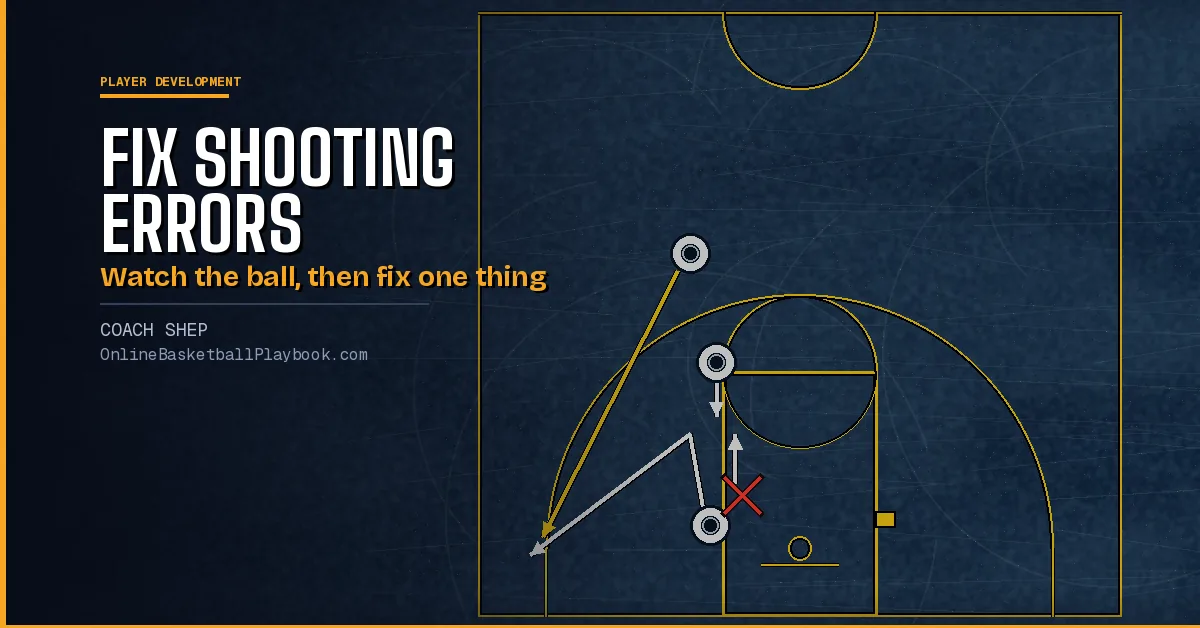
How to Fix Common Shooting Errors: Read the Miss First
How to fix common shooting errors: read what the ball does on the rim, find the cause, apply one correction, and coach the shooter through the dip.
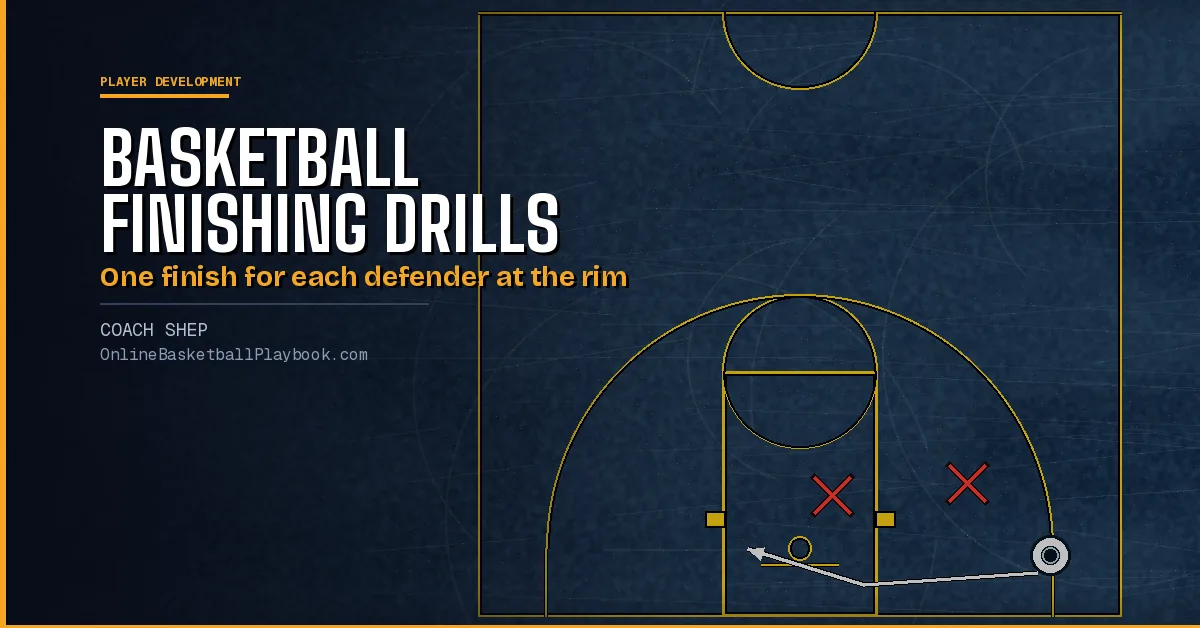
Basketball Finishing Drills: Read the Defender, Then Finish
Basketball finishing drills matched to the defender at the rim, from inside-hand and reverse finishes to the pro hop, contact drills and live progressions.