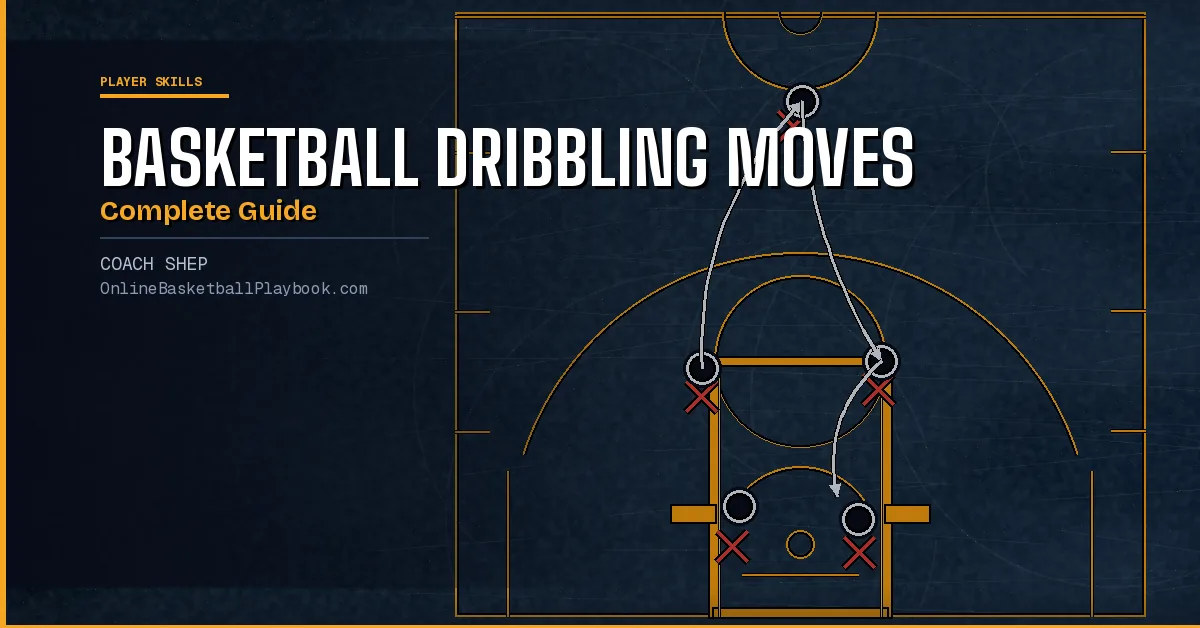
Dribbling moves win possessions when defenders close gaps and passing lanes disappear. This guide breaks down every essential move (from the crossover to the hesitation) with exact coaching cues you can apply today.
Why Dribbling Moves Matter
Every high-level offense (whether it's a motion offense or a structured set play) eventually puts the ball in a player's hands one-on-one against a defender. At that moment, a complete dribbling vocabulary is what separates players who create shots from players who turn it over or settle for a bad pass.
Dribbling moves are not tricks. They are tools. A crossover used at the wrong moment (or with poor footwork) results in a charge or a strip. The same move executed with proper balance, timing, and a clear read of the defender creates an open layup or a pull-up jumper at mid-range. The difference is not athleticism. It is technique combined with decision-making.
Coaches often underestimate how much dribbling affects team spacing and ball movement. A guard who cannot create off the bounce forces the offense to compensate. Other players collapse to help, spacing shrinks, and the defense recovers before a shot is available. One player's ball-handling limitation becomes an entire team's offensive ceiling. That is why individual skill work on dribbling moves belongs in every practice plan, not just pre-season training camps.
The moves covered in this guide follow a logical progression. Master the foundational moves first. Add complexity only after the basics are automatic. A player who can execute a jab-step pull-up and a hesitation reliably in a game is more dangerous than one who has practiced thirty moves but executes none cleanly under pressure.
Foundational Dribbling Moves
Before a player can read defenders and chain moves together, these five foundational moves must become automatic. Each one teaches a core skill (direction change, pace manipulation, or space creation) that carries into every more complex action.
The Crossover Dribble
The crossover is the most common dribbling move in basketball, and it is the most commonly executed incorrectly. Players tend to carry the ball wide across their body, telegraphing the direction change and exposing the ball to steals. The correct crossover is low, tight, and quick. The ball should cross just in front of the lead foot, not out wide. The outside hand is pulled back slightly (a body fake with the shoulders, not the ball) and then the player attacks hard in the new direction.
Coaching cue: "Keep the ball in front. Fake with your body, not your dribble." A wide crossover is a turnover waiting to happen. A tight, explosive crossover gets you to the rim.
The Between-the-Legs Dribble
Between-the-legs is a direction change that protects the ball better than a straight crossover when the defender is reaching. The ball travels under the front leg and into the opposite hand, keeping it shielded from the defender's active hand. Players must widen their stance slightly and stay low to execute this cleanly at game speed. Beginners often stand upright, which slows the move and reduces control.
Coaching cue: "Step wide, stay low, punch the ball through." This move is most effective off a controlled dribble into a natural step-through stance.
The Behind-the-Back Dribble
Behind-the-back is often introduced as a flash move, but it serves a specific functional purpose: changing direction while protecting the ball from a defender who has cut off the driving lane. Rather than crossing the ball in front of a reaching defender, the player wraps it behind the body to the opposite hand. Done correctly, the ball arrives in the new hand slightly ahead, in position to continue the drive. Done incorrectly, it bounces off the hip and creates a turnover.
Coaching cue: "Scoop it around, not over. The ball should arrive in front of the new hand, ready to attack." Pair this with solid footwork: The step behind the move determines where you end up and whether you have a straight lane to attack.
The Jab Step and Pull-Up
The jab step is a read-based move as much as a dribbling move. From triple-threat position, the player jabs hard toward the defender's foot. If the defender steps back to give space, the player rises up for the pull-up jumper. If the defender stands firm, the player attacks past the jab foot for a drive. The key is commitment. A halfhearted jab step gives the defender no information to react to and creates nothing.
Coaching cue: "Jab hard at their foot. Read their hips. If they back up, shoot it. If they hold, go."
The Retreat Dribble
The retreat dribble (sometimes called a pullback) is underused at every level below college. When a player dribbles into a dead-end, the instinct is to pick up the ball and look to pass. The retreat dribble creates a second chance. Two hard dribbles backward re-establish space, reset the defense's positioning, and reopen driving lanes or pass options. It also resets the shot clock threat, which forces the defense to come back out and guard.
Coaching cue: "Two hard dribbles back. Eyes up. Reset and attack." Combined with consistent ball handling drills, the retreat dribble becomes a reliable bailout that keeps possessions alive.
Advanced Moves for Skilled Players
Once foundational moves are solid, players can layer in more advanced tools. These moves require better timing, body control, and situational awareness to execute cleanly in games.
The Hesitation Dribble
The hesitation (sometimes called the "shake and bake") is one of the most effective pace-changing moves in basketball. The player drives hard, then suddenly hesitates: the knee comes up slightly, the body pauses, and the dribble continues in place for one beat. The defender, who had been retreating, stops. In that half-second of recovery, the player attacks hard past the defender. The hesitation works because defenders are trained to react to your speed. When you remove the speed cue suddenly, they freeze.
There is a variation where the hesitation is paired with a pump-fake (the "dribble pull-back)." The player hesitates, gives a slight pump, and the defender jumps. The player continues past the airborne defender. This is a high-level move that requires reading the defender's weight distribution before triggering the pump.
The Spin Move
The spin move creates separation by pivoting away from the defender rather than crossing in front of them. From a drive, the player plants the inside foot, rotates the body 180 degrees away from the defender, and gathers the dribble to the opposite hand mid-spin. The common mistake is losing the ball during the spin. It gets left behind as the body turns. The ball should stay low and close to the body throughout the rotation.
Coaching cue: "Keep the ball tight. Don't let it drift out on the spin." The spin move is most dangerous when the defender is over-committing on the drive and the player has already established a clear path.
The Euro Step and One-Step Floater
These are finishing moves rather than pure dribbling moves, but they both emerge directly from a live-dribble action. The Euro step uses two gather steps. The first plants and the second crosses to the opposite side of the paint, bypassing the shot blocker. The one-step floater is the surprise version: the player gathers on one step instead of two and releases quickly before the defense can recover.
Both moves require solid footwork discipline. Players who practice these during skill development build the muscle memory to use them without thinking when the moment arrives in a game.
The Body Fake Crossover
The body fake crossover is distinct from a standard crossover because the player keeps the ball in front rather than wide, using only the shoulders and head to sell the fake. The shoulders dip hard to one side, the defender's weight shifts to cover, and the ball crosses to the opposite hand in a tight, protected motion. This is the move when used correctly: low ball, shoulder sell, explosive step in the new direction.
How to Train Dribbling Moves
Training dribbling moves the right way is not about volume. It is about quality of reps combined with conditioning. Players who practice moves standing still at comfortable speed rarely transfer those moves to a game, where they are tired and a defender is in their face.
The most effective structure is a circuit approach: perform each move from a live dribble action, at game speed, finishing with a game-quality shot. Each station should be completed to a team make count. Stopping at a set number of repetitions regardless of quality teaches nothing. A make-based target forces the player to execute correctly to finish the drill.
Two-ball dribbling is a foundational conditioning tool for handles. When both hands are working simultaneously (alternating pounds, simultaneous pounds, one ball stationary while the other moves through patterns) the mind cannot focus on mechanics. Players develop handle through feel rather than thought, which is exactly how dribbling must function in a game. Eyes up, feet moving, and the ball takes care of itself.
Always end dribbling work on tired legs. The 5-spot shooting drill after a hard ball-handling circuit trains the player to make decisions and execute moves while physically fatigued (which is every fourth-quarter possession in a close game). Players who only practice when fresh are not practicing for real conditions.
Reading the Defense Before You Move
Every dribbling move should be a response to what the defender gives you, not a pre-planned sequence. This distinction separates players with good handles from players who are actually dangerous with the ball. If you decide on the hesitation before you read the defender, you will hesitate even when the defender is not there to freeze, and you will hesitate when you should be attacking directly.
The primary read before any dribbling move is the defender's hips. Where their hips point is where their momentum is committed. A defender whose hips are square to you can move equally in any direction and your move must be sharp to beat them. A defender whose hips have turned to your right has committed weight. Attack hard left.
Secondary reads are the defender's hands and the defensive help behind them. A defender reaching with the top hand is vulnerable to a between-the-legs move away from the reach. A defender whose help side is wide open means a crossover drive will get all the way to the rim. A defender whose help side is collapsed means a pull-up jumper at the elbow is available if you can create separation at the point of attack.
Train reads as deliberately as you train moves. Set up live-defender situations in practice where the player must read the defender's positioning and execute the appropriate move (not a scripted sequence). Skill without decision-making is just athleticism.
This read-based approach is what makes players with average athleticism effective ball-handlers. They do not need to be faster than the defender. They need to make the right decision a half-second before the defender can react. That skill is trainable through repetition in read-based drills, not station work alone.
Putting It All Together in Games
A complete offensive player does not cycle through a menu of moves. They recognize patterns (defensive tendencies, game situations, fatigue on the defender) and select the right tool. That takes time, but it starts with a solid foundation in the individual moves covered in this guide.
Incorporating dribbling moves into team offensive contexts is the final step. In a 5-out motion offense, ball-handlers need to be able to attack off the dribble when a teammate's cut creates a momentary mismatch. In transition, the hesitation and body fake crossover allow lead guards to beat defenders before help defense can set. In half-court sets, a jab-step pull-up from the elbow is a reliable possession-ending action when the defense takes away the pass.
Good dribbling moves also make teammates better. When a defender cannot let their man attack freely, they must hedge or help, which opens cutters, corners, and weak-side shooters. A player who can reliably create off the dribble does not need to score every time. The threat alone is enough to move the defense and create open looks for others.
Track which moves are working in your game film. Do not hold onto a move that defenders have figured out. Do not abandon a move that is opening up your teammates even when you are not scoring on it. Dribbling moves are situational tools. Understand what each one is creating and deploy them intelligently based on how the defense is playing you that night.
- Stay low and tight: every move starts with a low center of gravity. Upright dribbling telegraphs every change of direction before it happens.
- Eyes up always: keep your head up through the dribble move so you can see the pass option when it appears and read the defender's hips before committing.
- Commit to your move: a hesitation only works when the drive threat before it is real. Sell the drive first, then hesitate.
- Train on tired legs: end every ball-handling session with conditioning so game fatigue never degrades your handle or your decisions.
- One move, mastered: add moves to your game only after the previous move is automatic under pressure. Five moves you trust beat fifteen moves you hesitate on.
- Read before you react: the defender tells you which move to use. Their hips, their hands, and the help defense positioning are the cues. Let them decide for you.
Get free play diagrams, drills, and coaching guides delivered weekly.
Draw this play free in the play drawer →
Membership: the full library, playbook packs, and Pro drawing tools →
Keep Building
Related breakdowns
Basketball Dribble Moves: Complete Player Guide
Basketball Dribble Moves: Complete Player Guide
Basketball Finishing Moves: Complete Guide
Basketball Finishing Moves: Complete Guide
Youth Basketball Dribbling Drills: Cone Drills and Games by Age
Youth basketball dribbling drills for kids: finger-pad work, eyes-up games, cone dribbling drills, line drills and harder drills by age.