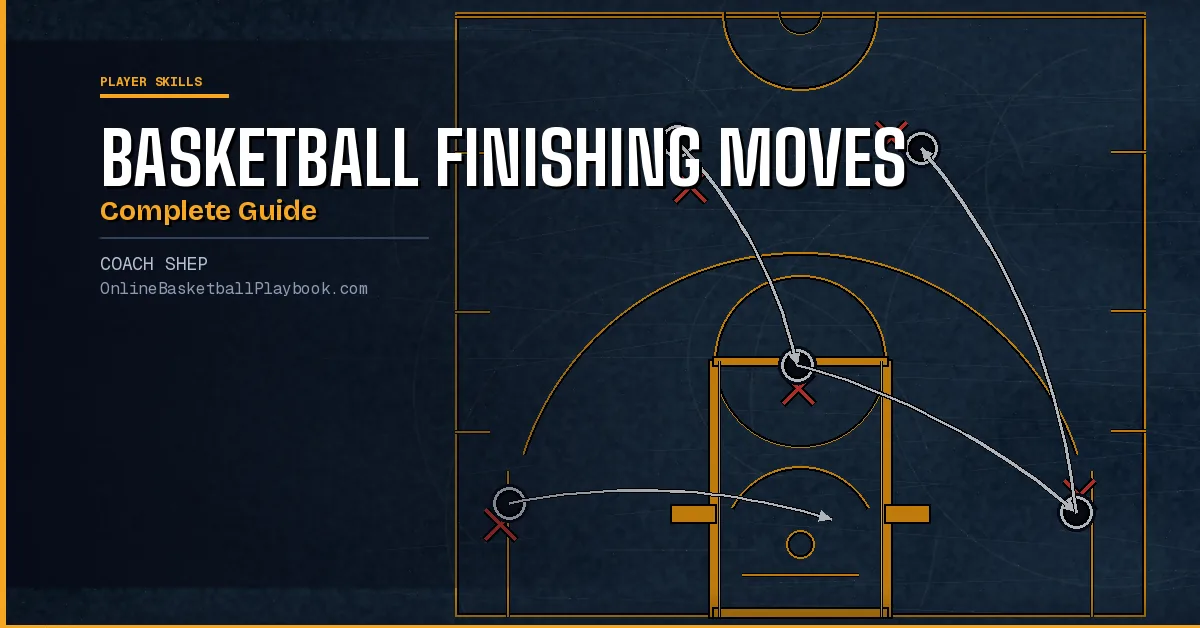
Finishing at the rim separates scorers from players who just get to the basket. This guide covers every finish players need (layups, floaters, reverses, Euro steps, and power moves) with the footwork fundamentals that make each one repeatable.
The Footwork Foundation Every Finish Depends On
You cannot teach finishing moves without first establishing the footwork base those moves rest on. A player who cannot control their body in traffic (who stumbles, drags a foot, or takes an extra hop) will not convert at the rim regardless of how creative their finish looks. Before introducing any specific move, coaches need to address stance, jump stops, stride stops, and pivots.
The jump stop is the most underused teaching tool in youth basketball. When a player receives a pass on the move and plants both feet simultaneously, they preserve both pivot options and stop their momentum cleanly. This is the foundation of the dead-ball game. Once a player has used their dribble, the jump stop gives them the platform to shot fake, step through, or pivot into a better angle at the rim.
The stride stop (a two-count stop where the player lands on one foot, then the other) is equally important but serves a different purpose. It allows players to gather momentum and still stop under control, and it sets up the traditional two-step layup footwork that most players default to. The key coaching point: the first foot to land becomes the pivot foot. Players who don't understand this consistently pick up travels when they try to create after stopping.
Body control is the skill that ties it all together. A player who can start fast, stop cleanly, and change direction without losing balance has the physical vocabulary to execute every finish in the menu. Basketball footwork drills should be a staple in every individual workout before any ball-handling or finishing work begins. The footwork is the finish. The hand placement and layup angle are details that come after.
Spend at least ten minutes per workout on jump stops and stride stops without any finishing component at all. Walk players through the mechanics slowly. Then add a ball, then a dribble, then a finish. Rushing straight to the Euro step before a player has reliable jump stop mechanics is building on sand.
Basic Layup Variations Players Must Own
The standard right-hand layup off the left foot is the entry point, but it is not the destination. Coaches who stop there are leaving significant offensive capability on the table. Every player (regardless of position) should be comfortable with at least four foundational layup variations before moving to advanced finishes.
The Standard Layup
Right hand, left foot. Left hand, right foot. The basics. The ball goes off the glass at the top right (or left) corner of the backboard square. Players should be able to shoot the standard layup in stride at full speed without gathering extra steps. The coaching emphasis here is the high release point and the soft touch off glass rather than a hard finish that rims out.
The Opposite-Hand Layup
Finishing with the weak hand is not optional for serious players. Defenders know which hand a player prefers, and they will overplay that side. A player who can only finish right-handed can be bodied left and forced into uncomfortable catch-and-shoot situations instead of clean finishes. Develop the weak-hand layup through repetition: start stationary, then walking, then at game speed. Pair it with ball handling drills that build weak-hand confidence generally.
The Power Layup
The power layup uses a two-foot jump stop gather instead of the traditional one-two step. It is the go-to finish when a player has drawn contact and needs to absorb it without losing the ball. The two-foot base gives players more stability through contact and makes the and-one opportunity much more likely. Post players and wings who attack the paint against physical defenders need this finish in their toolkit.
The Reverse Layup
The reverse layup uses the rim as a shield against the help defender. When a player drives baseline and the shot blocker rotates from the help side, laying the ball up on the far side of the rim takes the defender completely out of the play. This finish requires confidence and practice. Most players avoid it because it feels unnatural. The coaching cue is simple: finish on the far side of the rim, use the backboard if possible, and keep the ball above your ear on the release.
Advanced Finishes: Floaters, Euro Steps, and Reverses
Once players have the basic layup variations locked in, the advanced finish menu opens up. These moves exist to solve specific defensive problems. Each one answers a question that the defender is asking.
The Floater
The floater (also called the runner) is the answer to the rim protector. When a big defender has positioning to block a standard layup, the floater gets the ball up and over them before they can reach it. The mechanics vary slightly by player, but the constants are a one-foot push-off that creates lift without getting too close to the basket, a high arc that clears the defender's reach, and a soft touch that lets the ball fall through the net rather than rattling in hard.
Coaching the floater requires attention to the gathering step. Players need to float off the correct foot depending on which direction they approach from. A right-handed floater coming down the lane from the right side typically launches off the left foot. Repetition with both feet from multiple angles is the only way to build reliable mechanics. The floater off the proper foot, as coaches have long emphasized, is what makes the move effective in a real game context.
The Euro Step
The Euro step is a two-step gather that changes direction between steps to get around a defender. The player takes one long step in one direction, then a second step in the opposite direction, finishing at the rim. The key is that both steps are legal as long as the player gathers the ball before beginning the footwork. The Euro step is not a travel when executed correctly, though it looks like one to casual observers.
The Euro step is most effective against help defenders who commit early. When the help side defender slides over to take the charge, the Euro step goes around them rather than into them. Players need to practice this move from both sides and at game speed to make it a reliable weapon. Pairing it with a direct drive approach makes the setup look identical until the last step.
The Reverse Layup (Advanced)
The advanced version of the reverse layup involves gathering from a wider baseline angle and finishing on the far side of the basket with either hand. This is one of the most aesthetically difficult finishes in the game and one of the most effective when executed well. It completely eliminates the help defender who has to guess which side of the rim the ball is coming from.
Reading the Defense to Choose the Right Finish
Teaching the finish menu is only half the work. Players also have to learn how to read the defense in real time and select the right finish from the available options. A player who always finishes with a right-hand layup regardless of where the help is coming from will have that layup blocked consistently at higher levels of play.
The primary read is where the help defender is coming from. If the help is staying high and not rotating, a standard layup works. If the help is rotating from the weak side, a reverse layup puts the rim between the ball and the blocker. If a shot-blocking center is holding position under the rim, the floater gets the ball over the top. If the on-ball defender has overcommitted to one side, the Euro step goes around the other.
Coaches can build this reading ability through basketball player development progressions that add defenders gradually. Start with the finisher against no defense. Build the mechanics. Add a dummy defender who holds a position. The player learns to read and select. Add a live defender who reacts. The player applies the read under pressure. This progression takes weeks, not days.
Secondary reads involve contact. Some finishes are better for absorbing contact than others. The power layup is built for contact. The floater requires avoiding contact because it is a soft touch shot that contact disrupts. The Euro step sidesteps contact entirely. Players who understand this hierarchy make better decisions in traffic.
Third-level reads involve game situation. Late in a game when a player cannot risk an offensive foul, the Euro step or floater is smarter than a power layup into the defender. Understanding basketball IQ, including situational awareness around foul trouble, shot clock, and opponent positioning, shapes which finish is appropriate at any moment.
Most finishing breakdowns happen before the finish. The approach angle, dribble count, and gather step determine what options are available at the rim. Walk back turnovers and blocked shots to the decision point, not just the finish itself. Fixing the approach fixes the finish.
Finishing Drills That Transfer to Games
The most common mistake in finishing development is drilling one move in isolation until it looks perfect, then never connecting it to game reads. Players who spend 200 reps on the Euro step alone will attempt Euro steps against help defenders who are standing directly in front of them because they never learned the read that makes the move appropriate.
The Mikan Drill
The classic starting point for finishing development. The player stands directly under the basket and alternates finishing off each side (right hand off the left foot, left hand off the right foot) without the ball touching the floor between finishes. This builds soft touch, weak hand confidence, and body control under the basket. Run it for 30 seconds, then build to two minutes. Add power finishes once the alternating rhythm is consistent.
The Two-Ball Layup Circuit
A feeder passes to a driver cutting from the wing. The driver completes a predetermined finish (standard, reverse, power, floater), then goes to the back of the line. Running this as a full-team circuit with multiple stations hitting different angles builds volume reps efficiently. The key is calling out the finish required before each rep so players don't default to comfort.
The Read Layup Drill
A defender stands under the basket in a specific position: help from the left, help from the right, positioned for the block from center. The driver reads where the defender is standing before they reach the paint and selects the appropriate finish. This is the drill that actually transfers to games. No finish is correct in isolation. The correct finish depends on what the defense shows.
The Finishing Under Pressure Series
Run any finishing drill with a live, but restricted, defender. The defender can contest but cannot fully commit to blocking. This simulates game contact without the full collision risk of live play. Players who can only finish when completely unchallenged will not convert in games. Introduce passive resistance, then active resistance, then full live defense as the player's mechanics become reliable.
Coaching the Finish Menu: Building It Progressively
The goal is a finish menu, a set of reliable options a player can deploy depending on what the defense gives them. Building that menu takes a structured, progressive approach. Coaches who try to teach six finishes in one practice will get six broken finishes instead of six reliable ones.
Start with the two fundamentals: standard layup and power layup. Every player needs both. The standard layup is the default. The power layup is the answer to contact. These two alone will resolve a majority of finishing situations for young players.
Add the opposite-hand layup next. This is not an advanced move. It is a basic requirement. But it requires its own development timeline because most players have limited weak-hand feel at the rim. Budget four to six weeks of consistent weak-hand work before expecting game-speed reliability.
Then introduce the reverse layup. This move has the steepest learning curve of the foundational finishes because it requires spatial awareness about where the rim is and where the defender is simultaneously. Walk players through the baseline angle first with no defense. Add a passive defender once the mechanics are clean.
The floater comes next, followed by the Euro step. Both require the prior footwork vocabulary to be solid. A player who cannot stop cleanly and gather on the correct foot will not execute either move under game conditions. Test readiness by watching the gather step. If it is clean, the player is ready. If they are dragging a foot or adding steps, go back to the jump stop fundamentals.
Incorporate finishing development into the broader context of your offensive system. If your team runs motion offense, players are cutting and catching in traffic. Finishing off two-foot catches is relevant. If you run fast break basketball, players are finishing in transition at full speed. Stride stop mechanics and push-off angles at speed matter more. Match the finishing emphasis to what your system actually creates.
Finishing is also connected to conditioning. A player who is physically exhausted will revert to one finish regardless of what the defense shows. Basketball conditioning drills that maintain finishing sharpness late in games are worth including in your practice rotation. Finish drills at the end of practice when players are tired, not only when they are fresh.
- Build footwork before the finish: jump stops and stride stops are prerequisites, not warm-up fluff.
- Train both hands on every finish: a one-handed finisher is a half-finished player at any level above youth basketball.
- Teach the read before the move: every finish answers a defensive problem. Players must know which problem they are solving.
- Use the rim as a shield: the reverse layup and baseline Euro step are only effective when the player puts the rim between the ball and the help.
- Drill at game speed, both sides: finishing moves practiced slowly in one direction do not transfer to live game situations.
- Add fatigue to finishing work: run finishing drills at the end of practice to simulate fourth-quarter execution under physical stress.
- Progress from no defense to live defense systematically: build mechanics without defense, add passive resistance, then full live pressure. Skipping steps creates bad habits that are hard to unlearn.
Get free play diagrams, drills, and coaching guides delivered weekly.
Draw this play free in the play drawer →
Membership: the full library, playbook packs, and Pro drawing tools →
Keep Building
Related breakdowns
Basketball Dribble Moves: Complete Player Guide
Basketball Dribble Moves: Complete Player Guide
Basketball Dribbling Moves: Complete Guide
Basketball Dribbling Moves: Complete Guide
Guard Workout: Handles, Reads and Finishing You Can Print
A guard workout you can print: a full session with its standards, plus handle work, jab, closeout and ball-screen reads, finishing and shooting off the dribble.