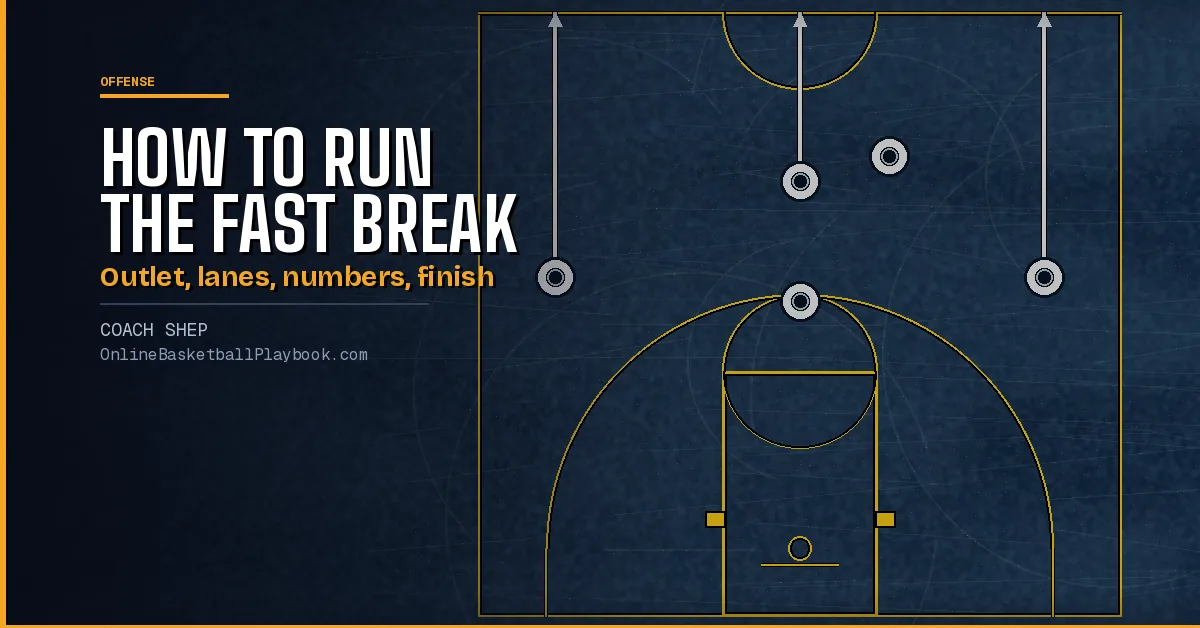
Learning how to run a fast break means learning a structured decision tree for every numbers situation, and not only how to run hard. A fast break attacks before the defense sets, from the moment a possession changes hands through the first wave of numbers advantages and into the secondary break. This guide covers what starts a break, the outlet, the lanes, the read for each situation, the secondary break, the drills and the mistakes.
How to Run the Fast Break at a Glance
| Phase | Rule |
|---|---|
| Start | A defensive stop, a rebound, a turnover or a made basket |
| Outlet | Turn outside, throw to the sideline at the free-throw line extended, never pass back |
| Lanes | Ball in the middle, wings wide, a rim runner ahead, a trailer behind |
| Reads | Attack the hoop first, pass second, and let the defender's choice decide |
| Secondary | A named action that flows into your half-court offense |
| Habit | Sprint every lane on every possession |
What Starts a Fast Break
Start with defense. Fast breaks begin with stops, so a team that wants to run builds a tough defense first. Then decide in advance who pushes the ball. Some teams give the job to the point guard alone, and some let any player bring it up. Either is a philosophy decision made before the game and not an in-game read. A program built on letting anyone push after every rebound is laid out on transition first program model.
The habit that creates breaks is to sprint every lane on every possession, whether or not a break looks likely. The act of sprinting produces the occasional uncontested layup. A team that walks the ball up loses its advantage before the advantage develops. Passing beats dribbling because the ball reaches the other end faster when it is thrown, and a dribble across half court wastes the window. Keep the pace controlled. Hurry, but do not rush, because a player who panics with the ball in transition gives the possession back faster than any defender can.
The Outlet
The outlet is the first action of the break. A few rules keep it clean.
- Rebound and turn to the outside. The rebounder turns in the air toward the outside, with his back to the sideline, and takes three low, explosive steps.
- Throw a strong pass. Pivot on the outside foot and throw a two-handed overhead pass to the wing. Dribble only if forced.
- Outlet at the free-throw line extended. The point guard receives the outlet there and not 28 feet from the basket. One rule says no outlet goes below the free-throw line, make or miss, unless you face a press.
- Catch facing the floor. The outlet receiver catches with his back to the sideline so he sees the court.
- Order of the pass. A long pass comes first, a short pass second and the middle third.
- Never pass back on the break.

After a made basket, inbound fast. One player inbounds every time, and the other four sprint their lanes at once. The timing creates the advantage before the defense organizes. See Transition Offense: Basketball Plays for Quick Scores for plays that start this way.
Fill the Lanes
Every player has a job the instant the possession changes.
- Ball handler. He runs the middle lane and takes a hard dribble into the frontcourt within three to five seconds. The middle keeps the ball available to either side.
- Wings. They sprint the sidelines about three feet from the line. The weak-side forward runs wide for the layup and trusts that the ball will come.
- Rim runner. He sprints to the rim and cleans to the dunker spot, the short corner, once he passes it. That keeps the lane open for the ball handler.
- Trailer. He follows the ball. The trailer and the safety stay short of half court, so a five-on-none never develops.

Roles can come from position or from skill. One numbered break gives each lane to a position. Another assigns them by skill. The point is the best ball handler, one wing is the most accurate long shooter, the other wing is the best all-around player, the post is a fly runner and the trailer is the best defensive rebounder. Pick one system and use it the same way for every team in your program.
Reads by Numbers
Each numbers situation has its own rule.
- One on none and two on none. Use the fewest dribbles so a recovering defender cannot catch you. Finish hard but soft and stay inbounds so the shot goes up vertically.
- Two on one. Attack the hoop first and pass second. Give the defender the outside shot and not the layup. A defender who steps up means pass, and a defender who lays back means go to the hoop. After you pass, do not charge into the defender.
- Three on one. Pass ahead at once to make a two-on-one.
- Three on two. The ball handler stops at the free-throw line and reads the top defender. When he commits to the ball, pass to the wing cutting toward the hoop. Do not drive below the free-throw line. It is the most commonly violated transition rule at the youth and high school level. Or pass ahead for a layup, takes the open jumper if there is no layup and crashes for the putback.
- Three on three. Beat the middle defender to create a three-on-two or flow into early offense.

Some teams run every break with one more player in attack and keep the ball in the middle so it can go either way. With two or fewer defenders back, score in two passes or less. When no one guards you, do not pass, and wait for the defender so the break becomes a two-on-one. A three-on-two drill used as a decision drill keeps the point guard in the middle channel, passes away from the best finisher and looks for a quick reversal against the grain. The standards are no contested threes, a foul or an open-lane shot, and layups are always best.
Get the next coaching guide in your inbox
One email when a new guide or diagram set goes up. Free.
The Secondary Break
The secondary break is the bridge from the first wave of numbers advantages into your half-court offense. Transition and half court are one continuous attack, so a team names what happens after the layup closes and does not leave it to chance.
- A numbered priority list. One installable break has the point guard attack the seam to the rim first. Next comes a pass to the wing or the corner, then a long pass to the post on the opposite block, then the cutting big through the lane and last the trailer for the outside shot. If none shows before half court, slow down and let the half-court offense take over.
- Do not clog the seam. The big on the opposite side delays and trails the ball if the point guard can attack the seam. If the point guard stops outside, the big flash-cuts to the ball-side block.
- One cue. An NBA model runs the secondary break off a single trigger, a hit-ahead or kick-ahead to a wing followed by a shuffle cut, and ends in a ball screen and not a reset.
- Flow into your offense. Reverse the ball on the secondary break and flow straight into your motion, flex or 5-out offense, and do not reset.
- Use one set of lanes. The lanes of the secondary break and the press break match. See Secondary Break Basketball and Press Break Basketball.
A broken press should become a fast break and not a reset, and a dribble drive team runs its entry off the break with the trailer opposite and the corners filled. Read Dribble Drive Motion Offense for that version.
Drills That Build It
- The numbers ladder. Run two on one, three on two, four on three, five on four and five on five in order. Run it for about 15 minutes early in the season and about five by March. A separate three-on-three drill gives each possession seven seconds and allows only threes and layups.
- Three on two and two on one. The decision drill above. Score it as a decision and not a layup line.
- Eleven-man. One shot per possession, and the rebounder outlets and becomes the next attacker.
- Old School. A cone passing zone at the hash mark and a three-dribble limit enforce passing over dribbling.
- Four-second bonus. A team earns a point for crossing the opposite foul line within four seconds, or six seconds for younger teams.
- A scout defense that has to earn it. The defense must get five or six stops before it may run its own offense. That keeps the break honest.
- Condition with the ball. Use a five-man break in place of suicides, so conditioning is also skill work.
Do not use the weave as a fast-break drill. Its wide-open passes do not resemble a real break, so treat it as a warm-up. More drills are on Fast Break Basketball Drills and Drills to Teach Transition Offense.
Mistakes to Coach Out
- Driving below the free-throw line in a three-on-two. Stop and read.
- Panicking. A rushed decision gives the possession back before the advantage is used.
- Walking the ball up. The advantage disappears before it exists.
- Cutting too early. Early cuts clog the seam. Slow, lazy cuts never get anyone open either.
- Running a three-on-one into a five-on-one. The trailer and the safety stay short of half court so the counter-attack cannot catch you.
- Cherry-picking without the defensive homework. Leaking a player deep for a long outlet gives up as many easy baskets as it creates unless the team drills four-on-five and three-on-four defense every day. See Transition Defense.
Where Coaches Split on the Fast Break
- Where the break ends. One three-on-three drill bans the ball screen on a miss or turnover and calls it a crutch, because guards are not winning one on one ahead of the ball. A secondary break that ends in a ball screen does the opposite. The ban is a drill rule for possessions off a stop, so decide where your break ends and use one rule for the ball handler.
- Who pushes. Some teams give the job to the point guard only. Others let any player bring the ball up.
- Lanes by position or by skill. Position lanes are simple to teach. Skill roles put the right player in each job.
- The pass ahead in a three-on-two. One rule stops the ball handler at the free-throw line to read and pass to a cutting wing. Another says to pass ahead for the layup and take an open jumper if there is none. Choose one and practice it.
Questions Coaches Ask About the Fast Break
What is a fast break in basketball?
It is an attack that starts the moment a possession changes hands and scores before the defense sets. It covers the first wave of numbers advantages and runs into the secondary break.
How do you run a fast break?
Get a stop, turn and outlet to the sideline at the free-throw line extended, fill the middle and both wing lanes with a rim runner ahead and a trailer behind, and attack the hoop first. Use the rule for the numbers you have, and flow into a secondary break when the layup closes.
What is a secondary break?
It is the set of named actions that follow the first wave of the break. A common version flows into the half-court offense without a reset.
How do you teach a 3-on-2 fast break?
Have the ball handler stop at the free-throw line, read the top defender and pass to the wing cutting to the hoop when that defender commits to the ball. Drill it as a decision and not a layup line.
Who should push the ball up the floor?
Decide before the game. Some teams use the point guard only, and some let any player bring it up. Whatever you choose, the ball goes in the middle lane and the wings run wide.
All offense pages sit under the Offense hub. Related guides include Early Offense in Basketball, How to Break the Full Court Press and Basketball Offense: A Complete Coaching Guide.
Want the printable playbook packs?
OBP Pro members get the premium playbook packs: the zone attack, out of bounds and practice plan PDFs, plus each new pack as it is finished. The membership page lists what is in each one. Or draw your own version free in PlayDraw.
See what OBP Pro includesMore Coaching Guides
- Game Plan Against a Press Defense: Scout, Roles and Rules
- Strategies for Coaching Against Zone Press Defenses
- Basketball Coaching Leadership: 5 Strategies That Hold Up
- Dribble Drive Motion Offense: Spacing, Reads and Install
Back to Early Offense in Basketball and every Offense page.
Keep Building
Related breakdowns
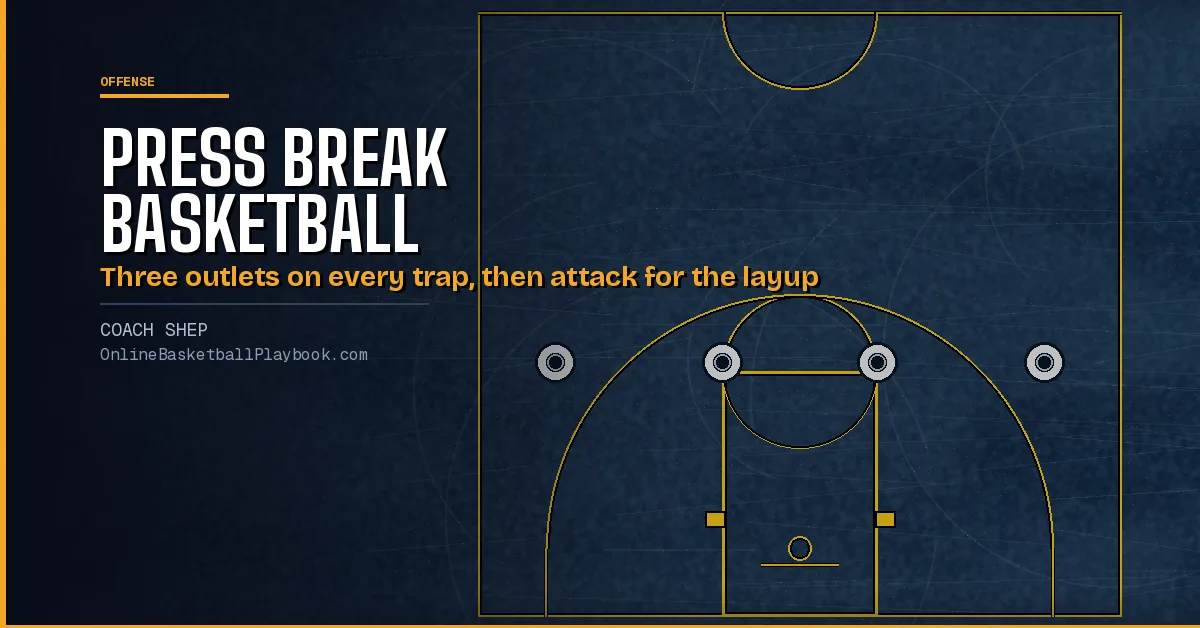
Press Break Basketball: Alignments, Reads and Drills
Press break basketball guide with the 1-4, 80-60-40 and 4-across alignments, reads against the 2-2-1, diamond and 2-1-2 press, and where coaches disagree.
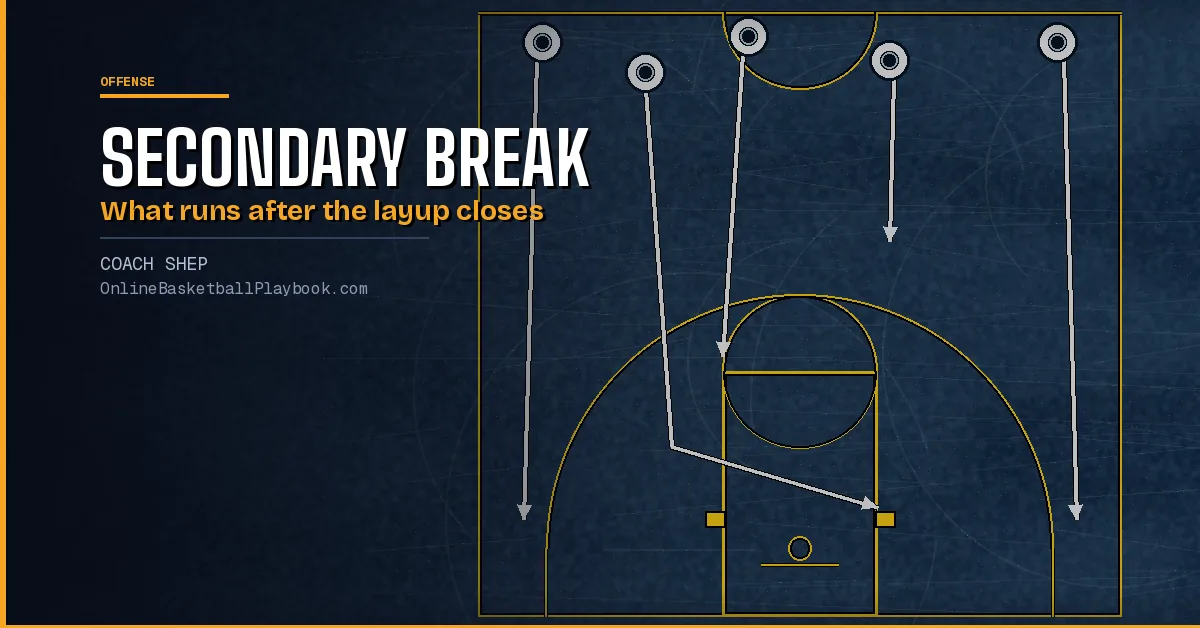
Secondary Break Basketball: Lanes, Options and Trailers
Secondary break basketball explained: where the primary break ends, the lanes, the numbered options, the trailer, after-make looks and where it flows next.
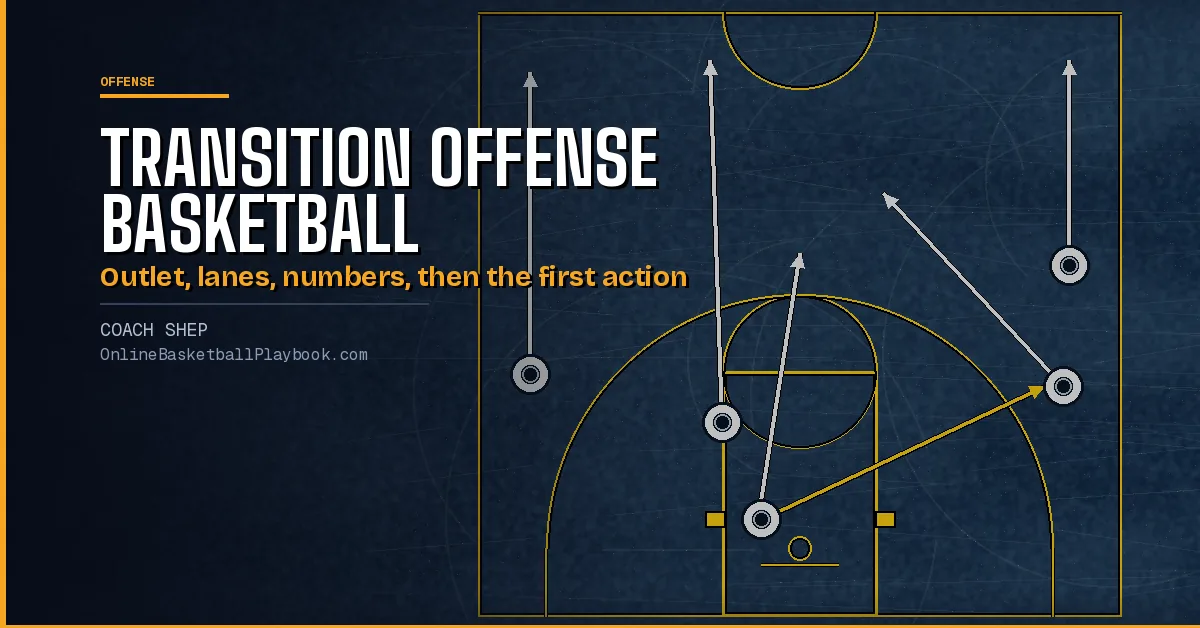
Transition Offense Basketball: Lanes, Reads and Early Offense
Transition offense basketball from rebound to first half-court action: outlets, lanes, 2 on 1 and 3 on 2 reads, the secondary break, early offense and crashing.