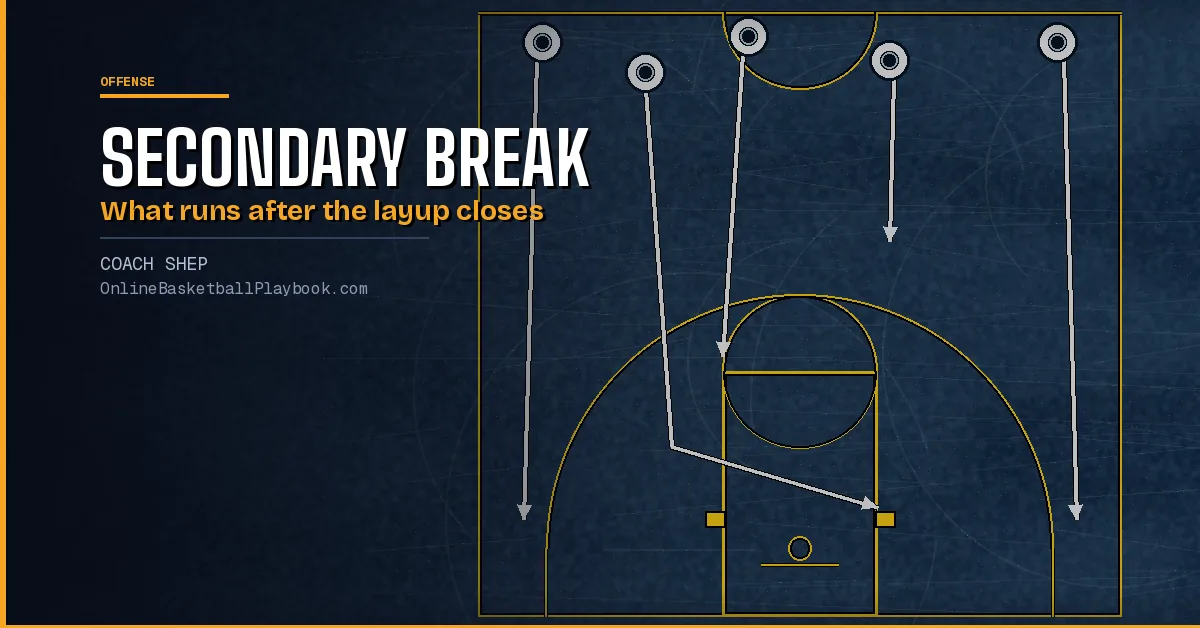
Secondary break basketball is what a team runs after the first wave of the fast break closes but before the defense is organized. The numbers are even or close to it, the defenders are back, and they have not yet matched up or set their help. The secondary break gives all five players spots and a short menu of reads for that window, then flows into the half-court offense without backing the ball out.
This page covers the structured part: the lanes, the numbered options, the trailer, the after-make looks and where the break goes next. The outlet and the 2-on-1 and 3-on-2 reads are on how to run the fast break, and the pace argument, the push clocks, the drag screen and pistol are on early offense. A whole program built around the push and what follows it is on transition first program model.
Where the Primary Break Ends
Roy Williams draws the line by counting defenders. The primary break is two or fewer defenders back, a 3-on-2 or a 2-on-1, with a shot in two passes or fewer. The secondary break is three or more defenders back. A later Williams clinic is reported with three passes instead of two for the same case.
Three situations describe the same line from the floor:
- A live-ball change of possession. Run.
- Defenders back, but not yet organized. That is the secondary window, called the place where games are won.
- The defense is back and organized. Run the half-court offense.
The break and the defense behind it are one plan. Want a trailer every time, and keep the trailer and the safety short of half court so a 3-on-1 never turns into a 5-on-1 that leaves nobody back. Who crashes and who gets back on the shot is on tagging up and transition defense. Count the defenders before you call it.
The Lanes Into the Secondary Break
The frame is the same: two wide wings, a big who runs to the rim, a trailer and the ball in the middle. The breaks differ on where each player stops.
| Break | Wings | First big | Trailer |
|---|---|---|---|
| Numbered break, base | 2 and 3 sprint the sidelines into the front court | 4 runs opposite the ball and cuts to the ball-side block | 5 trails last to the elbow opposite the ball |
| Numbered break, priority | 2 wide up the sideline to the corner | 5 runs to the right block | 4 stops just above the right elbow at the arc, and 3 trails behind the ball |
| Princeton break | The guards fill the middle and one sideline lane, the wings the outside lanes to the corner of the arc | The post races to beat his man to the block, and if he is beaten he wheels and pins at the block | Not named |
| Carolina break | Wide | The first big to get down the floor sprints to the rim | The trailing big, usually the rebounder, goes to the weak-side wing slot |
Two details carry across the breaks. In the base numbered break the 4 and the 5 can swap jobs, so the player who actually got the rebound becomes the trailer instead of running a fixed role. And the lanes of the numbered break match the lanes of a matching press break, so the two can be taught together (see basketball press break). Give every player a lane and a job.

Secondary Break Basketball Options
The numbered breaks give the point guard a short menu read off the same spots every time. Two menus:
| Option | Base menu | Priority menu |
|---|---|---|
| 1 | 1 all the way, a drive to the free-throw line that makes it 3-on-1 | 1 drives the seam for a layup |
| 2 | A long pass to a sprinting wing for a layup | A pass ahead to 2 in the corner for the shot |
| 3 | A pass to 4 cutting through on the ball-side block | A long pass to 5 for a layup |
| 4 | A pass to the trailer, 5, at the elbow | A pass to 4 cutting through the lane |
| 5 | Chained passes, such as 1 to 2 to 4, or 1 to 2 to 5 to 3 | A pass to the trailer, 3, for the outside shot |
Both end the same way. If nothing opens, the team flows into its half-court offense instead of forcing a pass. The priority menu adds the order. The seam drive is always tried first, and the other four come into play only when it is denied.
Do not clog the seam. The sharpest rule in the priority menu is for the big above the elbow. If the point guard can attack the seam, the big delays and trails him for the rebound. If he cuts too soon he fills the seam and takes away the first option.

The flash. If the point guard stops outside instead of driving, the same big flashes hard to the ball-side block and gets the pass. The drill form of this read wants the point guard to bring the ball almost to the arc before the big cuts, and never to pass from half court. The last option sends the trailer to the right wing for a catch-and-shoot three after the big cuts through.

The wing's options. The Princeton break starts with the wing who gets the pass ahead. He can shoot an open three, pass back to the middle guard or skip to the far wing. On the catch his order is the post first, then the drive, then the three. If the defense gets back, the team enters the low phase of its offense without resetting (see the Princeton offense).
Get the next coaching guide in your inbox
One email when a new guide or diagram set goes up. Free.
After a Made Basket
A make changes the start, not the idea. In the base numbered break the 5 takes the ball out of the net, steps out of bounds and inbounds to the point guard at once, before a press can set. Off a defensive rebound the same pattern runs, with the wings releasing up the sidelines as soon as the rebound is secured and the point guard coming to the ball-side top for the outlet.
Three high. This after-make look resembles a Princeton set. The 3 inbounds quickly and the point guard speed-dribbles up the floor while the other three sprint to the baseline, then flash up above the free-throw line as he crosses half court. The cuts must be hard and well timed, because slow, lazy cuts do not get open. If the pass to the wing or the high post is not there, the team goes straight into its half-court offense.

From that look the wing has a menu.
- Go one on one. With everyone high there may be no help-side defender.
- Ball screen. If he hesitates, the big ball-screens for him while the other big slides down for a kick-out three, or the big screens for the other big instead.
- High-low. The wing can pass to the high post for a two-man high-low.
- UCLA cut. This is the last option. The point guard passes to the wing and cuts off the high post's screen for a layup, clears to the corner if he does not get it, and the big then ball-screens for the wing.

A call off a make. On a make, a drill can give the offense a called action such as pistol or a hand-off game, see early offense.
Point Guard Triggers
What do you run when the ball comes down in three or four seconds and nothing is there? Three trigger actions answer it, and the point guard calls each one by what he does with the ball, while also saying it out loud. The bench does not call it.
| Trigger | The point guard's action | What follows |
|---|---|---|
| Flip | A dribble hand-off | The receiver comes off shoulder to shoulder into a two-guard front. The passer runs under the rim, and a pin and a flare work on the same side |
| Spin | A spin dribble instead of the hand-off | The same shape and the same screens, but the point guard works off the flare and the other guards off the pin. It is the counter when the defense denies the hand-off |
| Through | A pass and cut | Named, but its details are not described |
The flare in the flip has its own rules.
- Goes through. Bump.
- Chases. Curl.
- Goes under the flare. Stop behind the screen and look to shoot.
- Goes over. Finish the cut, then turn back and come get the ball again.
Get the team in flip within about three seconds, so the defense has to run back, play man and fight through screens all at once. The flare itself is on the flare screen. Call it out loud and read the defender.
Where the Secondary Break Goes Next
Do not back the ball out. The break can flow into several actions.
- A side pick and roll. An NBA model ends in a ball screen, not a reset: a hit-ahead or kick-ahead to a wing, a shuffle cut away, a reversal and a side pick and roll, with a denial counter for every action. The reads at the end are on pick and roll reads.
- The second trailer swings it. In an NBA model the second trailer swings the ball into a pick and roll, a weak-side stagger or a dive to the low post.
- A Carolina ball screen. The point guard hits the wing and the far post sets a ball screen for him.
- A Carolina dribble at. The point guard dribbles at the post, the post cuts backdoor and the far post steps high. A kick-back reverses the ball, and the post throws back to the point guard while the wing clears for a two-man pick and roll.
- Motion, a continuity or the dribble drive. The break can reverse into motion, run its entries into a continuity, or be the half-court offense itself. Those flows are on early offense.
Pick one flow and rep it until it is automatic.
Building It in Practice
Five trips, five options. A no-defense drill runs the five options from the same alignment, one trip each. The 3 inbounds, with the stress on sprinting the floor and a quick inbound. A down-and-back variation has the point guard call a live play before half court on each trip while the other four yell it back.
Add defenders one at a time. The numbers ladder, from 2-on-1 up through 5-on-4 and then 5-on-5, builds the reads that come before the secondary break, and it is drawn on fast break basketball drills and drills to teach transition offense.
Measure the break. Hubie Brown's homework is to take the film of your worst loss and split a page between points from the half-court offense and points from transition, the secondary break and second shots, before deciding how to spend practice time.
Run the break until the spots and the reads are automatic.
Questions Coaches Ask About the Secondary Break
What is a secondary break in basketball?
The set of spots and reads a team runs after the first wave of the fast break closes but before the defense is organized. It ends in a shot or flows straight into the half-court offense.
What is the difference between the primary break and the secondary break?
Roy Williams counts defenders. Two or fewer back is the primary break, with a shot in two passes or fewer. Three or more back is the secondary break.
What does the trailer do in the secondary break?
The trailer comes last, to the elbow opposite the ball or to the weak-side wing slot, as an outside shooter or the player who swings the ball. The rebounder can be the trailer.
Is the secondary break the same as early offense?
The two overlap. Early offense covers the whole window from the outlet to the first action, including the drag screen and pistol. The secondary break is the structured part with fixed spots and a numbered menu.
Can you run the secondary break after a made basket?
Yes. The numbered breaks inbound at once and run the same pattern, and a separate after-make look such as three high is also used.
Want the printable playbook packs?
OBP Pro members get the premium playbook packs: the zone attack, out of bounds and practice plan PDFs, plus each new pack as it is finished. The membership page lists what is in each one. Or draw your own version free in PlayDraw.
See what OBP Pro includesMore Coaching Guides From This Batch
- Pick and Roll Reads: Reading Ball Screens by Coverage
- Basketball Play Calling and Signals: How Coaches Call Sets
- Tagging Up in Basketball: Crash the Glass or Get Back
- 1-1-3 Zone Defense: Man-Zone Rules, Slides and Traps
Back to Fast Break and Transition Offense and every Offense page.
Keep Building
Related breakdowns
How to Run the Fast Break: Lanes, Reads and Drills
How to run a fast break: start it off a stop, fill three lanes, read each numbers situation, flow into a secondary break and build the habits with a drill ladder.
Press Break Basketball: Alignments, Reads and Drills
Press break basketball guide with the 1-4, 80-60-40 and 4-across alignments, reads against the 2-2-1, diamond and 2-1-2 press, and where coaches disagree.
Transition Offense Basketball: Lanes, Reads and Early Offense
Transition offense basketball from rebound to first half-court action: outlets, lanes, 2 on 1 and 3 on 2 reads, the secondary break, early offense and crashing.